If you have ever pictured Goddess Lakshmi standing on a lotus, holding coins that spill from her palm, or Saraswati with her veena against a soft wash of sky, you are almost certainly remembering a Raja Ravi Varma image, even if you have never heard his name. That is the strange power of this one man. He decided what the Hindu pantheon should look like, and more than a century later the calendar over your grandmother’s kitchen shelf still obeys him. Aspirants meet Ravi Varma as a single fill-in-the-blank fact, “father of modern Indian art”, and stop there. The real story is more interesting and more contested: a Travancore aristocrat who taught himself oil painting, married European technique to Indian mythology, and then did something no Indian artist had done before, he built a printing press to sell his gods to the masses.
Who was Raja Ravi Varma, in one clear sentence
Raja Ravi Varma was a nineteenth-century painter from the princely state of Travancore who fused European academic realism with Indian mythological and social subjects, and then mass-produced those images as cheap prints, making him the first genuinely popular artist India had. He was born on 29 April 1848 at Kilimanoor, a small palace estate in present-day Kerala, and died on 2 October 1906. His full name carried the aristocratic title Koil Thampuran, which is why “Raja” sits in front, it is a mark of noble birth, not a kingship he ruled.
The reason he matters for an exam and for cultural history is the same reason he was controversial: he took gods and goddesses who had, for centuries, been shown in stylized, symbolic, flat forms, and painted them as breathing, three-dimensional human beings with soft skin, wet eyes, and heavy silk. Before him, an ordinary devotee’s mental image of Lakshmi came from temple sculpture and folk art. After him, it came from a lithograph you could buy for a few annas. That shift, from the sacred image as something rare and priestly to something printed and domestic, is the single most important thing to understand about him.
The technique he borrowed and why it looked so new
Ravi Varma’s signature was oil paint and Western academic realism, the same illusionistic tradition that European portrait studios used, applied to subjects no European had ever painted. Academic realism means modelling a face with gradual light and shade so it looks rounded and solid, getting the anatomy right, and building deep three-dimensional space with a vanishing point. Indian painting traditions had extraordinary strengths, but this particular kind of photographic solidity was not their goal.
Think of the contrast this way. The older Indian painting schools worked in line, flat colour, and symbolic convention: a Mughal miniature or a Pahari painting tells you a figure is a king through jewellery and posture, not through the fall of light on his cheekbone. Ravi Varma instead made you feel you could reach out and touch Damayanti’s arm. He picked up the technique partly by watching the Dutch portraitist Theodore Jensen, who visited the Travancore court, and partly by relentless self-teaching, because the British-run art schools of the day were not exactly rushing to train a native prince in oils.
Here is the part that trips people up. It is tempting to file Ravi Varma as a colonial copyist, a man who simply imported a European style. That misreads him. The technique was borrowed; the *ambition* was entirely Indian. He aimed the realist toolkit at the Puranas, the epics, and everyday Indian womanhood, subjects European academic painting had never touched, and that recombination is why his images felt at once familiar and startlingly modern to Indian eyes in the 1880s.
The famous paintings you should be able to name
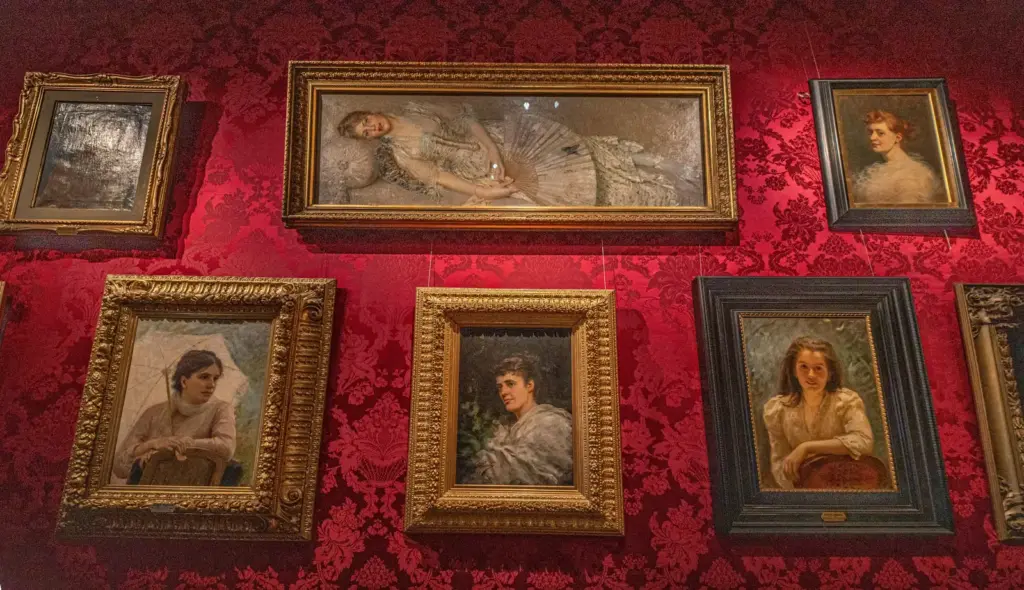
Ravi Varma’s reputation rests on a cluster of mythological and literary canvases, and being able to name a few with their subject is worth far more than a vague “he painted goddesses”. His breakthrough on the national stage came at the 1873 Vienna Exhibition, where a painting of a Nair lady won an award, and again at the 1893 World’s Columbian Exposition in Chicago, where he sent a set of paintings of Indian women and won medals. That international recognition, a colonized artist honoured in Europe and America, is part of why nationalists initially embraced him.
His best-known works pull from Sanskrit literature and the epics:
| Painting | Subject | Why it matters |
|---|---|---|
| Hamsa Damayanti | Princess Damayanti talking to a swan that carries a message from Nala | His most reproduced literary scene; the tender human treatment of a Puranic story |
| Shakuntala | Kalidasa’s heroine pretending to remove a thorn while glancing back at Dushyanta | Illustrated an English translation of the play; the archetypal romantic gaze |
| Galaxy of Musicians | A group of women from different regions of India with their instruments | An early visual argument for a single, plural “India” |
| Lady in the Moonlight / Nair lady adorning her hair | Everyday elite Kerala womanhood | Realism applied to contemporary Indian life, not just myth |
| Goddess Lakshmi and Saraswati | The devotional deities | Became the mass-print templates that define these goddesses to this day |
Beyond those, a working list worth keeping includes Draupadi Vastraharan, Arjuna and Subhadra, Jatayu Vadham from the Ramayana, and Keechaka and Sairandhri from the Mahabharata, all epic scenes staged with the same theatrical lighting and costume drama. Notice the pattern: he reached again and again for moments of high emotion from the Puranas and epics, the kind of scene a devotee already carried in their imagination, and then made it vivid and specific. That is why his images stuck. He was not inventing stories; he was giving a familiar story a face you could not unsee.
Two patrons made much of this possible. The court of Travancore gave him his start, and the Gaekwad of Baroda, Maharaja Sayajirao Gaekwad III, commissioned a large series of mythological paintings for the Lakshmi Vilas Palace. Royal patronage bought him the time and materials to paint at scale, and it is the reason so many originals sit in palace and museum collections in Kerala, Gujarat, and Mysore.
The self-taught prince and how he actually worked
It is worth pausing on how unlikely this career was. Ravi Varma was an aristocrat, not a trained professional, and the colonial art establishment offered a native prince little formal instruction in oils. He learned the medium by close observation, most usefully by watching the visiting Dutch portraitist Theodore Jensen at the Travancore court, and by sheer stubborn practice. He did not paint alone either. His younger brother, Raja Varma, was a gifted painter in his own right who handled much of the landscape and background work and managed the practical side of the studio, so that the “Ravi Varma” canvases are, in part, a family workshop’s output.
His method was methodical and almost cinematic. He travelled across India studying regional faces, costumes, and settings, and he used live models and photographs as reference, staging a mythological scene the way a director blocks actors before shooting. That is why a goddess in his painting wears a specific, observed silk and stands in a specific, real-feeling space rather than a symbolic void. This research-driven realism was new for devotional subjects, and it is the technical reason his gods felt like people. Understanding the working method also explains the criticism to come: what looked to admirers like devotion rendered lifelike looked to detractors like theatre, sacred figures posed like studio portraits.
The press that democratised the divine
The reason Ravi Varma reached the ordinary home, and not just the palace wall, is that in 1894 he set up the Ravi Varma Fine Art Lithographic Press near Bombay, later shifting it to Malavli near Lonavla. This is the hinge of his whole legacy, and it is the detail most short bios skip. A lithograph, and specifically the colour version called an oleograph or chromolithograph, let a single painting be reproduced thousands of times cheaply. Suddenly a family that could never own an oil painting could pin up a printed Lakshmi for pennies.
Consider what that actually did. A temple deity was, by definition, in one place and mediated by priests. A printed god travelled: it went into kitchens, shops, railway waiting rooms, and matchbox labels. For the first time, a vast public across regions and castes shared the *same* picture of Lakshmi or Krishna. Ravi Varma effectively standardized the popular Hindu visual imagination, and he did it through industrial print, not through religion. That is why cultural historians treat his press as a landmark in the making of modern mass culture in India, on a par with what cheap printing did for language and the press more broadly.
The business itself had a bumpy life. Ravi Varma, never a natural manager, sold the press to his German technician Fritz Schleicher around 1901, and it kept churning out religious oleographs for decades before a fire destroyed it in the 1970s. But the visual template was already set. Every “god poster” you have ever seen is, in a sense, a descendant of that press.
Why he was showered with honours
In his own lifetime Ravi Varma was the closest thing colonial India had to a celebrity artist. The British recognized him too: in 1904 the Viceroy, Lord Curzon, awarded him the Kaisar-i-Hind Gold Medal, one of the highest civilian honours the Raj gave to Indians. Curzon is a name aspirants meet in a very different context, the man behind the deeply unpopular Partition of Bengal (1905), and it is a useful reminder that the same colonial establishment could honour an Indian artist one year and inflame Indian nationalism the next. Ravi Varma’s fame, in other words, straddled the very years when organized nationalism was finding its feet through the early Indian National Congress and the coming storm of the anti-partition agitation.
Kerala keeps his memory alive institutionally. The state government’s Raja Ravi Varma Puraskaram is awarded for excellence in art, and his Kilimanoor birthplace remains a pilgrimage site for admirers. His descendants and later scholars have worked hard to reclaim the originals from the shadow of the cheap prints that made his name a household word.
The backlash: why serious critics turned on him
Here is where the story gets genuinely interesting, and where a thoughtful answer separates itself from a cheerleading one. Almost as soon as Ravi Varma became popular, a serious artistic and nationalist reaction set in against him. The charge, in blunt terms, was that his art was imitative, sentimental, and calendar-kitsch, Indian subjects dressed up in a borrowed European costume, pretty but not authentically Indian.
The most influential critic was the British art administrator E. B. Havell, who ran the Calcutta School of Art and argued that Indian art should return to its own spiritual and stylistic roots rather than ape Western realism. Out of that conviction grew the Bengal School of Art, led by Abanindranath Tagore, nephew of Rabindranath. The Bengal School consciously rejected Ravi Varma’s oily realism in favour of soft, wash-based, “Oriental” styles drawn from Mughal and Rajput miniature traditions and Ajanta murals. Its rise was tangled up with the cultural side of the Swadeshi movement after 1905: if you were boycotting British cloth, went the logic, you might also reject a British-derived way of painting your own gods.
There is a second, more modern line of criticism worth knowing. Feminist and postcolonial scholars have questioned how Ravi Varma painted women, arguing that his idealized, fair-skinned, doe-eyed heroines set a narrow standard for female beauty that his mass prints then broadcast to the whole subcontinent. Whether you find that persuasive or overstated, it is the kind of nuanced point that turns a flat “he was great” answer into a genuine argument.
A fair verdict holds both truths at once. Ravi Varma was technically brilliant and historically pivotal, and his critics had a real case that his realism was a stylistic dead end for a self-consciously national art. The Bengal School’s search for an indigenous idiom was a necessary correction. But it is also true that no correction reached anything like Ravi Varma’s public: the Bengal School spoke to connoisseurs, while Ravi Varma’s oleographs hung in millions of homes. Popularity and critical esteem parted ways, and they have never fully reconciled.
Where he fits in the sweep of Indian art
To place him correctly, hold three phases in your head. First, the classical and medieval traditions, temple sculpture, the great temple architecture of the Nagara and Dravida styles, Ajanta’s mural painting, and the courtly Mughal painting that peaked under emperors like Jahangir. Second, the regional folk and popular traditions that ran alongside, Kalighat painting in Bengal, Madhubani painting in Mithila, and dozens of others. Third, the colonial-modern moment, and this is where Ravi Varma stands, at the very hinge between academic realism and the nationalist Bengal School reaction.
Read against the wider story of modern history, Ravi Varma is the point where “Indian art” stopped being purely court and temple business and became a mass, printed, national phenomenon. Everything after him, the Bengal School, the Progressives of the 1940s, the moderns, is in some sense arguing with him, either rejecting his realism or rediscovering his popular reach.
How to study Raja Ravi Varma for the exam
Treat him as a bundle of five linked facts, not a biography to memorize. First, the identity: Travancore, 1848 to 1906, the fusion of European academic realism with Indian mythological and social themes. Second, three nameable works with subjects, Hamsa Damayanti, Shakuntala, and Galaxy of Musicians will carry you through almost any question. Third, the press, 1894, oleographs, and the one-line significance that it democratised religious imagery and shaped the popular image of Hindu deities. Fourth, the honours, Chicago 1893 medals and the Kaisar-i-Hind Gold Medal from Curzon in 1904. Fifth, and most examinable for a Mains-style answer, the critique: Havell, Abanindranath Tagore, and the Bengal School’s Swadeshi-era rejection of his realism as imitative.
The trap to avoid is treating art and culture as pure rote. Examiners increasingly want the *argument*, why his prints mattered socially, why nationalists both embraced and rejected him. If you can explain the paradox that his greatest strength, mass appeal, was exactly what elite critics held against him, you understand Ravi Varma better than a fact-sheet ever could. Pair him in your notes with the Bengal School so the two always come up together, because in the exam they usually do.
Frequently Asked Questions
Why is Raja Ravi Varma called the father of modern Indian art?
Because he was the first Indian artist to work in the European academic-realist tradition of oil painting, apply it to Indian mythological and social subjects, and then mass-produce those images through his own lithographic press, bringing “fine art” out of the palace and into the ordinary home. That combination of technique, subject, and reach had no precedent.
What is the difference between his paintings and his oleographs?
The paintings are unique oil canvases, most held today in palace and museum collections. The oleographs are cheap colour prints of those images, produced in thousands by his press from 1894 onward. The originals made his reputation with elites; the oleographs made his name a household word.
Which are Raja Ravi Varma’s most famous paintings?
Hamsa Damayanti (Damayanti and the swan), Shakuntala, Galaxy of Musicians, Lady in the Moonlight, and his devotional images of Lakshmi and Saraswati that became the standard popular templates for those goddesses.
Why did the Bengal School oppose him?
Led by Abanindranath Tagore and encouraged by E. B. Havell, the Bengal School held that his Western-derived realism was imitative and unsuited to Indian spiritual subjects. It sought an indigenous style drawn from Mughal, Rajput, and Ajanta traditions, a shift bound up with the cultural nationalism of the Swadeshi movement.
What awards and honours did he receive?
He won an award at the 1873 Vienna Exhibition, medals at the 1893 World’s Columbian Exposition in Chicago, and the Kaisar-i-Hind Gold Medal from Viceroy Lord Curzon in 1904. Kerala’s Raja Ravi Varma Puraskaram is named in his honour.
How did his press change Indian society?
By reproducing gods and goddesses as cheap prints, it standardized the popular Hindu visual imagination across regions and castes for the first time. A shared, printed image of Lakshmi or Krishna could now hang in millions of homes, a landmark in India’s modern mass culture.
Where was Raja Ravi Varma born and when did he die?
He was born on 29 April 1848 at Kilimanoor in the princely state of Travancore, in present-day Kerala, and died on 2 October 1906, reportedly of complications linked to diabetes.
Practice Questions
1. Raja Ravi Varma is best known for fusing which two elements?
a) Mughal miniature technique with Buddhist themes
b) European academic realism with Indian mythological and social themes
c) Bengal School wash technique with folk motifs
d) Rajput colour conventions with European portraiture
Answer: b) European academic realism with Indian mythological and social themes
2. The Ravi Varma Fine Art Lithographic Press, set up in 1894, is historically significant mainly because it:
a) Trained the first generation of Bengal School artists
b) Introduced photography to Indian courts
c) Democratised religious imagery through cheap mass-produced oleographs
d) Was funded directly by the British Crown
Answer: c) Democratised religious imagery through cheap mass-produced oleographs
3. Which honour did Raja Ravi Varma receive from Viceroy Lord Curzon in 1904?
a) Order of the Star of India
b) Kaisar-i-Hind Gold Medal
c) Rao Bahadur title
d) Padma Vibhushan
Answer: b) Kaisar-i-Hind Gold Medal
4. The Bengal School of Art, which reacted against Ravi Varma’s style, was associated with which pair?
a) E. B. Havell and Abanindranath Tagore
b) Theodore Jensen and Sayajirao Gaekwad
c) Nandalal Bose and Rabindranath Tagore alone
d) Fritz Schleicher and Lord Curzon
Answer: a) E. B. Havell and Abanindranath Tagore
5. Which of the following is a Raja Ravi Varma painting drawn from Sanskrit literature?
a) Bharat Mata
b) Hamsa Damayanti
c) The Last Journey
d) Mother India
Answer: b) Hamsa Damayanti
Mains-style questions
- “Raja Ravi Varma’s greatest artistic strength, mass appeal, was precisely what his critics held against him.” Critically examine this paradox in the context of the Bengal School’s reaction.
- Discuss how Raja Ravi Varma’s lithographic press transformed the popular visual imagination of Hindu deities and contributed to the making of modern mass culture in India.
- Trace the shift in Indian painting from court and temple traditions to the colonial-modern moment, situating Raja Ravi Varma within this evolution.
- To what extent was the reaction against Ravi Varma’s realism connected to the cultural nationalism of the Swadeshi era? Analyse.
- Evaluate the criticism that Raja Ravi Varma’s idealized depiction of women set a narrow standard of beauty across the subcontinent. Present a balanced view.
Raja Ravi Varma is not a name to memorize and move past. He is the figure through whom you can watch Indian art become modern, national, and mass, all at once, and then watch a serious generation of artists decide that modern was not the same as authentic. Hold the achievement and the critique together, and you will not only answer the factual question, you will be able to argue the harder one about what “Indian art” should even mean, which is exactly the kind of judgment the examiner is looking for.
Tell Google you want more of this.
Add Anantam IAS as a preferred sourceOne tap, and this site shows up more often in your own Top Stories, AI Overviews and AI Mode. Remove it any time.