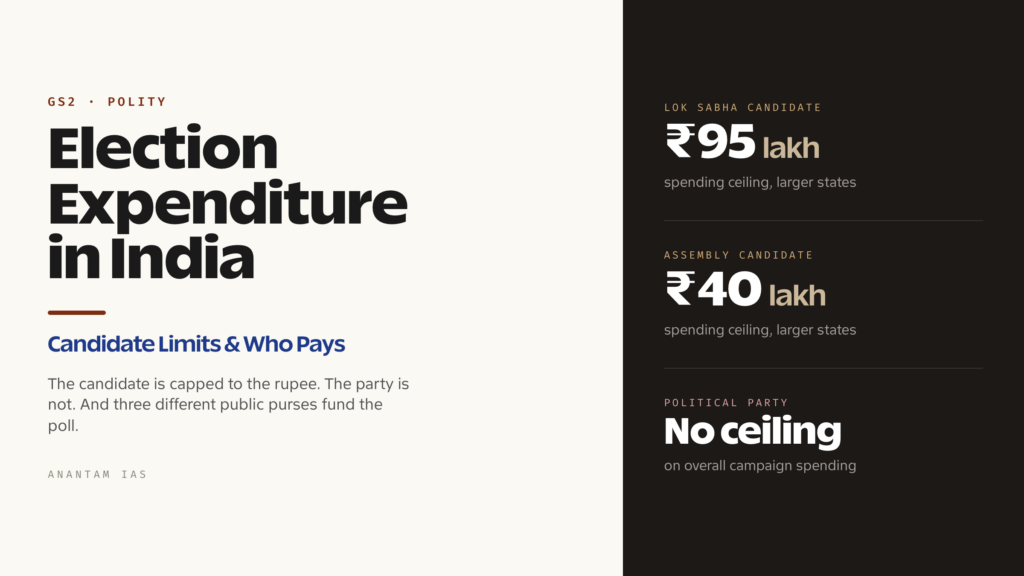
Ask most people who pays for a general election and they’ll shrug — the government, surely. But that one-word answer hides one of the more revealing corners of Indian democracy, because the money in an election flows along three completely separate tracks, and the rules on each track are wildly different. There’s the public money that runs the machinery of the poll — the booths, the EVMs, the staff. There’s the private money a candidate is allowed to spend on a campaign, capped to the rupee. And there’s the money a political party spends, which carries no ceiling at all. Mix those three up, as candidates and commentators routinely do, and the whole subject turns to fog.
For a UPSC aspirant this is exactly the kind of topic that rewards precision. It sits at the join between the Representation of the People Act, the Election Commission’s powers under Article 324, a string of Supreme Court judgments, and the live debate over money power that runs from the now-struck-down electoral bonds scheme to every demand for state funding of elections. Get the three tracks straight — who can spend what, and who foots the public bill — and you have a clean, high-value answer ready for any question on money and elections.
The Candidate’s Ceiling: How Much One Person Can Spend
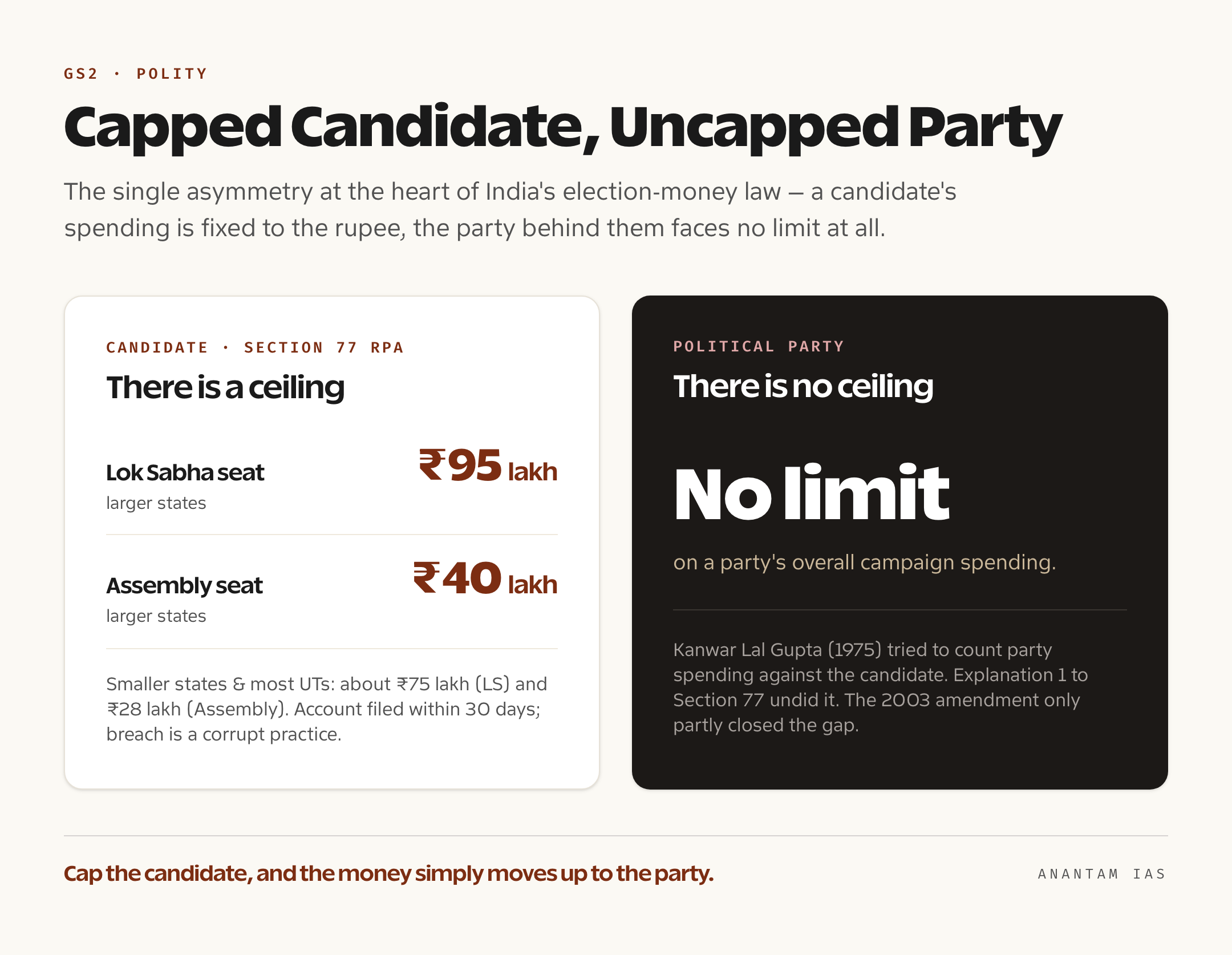
Start with the track that has a hard limit. Every candidate contesting a Lok Sabha or State Assembly seat faces a legal cap on what they may spend between the date they are nominated and the date results are declared. The power to fix this ceiling comes from Section 77 of the Representation of the People Act, 1951, read with Rule 90 of the Conduct of Election Rules, 1961, and the actual figures are revised by the government on the Election Commission’s advice. As of the 2024 general election, a Lok Sabha candidate in a larger state may spend up to Rs 95 lakh, and an Assembly candidate up to Rs 40 lakh. In the smaller states and most Union Territories the limits are lower — around Rs 75 lakh for a Lok Sabha seat and Rs 28 lakh for an Assembly seat — because campaign costs there are smaller. These ceilings were last raised by about 10 per cent in 2020 and then revised to their present levels, after a committee set up by the Commission examined the rising cost of campaigning.
What does that ceiling actually cover? Everything the candidate spends to win — public meetings and rallies, advertisements in print and on hoardings, posters, banners, the hire of vehicles, the campaign workforce, and the candidate’s share of any joint events. To keep this honest, the law puts real machinery around it. A candidate must open a separate bank account exclusively for election spending and route every campaign rupee through it. They must keep a day-to-day register of expenses, which the Commission’s expenditure observers and flying squads check against their own shadow accounts during the campaign. And within 30 days of the result, every candidate has to file a full statement of election expenses with the District Election Officer. Get this wrong and the consequences are serious: filing a false or incomplete account, or breaching the ceiling, is a corrupt practice and a ground for disqualification under Section 10A of the Act for up to three years.
The Party Loophole: Why There Is No Ceiling on Parties
Here is where the subject gets genuinely interesting, and where careless aspirants lose marks. The ceiling described above binds the candidate. It does not bind the candidate’s party. A political party in India can spend without any upper limit on a general election campaign, and that gap is not an accident of drafting — it’s the result of a deliberate tug-of-war between the courts and Parliament that every serious answer should be able to narrate.
The story starts in 1975 with Kanwar Lal Gupta v. Amar Nath Chawla. The Supreme Court held that money spent by a party or by supporters to promote a particular candidate should count as that candidate’s election expense, and so should fall within the candidate’s ceiling. The logic was about a level playing field: if a rich party could pour unlimited funds into one candidate’s campaign while the cap on the candidate stayed low, the cap meant nothing and financial muscle would decide elections. Parliament’s response was swift and blunt. It inserted Explanation 1 to Section 77, which declared that spending by a party or by others to generally promote the party’s programme would not be treated as the candidate’s expense. In one stroke the ceiling was hollowed out — a party could spend freely so long as it framed the spending as promoting itself rather than one candidate.
That position was tightened, but not closed, by the Election and Other Related Laws (Amendment) Act, 2003. The amendment recast the Explanation so that money a party or its supporters spend specifically on an individual candidate must now be reported and counted against that candidate’s ceiling, while genuinely general party propaganda — and notably the travel of a party’s star campaigners — stays outside it. So a real check exists at the edges, but the central reality survives: there is still no cap on a party’s overall campaign spending. The Law Commission’s 255th report and the Election Commission have both flagged this as the biggest hole in the system, because limiting what a candidate may spend while leaving the party free to spend crores simply shifts the money one level up and keeps it just as opaque.
Who Bears the Cost: The Centre, the States and the Consolidated Fund
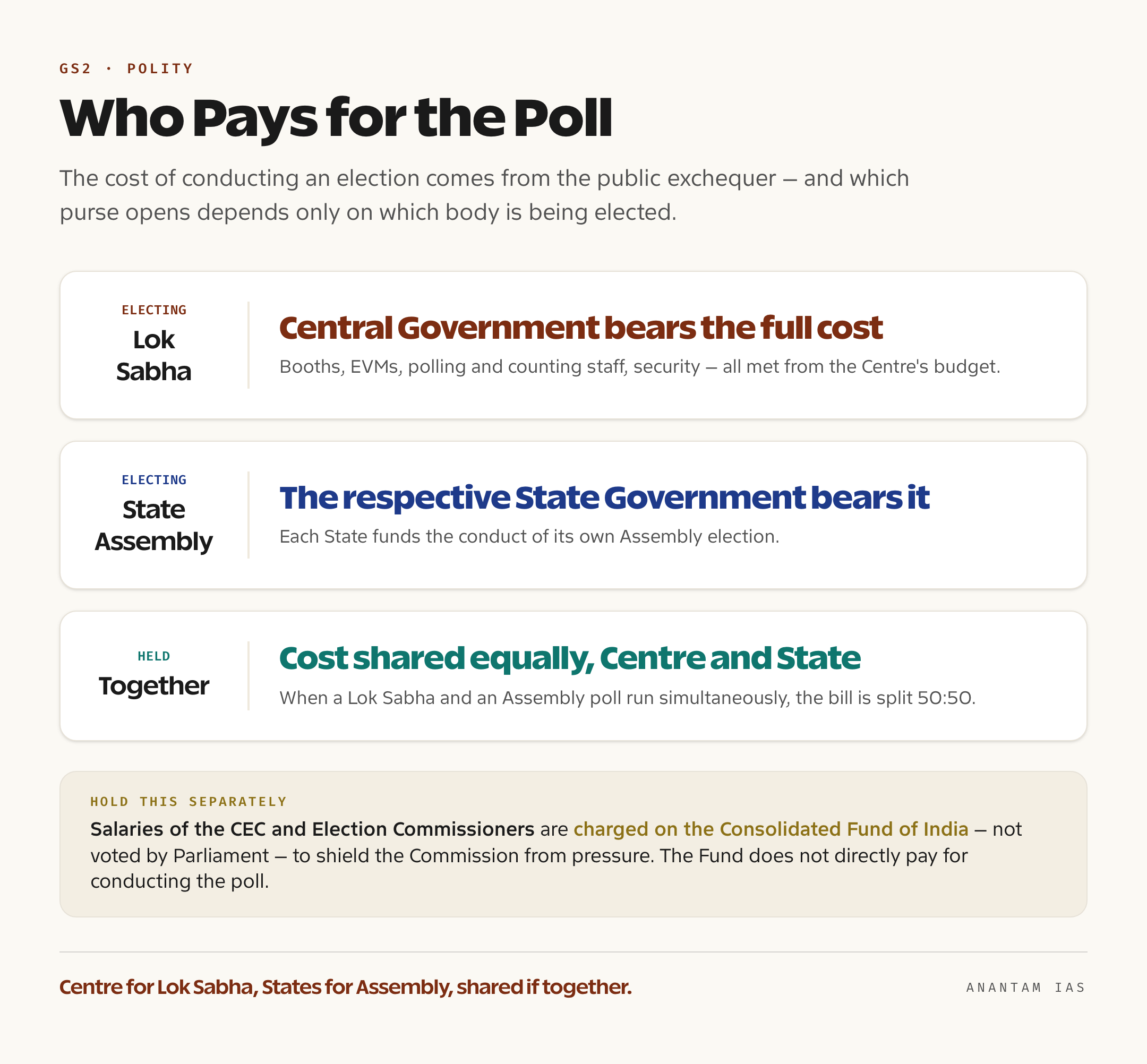
Now switch tracks entirely, from the private money of campaigns to the public money that runs the poll itself. The cost of actually conducting an election — printing ballot material, deploying electronic voting machines, paying the lakhs of polling and counting staff, securing the booths — is met from the public exchequer, and the rule on who pays turns simply on which body is being elected. The full expenditure of conducting a Lok Sabha general election is borne by the Central Government. The full expenditure of conducting a State Assembly election is borne by the respective State Government. This division was settled by guidelines the Union Law Ministry issued back in 1979 and has held ever since.
And the obvious question follows: what happens when a Lok Sabha poll and an Assembly poll are held together, as they often are? The answer is that the two governments split the bill — the cost of the simultaneous election is shared equally between the Centre and the State concerned. That single rule is worth memorising precisely, because it’s the kind of detail that distinguishes a candidate who has read the subject from one who is guessing. So for the conduct of a Lok Sabha general election held on its own, the answer to “who pays” is the Central Government — not the states, and not, as a tempting wrong option always suggests, the Consolidated Fund of a state.
There is one more layer that aspirants must hold separately, because it’s easy to blur. The Election Commission of India is a permanent constitutional body, and the salaries and allowances of the Chief Election Commissioner and the Election Commissioners — who draw the same pay as judges of the Supreme Court — are charged on the Consolidated Fund of India, so that Parliament cannot vote them down and use the purse to pressure the Commission. But the Commission’s wider operating budget, the money for its day-to-day administration, is voted by Parliament like any other department, not charged on the Fund. So the public money in an election lives in three pockets: the Centre’s budget for conducting Lok Sabha polls, the States’ budgets for Assembly polls, and the Consolidated Fund of India for the Commissioners’ own salaries. Keep those three apart and the “who pays” question stops being confusing.
The Bigger Battle: Black Money, Electoral Bonds and Reform
All these rules sit inside a single, unresolved problem — the role of money power in Indian democracy. The candidate ceiling was meant to limit the influence of wealth, but the party loophole, the gap between what is declared and what is actually spent, and the flood of unaccounted cash have kept the issue alive for decades. Studies by the Association for Democratic Reforms regularly show that parties and candidates report only a fraction of what observers believe is really spent, and that a large share of party income has historically come from sources the public could not see. Money decides who can run a serious campaign, and that quietly narrows the field of who can win.
The most recent chapter is the electoral bonds saga. Introduced in 2018, the scheme let donors buy interest-free bearer bonds from the State Bank of India and give them anonymously to parties, with the donor’s identity hidden from the public. Supporters argued it pushed political money out of cash and into the banking channel. Critics argued it did the opposite of transparency by legalising anonymous, unlimited corporate donations and tilting the field toward the ruling party of the day. In February 2024 a five-judge Constitution Bench of the Supreme Court, in the Association for Democratic Reforms case, struck the scheme down as unconstitutional, holding that voter anonymity in political funding violates the right to information under Article 19(1)(a). The Court ordered the State Bank to disclose who had bought the bonds and which parties had cashed them — pulling the curtain back on a system built to keep it shut.
So what’s the way forward that an examiner wants to see? The recurring proposals are clear. Place a ceiling on party expenditure, not just candidate expenditure, so the cap actually bites. Bring all parties under the Right to Information Act and tighten audit of their accounts. Consider some form of state funding of elections, as the Indrajit Gupta Committee and the Law Commission have explored, to reduce dependence on private money. And strengthen the Election Commission’s own enforcement hand. None of these is simple, and each carries trade-offs, but together they map the reform debate that any answer on election money should land on.
For Your Mains Answer
This is a core topic for GS Paper 2, under the Constitution, the conduct of elections, the role and powers of the Election Commission, and the broader theme of electoral reforms and the criminalisation of politics. Questions on money power, transparency in political funding, the strengths and limits of the Representation of the People Act, and the regulation of campaign finance can all draw on this material. The skill examiners reward is the one this article is built around: keep the three money-tracks separate, attach the right figure and section to each, and finish on the reform debate.
How to Build the Answer
Open by naming the three tracks of money in an election — candidate spending (capped), party spending (uncapped), and public spending on conduct (Centre or State). Then take them in order: the candidate ceiling under Section 77 with the Rs 95 lakh / Rs 40 lakh figures and the monitoring machinery; the party loophole through the Kanwar Lal Gupta-Explanation 1-2003 amendment arc; the who-pays rule for conduct (Centre for Lok Sabha, States for Assembly, shared if simultaneous); and the reform debate framed by electoral bonds. Close with a balanced line on transparency. That structure fits almost any campaign-finance question.
Common Mistakes to Avoid
Don’t say there is a ceiling on party spending — there isn’t, and that distinction is the whole point. Don’t claim the Consolidated Fund of India pays for conducting Lok Sabha polls; the Central Government’s budget does, while only the Commissioners’ salaries are charged on the Fund. Don’t confuse the candidate’s account (filed with the District Election Officer within 30 days) with the party’s account (filed with the Commission). And don’t treat electoral bonds as still operating — the scheme was struck down in February 2024.
A Compact Answer Spine
Three tracks of money → candidate ceiling under Section 77 RPA + Rule 90: Rs 95 lakh (Lok Sabha) / Rs 40 lakh (Assembly) in big states, monitored by observers, account filed in 30 days, breach is a corrupt practice → no ceiling on party spending: Kanwar Lal Gupta (1975) tried to cap it, Explanation 1 to Section 77 undid that, 2003 amendment only partly closed it → who conducts-pays: Centre for Lok Sabha, States for Assembly, shared if simultaneous; CEC/EC salaries charged on Consolidated Fund of India → money-power problem: electoral bonds struck down Feb 2024 (Article 19(1)(a)) → reforms: cap party spending, RTI on parties, state funding, stronger ECI.
Diagram or Flowchart Idea
Draw a simple three-column table: column one “Candidate” (capped, Section 77, Rs 95/40 lakh, files in 30 days), column two “Party” (no cap, 2003 amendment), column three “Public conduct cost” (Centre = Lok Sabha, State = Assembly, shared = simultaneous). A clean side-by-side like this makes the asymmetry visible at a glance and is quick to sketch under time pressure.
A Balanced-Conclusion Line
A line that earns marks: “India caps what a candidate may spend to the last rupee yet lets the party behind them spend without limit — so real reform of money in elections is less about tightening the candidate’s ceiling and more about bringing the party, and the donor, into the light.”
How to Use Data Without Cramming
You need only four anchors, not a table of numbers: Rs 95 lakh and Rs 40 lakh (the Lok Sabha and Assembly ceilings in big states), 30 days (the deadline to file the expense account), 1975 and 2003 (Kanwar Lal Gupta and the amendment that shaped the party loophole), and February 2024 (electoral bonds struck down). Attribute them plainly — “as the Election Commission’s expenditure norms set out” — rather than reeling off figures without a source.
FAQ
How much can a candidate spend in a Lok Sabha election? Under Section 77 of the Representation of the People Act, 1951, the ceiling for a Lok Sabha candidate in a larger state is Rs 95 lakh, and for an Assembly candidate it is Rs 40 lakh, with lower limits of about Rs 75 lakh and Rs 28 lakh in smaller states and most Union Territories. The cap covers the whole campaign — rallies, advertising, vehicles and workers — and every candidate must file a full statement of expenses within 30 days of the result.
Is there a limit on how much a political party can spend? No. There is no legal ceiling on a political party’s overall campaign spending. The Supreme Court tried to bring party spending on a candidate within the candidate’s cap in Kanwar Lal Gupta v. Amar Nath Chawla (1975), but Parliament inserted Explanation 1 to Section 77 to undo that, and the 2003 amendment only partly closed the gap. The result is that candidates are capped while parties are not — widely seen as the biggest loophole in election-finance law.
Who bears the expenditure of conducting a Lok Sabha election? The Central Government. The full cost of conducting a Lok Sabha general election is met by the Centre, while the cost of a State Assembly election is met by the respective State Government, under guidelines issued by the Union Law Ministry in 1979. When the two are held simultaneously, the cost is shared equally between the Centre and the State. Separately, the salaries of the Chief Election Commissioner and Election Commissioners are charged on the Consolidated Fund of India.
Why were electoral bonds struck down? In February 2024, a five-judge Constitution Bench of the Supreme Court, in the Association for Democratic Reforms case, struck down the electoral bonds scheme as unconstitutional. It held that the anonymity the scheme gave political donors violated the voter’s right to information under Article 19(1)(a), and it ordered the State Bank of India to disclose who had bought the bonds and which parties had encashed them.
Practice Questions
Prelims MCQs
- Under which provision is the ceiling on a candidate’s election expenditure prescribed?
(a) Section 29A of the Representation of the People Act, 1951
(b) Section 77 of the Representation of the People Act, 1951
(c) Article 324 of the Constitution
(d) Section 8 of the Representation of the People Act, 1951
Answer: (b) Section 77, read with Rule 90 of the Conduct of Election Rules, 1961, governs the candidate’s expenditure ceiling. - Who bears the expenditure incurred on the conduct of a Lok Sabha general election held on its own?
(a) The Central Government
(b) The respective State Governments
(c) The Consolidated Fund of India directly
(d) The Election Commission of India from its own budget
Answer: (a) The full cost of conducting a Lok Sabha election is borne by the Central Government; State Assembly polls are borne by the respective State Government, and simultaneous polls are shared equally. - With reference to election expenditure in India, consider the following statements:
1. There is a legal ceiling on the total campaign spending of a political party.
2. A candidate must file an account of election expenses within 30 days of the declaration of results. Which is/are correct?
(a) 1 only
(b) 2 only
(c) Both 1 and 2
(d) Neither 1 nor 2
Answer: (b) There is no ceiling on a party’s overall spending; the 30-day filing requirement for a candidate’s account is correct. - The salaries of the Chief Election Commissioner and the Election Commissioners are:
(a) Voted by Parliament each year
(b) Charged on the Consolidated Fund of India
(c) Paid from the Contingency Fund of India
(d) Borne by the respective State Governments
Answer: (b) Their salaries are charged on the Consolidated Fund of India, like those of Supreme Court judges, to insulate them from parliamentary pressure. - The Supreme Court’s judgment in Kanwar Lal Gupta v. Amar Nath Chawla (1975) is associated with which issue?
(a) Disqualification of convicted legislators
(b) Counting party spending on a candidate within the candidate’s expenditure ceiling
(c) The validity of electoral bonds
(d) The use of electronic voting machines
Answer: (b) The Court held that spending by a party to promote a candidate should count as the candidate’s election expense — a ruling Parliament later diluted through Explanation 1 to Section 77.
Mains Practice Questions
- Explain the framework regulating election expenditure in India. Why is the absence of a ceiling on political party spending considered the central weakness of this framework? (15 marks, 250 words)
- “India caps the candidate but not the party.” Critically examine how the interplay of Section 77, the Kanwar Lal Gupta judgment and the 2003 amendment has shaped the regulation of campaign finance. (15 marks, 250 words)
- Distinguish between the private money spent on election campaigns and the public money spent on conducting elections in India. Who bears the cost in each case? (10 marks, 150 words)
- Discuss the implications of the Supreme Court’s 2024 verdict striking down the electoral bonds scheme for transparency in political funding. (15 marks, 250 words)
- Money power is widely seen as a distorting force in Indian elections. Evaluate the reforms proposed to address it, including state funding of elections and bringing political parties under the Right to Information Act. (15 marks, 250 words)
Tell Google you want more of this.
Add Anantam IAS as a preferred sourceOne tap, and this site shows up more often in your own Top Stories, AI Overviews and AI Mode. Remove it any time.