
The right to vote in India is a statutory right, not a fundamental right — though the act of voting attracts constitutional protection as expression. That three-part formulation is what examiners are testing, and getting it wrong in either direction costs marks. The vote rests on Section 62 of the Representation of the People Act, 1951, on the constitutional foundation of universal adult suffrage in Article 326.
The Three Possible Characterisations
| Characterisation | What it would mean | Judicial position |
|---|---|---|
| Fundamental right | Enforceable under Article 32; restrictions tested for proportionality | Rejected in the settled line of cases |
| Constitutional right | Flows directly from Article 326; enforceable but not under Part III | Argued in dissents and academic writing; not the majority position |
| Statutory right | Conferred by Section 62 of the RP Act, 1951 and removable by statute | The settled position |
The Case Line
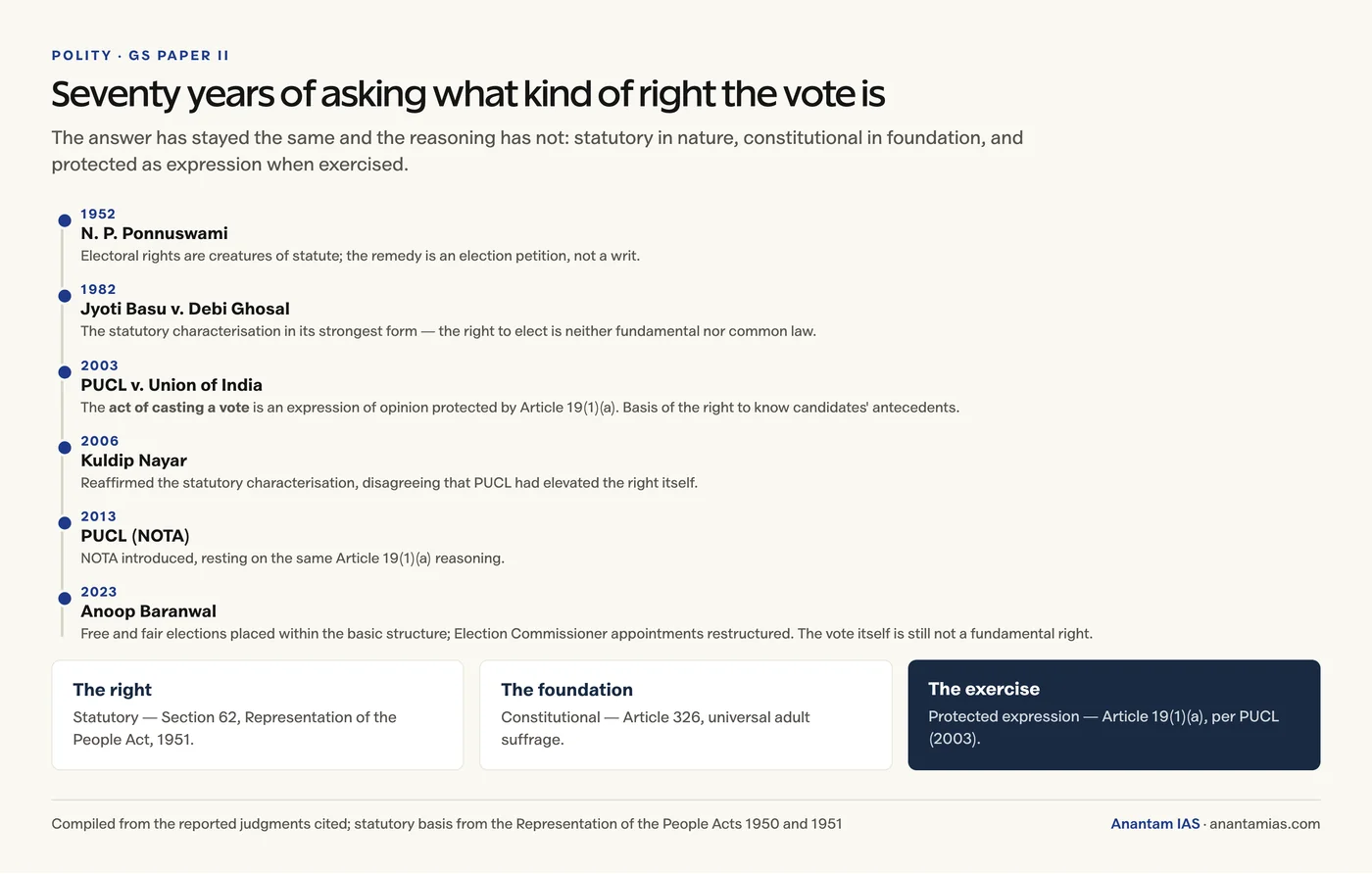
- N. P. Ponnuswami (1952). Electoral rights are creatures of statute; the remedy lies in an election petition, not a writ.
- Jyoti Basu v. Debi Ghosal (1982). Stated the statutory characterisation in its strongest form — the right to elect is neither fundamental nor common law.
- PUCL v. Union of India (2003). Held the act of casting a vote to be an expression of opinion protected by Article 19(1)(a). This is the basis of the right to know candidates’ antecedents, and later of NOTA in PUCL (2013).
- Kuldip Nayar v. Union of India (2006). Reaffirmed that the right to vote is statutory, disagreeing with the suggestion that PUCL had elevated it.
- Anoop Baranwal v. Union of India (2023). Placed free and fair elections within the basic structure and reformed the appointment of Election Commissioners, without converting the vote itself into a fundamental right.
Why the Distinction Matters in Practice
- A statutory right can be restricted by ordinary legislation, so disqualifications under Section 62(5) — such as the bar on prisoners voting — survive challenges that a fundamental right might not.
- Remedies differ: a fundamental-right violation goes to Article 32; an electoral grievance goes through the election petition machinery.
- The Article 19(1)(a) protection of the act of voting is what has driven the transparency line of cases, including the disclosure of criminal antecedents and, more recently, the electoral bonds judgment on the voter’s right to information.
The Constitutional Foundation
- Article 326 establishes elections to the Lok Sabha and state assemblies on the basis of adult suffrage.
- Article 325 bars exclusion from an electoral roll on grounds of religion, race, caste or sex.
- Article 324 vests superintendence, direction and control of elections and roll preparation in the Election Commission.
- The RP Act, 1950 governs roll preparation and qualification; the RP Act, 1951 governs the conduct of elections and the right to vote itself.
The Live Debate
Several judges and commentators have argued that a right resting on Article 326 is better described as a constitutional right than a statutory one, and that treating it as statutory understates its place in a democracy whose free and fair elections are now part of the basic structure. The counter-argument is practical: elevating it would make every electoral disqualification a Part III question. The debate has sharpened with intensive roll revision, where the burden of proving eligibility and the risk of exclusion are exactly what a stronger characterisation would test. Our note on electoral roll integrity covers that tension.
Frequently Asked Questions
Is the right to vote a fundamental right in India?
No. On the settled judicial position it is a statutory right conferred by Section 62 of the Representation of the People Act, 1951, resting on the constitutional foundation of adult suffrage in Article 326. However, the act of casting a vote is protected as an expression of opinion under Article 19(1)(a).
Which case held that voting is an expression under Article 19(1)(a)?
PUCL v. Union of India (2003). That holding is the basis for the voter’s right to know candidates’ criminal, educational and financial antecedents, and later supported the introduction of NOTA in PUCL (2013).
What is the difference between Article 325 and Article 326?
Article 325 bars exclusion from an electoral roll on grounds of religion, race, caste or sex, and provides for one general roll per constituency. Article 326 establishes that elections to the Lok Sabha and state legislative assemblies are on the basis of adult suffrage.
Why does it matter whether the right to vote is fundamental or statutory?
It determines the remedy and the standard of review. A statutory right can be restricted by ordinary legislation and grievances go through the election petition machinery, while a fundamental right would be enforceable under Article 32 and restrictions would face proportionality scrutiny.
Did Anoop Baranwal (2023) make voting a fundamental right?
No. It placed free and fair elections within the basic structure and restructured the appointment of Election Commissioners, but it did not elevate the right to vote itself to fundamental-right status.
Can prisoners vote in India?
Section 62(5) of the Representation of the People Act, 1951 bars persons confined in prison or in lawful police custody from voting, with an exception for those under preventive detention. Challenges to this provision have not succeeded, partly because the right is characterised as statutory.
Practice Questions
Prelims MCQs
1. The right to vote in India is best described as a:
- (a) Fundamental right under Article 19
- (b) Statutory right under the RP Act, 1951
- (c) Natural right
- (d) Directive Principle
Answer: (b) Statutory right under the RP Act, 1951
2. Which article establishes elections on the basis of adult suffrage?
- (a) Article 324
- (b) Article 325
- (c) Article 326
- (d) Article 327
Answer: (c) Article 326
3. PUCL v. Union of India (2003) is significant because it held that:
- (a) The right to vote is a fundamental right
- (b) The act of voting is an expression protected under Article 19(1)(a)
- (c) NOTA is unconstitutional
- (d) Electoral rolls cannot be revised
Answer: (b) The act of voting is an expression protected under Article 19(1)(a)
4. Article 325 of the Constitution provides that:
- (a) The ECI shall be a multi-member body
- (b) No person shall be excluded from an electoral roll on grounds of religion, race, caste or sex
- (c) Elections shall be held every five years
- (d) The Speaker decides disqualification
Answer: (b) No person shall be excluded from an electoral roll on grounds of religion, race, caste or sex
5. Anoop Baranwal v. Union of India (2023) primarily concerned:
- (a) NOTA
- (b) Appointment of Election Commissioners
- (c) Electoral bonds
- (d) Anti-defection
Answer: (b) Appointment of Election Commissioners
Mains Questions
- Is the right to vote a fundamental right? Discuss the position of the Election Commission of India while undertaking the revision of electoral rolls.
- “Treating the right to vote as merely statutory understates its place in a constitutional democracy.” Critically examine.
- Discuss the significance of PUCL (2003) for electoral transparency in India.
- Examine the constitutional and statutory framework governing the preparation and revision of electoral rolls.
- Assess whether free and fair elections being part of the basic structure changes the status of the individual right to vote.
Tell Google you want more of this.
Add Anantam IAS as a preferred sourceOne tap, and this site shows up more often in your own Top Stories, AI Overviews and AI Mode. Remove it any time.