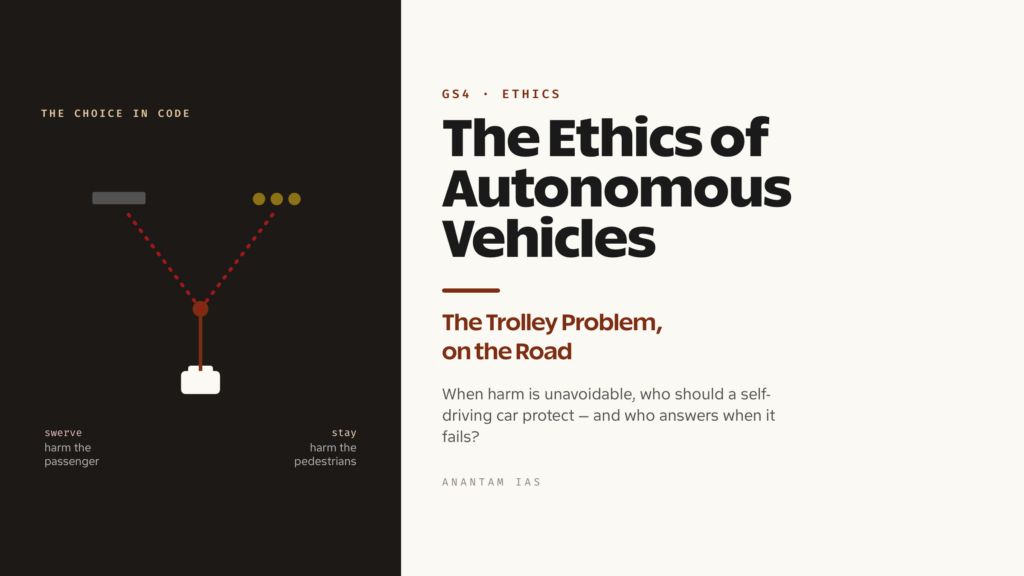
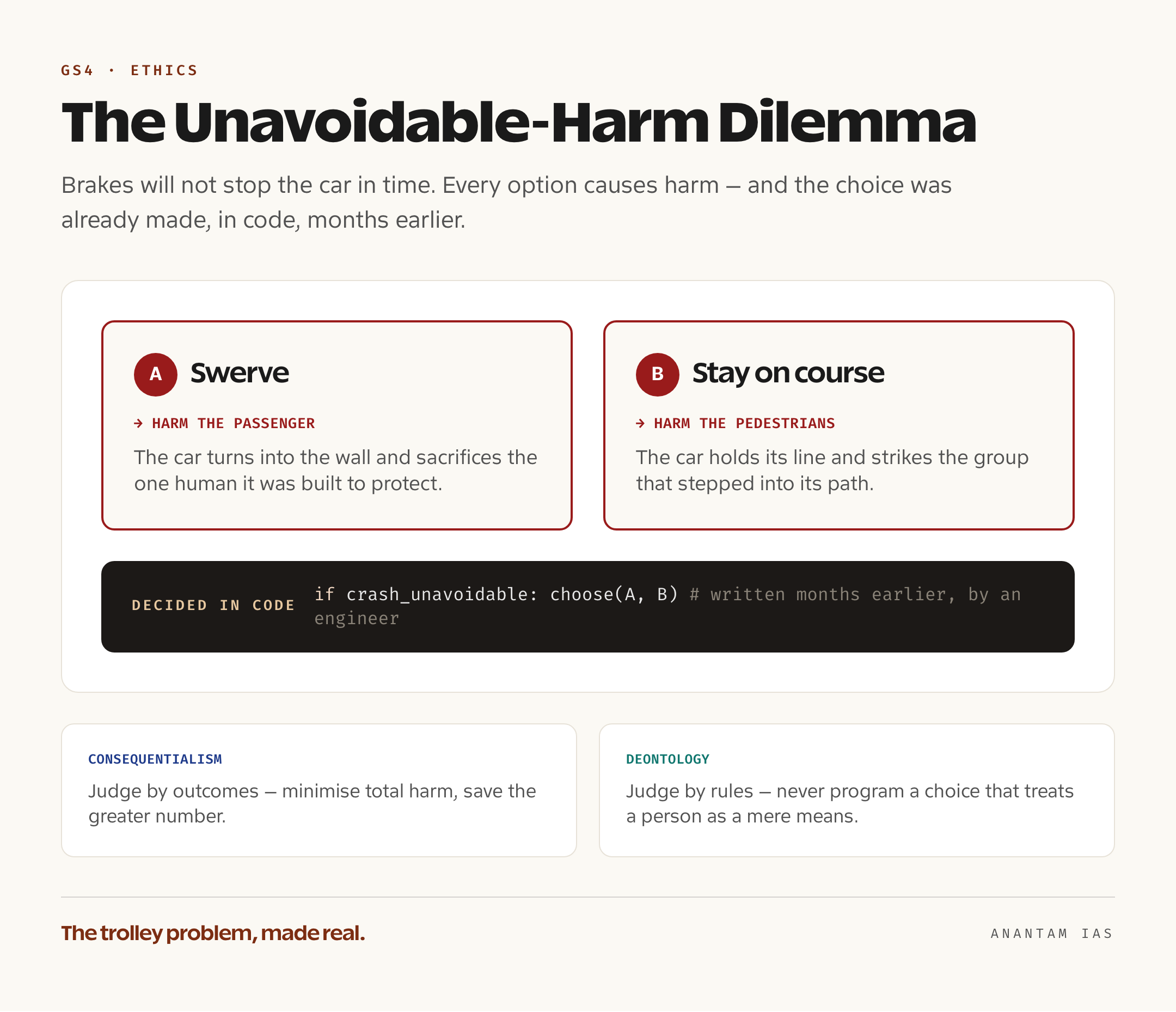
Picture a self-driving car carrying one passenger down a narrow street at speed. A group of children steps off the kerb into its path. The brakes will not stop it in time. The car has exactly two options written into its code: hold its line and strike the children, or swerve into a concrete wall and kill the passenger it was built to protect. There is no version of the next two seconds in which nobody is hurt. And the choice has already been made — not by a panicked human in the moment, but by an engineer at a desk, months earlier, writing the line of software that decides who lives. That is the unsettling heart of this subject. The oldest thought experiment in moral philosophy, the trolley problem, has climbed out of the seminar room and into the steering algorithm of a real machine.
This is why autonomous vehicles belong squarely in an ethics paper and not just a technology one. The question is no longer “can a car drive itself?” — engineers have largely answered that. The question is “how should it behave when harm is unavoidable, and who is accountable when it goes wrong?” Those are moral and legal questions, not technical ones, and they force a society to write down, in code, what it actually believes about the value of a human life. For an aspirant, the topic is a gift: it lets you take abstract ethical theories you have only read about — consequentialism, deontology, virtue ethics — and watch them collide over a concrete, modern dilemma that India itself is now debating.
The Trolley Problem Made Real
The trolley problem is a philosophy puzzle nearly sixty years old. A runaway trolley is about to kill five people on a track; you can pull a lever to divert it onto a side track where it will kill one. Do you pull it? The puzzle has no clean answer, which is exactly the point — it exposes the gap between two ways of thinking. A consequentialist, who judges actions by their outcomes, pulls the lever: five lives saved beats one lost, so the math is obvious. A deontologist, who judges actions by duties and rules rather than results, hesitates, because actively choosing to kill one person treats them as a mere means to an end, and that crosses a moral line no good outcome can erase. For decades this was a classroom abstraction, useful for sharpening argument but safely hypothetical.
Self-driving cars have ended that safety. An autonomous vehicle in an unavoidable-collision scenario is the trolley, and the lever is a few hundred lines of code decided long before the crash. The car’s software must contain some rule — explicit or buried in its training — about how to weigh the people inside against the people outside, the one against the many, the law-abiding pedestrian against the jaywalker. Whatever the engineers choose, they are not solving the trolley problem; they are taking a side in it, on behalf of everyone the car will ever encounter. And they are doing it in advance, in cold blood, which is morally heavier than a split-second human reaction. A driver who swerves on instinct is forgiven as human; a corporation that pre-decides the same outcome looks like it is rationing death by spreadsheet.
There is a further twist that makes the real version harder than the classroom one. A human driver’s choice is unpredictable and personal. A programmed car’s choice is systematic — it will make the same decision every time those conditions repeat, across millions of vehicles. So a single design decision is no longer one tragic act; it becomes a standing policy applied to a whole society, without that society ever having voted on it. The deeper you look, the more the trolley problem stops being about one crash and starts being about who gets to write the moral rules everyone else must live and die by.
The Moral Machine and the Search for Shared Rules
If a car must be given moral rules, whose morals should they be? In 2016 researchers at the MIT Media Lab tried to answer that empirically with an online experiment called the Moral Machine. It put visitors in the driver’s seat of unavoidable-crash scenarios and asked them to choose who the car should spare — old or young, many or few, humans or animals, passengers or pedestrians, the lawful or the rule-breakers. It went viral, and by the time the team published its findings it had collected around 40 million decisions from millions of people across 233 countries and territories — one of the largest studies of human moral preference ever run.
Three preferences turned out to be close to universal: people everywhere leaned toward sparing human lives over animals, toward saving the greater number over the few, and toward protecting the young over the old. But the more striking result was where people disagreed. The choices clustered along cultural lines. As the MIT team and the journal Nature reported, individualistic Western societies leaned harder toward simply saving more lives, while many East Asian and other societies with strong respect for elders were markedly less willing to sacrifice older people, and some economically unequal societies showed a sharper split in how they treated people of higher and lower status. There was no single global morality waiting to be discovered. Ethics, it turned out, has a postcode.
That finding is a warning, not a recipe. It would be a mistake to read the Moral Machine as a vote on whom cars should kill — sparing the young over the old, taken literally, is just age discrimination dressed up as data, and “the crowd preferred it” is no defence in ethics. What the experiment really showed is twofold and useful for any answer. First, a machine that drives among humans cannot be morally neutral; its code will encode some values, so the only choice is whether those values are chosen openly and accountably or smuggled in by default. Second, because moral intuitions differ so sharply across cultures, a rule written for German roads cannot simply be exported to Indian ones. That tension — between the need for shared, enforceable rules and the reality of plural moral views — is the live debate, and it maps neatly onto the wider struggle over how to govern artificial intelligence in India.
The Responsibility Gap: Who Is to Blame When No One Is Driving
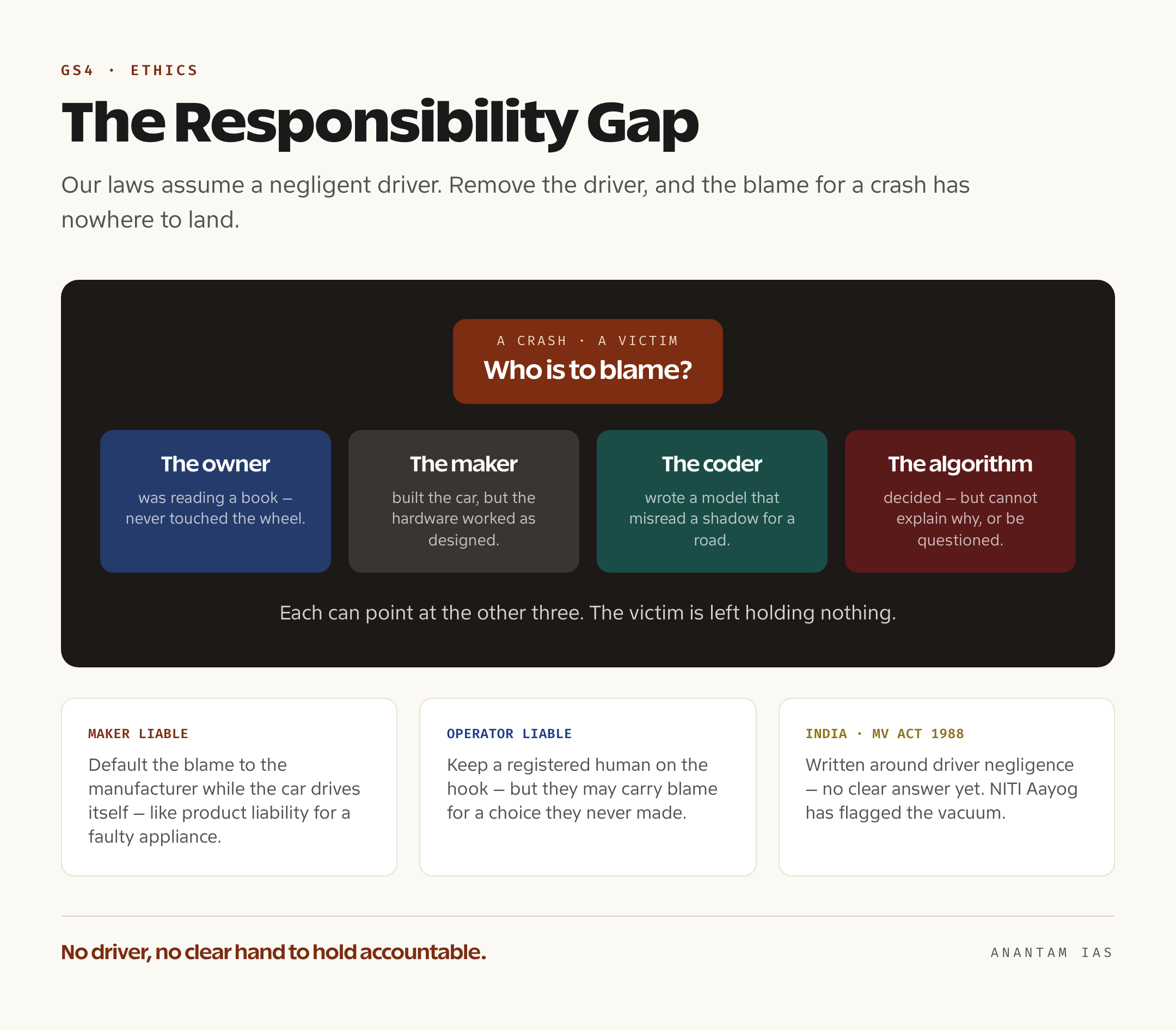
Step away from the rare crash dilemma and a more ordinary, more important ethical problem appears: accountability. Our entire moral and legal apparatus for road deaths rests on a human at the wheel. Blame, punishment, insurance, compensation — all of it flows from finding the negligent driver. Take the driver out, and that chain snaps. When a fully autonomous car kills someone, who is morally responsible? The owner, who was reading a book? The manufacturer, who built the hardware? The software firm, whose algorithm misjudged a shadow for a road? The engineers, who trained the model on imperfect data? Or no one at all — just “the system”? Philosophers call this the responsibility gap: a harm has clearly occurred, yet there is no single agent who straightforwardly caused it with intent or negligence. Accountability scatters, and a society that cannot locate blame cannot deliver justice.
This is sharpened by a second problem — explainability. Modern self-driving systems lean on machine-learning models whose decisions even their makers cannot fully explain after the fact. If a car swerves and we genuinely cannot say why it chose as it did, then the moral demand that a wrongdoer be able to answer for their act has nowhere to land. You cannot cross-examine a neural network. The same opacity that haunts other powerful AI systems, from agentic AI that acts on its own to lethal autonomous weapons that select their own targets, shows up here on the public road: the more capable and self-directed the machine, the harder it becomes to pin responsibility on a human who can be held to account.
Different societies are trying to close the gap in different ways, and the contrasts are instructive. One approach shifts liability onto the manufacturer by default for as long as the car is driving itself — a sensible move that treats the maker as the party best placed to bear and reduce the risk, the way product-liability law already treats faulty appliances. Another keeps a registered human “operator” legally on the hook even when they are not steering, which preserves accountability but risks making a person carry blame for a decision they never made and could not have prevented. India’s own law, the Motor Vehicles Act of 1988, was written around driver negligence and offers no clear answer at all, which is why bodies like NITI Aayog have flagged the legal vacuum as something to fix before, not after, such cars arrive. The ethical test for any of these models is simple to state: does it leave a real, identifiable agent who can be praised, blamed and made to pay — or does it let everyone point at everyone else until the victim is left holding nothing?
The Safety Paradox, Jobs and the Justice Questions
The dilemma scenarios get the headlines, but the largest ethical stakes are mundane and statistical. India loses around 1.7 lakh people to road crashes every year — over 1.72 lakh in 2023 and roughly 1.7 lakh in 2024 by the Ministry of Road Transport and Highways’ own count — and the overwhelming majority of those deaths trace back to human error: speeding, drink-driving, fatigue, distraction. Autonomous vehicles, in principle, do none of those things. They do not get drunk, tired, angry or bored. If they could deliver even a fraction of their promised reduction in crashes, the lives saved each year would dwarf any number that could ever be lost in a rare trolley-style event. From a consequentialist standpoint, that is close to a moral obligation to deploy them. This is the safety paradox: the very technology we fear because of how it might kill could, on the balance sheet, save far more than it takes.
But the paradox cuts both ways, and a careful answer holds both edges. Autonomous vehicles trade familiar, distributed human errors for new, concentrated, systemic ones. A drunk driver kills on one road on one night; a single software flaw, a spoofed sensor or a successful cyberattack could disable or weaponise an entire fleet at once. Cybersecurity stops being an IT concern and becomes a question of physical safety and even national security, because a car is a two-tonne object moving at speed and a hacked one is a remote-controlled weapon. The machine also runs on a constant stream of data about where people go, when and with whom, raising a real privacy stake in who owns and can surveil that trail. So the honest framing is not “safe versus dangerous” but a trade of one risk profile for another — and the duty is to deploy only when the new risks are genuinely smaller and well governed, not merely different.
Then there is the question India keeps returning to: justice, and specifically jobs. The country’s transport sector employs an estimated 70 to 80 lakh drivers — of trucks, taxis, autos and private cars — and Union minister Nitin Gadkari has said plainly, including at the FICCI road-safety event in 2025, that he will not allow driverless cars in India precisely because they could put around a crore people out of work. That is not Luddism; it is a serious utilitarian and Rawlsian point. A technology that saves lives while destroying the livelihoods of the poorest workers, and whose safety benefits accrue first to those who can afford an expensive new car, raises hard questions about who bears the costs and who pockets the gains. Equitable access, a humane transition for displaced drivers, and rules made for India’s gloriously chaotic mixed traffic — where a self-driving system must read a bullock cart, a weaving scooter and a jaywalking pedestrian in the same frame — are why full autonomy remains a distant prospect here, and why the ethical conversation cannot be imported wholesale from Phoenix or Munich. For the technology and readiness side of this story, see the companion explainer on autonomous vehicles, SAE levels and India’s readiness.
For Your Mains Answer
This is a high-value topic for GS Paper 4 (Ethics, Integrity and Aptitude), and it can anchor several of that paper’s themes at once: applied ethics and ethical dilemmas, ethics in the use of technology and AI, the difference between consequentialist, deontological and virtue-based reasoning, and accountability in public and corporate life. It also feeds GS Paper 3 (science and technology, internal security via cybersecurity) and the Essay paper on technology and the human condition. Examiners reward the candidate who can name the moral frameworks precisely and then apply them to the case, rather than just describing the gadget.
How to Build the Answer
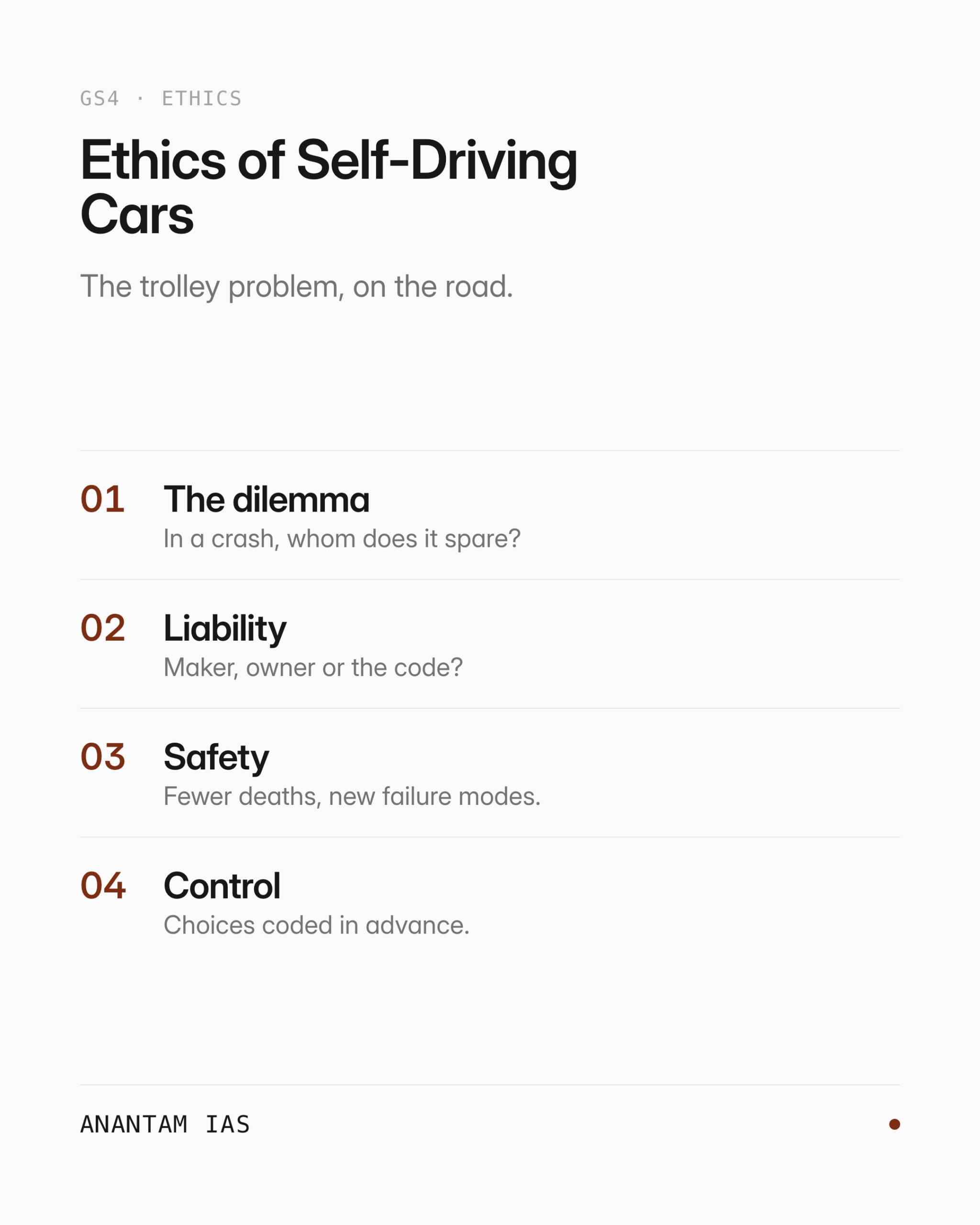
Open by framing autonomous vehicles as the trolley problem made real — that single sentence signals you understand why this is an ethics question, not a tech one. Then move through three layers in order: the dilemma (whom the car should protect, and that any rule encodes values), the accountability problem (the responsibility gap and explainability when no human is driving), and the social stakes (the safety paradox, jobs, privacy, cybersecurity and equity). Apply each ethical lens as you go — consequentialism says deploy to cut 1.7 lakh annual deaths, deontology says never program a rule that treats a person as a mere means or discriminates by age or status, virtue ethics asks what a responsible society and engineer should do. Close with a balanced judgment that holds the safety promise and the justice concerns together.
Common Mistakes to Avoid
Don’t reduce the answer to a description of how self-driving cars work — the examiner wants ethics, not engineering. Don’t treat the Moral Machine as a verdict on whom cars should kill; cite it as evidence that morality varies across cultures and that machines cannot be value-neutral, then note that majority preference is no ethical justification for discrimination. Don’t ignore the Indian context — the jobs and mixed-traffic angle is what localises a generic global answer. And don’t pretend the dilemma has a tidy solution; the marks are in showing you can reason through the tension, not resolve it.
A Compact Answer Spine
Self-driving car in an unavoidable crash = the trolley problem made real → any code encodes values, so neutrality is impossible (MIT Moral Machine: ~40 million choices, universal leanings yet sharp cultural divergence) → the responsibility gap: no human driver means blame scatters across maker, owner, coder and algorithm, worsened by unexplainable AI → safety paradox: could cut much of India’s ~1.7 lakh annual road deaths, but trades distributed human error for systemic risks (cyberattack, fleet-wide flaw, privacy) → India angle: ~70-80 lakh driver jobs, chaotic mixed traffic, a Motor Vehicles Act built for human negligence → frameworks: utilitarian “minimise harm” vs deontological “no discrimination, life over property” (Germany’s 2017 rules) vs virtue ethics → verdict: deploy only with clear liability, transparency, security and a just transition.
Diagram or Flowchart Idea
Sketch the car at a fork: one arrow “swerve → harm passenger”, the other “stay → harm pedestrians”, with a small box labelled “decided in code, months earlier” sitting above the fork. Beside it, draw a second simple diagram of the responsibility gap — a crash in the centre with arrows pointing outward to “owner”, “manufacturer”, “software developer” and “algorithm”, none of them clearly the cause. Two clean visuals like these show the dilemma and the accountability problem at a glance.
A Balanced-Conclusion Line
A line that lands the marks: “The autonomous vehicle does not remove the moral choice from the road — it merely moves it from the driver’s hands to the designer’s desk, which is why the technology must be allowed to save lives only once we can say, clearly and in advance, whose values it carries and who answers when it fails.”
How to Use Data Without Cramming
You need four anchors, not a dataset: the trolley problem (the framing), MIT’s Moral Machine (~40 million decisions, 233 countries — proof that morality is plural), India’s ~1.7 lakh annual road deaths (the safety stakes), and the ~70-80 lakh drivers at risk (the justice stakes). Attribute them in plain prose — “as the MIT Media Lab’s Moral Machine experiment found”, “by the road-transport ministry’s own count” — rather than scattering numbers loose.
Frequently Asked Questions
What is the trolley problem and why does it matter for self-driving cars?
The trolley problem is a classic ethics puzzle in which you must choose between two harmful outcomes — letting a runaway trolley kill five people or diverting it to kill one. It matters for autonomous vehicles because a self-driving car in an unavoidable crash faces the same choice, except the decision is written into its software in advance by engineers rather than made on instinct by a human. That turns an abstract philosophy debate into a concrete design decision about whom a machine should protect.
What was MIT’s Moral Machine experiment, and what did it find?
The Moral Machine, launched by the MIT Media Lab in 2016, was an online experiment that asked people worldwide to decide whom a self-driving car should spare in unavoidable crashes. It gathered around 40 million decisions from people in 233 countries and territories. It found three near-universal leanings — sparing humans over animals, more lives over fewer, and the young over the old — but also sharp cultural differences, showing there is no single global morality a car could simply follow.
What is the “responsibility gap” in autonomous-vehicle ethics?
The responsibility gap is the problem that when a self-driving car causes harm and no human was driving, it becomes unclear who is morally and legally to blame — the owner, the manufacturer, the software developer or the algorithm. Because our laws and moral instincts assume a negligent human driver, removing that driver leaves accountability scattered, with no single agent who clearly caused the harm. Opaque, unexplainable AI makes this worse.
Why is India cautious about allowing fully autonomous cars?
India’s caution rests on three pillars. First, jobs: the transport sector employs roughly 70 to 80 lakh drivers, and the government has said it will not let driverless cars displace around a crore livelihoods. Second, road conditions: India’s mixed, often unlane-disciplined traffic is far harder for autonomous systems than the orderly roads where they are tested. Third, law: the Motor Vehicles Act, 1988 is built around human-driver negligence and has no clear framework for accidents caused by a machine.
Practice Questions
Prelims MCQs
- The “trolley problem”, often invoked in discussions on the ethics of autonomous vehicles, is best described as:
(a) A puzzle about the most fuel-efficient route for public transport
(b) An ethical dilemma forcing a choice between two outcomes, each of which causes harm
(c) A traffic-engineering model for signal timing
(d) A theory about the economics of railway pricing
Answer: (b) The trolley problem is a moral dilemma in which every available choice results in harm, used to contrast outcome-based and rule-based ethical reasoning. - With reference to MIT’s Moral Machine experiment, which of the following statements is/are correct? 1. It collected tens of millions of moral choices from people across the world.
2. It found that moral preferences were identical across all cultures.
3. It revealed near-universal leanings such as sparing more lives over fewer. Select the correct answer:
(a) 1 and 2 only
(b) 1 and 3 only
(c) 2 and 3 only
(d) 1, 2 and 3
Answer: (b) The experiment gathered around 40 million decisions and found some near-universal leanings, but it specifically documented sharp cultural differences, so statement 2 is wrong. - In the ethics of autonomous vehicles, the term “responsibility gap” refers to:
(a) The distance an automated car needs to stop safely
(b) The difficulty of assigning moral or legal blame when a machine causes harm and no human was driving
(c) A shortfall in the number of trained safety drivers
(d) The delay between a sensor reading and a braking response
Answer: (b) The responsibility gap is the problem of locating accountability when harm is caused by an autonomous system rather than a negligent human driver. - A purely consequentialist (utilitarian) argument in favour of deploying autonomous vehicles in India would most likely emphasise that they:
(a) Always protect their own passengers first
(b) Could sharply reduce the roughly 1.7 lakh annual road-crash deaths by removing human error
(c) Preserve the maximum number of driving jobs
(d) Follow traffic rules written into the Motor Vehicles Act, 1988
Answer: (b) Consequentialism judges actions by outcomes, so its strongest argument is the large net reduction in deaths from eliminating human error. - Germany’s 2017 ethics commission on automated and connected driving laid down rules that included which of the following principles? 1. The protection of human life takes priority over damage to property.
2. In unavoidable accidents, the system may discriminate between people based on age or gender.
3. Distinctions between individuals based on personal features are impermissible. Select the correct answer:
(a) 1 and 2 only
(b) 1 and 3 only
(c) 2 and 3 only
(d) 1, 2 and 3
Answer: (b) The German rules prioritised human life over property and forbade discrimination by personal features such as age or gender, so statement 2 contradicts them.
Mains Practice Questions
- “The autonomous vehicle does not remove the moral choice from the road; it moves it from the driver’s hands to the designer’s desk.” Examine the ethical challenges of programming self-driving cars for unavoidable-harm situations. (15 marks, 250 words)
- The MIT Moral Machine experiment found both near-universal moral leanings and sharp cultural differences. Discuss what this tells us about the possibility of writing globally acceptable ethical rules for machines. (15 marks, 250 words)
- Explain the “responsibility gap” in the context of autonomous vehicles. How should liability and accountability be distributed among the manufacturer, owner, software developer and operator? (15 marks, 250 words)
- “Autonomous vehicles trade familiar human errors for new systemic risks.” Critically analyse this safety paradox with reference to road safety, cybersecurity and privacy. (10 marks, 150 words)
- India’s resistance to fully autonomous cars rests heavily on the livelihoods of millions of drivers. Evaluate this concern using the lens of consequentialist and justice-based ethics, and suggest a humane way forward. (15 marks, 250 words)
Tell Google you want more of this.
Add Anantam IAS as a preferred sourceOne tap, and this site shows up more often in your own Top Stories, AI Overviews and AI Mode. Remove it any time.