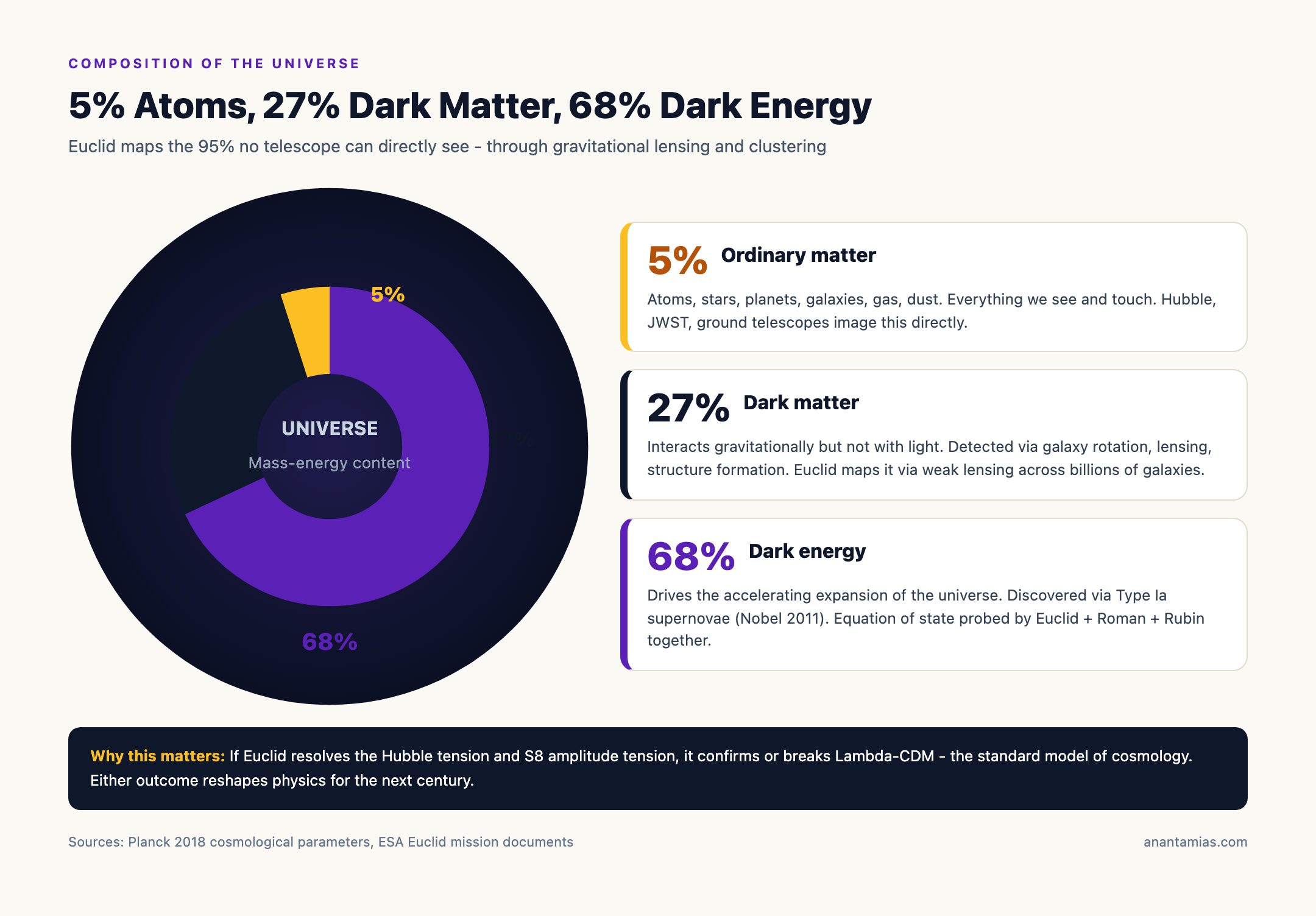
The Euclid mission, launched by the European Space Agency on July 1, 2023 aboard a SpaceX Falcon 9 from Cape Canaveral, is an attempt to map the parts of the universe that no telescope can directly see. Roughly 95% of the cosmos by mass-energy content is invisible. Five percent is ordinary matter (atoms, stars, planets, gas, dust), 27% is dark matter (which interacts gravitationally but not electromagnetically), and 68% is dark energy (the unidentified phenomenon driving the accelerated expansion of the universe). Euclid’s job is to map the geometry of that dark sector with enough precision to test the theories that try to explain it.
The science is built on a simple principle. Dark matter cannot be seen, but its gravity bends the light of more distant galaxies, creating a measurable distortion called weak gravitational lensing. Dark energy cannot be seen, but its effect on cosmic expansion can be inferred from how galaxy clusters cluster at different epochs. By imaging billions of galaxies across one-third of the sky, and measuring their shapes and redshifts (distances), Euclid will produce a 3D map of the universe across the last ten billion years. Cosmologists can then test whether the standard Lambda Cold Dark Matter (Lambda-CDM) model holds up, or whether modifications to general relativity, alternative dark-energy equations of state, or entirely new physics are required.
For UPSC, Euclid is a crisp prelims fact (ESA, L2, Falcon 9, 2023) and a substantive GS-III topic (space science, international cooperation, India’s Aditya-L1 and TMT links). It also offers a clean entry point into cosmology (the Hubble constant tension, dark sector physics) that increasingly figures in question banks. This guide builds the topic from the spacecraft itself out to the broader landscape of space and ground-based telescopes operating today.
Quick Facts
- Agency: European Space Agency (ESA), with NASA contribution to NISP detectors
- Launch date: July 1, 2023
- Launch vehicle: SpaceX Falcon 9 (Cape Canaveral, USA)
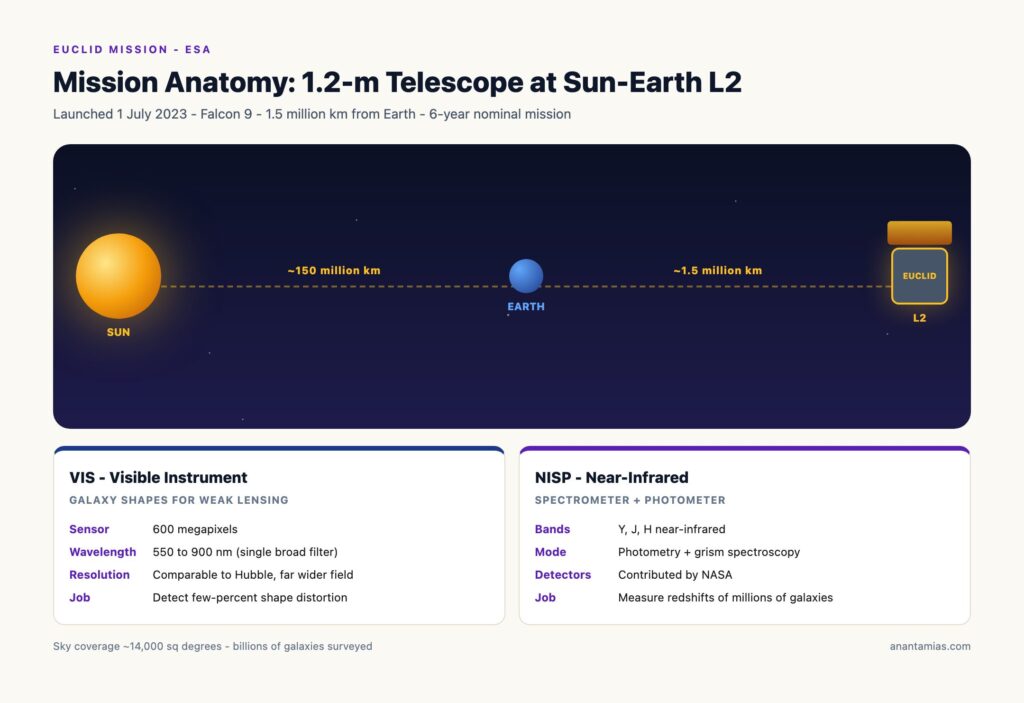
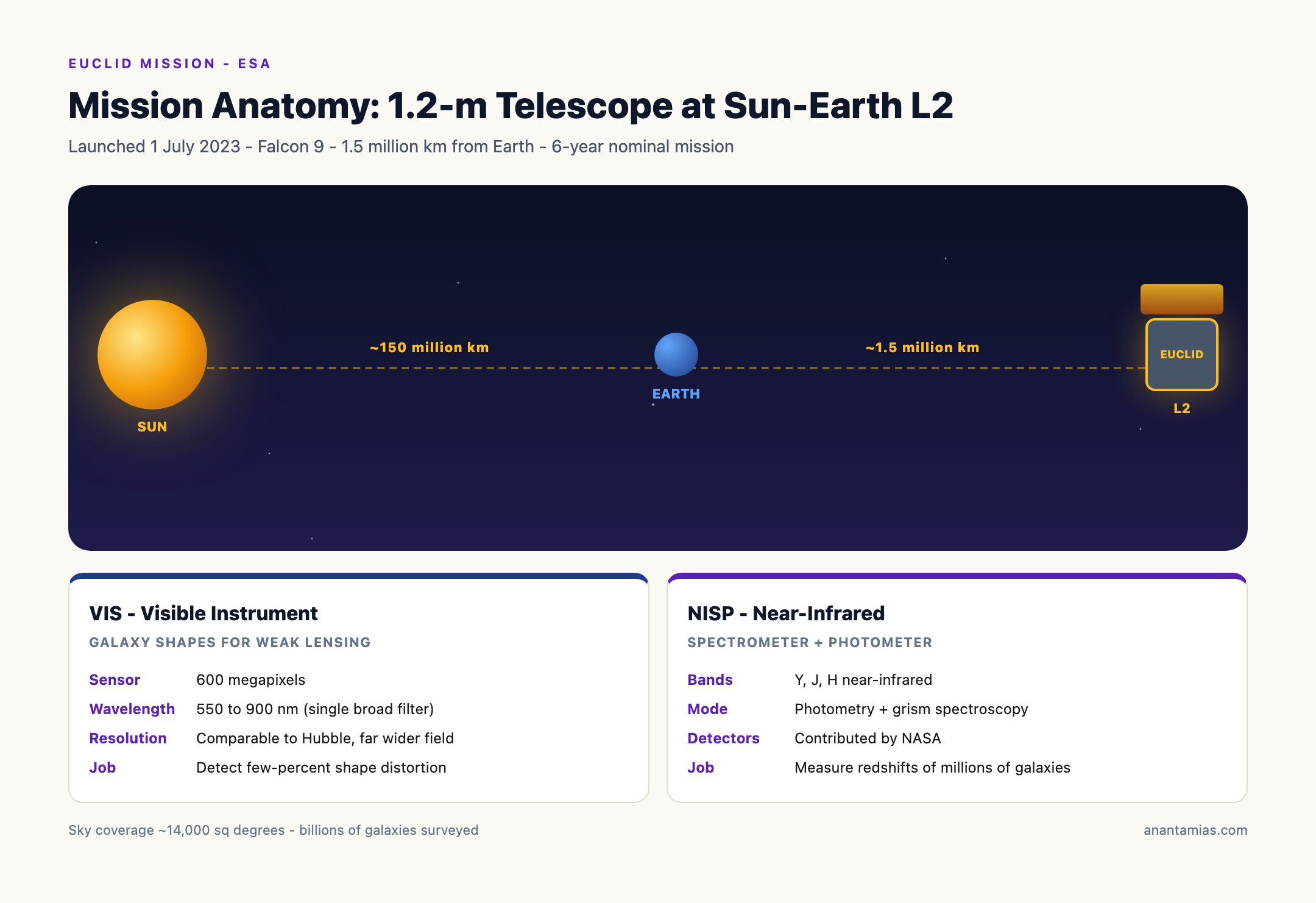
- Destination orbit: Sun-Earth Lagrange Point 2 (L2), ~1.5 million km from Earth
- Nominal mission duration: 6 years (with possible extension)
- Primary mirror: 1.2 metres
- Sky coverage: ~1/3 of the sky (~14,000 square degrees)
- Galaxies surveyed: Billions, across redshift z = 0.7 to 2 (looking back ~10 billion years)
- Payloads: VIS (Visible Instrument), NISP (Near-Infrared Spectrometer and Photometer)
- First-light images released: November 2023; first cosmology data release expected through the late 2020s
What the Euclid Mission Is
Euclid is a wide-field space telescope designed specifically to survey the geometry of the universe. Unlike the James Webb Space Telescope, which is an observatory that points at small targets in extreme detail, Euclid is a survey machine that scans broad swaths of sky uniformly. Its 1.2-metre primary mirror feeds two instruments simultaneously: VIS, which captures very sharp images of galaxy shapes in visible light, and NISP, which measures the near-infrared spectra of galaxies to determine their redshifts (and hence distances).
The science strategy rests on two complementary cosmological probes. First, weak gravitational lensing: as light from distant galaxies passes through the cosmic web of dark matter, it is gently bent, distorting galaxy shapes by a few percent. Statistically averaged over billions of galaxies, this distortion reveals the distribution of dark matter. Second, baryon acoustic oscillations and galaxy clustering: galaxies are not randomly distributed; they cluster on a characteristic scale set by sound waves in the early universe. The way that scale evolves with redshift constrains dark energy.
Background and Historical Context
The dark sector emerged from the late twentieth century in two stages. Vera Rubin’s observations in the 1970s of galaxy rotation curves established that visible matter alone could not explain how galaxies rotate; some unseen mass had to be present. Fritz Zwicky had hypothesised this in the 1930s for the Coma cluster, but Rubin’s data made it inescapable. The cosmic microwave background measurements of COBE (1992), WMAP (2001-2010), and Planck (2009-2013) confirmed the cold dark matter component with growing precision.
Dark energy entered the picture in 1998, when two independent teams (Saul Perlmutter, Brian Schmidt, Adam Riess) discovered that the expansion of the universe is accelerating, using Type Ia supernovae as standard candles. The 2011 Nobel Prize in Physics recognised this discovery. The cosmological constant (Lambda), which Einstein had introduced and then disowned, was rehabilitated as a placeholder for the unknown dark-energy contribution. The current Lambda-CDM model fits a vast range of data but leaves dark energy and dark matter physically unexplained.
Euclid was selected by ESA in 2011 as a medium-class (M2) mission of the Cosmic Vision 2015-2025 programme. It was designed and built by an international consortium of research institutions across Europe, with NASA contributing detectors for the NISP infrared instrument. Originally targeted for a 2020 launch on a Russian Soyuz rocket from Kourou, the mission was delayed by the Ukraine war and rebooked on a SpaceX Falcon 9, eventually launching in July 2023.
Spacecraft and Payloads
The Euclid spacecraft carries a 1.2-metre Korsch-type telescope shielded by a sun shield to maintain stable temperatures essential for astronomical precision. Light from the telescope is split between the two science instruments via a dichroic beam splitter.
VIS: The Visible Instrument
VIS is a 600-megapixel camera operating in a single broad visible-light filter (550 to 900 nm). It captures very sharp images of galaxy shapes, with point spread function precision good enough to detect the few-percent shape distortion induced by weak gravitational lensing. VIS produces images comparable in resolution to the Hubble Space Telescope but over a far larger field of view per exposure.
NISP: The Near-Infrared Spectrometer and Photometer
NISP operates in three near-infrared bands (Y, J, H) for photometry and uses grism-based spectroscopy to measure the redshifts of millions of galaxies. By dispersing light into spectra, NISP determines how much each galaxy’s light has been stretched (red-shifted) by cosmic expansion, which in turn fixes the distance and look-back time. Photometric and spectroscopic redshifts are calibrated against ground-based surveys for consistency.
Why L2: The Sun-Earth Lagrange Point 2
L2 is one of five gravitational equilibrium points in the Sun-Earth system where a small object can maintain a roughly fixed position relative to both bodies. L2 sits 1.5 million kilometres beyond Earth in the anti-Sun direction. A telescope at L2 enjoys three advantages.
First, thermal stability: with the Sun, Earth, and Moon all on one side, a sun shield can permanently shadow the spacecraft, allowing instruments to operate at very low and stable temperatures essential for infrared astronomy.
Second, an unobstructed sky: from L2, the Earth and Moon never block the field of view, allowing continuous observation of any target.
Third, low fuel for orbit maintenance: L2 halo orbits require minimal station-keeping fuel, extending mission life.
L2 is also home to the James Webb Space Telescope, the Solar and Heliospheric Observatory’s L1 sibling, the Planck satellite (operations ended), and India’s Aditya-L1 (which is at L1, not L2, but the same orbital-mechanics logic applies). Real estate at L2 is increasingly contested as more missions queue up for the same favourable location.
Euclid versus James Webb Space Telescope
The two missions are often confused because both operate at L2 and study the universe, but they are designed for complementary purposes.
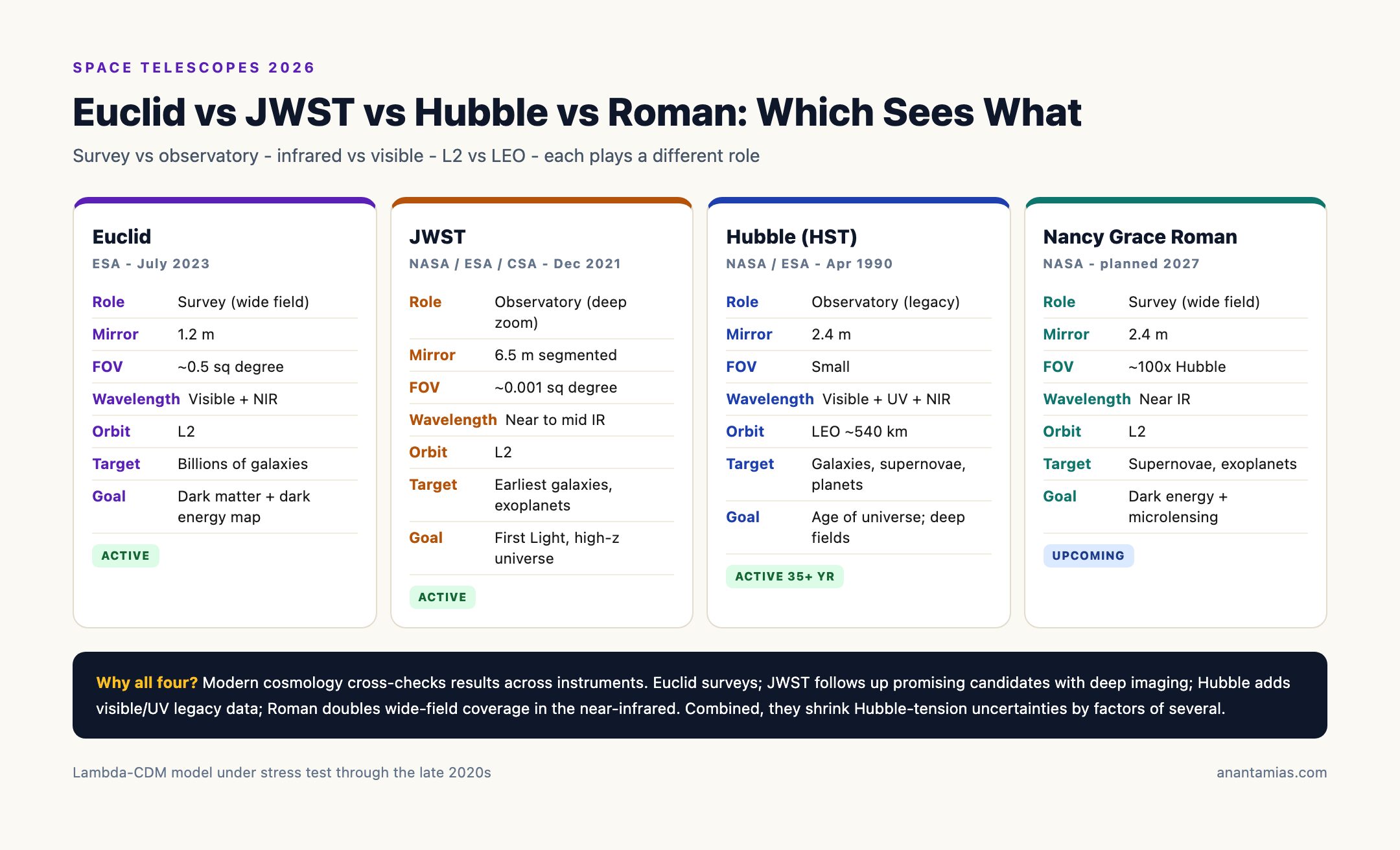
| Feature | Euclid (ESA) | JWST (NASA/ESA/CSA) |
|---|---|---|
| Primary role | Survey telescope (wide field) | Observatory (deep, narrow field) |
| Field of view | ~0.5 square degrees per exposure | ~0.001 square degrees per exposure |
| Mirror size | 1.2 metres | 6.5 metres (segmented gold-coated) |
| Wavelength | Visible + near-infrared | Near to mid-infrared |
| Target | Billions of galaxies, statistical | Individual targets, deep imaging |
| Launched | July 1, 2023 | December 25, 2021 |
Euclid scans large areas to characterise statistical properties of the cosmic web; JWST zooms into individual galaxies, nebulae, exoplanets, and the most distant known sources. Cosmologists use both: JWST follows up the most interesting Euclid candidates with deeper imaging and spectroscopy.
Major Space Telescopes Today
James Webb Space Telescope (JWST)
NASA, ESA, and CSA partnership; launched December 25, 2021; orbits L2; 6.5-metre segmented gold-coated primary mirror; near-to-mid-infrared sensitivity; observes the “first light” of the universe (the earliest galaxies and stars), exoplanet atmospheres, and the high-redshift universe. JWST replaced Hubble as the most powerful space telescope.
Hubble Space Telescope (HST)
NASA and ESA partnership; launched April 1990; Low Earth Orbit at ~540 km; 2.4-metre primary mirror; visible, ultraviolet, near-infrared. Hubble has been operating for over 35 years; it determined the age of the universe to ~13.8 billion years, discovered dark energy via Type Ia supernovae, and produced iconic deep-field images that revealed billions of galaxies.
Nancy Grace Roman Space Telescope
NASA, planned launch around 2027; field of view ~100 times larger than Hubble; will hunt for dark energy via supernovae and weak lensing, and survey for exoplanets via gravitational microlensing. Roman is highly complementary to Euclid: their data sets, when cross-correlated, will tighten constraints on cosmological parameters significantly.
Xuntian (China)
Planned Chinese space telescope to orbit near the Tiangong space station, allowing the rare advantage of in-orbit servicing. Expected to operate in optical and ultraviolet wavelengths with a 2-metre mirror.
Major Ground-Based Telescopes
| Telescope | Location | Mirror | Status | Notable |
|---|---|---|---|---|
| European Extremely Large Telescope (E-ELT) | Atacama, Chile | 39 m segmented | Under construction | Largest optical/near-IR telescope when complete |
| Thirty Meter Telescope (TMT) | Mauna Kea (proposed) | 30 m | Site contested | India is a full member |
| Giant Magellan Telescope (GMT) | Las Campanas, Chile | 7 x 8.4 m circular mirrors | Under construction | Flower-petal mirror configuration |
| Square Kilometre Array (SKA) | South Africa + Australia | Distributed antennas | Phase 1 deployment | World’s largest radio telescope, 1 sq km collecting area |
| Vera C. Rubin Observatory (LSST) | Cerro Pachon, Chile | 8.4 m | Operational | 10-year Legacy Survey of Space and Time |
India is a full participant in TMT (with contributions to mirror polishing, instrumentation, and software at the Aryabhatta Research Institute of Observational Sciences and IIA Bengaluru) and a member of SKA (operations led from the National Centre for Radio Astrophysics, Pune). These memberships secure observing time and downstream data access for Indian astronomers.
Why It Matters: The Stakes for Cosmology
The standard Lambda-CDM model fits the cosmic microwave background, large-scale structure, supernova distances, and primordial nucleosynthesis abundances within current uncertainties. But tensions are emerging. The Hubble constant measured from the early universe (CMB) versus the late universe (supernovae and Cepheids) disagrees at roughly 4 to 5 sigma; this is the famous “Hubble tension.” The S8 amplitude of matter clustering measured from weak lensing surveys also shows tension with CMB-derived predictions. Euclid will test whether these tensions are statistical fluctuations, systematic errors in measurement, or signals of physics beyond Lambda-CDM.
If Euclid confirms the tensions with reduced error bars, the implications are profound: dark energy may not be a constant; gravity itself may behave differently on cosmic scales; or there may be additional cosmological constituents (early dark energy, sterile neutrinos, modified gravity) that revise the standard model.
If Euclid resolves the tensions in favour of Lambda-CDM, the model graduates from “best fit” to “consensus theory” of the universe at large scales, freeing theoretical physicists to focus on smaller-scale puzzles (small galaxy abundance, the cusp-core problem, satellite galaxy distributions).
Either outcome reshapes physics. Few mission objectives in modern science are as cleanly defined.
Comparative: Cosmology Missions over Five Decades
| Era | Mission | Achievement |
|---|---|---|
| 1989-93 | COBE | First measurement of CMB anisotropies (Mather and Smoot, Nobel 2006) |
| 1990-present | Hubble | Age of universe; dark energy via supernovae |
| 1998 | Type Ia SN teams | Discovery of accelerated expansion (Nobel 2011) |
| 2001-10 | WMAP | Precision CMB cosmology |
| 2009-13 | Planck | Highest precision CMB measurements |
| 2021-present | JWST | Earliest galaxies; high-redshift universe |
| 2023-present | Euclid | Dark matter and dark energy survey |
| 2027 (planned) | Nancy Grace Roman | Wide-field cosmology, complementary to Euclid |
| 2030s | LiteBIRD, CMB-S4 | Search for primordial gravitational waves in the CMB |
Each generation has pushed the precision of cosmological parameters by an order of magnitude. Euclid sits at the centre of the current generation’s effort.
Challenges and Risks
- Calibration: Weak lensing measures shape distortions of a few percent. Telescope optics, detector imperfections, and atmospheric effects (for ground follow-up) all introduce systematics that can mimic cosmological signals.
- Photometric redshift accuracy: NISP measures redshifts via spectra and photometry; small errors in redshift propagate to large errors in distance and clustering.
- Foreground contamination: The Milky Way’s stars and dust complicate clean cosmological signal extraction; sky regions must be carefully masked.
- Data volume: Euclid generates roughly 100 GB per day; processing pipelines, ground-based archives, and joint surveys with Roman, Rubin, and ground spectroscopic surveys must coordinate.
- Mission lifetime: Six nominal years with possible extension; instrument degradation could limit the final cosmology data release.
- Theoretical interpretation: A detection of physics beyond Lambda-CDM requires both compelling data and broadly accepted theoretical frameworks; reaching consensus is itself a multi-decade process.
Prelims Pointers
- Euclid was launched on July 1, 2023 by the European Space Agency (ESA).
- It rode a SpaceX Falcon 9 from Cape Canaveral, USA.
- It orbits the Sun-Earth Lagrange Point 2 (L2), ~1.5 million km from Earth.
- Two instruments: VIS (visible) and NISP (near-infrared spectrometer and photometer).
- Primary mirror: 1.2 metres; mission duration: nominal 6 years.
- The universe is ~5% ordinary matter, ~27% dark matter, ~68% dark energy.
- JWST has a 6.5-metre segmented gold-coated mirror; it observes mainly in infrared and orbits L2.
- Hubble Space Telescope orbits Low Earth Orbit (~540 km) and observes visible, UV, and near-infrared.
- Nancy Grace Roman Space Telescope is NASA’s upcoming wide-field cosmology mission (launch around 2027).
- TMT (Thirty Meter Telescope) is a proposed ground telescope; India is a full member.
- SKA (Square Kilometre Array) is a radio telescope across South Africa and Australia.
- Aditya-L1 orbits L1, not L2; it is India’s first solar mission.
Mains Practice Questions
- GS-III: Discuss the scientific objectives and instruments of the Euclid mission. How will it enhance our understanding of dark matter and dark energy compared with previous space missions? (250 words)
- GS-III: Differentiate between survey telescopes (Euclid, Roman, Rubin) and observatory telescopes (JWST, Hubble). Why does modern astronomy require both? (150 words)
- GS-III: Explain the strategic and scientific significance of the Sun-Earth Lagrange Points for space-based astronomy. Compare their use across major missions. (250 words)
- GS-III: Examine India’s participation in international astronomy collaborations such as TMT and SKA. How can India strengthen its leadership in observational astronomy? (250 words)
Way Forward
For the global community, Euclid’s data should be combined with the Nancy Grace Roman Space Telescope (launching around 2027), the Vera C. Rubin Observatory’s Legacy Survey of Space and Time (operating now), and ground spectroscopic surveys like DESI and 4MOST. Joint analysis suppresses systematics and tightens cosmological parameter constraints by factors of several. Coordination between ESA, NASA, and ground-based observatories is essential.
For India specifically, Euclid creates two opportunities. First, observational astronomy: Indian institutions (IUCAA Pune, IIA Bengaluru, ARIES Nainital, NCRA Pune) should secure joint analysis access to Euclid data via collaborations with European consortia, particularly for combined Euclid plus SKA studies of the matter distribution. Second, instrumentation: the success of Indian-made detector arrays, optical components, and software at Euclid-class missions opens the door to Indian leadership roles in next-generation cosmology missions of the 2030s and 2040s. ISRO’s growing platform capability and India’s positioning at TMT and SKA, combined with Aditya-L1’s success, position the country to participate in any successor mission that surveys the universe at higher precision.
The dark sector is the largest open problem in physical science. Whoever maps it best will shape the cosmology curriculum for the next century. Euclid is the European bid; the response from India, the United States, China, and Japan will define the geography of cosmology for the rest of the 21st century.
Frequently Asked Questions
What is the Euclid Mission and who runs it?
The Euclid Mission is a wide-field space telescope developed by the European Space Agency (ESA), with NASA contributing detectors, to map the geometry of the dark universe. It launched on July 1, 2023 aboard a SpaceX Falcon 9 from Cape Canaveral and operates from the Sun-Earth Lagrange Point 2.
What does Euclid actually measure?
Euclid measures the shapes of billions of galaxies in visible light (using its VIS instrument) and the redshifts of millions of galaxies in near-infrared (using NISP). These measurements probe weak gravitational lensing and galaxy clustering, which together constrain the distribution of dark matter and the equation of state of dark energy.
Why is Euclid placed at Sun-Earth Lagrange Point 2?
L2 is a gravitational equilibrium point ~1.5 million km from Earth in the anti-Sun direction. A spacecraft there enjoys thermal stability (sun shield protects from solar heat), unobstructed observation (Earth and Moon never block the view), and minimal fuel for orbit maintenance. JWST also orbits L2.
How does Euclid differ from the James Webb Space Telescope?
Euclid is a survey telescope with a wide field of view designed to image one-third of the sky uniformly. JWST is an observatory with a much larger 6.5-metre mirror designed to observe small targets in extreme detail in infrared. Euclid identifies cosmologically interesting candidates; JWST follows them up at higher resolution.
What are dark matter and dark energy?
Dark matter is unseen matter that interacts gravitationally but not electromagnetically; it accounts for ~27% of the universe’s mass-energy content. Dark energy is an unidentified phenomenon driving the accelerated expansion of the universe; it accounts for ~68%. Ordinary visible matter (atoms, stars, gas) is only ~5%.
What is gravitational lensing and why is it useful?
Gravitational lensing is the bending of light by mass, predicted by general relativity. Strong lensing produces dramatic arcs and Einstein rings; weak lensing produces small (few percent) distortions in galaxy shapes. Euclid uses weak lensing on billions of galaxies to map dark matter statistically.
Has India participated in the Euclid Mission?
India is not a formal Euclid consortium member, but Indian astronomers can access data through bilateral collaborations and post-publication public releases. India’s main international observatory commitments are TMT (where India is a full member) and SKA (member, with NCRA Pune leading operations).
How does the Euclid Mission compare with the Nancy Grace Roman Space Telescope?
Both are wide-field space telescopes designed for cosmology. Euclid (1.2-metre mirror, ESA, 2023 launch) and Roman (2.4-metre mirror, NASA, ~2027 launch) are highly complementary; combining their data sets will tighten cosmological parameter constraints and significantly extend the survey area.
What is the Hubble tension and how will Euclid help?
The Hubble tension is the disagreement between the Hubble constant measured from the early universe (CMB, ~67 km/s/Mpc) and from the late universe (supernovae, ~73 km/s/Mpc). Euclid’s combination of weak lensing, galaxy clustering, and supernovae will provide an independent measurement that may resolve, confirm, or sharpen the tension.
How does Euclid fit into the larger ecosystem of space and ground telescopes?
Euclid joins JWST and Hubble in space, and Vera C. Rubin Observatory, ELT, GMT, TMT, and SKA on the ground. Each plays a different role: Hubble for visible and UV, JWST for infrared zoom-in, Euclid for wide visible-near-IR survey, Rubin for time-domain optical survey, ELT for the largest single-aperture optical, SKA for radio. Modern cosmology is a multi-instrument enterprise.
Tell Google you want more of this.
Add Anantam IAS as a preferred sourceOne tap, and this site shows up more often in your own Top Stories, AI Overviews and AI Mode. Remove it any time.