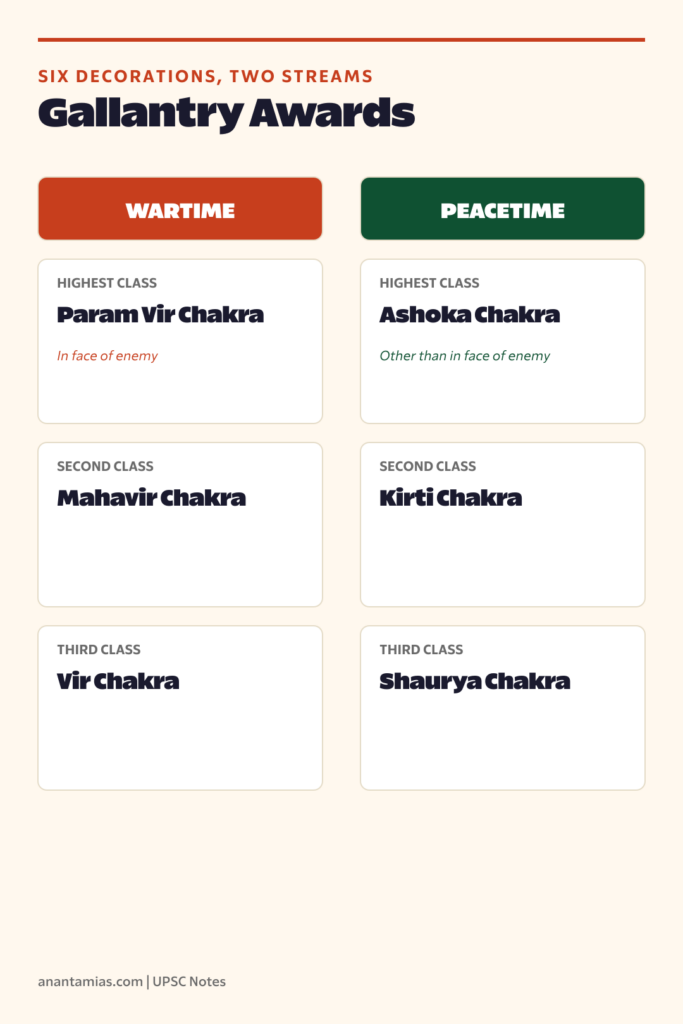
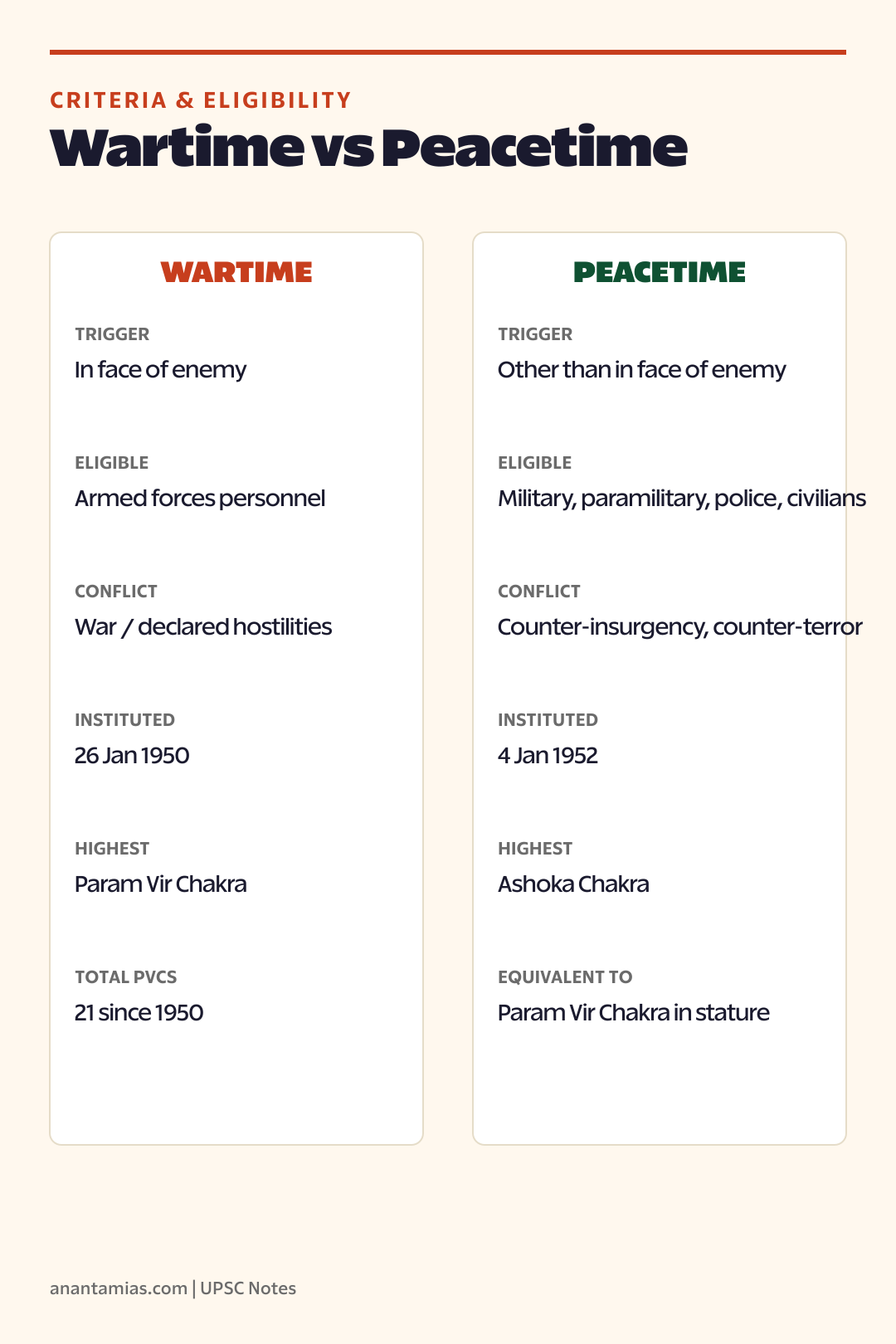
Gallantry awards of India are conferred in two tiers and across two categories of service. The wartime decorations, awarded for action in the face of the enemy, are the Param Vir Chakra, the Mahavir Chakra, and the Vir Chakra. The peacetime decorations, awarded for valour other than in the face of the enemy, are the Ashoka Chakra, the Kirti Chakra, and the Shaurya Chakra. The two streams are exactly parallel in seniority. The Param Vir Chakra and the Ashoka Chakra are the two highest, awarded in their respective categories. Each is roughly equivalent in stature to the highest military gallantry awards in comparable democracies.
The architecture goes back to a 1950 notification issued shortly after the Republic was proclaimed. Major Somnath Sharma, killed in action at Badgam in November 1947 while holding the line against Pakistani raiders advancing on Srinagar airfield, became the first recipient of the Param Vir Chakra. The award was conferred posthumously. The Ashoka Chakra, then called the Ashoka Chakra Class I, was instituted at the same time. The hierarchy was rationalised in January 1952 and again in 1967, when the names and the three-class structure within the peacetime stream were settled.
This explainer walks through each of the six gallantry awards of India, the criteria, the design, the history, and recent recipients. It also covers the bar mechanism, the cash allowances attached to each decoration, and the prelims-ready facts UPSC tends to test.
The two streams and the hierarchy
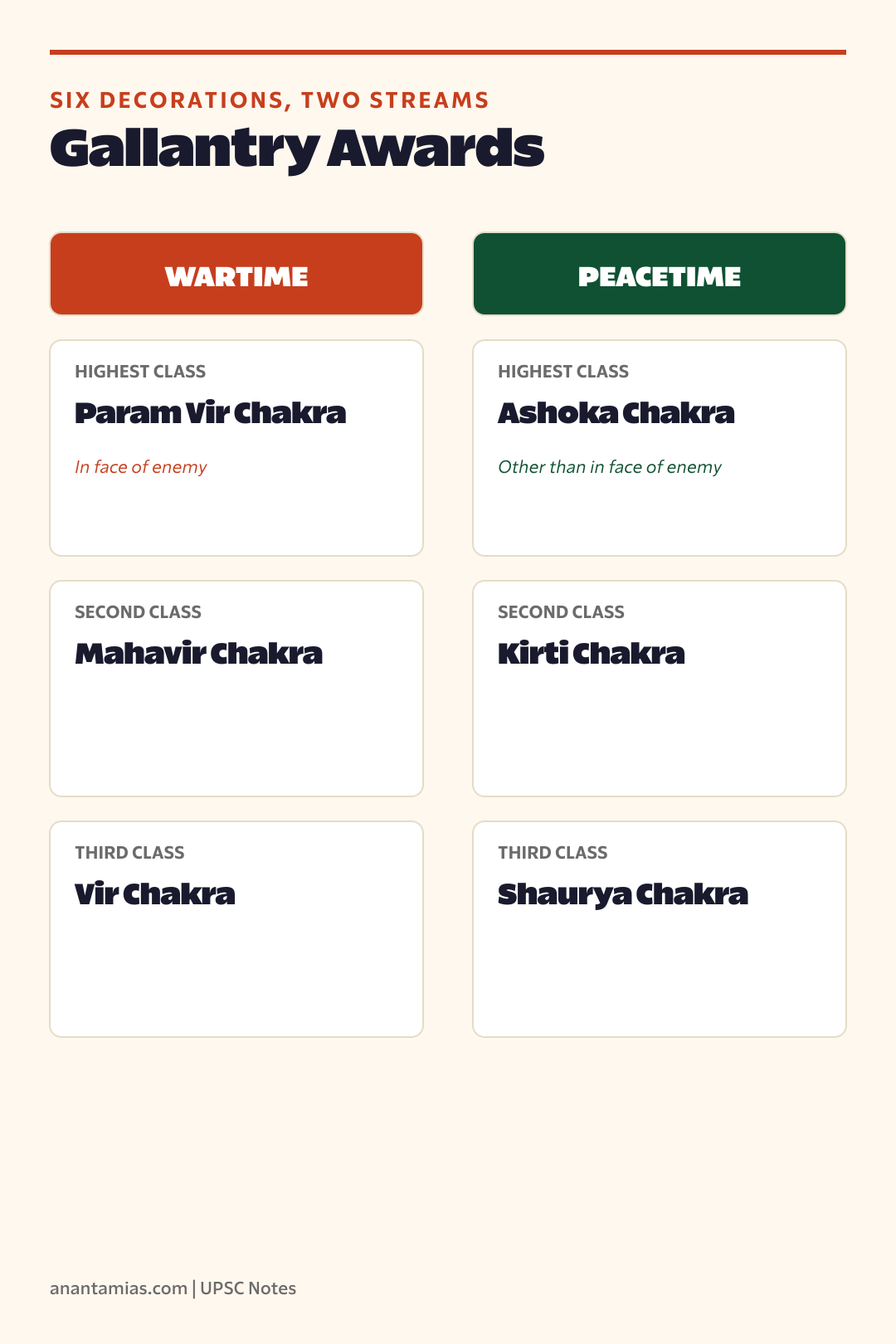
Gallantry awards of India sit in a clean two-by-three grid. The wartime stream and the peacetime stream each have three classes, in descending order of seniority. Within each stream the senior award is conferred sparingly, typically once or twice a year and often posthumously.
The order of precedence, from highest to lowest:
- Param Vir Chakra, wartime, highest
- Ashoka Chakra, peacetime, highest, equivalent to the Param Vir Chakra in stature
- Mahavir Chakra, wartime, second class
- Kirti Chakra, peacetime, second class, equivalent to the Mahavir Chakra
- Vir Chakra, wartime, third class
- Shaurya Chakra, peacetime, third class, equivalent to the Vir Chakra
The Param Vir Chakra and the Ashoka Chakra are conferred for the most conspicuous bravery or some daring or pre-eminent act of valour or self-sacrifice. The Mahavir Chakra and the Kirti Chakra are for acts of conspicuous gallantry. The Vir Chakra and the Shaurya Chakra are for acts of gallantry. The descending scale runs in parallel across both streams.
The Param Vir Chakra
The Param Vir Chakra was instituted on 26 January 1950, with retrospective effect from 15 August 1947. It is India’s highest wartime gallantry decoration. The design, by Savitri Khanolkar, shows the Indra’s vajra around the Ashokan emblem on a bronze disc. The ribbon is plain purple. The vajra design draws on the Vedic story of Sage Dadhichi, who is said to have given his bones to forge the weapon that defeated Vritra.
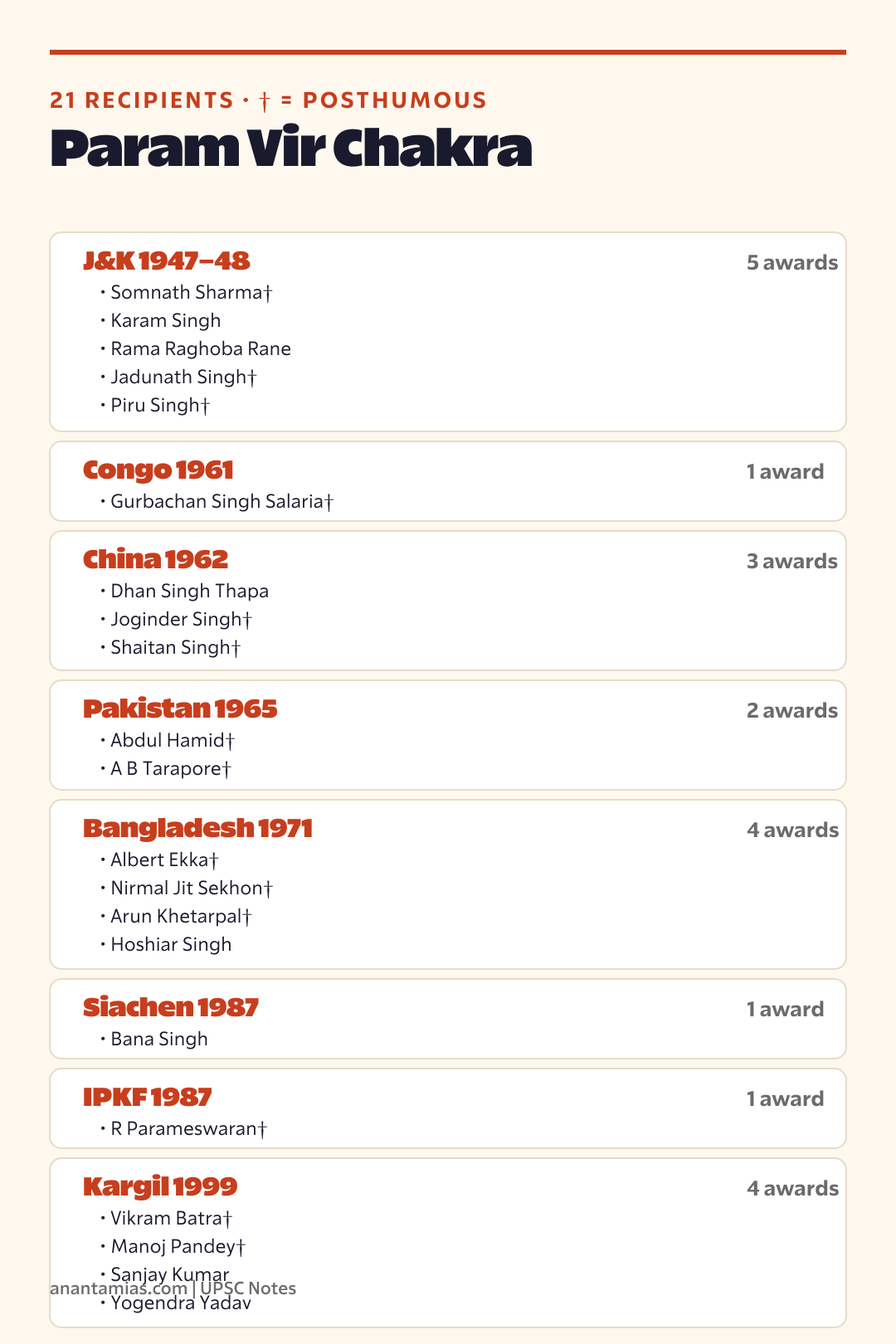
The Param Vir Chakra has been awarded twenty-one times since 1950. Fourteen of those awards were posthumous. The first recipient was Major Somnath Sharma in 1947. Subsequent recipients have come from each of the major conflicts.
Param Vir Chakra recipients
The full list, by conflict, includes:
- Major Somnath Sharma, 4 Kumaon, Jammu and Kashmir 1947, posthumous
- Lance Naik Karam Singh, 1 Sikh, Jammu and Kashmir 1948
- Second Lieutenant Rama Raghoba Rane, Bombay Engineers, Jammu and Kashmir 1948
- Naik Jadunath Singh, 1 Rajput, Jammu and Kashmir 1948, posthumous
- Company Havildar Major Piru Singh, 6 Rajputana Rifles, Jammu and Kashmir 1948, posthumous
- Captain Gurbachan Singh Salaria, 3 Gorkha Rifles, Congo 1961, posthumous
- Major Dhan Singh Thapa, 8 Gorkha Rifles, Ladakh 1962
- Subedar Joginder Singh, 1 Sikh, NEFA 1962, posthumous
- Major Shaitan Singh, 13 Kumaon, Rezang La 1962, posthumous
- Company Quartermaster Havildar Abdul Hamid, 4 Grenadiers, Khem Karan 1965, posthumous
- Lieutenant Colonel Ardeshir Burzorji Tarapore, Poona Horse, Sialkot 1965, posthumous
- Lance Naik Albert Ekka, 14 Guards, Gangasagar 1971, posthumous
- Flying Officer Nirmal Jit Singh Sekhon, 18 Squadron IAF, Srinagar 1971, posthumous
- Second Lieutenant Arun Khetarpal, Poona Horse, Basantar 1971, posthumous
- Major Hoshiar Singh, 3 Grenadiers, Basantar 1971
- Naib Subedar Bana Singh, 8 JAK LI, Siachen 1987
- Major Ramaswamy Parameswaran, 8 Mahar, Sri Lanka IPKF 1987, posthumous
- Captain Vikram Batra, 13 JAK Rifles, Kargil 1999, posthumous
- Lieutenant Manoj Kumar Pandey, 1/11 Gorkha Rifles, Kargil 1999, posthumous
- Rifleman Sanjay Kumar, 13 JAK Rifles, Kargil 1999
- Subedar Major Yogendra Singh Yadav, 18 Grenadiers, Kargil 1999
Design and allowance
The medal is a bronze disc, 1.375 inches in diameter, embossed with four replicas of Indra’s vajra around the state emblem at the centre. The reverse carries the words Param Vir Chakra in Hindi and English. The ribbon is plain purple. The cash allowance for a serving recipient was revised by the Ministry of Defence in 2017 and again in subsequent pay-commission decisions. The award also carries entitlements for the family in the event of a posthumous decoration.
The Mahavir Chakra
The Mahavir Chakra is the second-highest wartime gallantry award. It was instituted on 26 January 1950, also with retrospective effect from 15 August 1947. The medal is a circular silver disc with a five-pointed star embossed in the centre. The ribbon is half saffron, half white. Over 220 recipients have received the award since 1950.
The Mahavir Chakra has been awarded across the Jammu and Kashmir operations of 1947 to 1948, the 1962 China war, the 1965 and 1971 Pakistan wars, the Sri Lanka IPKF operations, and the 1999 Kargil conflict.
The Vir Chakra
The Vir Chakra is the third-class wartime gallantry award, again instituted on 26 January 1950 with retrospective effect. The medal is a circular silver-bronze disc. The ribbon is half blue, half saffron. The Vir Chakra has been awarded over 1300 times across all post-1947 conflicts and continues to be conferred in counter-insurgency operations where the enemy is engaged in the form of armed cross-border combatants.
The Ashoka Chakra
The Ashoka Chakra is the highest peacetime gallantry award and ranks equally with the Param Vir Chakra in the overall hierarchy. It was instituted on 4 January 1952 and rationalised into its current name in 1967. The medal is a circular gold-gilted disc with the Ashoka Chakra embossed at the centre, surrounded by lotus wreaths. The ribbon is dark green with two saffron vertical stripes.
The Ashoka Chakra is conferred for the most conspicuous bravery or some daring or pre-eminent act of valour or self-sacrifice other than in the face of the enemy. It is open to military and paramilitary personnel and to civilians. Recent recipients include Major Sandeep Unnikrishnan of the NSG, killed during the November 2008 Mumbai attacks, and Havildar Hangpan Dada of 4 Assam, killed in action against terrorists in Kupwara in 2016.
Recent Ashoka Chakra recipients
The award has been conferred on counter-terror and counter-insurgency operations across the past decade. Recent recipients include:
- Major Sandeep Unnikrishnan, 51 Special Action Group NSG, Mumbai 2008, posthumous
- Lieutenant Colonel Niranjan Kumar, 51 SAG NSG, Pathankot 2016, posthumous
- Havildar Hangpan Dada, 4 Assam Regiment, Kupwara 2016, posthumous
- Lance Naik Nazir Ahmed Wani, 162 Territorial Army, Kashmir 2018, posthumous
- Babu Ram, Constable, Jammu and Kashmir Police, Kashmir 2018, posthumous
The Kirti Chakra
The Kirti Chakra is the second-class peacetime gallantry award. It is the peacetime equivalent of the Mahavir Chakra. The medal is a circular silver disc with the Ashoka Chakra at the centre, encircled by lotus wreaths. The ribbon is dark green with two saffron stripes narrower than those on the Ashoka Chakra. Over 500 recipients have received the award since 1952.
The Kirti Chakra has been a routine decoration for counter-insurgency operations in Jammu and Kashmir, the North-East, and against Maoist groups in central India. It is conferred annually on Republic Day and Independence Day, with the list announced through the Gazette of India.
The Shaurya Chakra
The Shaurya Chakra is the third-class peacetime gallantry award, equivalent in stature to the Vir Chakra. The medal is a circular bronze disc with the same Ashoka Chakra and lotus motif. The ribbon is dark green with three saffron stripes. Several thousand recipients have received the award since 1952. The Shaurya Chakra is the most frequently conferred of the six gallantry awards of India.
Bars, allowances, and family entitlements
A recipient who performs a further act meeting the criteria of the same award is entitled to a bar, indicated by an additional clasp on the ribbon. Only a handful of personnel hold a Param Vir Chakra or Ashoka Chakra with bar; the figure is in single digits.
Cash allowances for the six decorations are revised periodically by the Ministry of Defence and tied to pay-commission cycles. The 2017 revision raised the Param Vir Chakra monthly allowance to a multiple of its earlier figure and harmonised the Ashoka Chakra allowance with it. Family pension and education entitlements for next of kin follow specific notifications and differ between the wartime and peacetime streams.
For broader UPSC context, the statutory constitutional bodies overview post covers the constitutional framework within which the President of India confers gallantry awards. The contemporary issues in Indian constitutional law post covers the Article 18 prohibition on titles and how gallantry awards sit alongside that prohibition.
UPSC angles to track
For prelims, the testable facts are the year of institution of each award, the order of precedence, and the difference between the wartime and peacetime streams. The most common confusion is treating the Ashoka Chakra as the peacetime second-class award. It is the highest peacetime award, equivalent to the Param Vir Chakra.
For mains, the GS-II governance paper and the GS-III internal security paper have used gallantry awards as anchors for questions on civil-military relations and on counter-terror operations. The essay paper has used the question of national valour and remembrance as a theme. The November 2008 Mumbai attacks and the 1999 Kargil conflict have appeared as case-study material.
The ground to prepare is the six-award grid, the canonical recipients, and the institutional setting under which the President of India confers each decoration on the recommendation of the Ministry of Defence.
Frequently Asked Questions
What is the highest gallantry award of India?
The Param Vir Chakra is the highest gallantry award of India for action in the face of the enemy. The Ashoka Chakra is the highest peacetime gallantry award, equivalent in stature to the Param Vir Chakra. Both rank above all other military decorations.
Who was the first recipient of the Param Vir Chakra?
Major Somnath Sharma of 4 Kumaon was the first recipient of the Param Vir Chakra. He was killed in action at Badgam in November 1947 while holding the line against Pakistani raiders advancing on Srinagar airfield. The award was conferred posthumously.
How many Param Vir Chakras have been awarded?
Twenty-one Param Vir Chakras have been awarded since the decoration was instituted in 1950 with retrospective effect from 15 August 1947. Fourteen of the awards have been posthumous.
What is the difference between the Ashoka Chakra and the Param Vir Chakra?
The Param Vir Chakra is awarded for valour in the face of the enemy, meaning in declared or undeclared war against a foreign force. The Ashoka Chakra is awarded for valour other than in the face of the enemy, including counter-terror and counter-insurgency operations. Both rank as the highest in their respective streams.
Who designed the Param Vir Chakra medal?
Savitri Khanolkar designed the Param Vir Chakra medal. The design shows Indra’s vajra around the state emblem, drawing on the Vedic story of Sage Dadhichi, who gave his bones to forge the weapon that defeated Vritra. Khanolkar was a Hungarian-born Indian artist married to an Indian Army officer.
Can civilians receive the Ashoka Chakra?
Yes. The Ashoka Chakra is open to military personnel, paramilitary personnel, police, and civilians. Several recent recipients have been from the Jammu and Kashmir Police and the Central Reserve Police Force. The award is not restricted to the regular armed forces.
What is the peacetime equivalent of the Mahavir Chakra?
The Kirti Chakra is the peacetime equivalent of the Mahavir Chakra. Both are second-class gallantry awards in their respective streams. The Kirti Chakra is conferred for acts of conspicuous gallantry other than in the face of the enemy.
Who confers gallantry awards in India?
The President of India confers all six gallantry awards on the recommendation of the Ministry of Defence. The Service Headquarters of the three services and the relevant ministry process recommendations through internal selection boards. The Ashoka Chakra and Kirti Chakra are conferred on civilians on the recommendation of the Ministry of Home Affairs as well.
When are gallantry awards announced?
Gallantry awards are announced twice a year, on Republic Day on 26 January and on Independence Day on 15 August. The Gazette of India carries the formal notification. The President presents the awards at an annual investiture ceremony at Rashtrapati Bhavan.
Which Kargil heroes received the Param Vir Chakra?
Four Kargil heroes received the Param Vir Chakra: Captain Vikram Batra of 13 JAK Rifles, posthumous; Lieutenant Manoj Kumar Pandey of 1/11 Gorkha Rifles, posthumous; Rifleman Sanjay Kumar of 13 JAK Rifles; and Subedar Major Yogendra Singh Yadav of 18 Grenadiers. Yadav and Sanjay Kumar survived; Batra and Pandey were posthumous.
Tell Google you want more of this.
Add Anantam IAS as a preferred sourceOne tap, and this site shows up more often in your own Top Stories, AI Overviews and AI Mode. Remove it any time.