

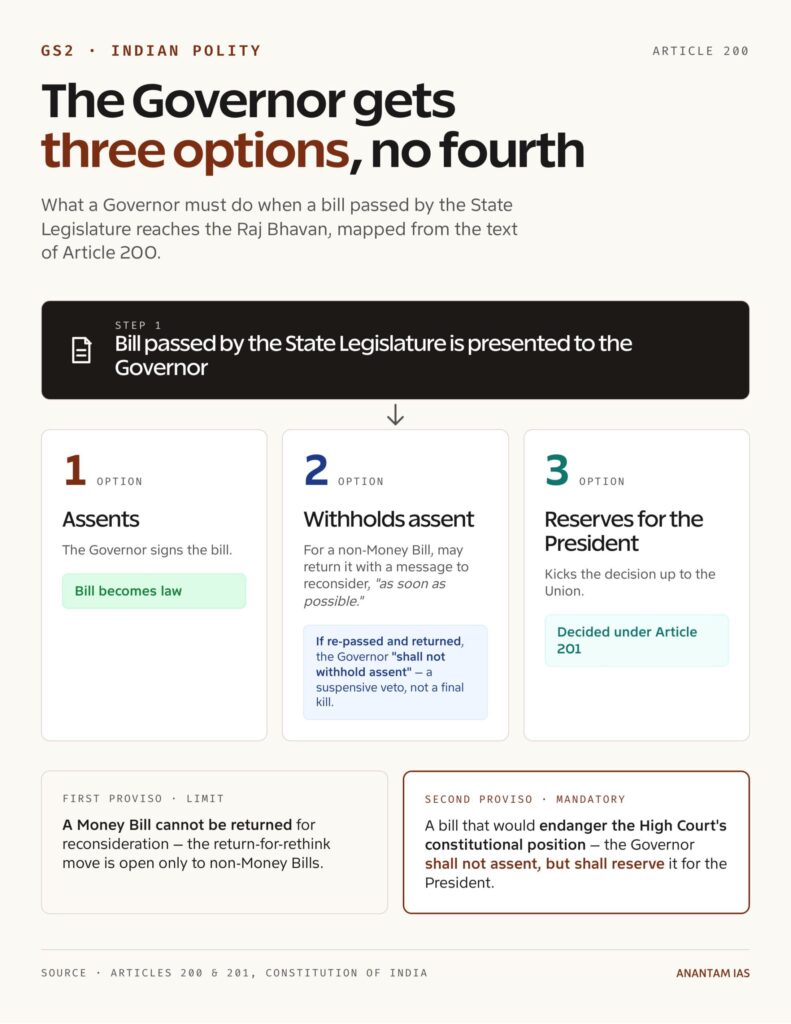
Article 200 of the Constitution gives a Governor three options on a bill passed by the State Legislature — assent to it, withhold assent, or reserve it for the President — and no fourth; a bill returned for reconsideration and re-passed by the House must receive assent. On 20 November 2025, a five-judge Constitution Bench led by CJI B.R. Gavai (in 2025 INSC 1333) held that courts cannot fix timelines for the Governor or President and that there is no “deemed assent,” while ruling that Governors cannot sit on bills indefinitely and that a court may issue a limited mandamus where inaction is “prolonged, unexplained and indefinite.”
A state assembly is the one body in the system that voters actually elect to make law. So when a bill it has passed simply sits, unsigned, on a Governor’s desk for months or years, something has gone quietly wrong with the wiring of Indian democracy. No formal rejection, no public reason, just silence that does the work a veto would do. That’s the friction at the heart of this topic, and in November 2025 the Supreme Court gave it the most authoritative answer the country has yet had.
The pull on the other side is just as real. The Governor isn’t only a state functionary. The office is a federal link the Constitution built into the lawmaking chain on purpose, with a duty to reserve certain bills for the President. So the question was never “Governor good or bad.” It’s how a constitutional system keeps an unelected appointee from smothering an elected legislature, without turning courts into the people who manufacture assent that was never given. That balance is the whole exam-worthy story.
The Issue, Framed
The dispute isn’t about whether the Governor has a role in lawmaking. The text gives one. The dispute is about what happens in the gap the text leaves open, the moment the Governor neither signs nor returns a bill, and just waits.
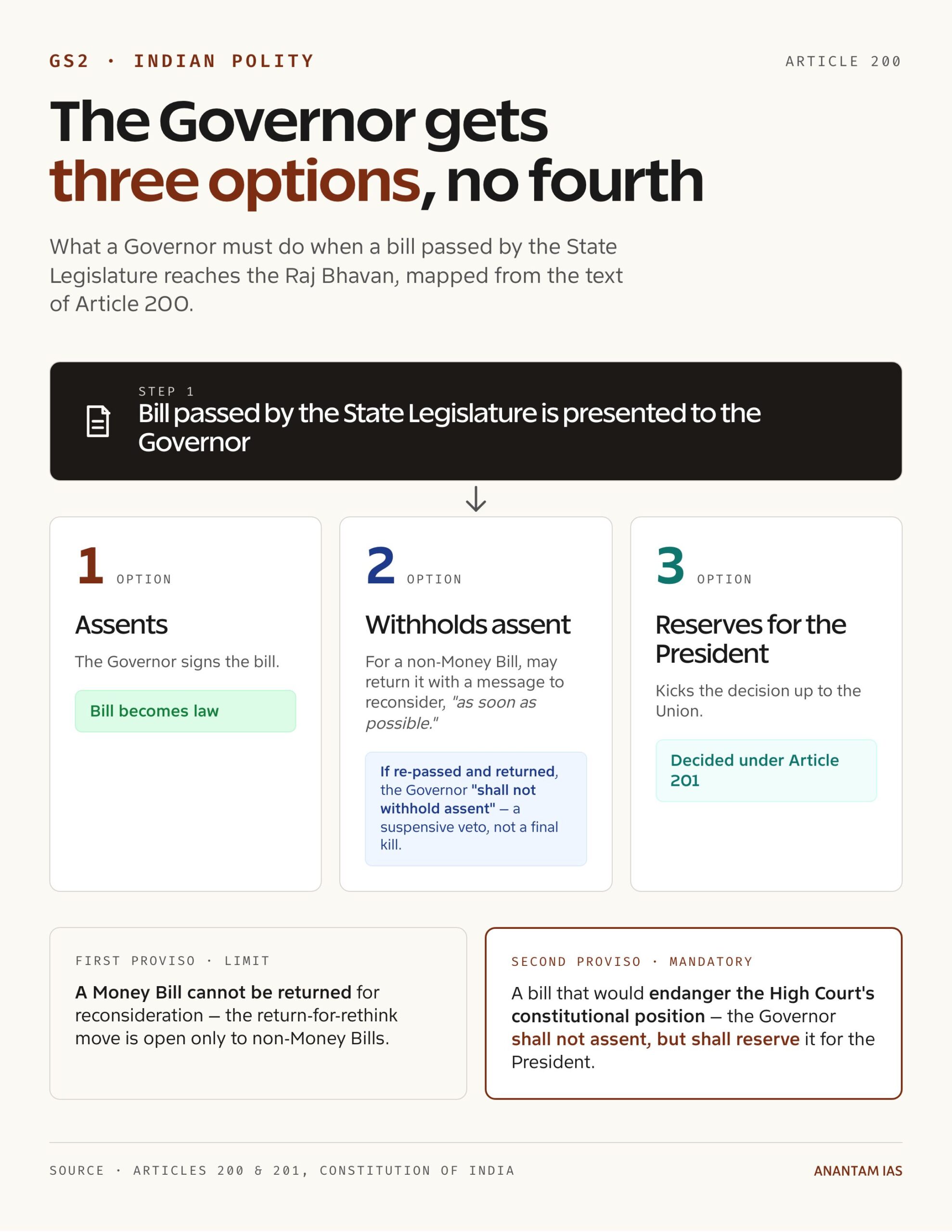
Let’s fix the vocabulary first, because most of the confusion here comes from loose usage. Article 200 is the provision that governs what a Governor does when a bill passed by the State Legislature reaches the Raj Bhavan. It gives the Governor exactly three options, no fourth. He may assent, and the bill becomes law. He may withhold assent. Or he may reserve the bill for the consideration of the President, which kicks the decision up to the Union under Article 201. The first proviso adds a fourth move that isn’t a final decision: for a bill that isn’t a Money Bill, the Governor “may, as soon as possible after the presentation,” return it with a message asking the House to reconsider. And here’s the teeth in it, if the House passes it again and sends it back, “the Governor shall not withhold assent therefrom.” That’s a suspensive veto, a power to delay and ask for a rethink, not to kill a bill outright.
Two phrases inside Article 200 do all the heavy lifting in the modern fight. The first is “as soon as possible.” That’s the Constitution’s only temporal cue, and you’ll notice it’s a standard, not a deadline. The second is the second proviso, which says the Governor shall not assent to, but shall reserve for the President, any bill that would so derogate from the powers of the High Court as to endanger its constitutional position. So reservation isn’t always discretionary mischief. Sometimes it’s mandatory federal hygiene built into the article itself.
Now the term that names the problem: pocket veto. Because Article 200 sets no express deadline, a Governor who simply never decides, never signs, never returns, never reserves, can stall a bill indefinitely. There’s no formal rejection to challenge, so the bill just dies in a drawer. That’s the pocket veto, and it’s the move that turned Raj Bhavans into a federal flashpoint.
Underneath sits the doctrine that’s supposed to prevent all this. The Governor is a formal constitutional head who acts on the aid and advice of the state Council of Ministers under Article 163, except where the Constitution expressly hands him personal discretion. So most of the time, the elected ministry decides and the Governor signs. The fight is about how much room that “except” really leaves, and whether silence is a way of smuggling discretion in through the back door.
The last word you need is justiciability, whether a court can even sit in judgment on the Governor’s choice. If assent decisions are fully justiciable, courts can police delay aggressively. If they’re not, the remedy for a stalled bill has to come from somewhere else. The November 2025 opinion drew that line with unusual care, and that line is the news.
What the Data Says
The numbers here aren’t survey statistics. They’re dates, citations, and bench sizes, and in constitutional law those are the data. Get them precise and the rest of the answer writes itself.
Start with the article’s own architecture. Article 200 offers three terminal choices, assent, withhold, or reserve, plus one non-terminal move, return for reconsideration, available only for non-Money Bills. A Money Bill can’t be returned at all. And on a re-passed bill, the text flips to a command: the Governor “shall not withhold assent.” That asymmetry, discretion on the first pass, no discretion on the second, is the spine of the whole scheme.
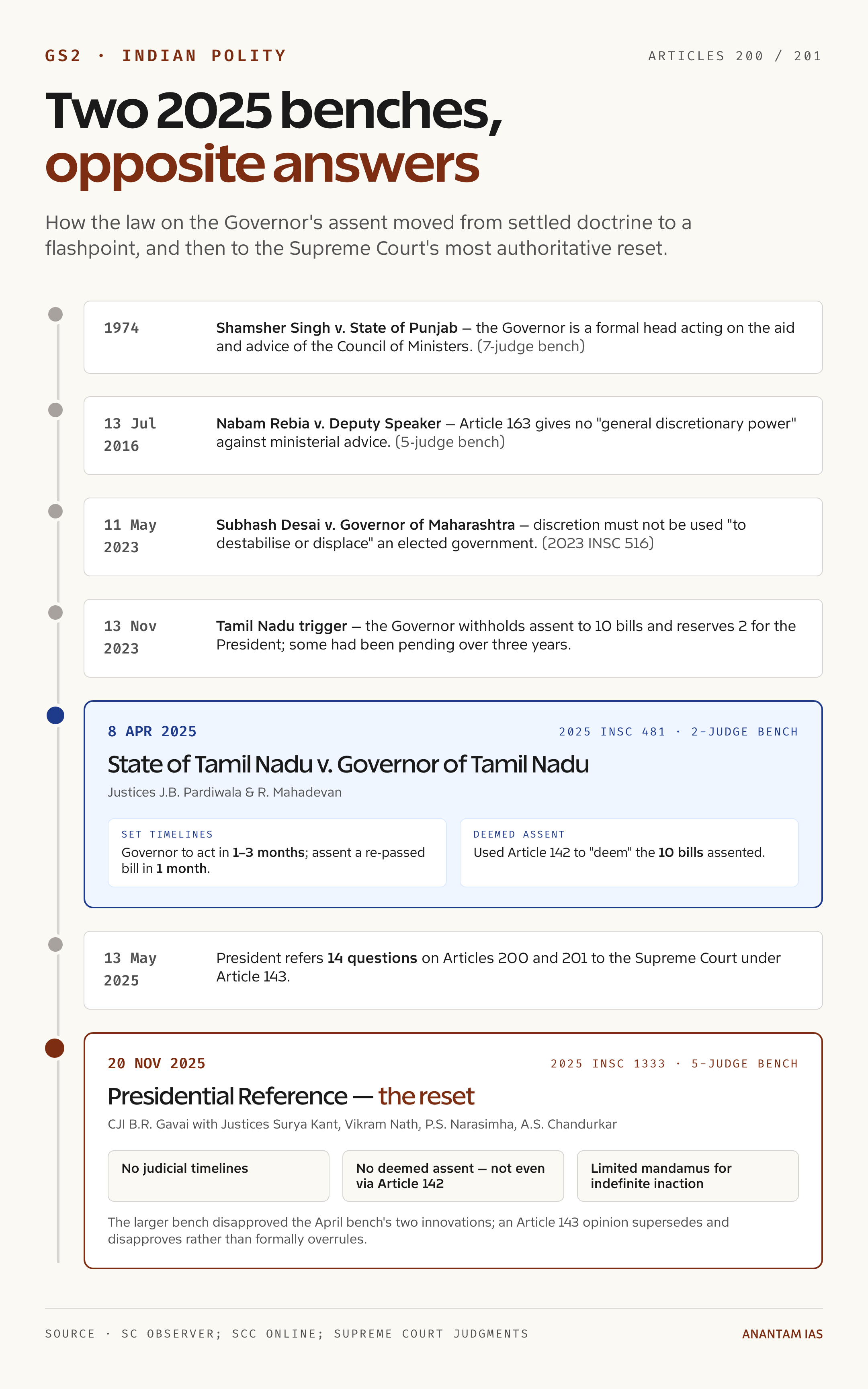
The case that lit the fuse is State of Tamil Nadu v. Governor of Tamil Nadu, decided 8 April 2025, citation 2025 INSC 481, by a two-judge bench of Justices J.B. Pardiwala and R. Mahadevan. The facts are the data point that matters most: between 2020 and 2023 the Tamil Nadu Assembly passed a clutch of bills, the Governor sat on them, and on 13 November 2023 he withheld assent to 10 and reserved 2 for the President. Some had been pending for over three years. So this wasn’t a hypothetical about delay. It was three-plus years of silence on bills an elected House had passed.
That bench did two big things, and the Supreme Court later undid both. First, it prescribed timelines, roughly one to three months for the Governor to act depending on the situation, and one month to assent to a re-passed bill. Second, using its Article 142 power to do “complete justice,” it declared the 10 bills “deemed to have received assent” on the date they were re-presented. That’s the device you have to understand to follow the rest. Deemed assent means a court treats a bill as signed even though the Governor never signed it, the assent is legally manufactured to break a deadlock.
Then came the reset. On 20 November 2025, a five-judge Constitution Bench led by CJI B.R. Gavai, with Justices Surya Kant, Vikram Nath, P.S. Narasimha and A.S. Chandurkar, delivered an advisory opinion on a Presidential Reference under Article 143, citation 2025 INSC 1333. It answered a reference of 14 questions on Articles 200 and 201. The headline holdings: courts cannot prescribe judicially-mandated timelines, and there is no concept of “deemed assent,” not even via Article 142. So the larger bench disapproved exactly the two innovations the April bench had used. One caution worth carrying into an answer: a court calling the larger opinion an outright “overruling” is shorthand, an Article 143 advisory opinion technically supersedes and disapproves rather than formally overrules, but in practice every court will follow the November view.
But the same opinion refused to hand Governors a blank cheque. It held that Articles 200 and 201 are largely non-justiciable at the pre-enactment stage, the assent process is a “dialogic” exchange between two constitutional authorities, not something courts adjudicate. Except in “glaring” cases of inaction that is “prolonged, unexplained and indefinite,” where a court may issue a limited mandamus, an order simply directing the Governor to act within a reasonable time, “without making any observations on the merits”. So the door to courts narrowed to a crack, but it didn’t close.
The Case For
The case for the Court’s restraint, and for some genuine gubernatorial space, is stronger than the headlines suggest. Steelman it before you knock it, because that’s how a Mains answer earns the “balanced” mark.
Start with the plain text. Article 200 says “as soon as possible,” not “within thirty days.” Reading a hard deadline into language the framers deliberately left flexible is, in effect, amending the Constitution by judgment, a job the text reserves for Parliament under Article 368. The November 2025 bench leaned on exactly this: the only temporal aspect is the “as soon as possible” standard, and a “one-size-fits-all timeline” ignores that bills differ wildly in complexity. A constitutional amendment touching the High Court needs more careful scrutiny than a routine fee revision. So a uniform clock could force hasty assent to a genuinely doubtful bill.
Then there’s separation of powers, and this is the bench’s sharpest point. Assent is a “dialogic,” non-adjudicatory process between two constitutional authorities, the Governor and, where reserved, the President. Courts climbing into that exchange would, in the opinion’s framing, shatter the permeable walls between the organs of state. A judge deciding when and how a Governor must sign is a judge doing executive work.
The deemed-assent device draws the harshest criticism, and fairly. To declare a bill assented when no assent was ever given is, the Court said, virtually a takeover of the role of a separate constitutional authority. A bill becomes law because someone with the constitutional power signs it, not because a court conjures a signature to resolve a standoff. And Article 142, the “complete justice” power, is meant for doing justice within a case, not for rewriting constitutional procedure. The Court was explicit that Article 142 can’t substitute the Governor’s or President’s constitutional orders.
There’s a federal point that cuts the way people don’t expect, too. Reservation for the President isn’t always obstruction. The second proviso requires the Governor to reserve a bill that would endanger the High Court’s position. So the office is a designed link in a federal chain, not a state rubber stamp. And the restraint isn’t immunity: the very same opinion keeps limited mandamus alive for indefinite inaction, so a Governor who stonewalls forever can still be made to move. Restraint, in other words, came with a leash attached.
The Case Against
Here’s what the restraint case walks past. A power with no enforceable timeline and a remedy you have to litigate from scratch each time is, for an elected government facing a hostile Raj Bhavan, very close to no remedy at all. The strongest version of the federalism worry is worth stating at full strength.
The Tamil Nadu facts are the indictment. Bills sat for up to three-plus years before any decision. That silence nullified a popular mandate without the Governor ever formally rejecting a single bill. A pocket veto, by never producing a decision, never produces a thing to challenge, until a court invents one. So “the law is now clear” is cold comfort if the clarity is that nobody can be compelled to act on a fixed clock.
The hierarchy point comes straight from precedent. In Nabam Rebia v. Deputy Speaker (2016), a five-judge bench held that Article 163 gives the Governor no “general discretionary power” to act against or without ministerial advice, an unelected nominee cannot wield overriding authority over an elected House. Indefinite withholding inverts exactly that hierarchy. It lets the appointee outlast the elected. And Subhash Desai v. Principal Secretary, Governor of Maharashtra (2023), citation 2023 INSC 516, another five-judge bench, warned that gubernatorial discretion must not be used “to destabilise or displace” an elected government. Silent stalling of a legislative agenda is destabilisation by other means.
The “as soon as possible” phrase itself signals promptness, the critics argue. An interpretation that tolerates indefinite delay reads the temporal duty clean out of the Constitution. And a remedy that requires a state to run to court for a mandamus every single time a bill stalls is slow, reactive and expensive, where a bright-line timeline would be self-executing. Commentators have called the November opinion “clarity without cure,” clear law, no effective time-bound fix for an elected government. There’s a pattern worth naming neutrally, too: the friction has clustered in states governed by parties opposed to the Centre, which feeds a perception, fair or not, that the office gets used politically. So the live worry is that the autonomy of a state legislature, a value the basic structure protects, can be worn down by a Centre-appointed functionary with limited consequence.
The Deeper Structural Read
Step back from the bench sizes and the real fault line shows up. This was never “courts versus Governors.” It’s a three-cornered contest, the elected state legislature, the appointed Governor as a Union link, and the judiciary deciding how far it may police the gap between them. And the November 2025 opinion is best read as the Court refusing to occupy a space it thinks belongs to the political branches.
Hold two propositions together, because the opinion does. The Governor is a formal head bound by aid and advice, that’s the line from Shamsher Singh v. State of Punjab (1974), a seven-judge bench that fixed real executive power in the elected ministry, not the Raj Bhavan. So in the ordinary run, the Governor has no business sitting on a bill the Cabinet backs. Yet the Constitution still routes assent through that office, and even builds in a mandatory reservation duty for High-Court-affecting bills. The office is simultaneously a near-ceremonial signature and a federal checkpoint. That doubleness is the source of every fight, and no judgment can dissolve it because the text wrote it in.
The Court’s deeper move was to relocate the remedy. The April 2025 bench tried to solve a political pathology, an appointee stalling an elected House, with a judicial instrument, deemed assent on a court-set clock. The November bench said, in effect, that’s the wrong tool. Manufacturing assent makes the judiciary the lawmaker of last resort, which corrodes separation of powers to fix federalism. So it kept a thin judicial backstop, limited mandamus for indefinite inaction, and pushed the durable cure back to where it belongs: Parliament, convention, and the political process. As the bench put it in reported terms, “dialogue, reconciliation and balance, and not obstructionism, is the essence of constitutionalism”.
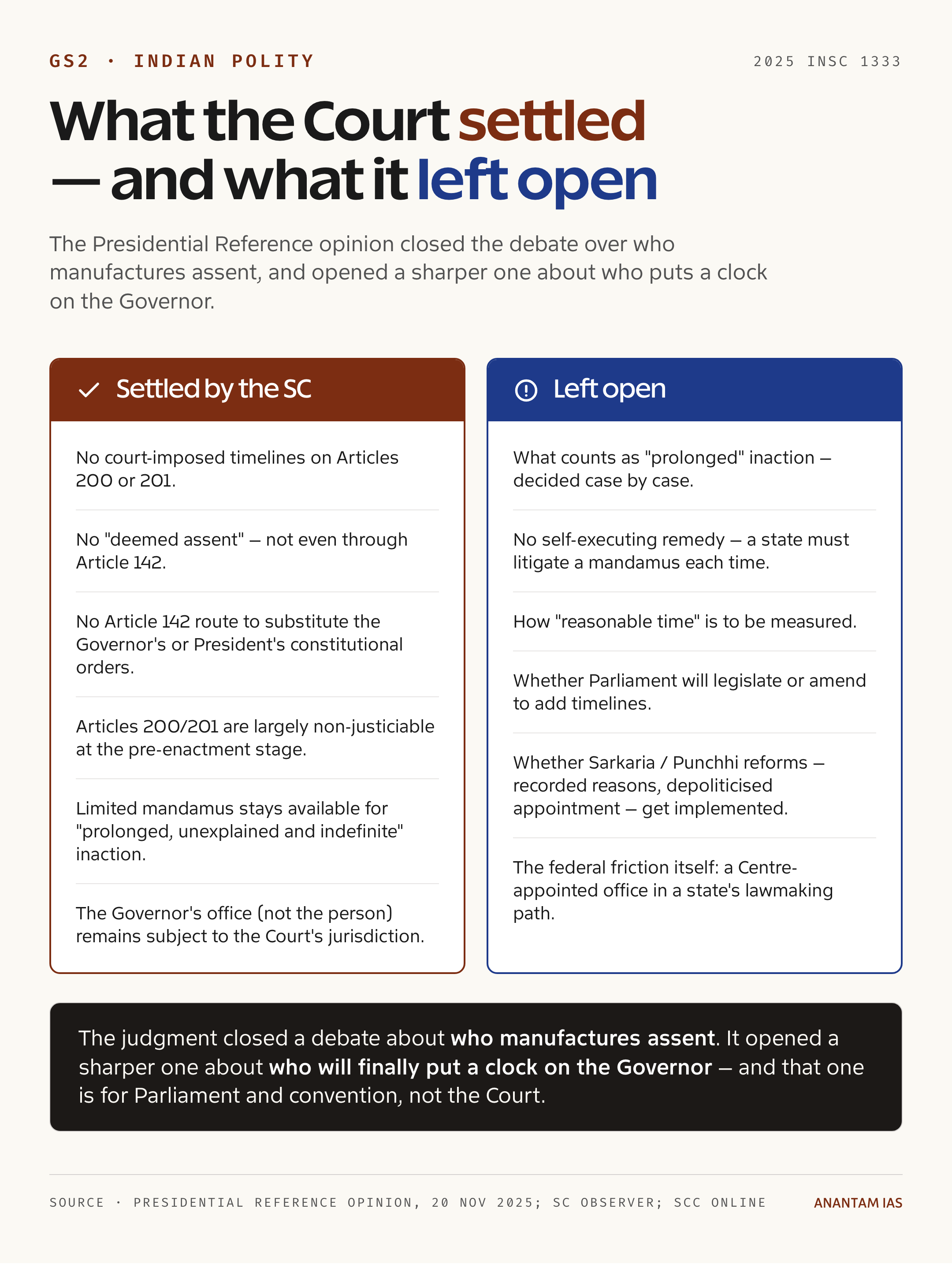
And here’s the uncomfortable structural truth a future administrator should sit with. The opinion is doctrinally tidy and federally incomplete at the same time. It protects the Governor’s office from judicial micromanagement, which is sound. But it leaves the elected state without a self-executing answer to a stalled bill, which means the political branches now have to act, through fixed timelines by convention or amendment, or the gap the Court declined to fill just stays open. The judgment closed a debate about who manufactures assent. It opened a sharper one about who will finally put a clock on the Governor, and that one isn’t the Court’s to answer.
There’s a federalism layer beneath even that. A Centre-appointed functionary standing in the lawmaking path of a state legislature is structural friction, not partisan noise, the architecture itself guarantees some heat. So the design question for the republic isn’t whether to abolish the friction. It’s how to make the friction transparent, time-bound and reviewable, so it reads as cooperative federalism rather than as the Centre’s thumb on a state’s scale.
What Should Be Done
So what does a fix actually look like, given the Court has now ruled out the judicial shortcuts? Not a vague plea for “harmony,” but concrete steps with a clear actor for each. Six guardrails, none of which needs the bench to reverse itself.
- Put timelines in by convention or amendment, since courts won’t. The legitimate route is political and legislative, exactly where the November opinion pointed. The Punchhi Commission favoured a constitutional amendment fixing a time limit for the Governor to decide, while the Sarkaria Commission preferred firm conventions over amendment, the two diverge, and the precise figure floated for the Governor is cited as three months in some readings and six in others, so a candidate should attribute it loosely rather than quote a hard number. The principle is settled even if the months aren’t. A duty that’s visible on a calendar is a duty that can’t hide. See the broader argument on Centre-State relations.
- Force reasons onto the record. The Sarkaria Commission recommended that a Governor communicate, in writing, the reasons for withholding assent or reserving a bill. A reasoned decision is reviewable and politically costly to abuse; a silent drawer is neither. So the cheapest reform going is simply: no decision, and no inaction, without a stated ground.
- Depoliticise the appointment itself. Sarkaria and Punchhi both urged picking an eminent person from outside the state, detached from active politics, ideally not a recent partisan, after consulting the Chief Minister, with a fixed five-year tenure. Most assent friction starts at appointment. Fix the input and you shrink the output. This ties directly into the wider debate on the office of the Governor.
- Operationalise the November safeguard with a benchmark. The Court allowed limited mandamus for “prolonged, unexplained and indefinite” inaction but didn’t define those words. A non-binding administrative benchmark for “reasonable time,” set by convention, would spare states from litigating the meaning of “prolonged” from a blank slate every time.
- Time-bound the President under Article 201 too, by convention. Reservation can become a second-stage pocket veto if a reserved bill simply sits with the Union. The cure for delay at the Raj Bhavan shouldn’t just relocate the delay to Rashtrapati Bhavan. So the same promptness norm should run up the chain.
- Use the federal forums before the courtroom. A strengthened Inter-State Council and live cooperative-federalism channels can resolve Centre-State friction politically before a bill ever becomes a writ petition. Litigation is the most expensive way to run a federation, and it’s where this dispute keeps ending up. The link to cooperative federalism matters here.
Every one of these strengthens the system without asking a court to play lawmaker. A Governor who must decide on a clock, state reasons, and answer to a depoliticised appointment process is a Governor doing the constitutional job, not a veto in waiting.
For Your Mains Answer
This is a GS2 gift wrapped in current affairs. It fuses federalism, separation of powers, constitutional offices, and judicial review into one frame, and the November 2025 opinion gives you a live, citable anchor most candidates won’t yet have.
GS paper mapping: GS2: Indian Constitution and its features; functions and responsibilities of the Union and States, and issues in the federal structure; separation of powers; appointment to and powers of constitutional posts; structure and functioning of the Executive.
PSIR (optional) relevance: Paper I, Indian Government and Politics, the office of the Governor, Centre-State relations, and the federal executive. Paper I, Political Theory, separation of powers and constitutionalism. You can deploy K.C. Wheare’s “quasi-federal,” Granville Austin’s “cooperative federalism,” and Ambedkar’s framing of the Governor as a constitutional head with no independent mandate. That theory layer is what lifts a PSIR answer above a GS reproduction.
Likely question frames:
- “The Governor’s silence can do the work of a veto the Constitution never gave.” Examine in light of Article 200 and the Supreme Court’s 2025 Presidential Reference opinion.
- The Supreme Court has chosen restraint over remedy on gubernatorial assent. Critically analyse the consequences for Indian federalism.
- Discuss the scope and limits of the Governor’s discretion under Articles 200 and 201, with reference to relevant case law.
Quotable data and cases:
- Article 200 gives three options, assent, withhold, or reserve, plus a return-for-reconsideration move for non-Money Bills only; on a re-passed bill the Governor “shall not withhold assent”.
- In re: Assent… (2025 INSC 1333), five-judge bench, CJI Gavai, 20 November 2025: no judicial timelines, no “deemed assent” even via Article 142, Articles 200/201 largely non-justiciable, but limited mandamus for “prolonged, unexplained and indefinite inaction”.
- State of Tamil Nadu v. Governor (2025 INSC 481), two-judge bench, 8 April 2025: set 1-3 month timelines and used Article 142 to “deem” 10 bills assented, disapproved by the November bench.
- Shamsher Singh (1974): Governor is a formal head acting on aid and advice. Nabam Rebia (2016): no “general discretionary power” under Article 163. Subhash Desai (2023 INSC 516): discretion can’t be used “to destabilise or displace” an elected government.
- Sarkaria (conventions, reasons recorded) and Punchhi (timelines via amendment) recommendations, with the exact Governor timeline figure contested across sources.
Keywords to use: Article 200, Article 201, aid and advice, Article 163, suspensive veto, pocket veto, deemed assent, “as soon as possible,” justiciability, limited mandamus, separation of powers, cooperative federalism, basic structure.
Syllabus linkages: features of the Constitution; Union-State relations and federalism; separation of powers; constitutional posts and their powers; functioning of the Executive; judicial review.
Balanced conclusion line: The Constitution made the Governor a signature in a federal chain, not a switch that can be left off, the unfinished task isn’t judicial, it’s political, to put a visible clock and a stated reason on a power the text left silent.
How to Build the Answer
Open with the conflict, not a definition. The tension is that the Governor is both a near-ceremonial head bound by aid and advice and a federal checkpoint with a real reservation duty, and indefinite silence exploits the gap between those two roles. That first sentence tells the examiner you’ve seen both faces of the office. The definition of Article 200’s three options can land in the second sentence.
Anchor early to the November 2025 opinion, because recency plus a correct citation signals a candidate who reads judgments, not coaching notes. State the holding crisply, no timelines, no deemed assent, largely non-justiciable except for limited mandamus, then say what it means for federalism. UPSC rewards the move from holding to consequence.
The second body block should steelman the side you don’t favour. If you back the elected government, first concede the genuine separation-of-powers cost of deemed assent. If you back the Court’s restraint, first admit the three-plus-year Tamil Nadu stall is a real democratic harm. That’s how an answer reads balanced without going mushy.
Group the way forward, never scatter it. Cluster the reforms: timelines by convention or amendment, recorded reasons, depoliticised appointment, a benchmark for “reasonable time,” a time-bound President, and federal forums. Use the topic’s own vocabulary, aid and advice, suspensive veto, justiciability, cooperative federalism, so the answer reads as constitutional analysis, not news recap.
Close on the syllabus value, federalism and separation of powers, and don’t echo your introduction. The reliable closer here is “the remedy the Court declined to give is the one Parliament and convention now have to,” which converts a case summary into judgment.
Common Mistakes to Avoid
- Don’t confuse the two 2025 judgments. The April two-judge bench set timelines and used deemed assent; the November five-judge bench disapproved both. Mixing them up is the single fastest way to lose credibility on this topic.
- Don’t say the November opinion “overruled” the April one. An Article 143 advisory opinion supersedes and disapproves; “overrules” is loose. Write “disapproved” or “superseded.”
- Don’t treat the Governor as a villain. The office has a real federal function, including a mandatory reservation duty. A one-sided answer reads as a political pamphlet, not analysis.
- Don’t quote a hard Punchhi or Sarkaria timeline figure. The three-versus-six-month numbers diverge across sources. Attribute the principle, hedge the exact months.
- Don’t forget the elected House. Name who pays for delay: the voters whose mandate is stalled without a single formal rejection.
A Compact Answer Spine
- Introduction: Open with the dual role of the Governor and the silence-as-veto problem in one sentence; name Article 200’s three options in the next.
- The law now: The November 2025 opinion, no timelines, no deemed assent, largely non-justiciable, limited mandamus for indefinite inaction.
- Arguments: The case for restraint, separation of powers, no judicial amendment, then the case against, stalled mandates and a slow remedy. Keep both fair.
- Structural diagnosis: Formal head under aid and advice meets federal checkpoint; the real question is who puts a clock on the gap.
- Way forward: Grouped guardrails, each with an actor, convention, amendment, Sarkaria/Punchhi reforms, Inter-State Council.
- Conclusion: Adapt the balanced conclusion line to the exact question.
Diagram or Flowchart Idea
For a 15-marker, draw the Article 200 decision tree, not a decorative cloud. Bill passed by the State Legislature reaches the Governor, who then branches three ways: assent and it becomes law; withhold and return a non-Money Bill for reconsideration, after which a re-passed bill must get assent; or reserve for the President under Article 201. Add one note: a bill endangering the High Court must be reserved. The examiner reads that logic in five seconds.
For a 10-marker, skip the tree and draw a two-column table instead: “Settled by the SC (Nov 2025)” against “Left open.” Settled, no timelines, no deemed assent, limited mandamus only. Open, what counts as “prolonged,” whether Parliament will legislate, depoliticised appointments. Faster to evaluate under time pressure, and it proves you know the limits of the ruling.
Ethics and Governance Angle
Add one governance-ethics line even in a doctrinal answer. The deeper value at stake is fidelity to a mandate: a constitutional office holder using silence to defeat what voters chose, without ever owning the decision in public, is a failure of accountability, not merely a legal grey area. Naming that converts the topic from procedure to principle.
Then turn the value into design. Don’t just say “Governors should respect the elected government.” Say how: decide on a fixed clock, record reasons in writing, and route genuine constitutional doubts to the President under the second proviso rather than into a drawer. That’s the move from moral language to administrative maturity.
A portable sentence pattern: “The office is legitimate, but its legitimacy depends on acting visibly, promptly, and for stated reasons.” It honours the constitutional function without handing it an unaccountable veto, which is exactly the balance the examiner wants on a federalism question.
How to Use Data Without Sounding Mechanical
In a polity answer, your “data” is citations, so ration them like statistics. Three load-bearing references beat ten name-dropped ones. Lead with the November 2025 opinion as the anchor, use the April 2025 Tamil Nadu bench as the contrast, and use one older precedent, Shamsher Singh or Nabam Rebia, to show the doctrine has deep roots. One anchor, one contrast, one foundation is usually enough.
Never leave a citation standing alone. Follow each with “which means…” or “the consequence is…” Citing Nabam Rebia is recall; saying it means an unelected nominee can’t outrank an elected House is analysis. In Mains, the case is raw material and the inference is the mark.
Finish by asking whether a tired examiner can follow the chain in a single read. If the two 2025 judgments blur together on the page, your structure is the problem, separate them with a clean signpost, “the earlier bench… the later bench…” Clarity isn’t a lower standard than depth. For UPSC, clarity is how depth becomes visible. Cut any sentence that sounds grand but carries no fact, cause, consequence, or reform, and write for marks, not for noise.
FAQ
What are the Governor’s three options under Article 200?
When a bill passed by the State Legislature reaches the Governor, Article 200 lets the Governor do one of three things: assent to the bill, so it becomes law; withhold assent; or reserve the bill for the President’s consideration under Article 201. For a bill that isn’t a Money Bill, the Governor can also return it once with a message asking the House to reconsider, but if the House re-passes it, the Governor “shall not withhold assent.”
What did the Supreme Court hold in the November 2025 Presidential Reference?
In In re: Assent… (2025 INSC 1333), decided 20 November 2025 by a five-judge bench led by CJI B.R. Gavai, the Court held that courts cannot prescribe fixed timelines for the Governor or President to act on bills, and there is no “deemed assent,” not even through Article 142. It also held that Articles 200 and 201 are largely non-justiciable before a bill becomes law, except that courts may issue a limited mandamus where inaction is “prolonged, unexplained and indefinite.”
What is “deemed assent” and why was it rejected?
Deemed assent is when a court treats a bill as having received assent even though the Governor never signed it, manufacturing the assent to break a deadlock. The April 2025 Tamil Nadu two-judge bench used Article 142 to deem 10 bills assented. The November 2025 five-judge bench disapproved this, holding that the Constitution, including Article 142, does not allow deemed assent, since fabricating an assent is effectively a judicial takeover of a separate constitutional authority’s function.
Can a Governor sit on a bill indefinitely after this ruling?
No. The November 2025 opinion ruled out court-imposed timelines and deemed assent, but it expressly kept a narrow remedy alive: where a Governor’s inaction is “prolonged, unexplained and indefinite,” a court may issue a limited mandamus directing him to act within a reasonable time, without commenting on the merits of his decision. So there’s no eternal pocket veto, but the elected government has to approach the court each time rather than rely on a self-executing deadline.
Tell Google you want more of this.
Add Anantam IAS as a preferred sourceOne tap, and this site shows up more often in your own Top Stories, AI Overviews and AI Mode. Remove it any time.






