India has a research station inside the Arctic Circle, an underwater observatory off Svalbard, and a seat at the Arctic Council. By the standards of a country with no Arctic coastline, that’s a real footprint. But a footprint isn’t a strategy. The clearest sign of the gap arrived this year: India’s deepest practical access to the Arctic now runs through a logistics pact with Russia, not through any institution India built for itself. A research station tells you a country is curious. A logistics agreement tells you whose ships it expects to depend on. Those are two very different statements about the same region.
That distinction is the whole topic. India’s Arctic policy reads like science diplomacy, careful and credible and welcome. Yet the Arctic stopped being a purely scientific question a while ago. Shipping lanes, undiscovered energy, great-power rivalry, and the physics of a melting ocean have turned it into a contest over rules and access that’s being settled right now, while India is still mostly watching. The mark-scoring question is whether a science-first posture is the smart, honest play for a non-Arctic state, or whether it’s quietly leaving India a rule-taker in a region where the rules are being written.
The Issue, Framed
The argument here isn’t whether India belongs in the Arctic. It does, for reasons that are concrete and selfish before they’re symbolic. The argument is whether what India has built so far amounts to a strategy or just a presence.
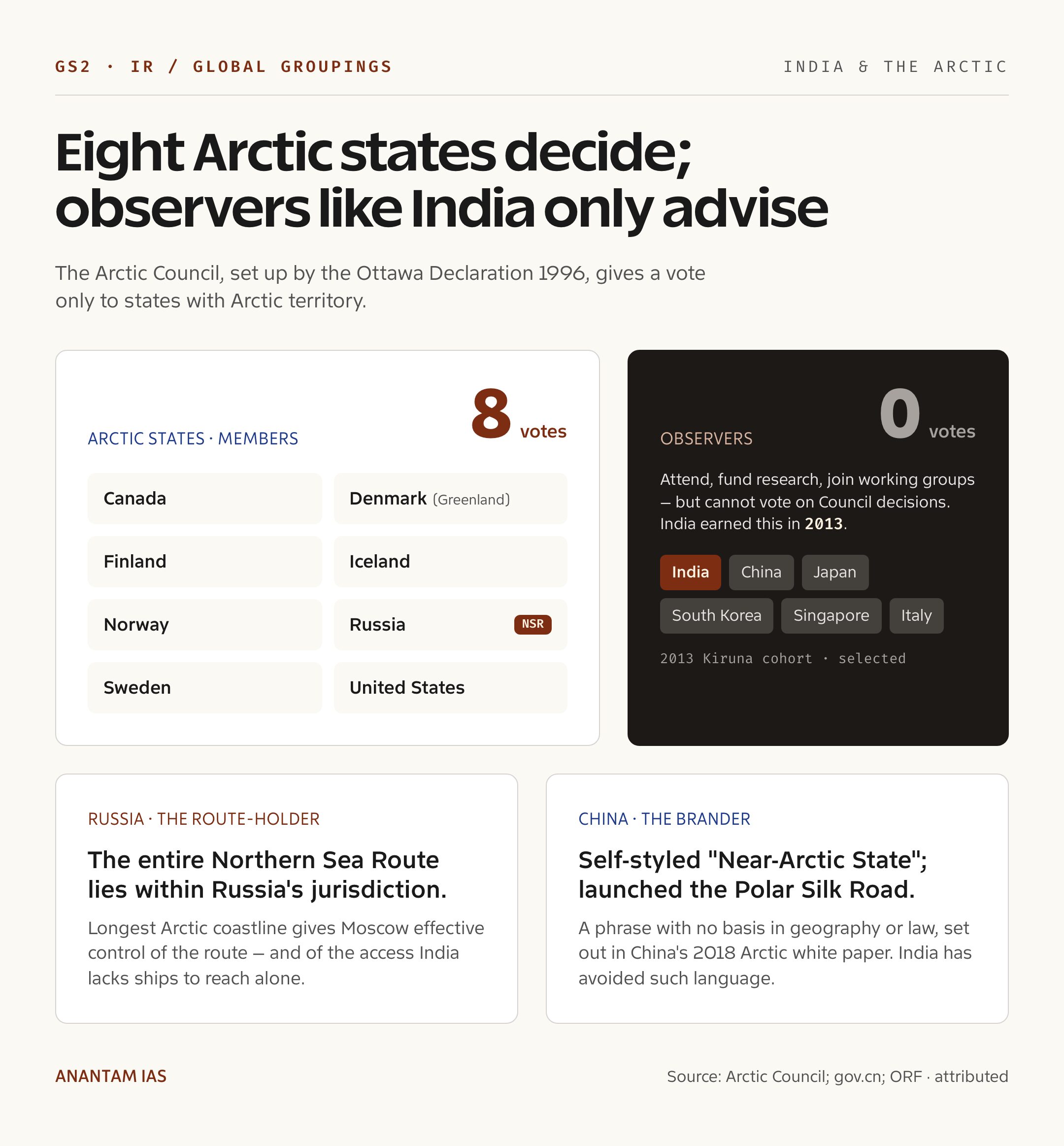
Let’s fix the vocabulary first, because the Arctic comes loaded with terms people use loosely. The Arctic Council is the main intergovernmental forum for the region, set up by the Ottawa Declaration of 1996. It has exactly eight full members, the states with Arctic territory: Canada, Denmark (through Greenland), Finland, Iceland, Norway, Russia, Sweden, and the United States. Only those eight vote. Everyone else, including India, sits as an Observer, which means you can attend, fund research, and contribute to working groups, but you don’t get a vote on anything the Council decides. India earned Observer status in 2013 at the Kiruna Ministerial, in the same cohort as China, Japan, South Korea, Singapore, and Italy. So India is in the room. It just isn’t at the table.
Two more terms run through the whole debate. The Northern Sea Route (NSR) is the shipping lane that hugs Russia’s Arctic coast, linking Asia to Europe over the top of the world. As the ice retreats, it becomes navigable for more of the year, and it can shorten the Asia-Europe voyage by up to about 40% compared with the Suez Canal route. And then there’s China’s framing, which matters because India keeps getting measured against it. In its 2018 Arctic white paper, China called itself a “Near-Arctic State”, a phrase with no basis in geography or law, and announced a Polar Silk Road, an Arctic extension of its Belt and Road Initiative. India has deliberately avoided that kind of language. Its 2022 policy is titled, plainly, “Building a Partnership for Sustainable Development.”
So here’s the frame. India built genuine scientific credibility. That credibility bought a seat with no vote. And the moment the Arctic became about ships, energy, and alignment rather than just ice cores, the limits of a science-only footing started to show.
What the Data Says
The Arctic matters to India for three measurable reasons, and none of them is sentimental. Start with the physics, because it’s the one stake India can’t opt out of.
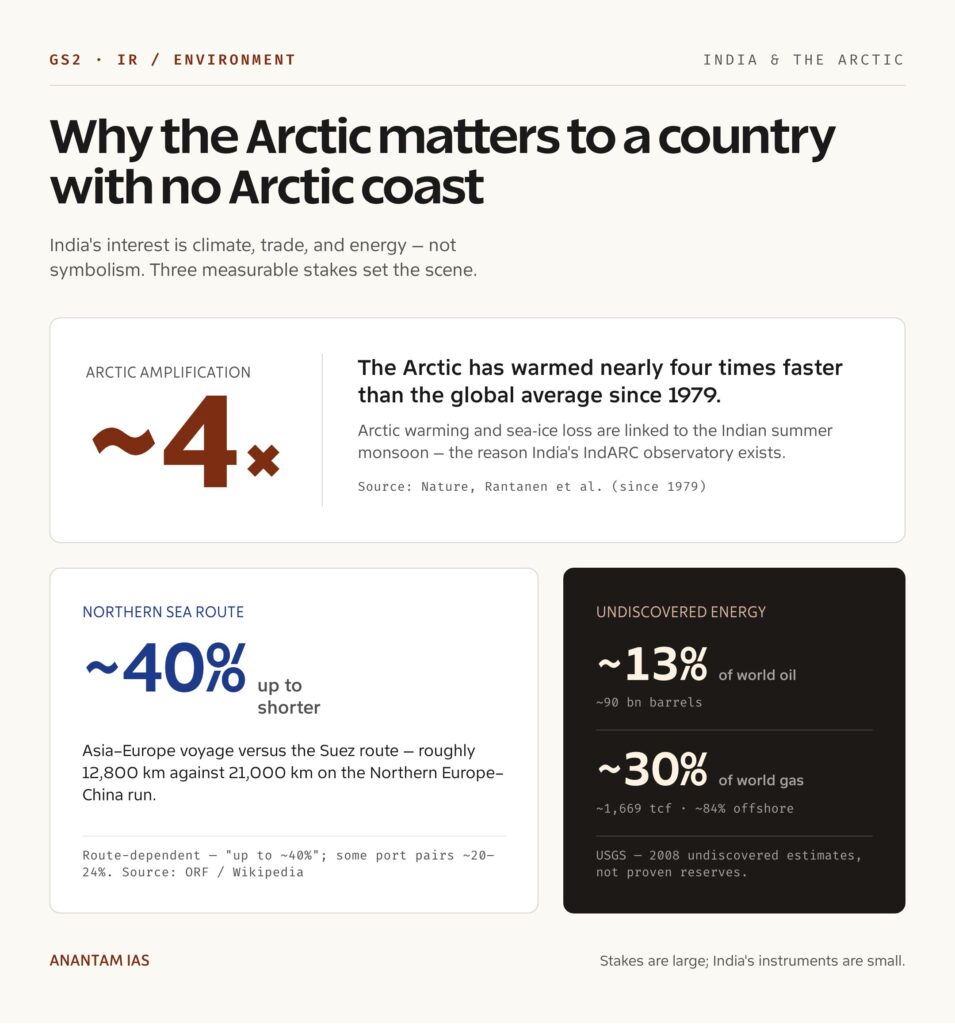
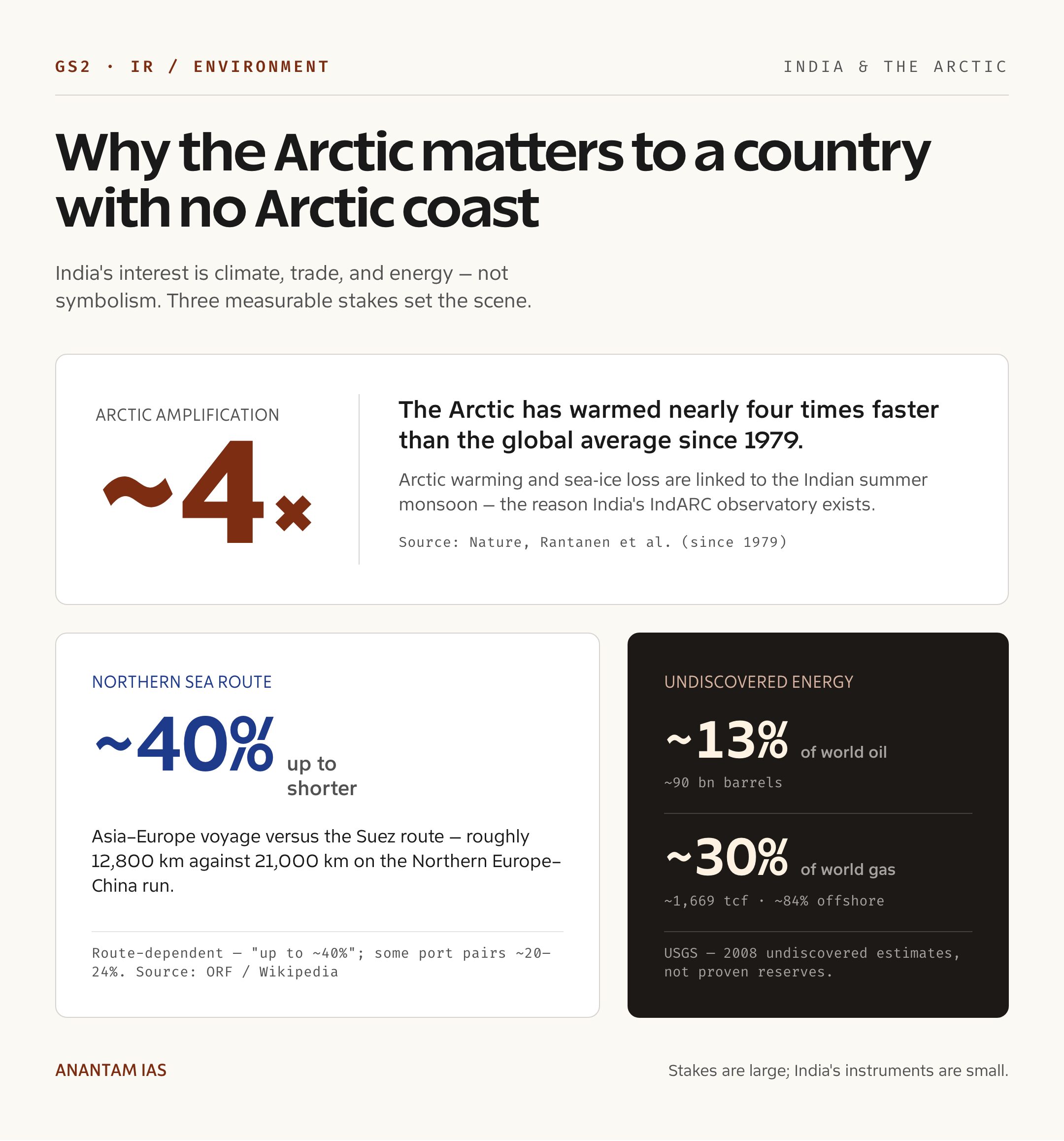
The Arctic is warming nearly four times faster than the global average since 1979. That’s not a rounding artefact. Older benchmarks from the IPCC and AMAP put it at two to three times, so the honest range is roughly three to four times, and the trend keeps revising upward. For India this isn’t an abstraction. Arctic warming and sea-ice loss are scientifically linked to the behaviour of the Indian summer monsoon, which is the entire reason India’s IndARC observatory exists. A bad monsoon is a bad year for a billion people. So Arctic science is, for India, climate self-interest wearing a lab coat.
Then the shipping. The Northern Sea Route can cut the Asia-Europe voyage by up to about 40% against Suez, roughly 12,800 km versus 21,000 km on the Northern Europe-to-China run, with proportional savings in time, fuel, and carbon. Read “up to about 40%” carefully, though, because the saving is route-dependent: some port pairs see closer to 20-24%. The headline number is real, but it’s a ceiling, not an average.
Now the energy, and here the caveat is the point. The most-quoted figures come from the USGS Circum-Arctic Resource Appraisal, which estimated the Arctic may hold about 13% of the world’s undiscovered conventional oil, roughly 90 billion barrels, and about 30% of undiscovered conventional natural gas, around 1,669 trillion cubic feet, with about 84% of it offshore. That’s a serious prize, larger than the proven reserves of most petro-states. But those are 2008 estimates of undiscovered and technically recoverable resources, not proven reserves, and they carry wide uncertainty. Anyone quoting them should say “estimated” and mean it.
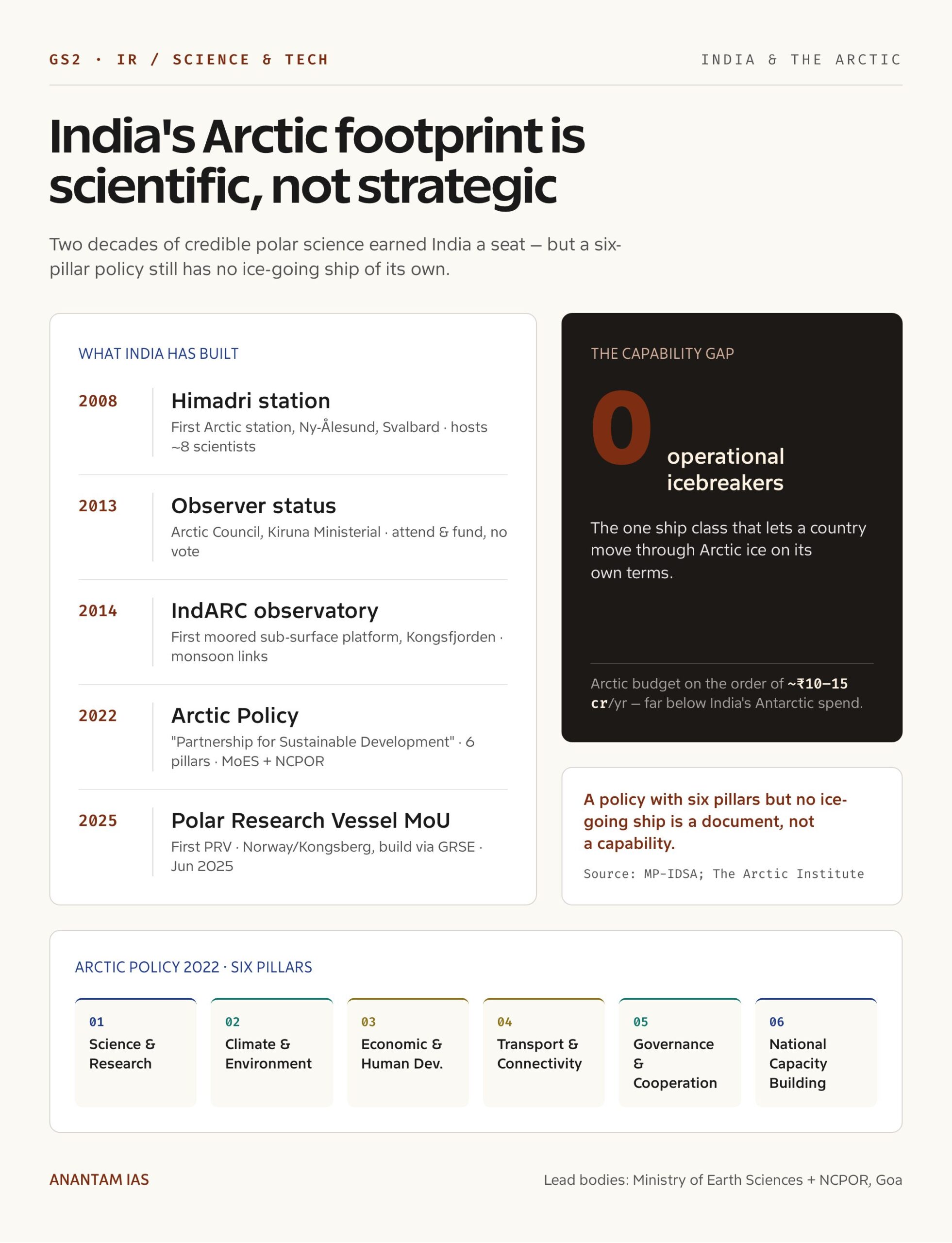
Against those stakes, look at what India actually fields. Its Arctic budget has run on the order of about ₹10-15 crore a year, far below its Antarctic spend, by IDSA’s account. India owns no operational icebreaker, the one ship class that lets a country move through Arctic ice on its own terms. And until a 2025 agreement, it had no dedicated polar research vessel either, despite approving one back in 2014. So the gap is stark: monsoon-scale climate stakes and a 40%-shorter trade route on one side, and a research-grade budget with no ice-going hardware on the other.
The Case For
The case for India’s calibrated, science-first approach is genuinely strong, and a lazy answer would skip past it. So let’s state it at full strength.
India is a non-Arctic state, and that’s a fact, not a failing. It has no Arctic coastline, no territory, no littoral rights. Under the UN Convention on the Law of the Sea and the Arctic Council’s own framework, a science-and-cooperation footing is the legally and diplomatically honest basis for engagement. India isn’t pretending to be something it isn’t. That restraint is an asset when you’re asking eight sovereign states to take you seriously.
Scientific credibility is hard currency in the Arctic, and India has spent two decades earning it. The Himadri research station opened at Ny-Ålesund on Svalbard on 1 July 2008, making India one of the first developing nations after China to hold a permanent Arctic presence. The IndARC moored observatory went into Kongsfjorden in July 2014, India’s first multi-sensor underwater Arctic platform. Add the Gruvebadet atmospheric observatory and India’s first winter expedition in 2023, and you have a body of work that peers respect. That track record is exactly what earned and sustains the Observer seat. You don’t get invited into Arctic governance by announcing ambitions. You get in by showing up with data.
The sustainability framing fits India’s diplomacy in a way China’s doesn’t. “Building a Partnership for Sustainable Development” lets India work with Arctic states and Indigenous communities without triggering the alarm that “Near-Arctic State” and “Polar Silk Road” set off across Western capitals. India gets to be the constructive outsider, not the one rewriting the map. That goodwill is cheap to keep and expensive to rebuild.
And restraint preserves optionality. As a non-claimant with no hard strategic posture, India can hold working relationships with all eight Arctic states at once, including both Russia and the NATO members now lined up against it. Finland and Sweden joined NATO in 2023 and 2024, which means seven of the eight Arctic states are now in the alliance and only Russia sits outside it. A more aggressive footing would force India to pick a side in exactly that split, in a region where staying unaligned is the whole advantage. So the science-first posture isn’t timidity. It’s a non-Arctic state playing the only hand the geography actually deals it.
The Case Against
Here’s what the science-first case walks past. A presence is judged by what it lets you do when the stakes change. And the Arctic’s stakes have already changed, from ice cores to shipping lanes, energy, and alignment, while India’s instruments stayed scientific. On that test, the footprint has real holes.
The stakes are now economic and strategic, and a research presence captures none of them. A 40%-shorter trade route, an estimated 13% of undiscovered oil and 30% of undiscovered gas, plus minerals and fisheries, these are commercial and security questions. A weather station near Svalbard doesn’t give India a berth on the Northern Sea Route, a stake in Arctic energy, or a vote on who gets to use either. The policy’s economic and transport pillars exist on paper. The hardware to act on them doesn’t.
Because India has almost no strategic instruments. No icebreaker. A budget in the ₹10-15 crore range. No commercial Arctic shipping line and no Arctic energy stake of its own. A policy with six pillars but no ice-going ship is a document, not a capability. You can’t run a “transportation and connectivity” pillar from a press release.
And the Russia lock-in is deepening at the worst possible moment. India’s most concrete Arctic access now runs through Moscow: cooperation on the Northern Sea Route, the Chennai-Vladivostok Eastern Maritime Corridor, polar-navigation training for Indian seafarers at Vladivostok, plans to join Russia’s drifting “North Pole” science platform, and now a logistics pact. Russia ratified that Reciprocal Exchange of Logistics Agreement (RELOS) on 18 February 2025 and it reportedly became operational around 12 January 2026, with the agreement reportedly letting each side station warships, aircraft, and personnel on the other’s territory. So India’s deepest Arctic access arrives just as the West sanctions Russian Arctic energy and as Russia and China tighten their own Arctic alignment. That’s dependency and sanctions exposure stacked together.
Meanwhile China is setting the template India is ceding. Beijing converted a “near-Arctic” claim with no legal basis into shipping deals, infrastructure, and a Polar Silk Road brand. You don’t have to admire the method to see the result: China is shaping access rules India will later have to live with. And the structural ceiling stays fixed. Observer status has no vote. Influence over Arctic governance needs capability and coalitions India hasn’t built. A seat you can’t vote from is a seat you can be talked around.
The Deeper Structural Read
Step back from the ships and the budget lines, and the real fault line shows up. It isn’t “science versus strategy.” It’s a mismatch between how India frames the Arctic and what the Arctic has become, and that mismatch quietly costs India its strategic autonomy.
Strategic autonomy means keeping the freedom to decide for yourself, not being maneuvered by another power’s choices. India’s Arctic engagement is drifting away from that, and the drift is hidden by the comfort of the science story. Every concrete capability India reaches for, the Northern Sea Route, navigation training, the polar platform, deep logistics access, currently routes through Moscow. That’s not because India chose Russia as its Arctic gateway on the merits. It’s because Russia controls the only Arctic coast and route on offer to a partner that lacks its own ships. The Arctic Institute puts it bluntly: India’s Arctic posture has become “problematically dependent on Moscow.” Dependency by default is still dependency. And a dependency you backed into is harder to see than one you chose.
Underneath that sits a capability trap, and it’s the part that should bother a future administrator most. The single thing that would convert India’s scientific credibility into strategic reach is the boring one: ships. An icebreaker and a polar research vessel are what let a country operate in the Arctic on its own schedule rather than someone else’s. India approved a polar research vessel in 2014 and then didn’t acquire one for over a decade. So the gap between policy and capability isn’t an oversight. It’s a habit. India writes ambitious frameworks and underfunds the unglamorous hardware that would make them real, and the Arctic is just the latest place that pattern shows.
There’s a governance layer too, and it cuts against complacency. The Arctic’s rules, on shipping standards, fisheries, black carbon, resource access, are being written now, by the eight states and the players with hardware on the ice. A non-Arctic state with no vote and no ships influences those rules only through coalitions and credibility. India has the credibility. It hasn’t yet built the coalitions or the capability that turn credibility into leverage. So the deeper read is neither alarmist nor triumphant. India’s science-first approach was the right opening move for a non-Arctic state. The mistake would be treating an opening move as the whole game, while a melting ocean rewrites the board and other players make theirs.
What Should Be Done
So what does an actual Arctic strategy look like, as opposed to a presence? Not a louder claim or a “Near-Arctic” slogan India would be wrong to copy. A capability-and-coalition plan that keeps the science strength and fixes the strategic gap. Five moves, in priority order.
- Build the polar capability stack, starting with ships. Deliver the indigenous Polar Research Vessel, the gap India finally moved on with the June 2025 MoU with Norway’s Kongsberg, with the build through GRSE, and then develop genuine icebreaking capacity for autonomous Arctic operations. This is the hinge. Everything else in an Arctic strategy depends on being able to get there on your own keel. A science programme that has to borrow a ship to reach the ice has a ceiling built in.
- Engage Russia pragmatically, but hedge hard. Use the Northern Sea Route cooperation and the Eastern Maritime Corridor for learning, commercial entry, and crew training, the things India genuinely gains. But diversify the Arctic relationship across the Nordic states, Norway, Finland, Iceland, so India isn’t one sanctions package away from losing its Arctic access. A single-point dependency on Moscow is a strategic risk dressed up as a partnership.
- Turn science credibility into governance influence. Pair India’s monsoon-linked research with active positions on the issues the Arctic Council actually decides: Central Arctic Ocean fisheries, black-carbon emissions, sustainable shipping standards. This is how a non-voting Observer earns leverage, by being indispensable on the questions, not loud about the region. Credibility you don’t spend on governance is credibility wasted.
- Fund it like it matters. Raise the Arctic budget well beyond the ₹10-15 crore order of magnitude so the policy’s economic and transport pillars stop being aspirations. A six-pillar policy on a one-pillar budget is a contradiction the rest of the world can read as easily as India can.
- Build polar talent. Expand the pipeline in glaciology, polar ocean engineering, and Arctic law, and grow a steady cadre of polar-trained mariners and researchers. Ships need crews, governance needs lawyers, and credibility needs the next generation of scientists who built it in the first place.
Read the India Arctic Policy 2022 and the strategic autonomy debate together and the through-line is obvious. Every one of these moves keeps the science that earned India its seat, and adds the capability that would let India actually use it. That’s the difference between a footprint and a strategy.
For Your Mains Answer
This topic is a rare GS2-GS3 crossover that rewards a candidate who can hold both papers in one frame. It touches international groupings, strategic autonomy, energy and resource security, climate change, and science and technology at once.
GS paper mapping: GS2: bilateral, regional, and global groupings affecting India’s interests; effect of policies of developed and developing countries on India; India’s strategic autonomy. GS3: energy and resource security; environment and climate change; science and technology and indigenous capability.
Likely question frames:
- “India’s Arctic engagement is scientifically credible but strategically thin.” Examine in the light of India’s Arctic Policy 2022 and recent India-Russia Arctic cooperation.
- A non-Arctic state can shape Arctic governance only through capability and coalitions. Critically analyse India’s position as an Arctic Council Observer.
- Discuss how Arctic climate change links to India’s national interests, and assess whether India’s institutional response matches the scale of the stakes.
Quotable data points:
- The Arctic has warmed nearly four times faster than the global average since 1979.
- The Northern Sea Route can cut the Asia-Europe voyage by up to about 40% versus Suez.
- The Arctic may hold an estimated 13% of undiscovered oil (about 90 billion barrels) and 30% of undiscovered gas (about 1,669 tcf), about 84% offshore.
- India set up Himadri at Ny-Ålesund on 1 July 2008, and deployed the IndARC observatory in Kongsfjorden in July 2014.
- India became an Arctic Council Observer in 2013; the Council has 8 voting members and Observers have no vote.
- India’s Arctic Policy 2022 rests on six pillars, led by MoES and NCPOR.
- India’s Arctic budget has run on the order of about ₹10-15 crore a year, with no operational icebreaker.
- China branded itself a “Near-Arctic State” and launched the Polar Silk Road in its 2018 white paper.
Keywords to use: India Arctic Policy 2022, Arctic amplification, science-to-strategy gap, Northern Sea Route, strategic autonomy, Arctic-monsoon teleconnection, polar research vessel, Near-Arctic State, Observer status.
Syllabus linkages: international groupings and forums, India’s foreign relations, strategic autonomy, global commons governance, energy security, climate change and the cryosphere, indigenous science and technology capability.
Balanced conclusion line: India’s scientific footprint earned it a seat in the Arctic, but a seat without ships, budget, or a vote is presence, not strategy; the task now is to convert two decades of credibility into the capability and coalitions that let a non-Arctic state actually shape a region the rest of the world is racing to claim.
How to Build the Answer
Open with the tension, not a definition. The strongest first line says India has a real scientific footprint and then immediately questions whether a footprint is a strategy. That signals to the examiner that you’ve grasped both the achievement and its limit. A one-line definition of the Arctic Council or India’s non-Arctic status can follow in the second sentence. The opening should frame the debate, not recite a glossary.
Bring data in early, but ration it. A strong first body paragraph can carry three figures: the nearly fourfold Arctic warming, the up-to-40% NSR saving, and the ₹10-15 crore budget. Then say what they prove together, that the stakes are large and India’s instruments are small. UPSC rewards the move from fact to inference. The number is the anchor; the “this means…” is the mark.
The second body paragraph should steelman the other side. If your stance argues India must do more, first concede why the science-first posture is genuinely smart for a non-Arctic state, the legal honesty, the credibility, the optionality. If your stance defends the calibrated approach, first admit the real costs, the Russia dependency, the missing hardware. That’s how an answer reads balanced without going vague.
Group the way forward, never scatter it. Cluster the recommendations: capability (the polar vessel and icebreaker), hedged engagement (Russia plus the Nordics), governance influence (fisheries, black carbon, shipping standards), funding, and talent. Use the topic’s own vocabulary, strategic autonomy, science-to-strategy gap, global commons, so the answer reads as IR analysis, not a news recap.
Close on judgment, linked to the syllabus. The last line should not echo the introduction. Use the reliable pattern “the goal is not X alone, but X with Y”, here, not a scientific presence alone, but a presence backed by capability and coalitions. That balances achievement with the gap and lands as a decision, not a summary.
Common Mistakes to Avoid
- Don’t write it as a pure environment answer. The cryosphere is the hook, but the marks are in the IR and strategic-autonomy layer. Climate is why India cares; geopolitics is why the answer is interesting.
- Don’t slip into jingoism. “India must dominate the Arctic” is both wrong and unmarkable. India is a non-Arctic, non-claimant state; the realistic ceiling is influence, not dominance.
- Don’t treat the USGS figures as proven reserves. They’re 2008 estimates of undiscovered, technically recoverable resources. Say “estimated” or lose credibility with a careful examiner.
- Don’t go one-sided on Russia. The dependency is a real risk, but the cooperation also delivers genuine learning and access. Mark both, then take a position on hedging.
- Don’t forget the hardware. Many answers float on policy and forget that an Arctic strategy ultimately runs on ships. Naming the icebreaker-and-PRV gap shows you understand capability, not just diplomacy.
A Compact Answer Spine
- Introduction: Footprint versus strategy in one line; define India’s non-Arctic Observer status in the next.
- Stakes: Two or three attributed data points, warming, NSR, energy, each tied to why India cares.
- Arguments: The case for the science-first posture, then the case that it’s strategically thin. Keep both fair.
- Structural diagnosis: The science-to-strategy gap and the Russia-routed dependency as a strategic-autonomy problem.
- Way forward: Five grouped moves, each with a clear actor, MoES/NCPOR, the shipbuilder, MEA, the Finance Ministry.
- Conclusion: Adapt the balanced conclusion line to the exact question wording.
Diagram or Flowchart Idea
For a 15-marker, draw one causal chain, not a decorative map. The cleanest format here: Arctic warming (about 4x) → ice retreat → NSR opens plus energy access → great-power contest (Russia controls the route, China’s Polar Silk Road) → India’s response (science credibility, but no ships, no vote, Russia-routed access). The examiner reads that logic in five seconds.
For a 10-marker, skip the diagram unless it’s genuinely simple. A two-column table, “What India has built (Himadri, IndARC, Observer seat)” against “What India lacks (icebreaker, budget, vote, NSR stake),” does more work and is faster to evaluate under time pressure.
Ethics and Governance Angle
Even an IR answer can carry one line on governance values, and the Arctic offers a clean one: the region is a global commons under stress, and a credible India argues for sustainable, rules-based access rather than a resource grab. That positions India’s restraint as principled, not merely weak.
Then convert principle into design. Don’t just say “India should be responsible.” Say how: champion the Central Arctic Ocean fisheries moratorium, push black-carbon limits that also protect Himalayan glaciers and Indian monsoons, and back binding polar shipping standards. That’s the move from moral language to administrative substance.
A useful sentence pattern travels across topics: “India’s engagement is legitimate in aim, but its influence depends on capability, credibility, and coalitions.” It accepts the goal without pretending the means are already in place, which is exactly the calibrated judgment a balance question rewards.
How to Use Data Without Sounding Mechanical
Use fewer numbers than you know. Three well-explained figures beat ten scattered ones. Lead with one big number (the nearly fourfold warming, the human stake), use a second for the opportunity (up-to-40% NSR saving), and use a third for the gap (the ₹10-15 crore budget against an estimated 13% of world oil). One stake, one opportunity, one shortfall is usually enough.
Never leave a statistic standing alone. Follow it with “this means…” or “the strategic implication is…” That small move turns a fact sheet into analysis. In Mains, facts are raw material; judgment is the finished answer.
Finish by asking one question: can a tired examiner follow this in a single pass? If it needs rereading, simplify. Short introduction, data early, two sides marked cleanly, a grouped way forward. Clarity isn’t a lower standard than depth. For UPSC, clarity is how depth becomes visible. Cut any line that sounds impressive but does no work, and replace it with a fact, a cause, a consequence, or a reform.
FAQ
Why does the Arctic matter to India when India has no Arctic coastline?
For three reasons, and the first is unavoidable. Arctic warming, running at nearly four times the global average since 1979, is scientifically linked to the Indian monsoon, which is why India runs polar science there. Second, the Northern Sea Route could shorten Asia-Europe shipping by up to about 40%, a trade interest. Third, the Arctic holds an estimated 13% of undiscovered oil and 30% of undiscovered gas, an energy and resource stake. So India’s interest is climate, trade, and energy, not symbolism.
What is India’s status at the Arctic Council, and what does it allow?
India has been an Observer since 2013. The Council has eight full members, the states with Arctic territory, and only they vote. As an Observer, India can attend meetings, fund and contribute to working-group research, and build influence through expertise, but it has no vote on the Council’s decisions. So India shapes outcomes through credibility and coalitions, not through a ballot.
Why is India’s Arctic access described as “Russia-routed”?
Because the most concrete pieces of India’s Arctic engagement run through Moscow: cooperation on the Northern Sea Route, the Chennai-Vladivostok Eastern Maritime Corridor, polar-navigation training at Vladivostok, plans to join a Russian science platform, and a logistics pact (RELOS) that reportedly became operational around January 2026. India lacks its own icebreaker, so Russia is the partner with the ships and the coastline. Analysts warn this risks a dependency that complicates India’s strategic autonomy, especially amid Western sanctions on Russian Arctic energy.
Is India’s science-first Arctic approach a mistake?
Not as an opening move. For a non-Arctic, non-claimant state, leading with science is legally honest, builds genuine credibility, and keeps India on good terms with all eight Arctic states at once. The risk is treating it as the finished strategy. The Arctic is now an economic and strategic contest, and a presence with no icebreaker, a thin budget, and no vote can’t act on those stakes. The fix is to keep the science and add the capability, the polar research vessel, eventual icebreaking capacity, and active governance positions, so credibility turns into influence.
Tell Google you want more of this.
Add Anantam IAS as a preferred sourceOne tap, and this site shows up more often in your own Top Stories, AI Overviews and AI Mode. Remove it any time.