Disclosure: this guide contains Amazon affiliate links. As an Amazon Associate, Anantam IAS earns from qualifying purchases — at no extra cost to you.
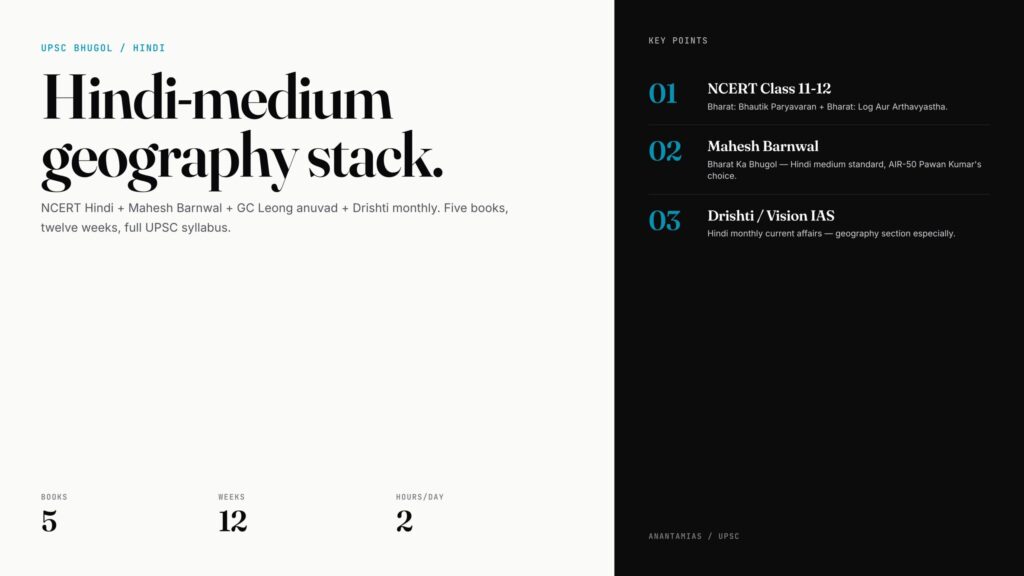
You searched “indian geography in hindi language” because you want geography content in Hindi specifically — not English with a glossary, not bilingual hand-waving. Hindi-medium UPSC aspirants get pushed to English material constantly. The result? You spend twice the time absorbing the same content, and your Mains answers come out clunky because you’ve been thinking in English and writing in Hindi. I’ve watched Hindi-medium aspirants close this gap by doing one thing — committing to a tight stack of Hindi-language geography resources and ignoring the English-medium chatter. This article maps that exact stack. Indian geography in hindi language content here covers the books, the syllabus mapping, and the revision strategy that Hindi-medium toppers actually use. The article itself is in English (because Anantamias is English-medium), but it’s structured for Hindi-medium learners — every section names the Hindi book, the chapter, the exact terminology.
Note for Hindi-medium aspirants — यह लेख अंग्रेज़ी में है, परंतु इसका उद्देश्य हिंदी माध्यम के UPSC अभ्यर्थियों को सही भूगोल पुस्तकों, संसाधनों और रणनीति की ओर निर्देशित करना है। सभी प्रमुख शब्द हिंदी और transliteration में दिए गए हैं।
What is Indian geography in Hindi language?
Indian geography in Hindi language refers to the body of UPSC-aligned geography study material written natively or translated faithfully into Hindi — covering NCERT textbooks (Bharat: Bhautik Paryavaran, Bharat: Log Aur Arthavyastha), authored books by Mahesh Barnwal and GS Lalwani in Hindi, GC Leong‘s Hindi anuvad, plus monthly current-affairs notes from Drishti IAS and Vision IAS in Hindi. The total syllabus weight in Prelims is 8–12 questions per year, and Mains GS-I has at least one full-length geography question per paper.
Three quick facts:
- Subject coverage — physical geography (Bhautik Bhugol), human geography (Manav Bhugol), economic geography (Arthik Bhugol).
- Key Hindi NCERT — Class 11 Bharat: Bhautik Paryavaran (भारत: भौतिक पर्यावरण) and Class 12 Bharat: Log Aur Arthavyastha (भारत: लोग और अर्थव्यवस्था).
- Toppers’ standard book — Mahesh Barnwal’s Bharat Ka Bhugol (भारत का भूगोल), Hindi medium.
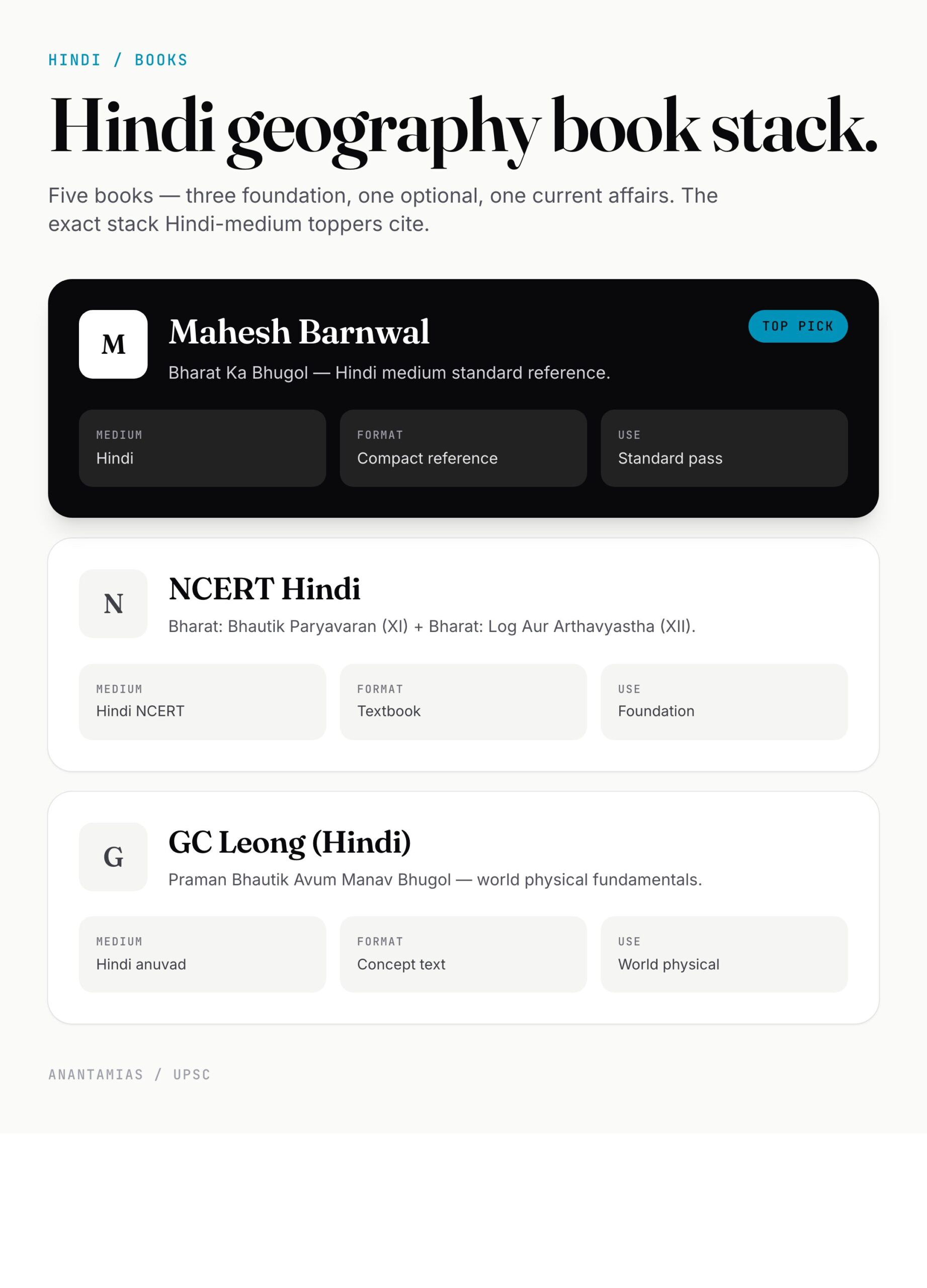
The Hindi-medium geography book stack (UPSC-tested)
Five books and one current-affairs source. That’s the entire stack. Anything more is overkill.
1. NCERT — Class 6 to 12 (Hindi medium)
The bedrock. Available as free PDFs on the NCERT website.
- Class 6 — Prithvi Hamara Aavas (पृथ्वी हमारा आवास) — basics of earth.
- Class 7 — Hamara Paryavaran (हमारा पर्यावरण) — environment.
- Class 8 — Sansadhan Aur Vikas (संसाधन और विकास) — resources and development.
- Class 9 — Samkaleen Bharat — I (समकालीन भारत — I) — contemporary India.
- Class 10 — Samkaleen Bharat — II (समकालीन भारत — II) — contemporary India deepening.
- Class 11 — Bhautik Bhugol Ke Mool Sidhdhant (भौतिक भूगोल के मूल सिद्धांत) + Bharat: Bhautik Paryavaran (भारत: भौतिक पर्यावरण).
- Class 12 — Manav Bhugol Ke Mool Sidhdhant + Bharat: Log Aur Arthavyastha (भारत: लोग और अर्थव्यवस्था).
For UPSC-relevant prioritisation, see NCERT books for UPSC. Also useful — NCERT books for UPSC subject-wise covers the full reading order.
2. Mahesh Barnwal — Bharat Ka Bhugol
Hindi medium’s most-used standard reference. Covers the entire UPSC geography syllabus in compact, exam-aligned chapters. Used by AIR-50 Pawan Kumar (Hindi medium, 2019) and others.
3. GC Leong — Praman Bhautik Avum Manav Bhugol (Hindi anuvad)
For world physical geography concepts — landforms, climate types, biomes. The Hindi translation is faithful and well-illustrated. Skip the world regional chapters; focus on physical geography fundamentals.
4. Majid Hussain — Bharat Ka Bhugol (Hindi)
For Geography optional aspirants. Comprehensive, deep, organised by Indian regional geography. Not needed for GS-only aspirants.
5. R.C. Tiwari / Savindra Singh (Hindi) — Bhautik Bhugol
Used for advanced physical geography (geomorphology, climatology, oceanography). Optional for GS, mandatory for Geography optional.
6. Current affairs — Drishti IAS Hindi monthly
Drishti Current Affairs Today (Hindi edition). Geography section specifically — new Ramsar sites, biosphere reserves, recent border issues, climate events.
Mapping the syllabus to Hindi books (chapter-by-chapter)
This is the part most coaching institutes skip. You don’t need every book end-to-end — you need specific chapters from specific books for specific syllabus items.
| Syllabus topic (UPSC) | Best Hindi source | Chapter / section |
|---|---|---|
| Earth’s interior, plate tectonics | NCERT Class 11 Bhautik Bhugol Ke Mool Sidhdhant | Chapters 2–4 |
| Indian relief features | NCERT Class 11 Bharat: Bhautik Paryavaran | Chapters 1–2 |
| Drainage system | NCERT Class 11 Bharat: Bhautik Paryavaran | Chapter 3 |
| Indian climate | NCERT Class 11 Bharat: Bhautik Paryavaran | Chapter 4 |
| Vegetation & soils | NCERT Class 11 Bharat: Bhautik Paryavaran | Chapters 5–6 |
| World climate types | GC Leong Hindi | Chapters on climatic regions |
| Population | NCERT Class 12 Bharat: Log Aur Arthavyastha | Chapters 1–3 |
| Agriculture, industry | NCERT Class 12 Bharat: Log Aur Arthavyastha | Chapters 5–8 |
| Resources & development | NCERT Class 8, Class 10 | Multiple |
Indian geography essentials in Hindi (key concepts)
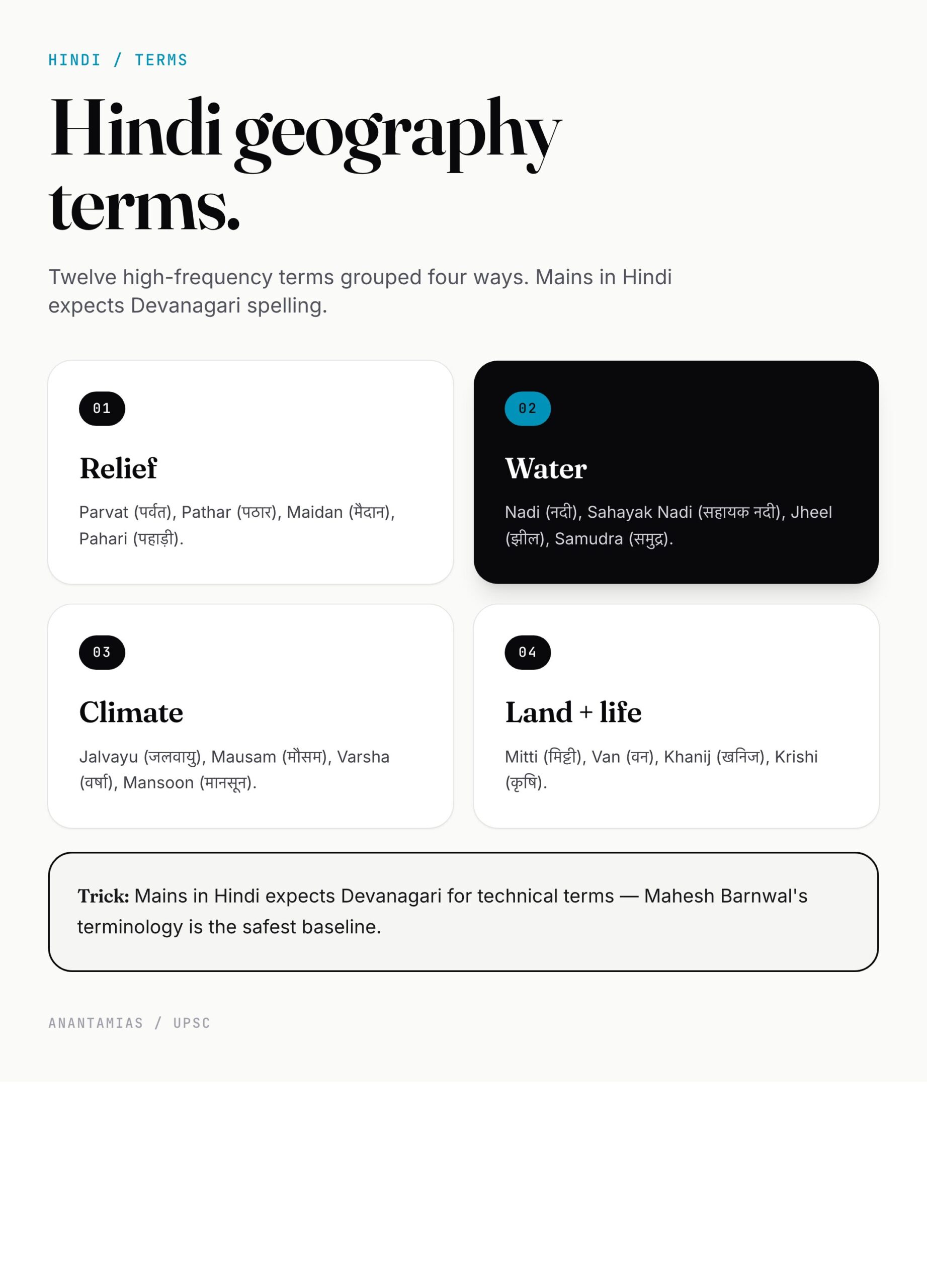
Physiographic divisions — Bhu-aakritik Pradesh
| English | Hindi (Devanagari) | Transliteration |
|---|---|---|
| Himalayan Mountains | हिमालय पर्वत | Himalaya Parvat |
| Northern Plains | उत्तरी मैदान | Uttari Maidan |
| Peninsular Plateau | प्रायद्वीपीय पठार | Prayadveepiya Pathar |
| Coastal Plains | तटीय मैदान | Tatiya Maidan |
| Islands | द्वीप समूह | Dweep Samuh |
Deeper — Himalaya mountain, Northern Plains, peninsular plateau.
Drainage — Apvah Tantra
Two systems:
- Himalayan rivers — Himalayi Nadiyan — perennial (Indus, Ganga, Brahmaputra systems). See river systems of India.
- Peninsular rivers — Prayadveepiya Nadiyan — seasonal (Mahanadi, Godavari, Krishna, Cauvery; Narmada, Tapi).
Climate — Jalvayu
Monsoonal climate (mansooni jalvayu). Four IMD seasons:
- Sheet Ritu (शीत ऋतु) — winter.
- Greeshm Ritu (ग्रीष्म ऋतु) — summer.
- Varsha Ritu (वर्षा ऋतु) — monsoon (June–Sept).
- Sharad Ritu (शरद ऋतु) — post-monsoon (Oct–Nov).
Read monsoon in India.
Soils — Mitti
Eight ICAR types — Jalodh (alluvial), Kali (black), Lal aur Peeli (red and yellow), Latrite, Marusthaliya (arid), Lavni-Khari (saline-alkaline), Peati (peaty), Vaniya (forest). See soil types of India.
Vegetation — Vanaspati
Five types — Sadabahar (evergreen), Patjhad (deciduous), Kantedaar (thorn), Parvatiya (montane), Madbhumi (mangrove). See natural vegetation of India.
Hindi geography terms — exam-tested vocabulary
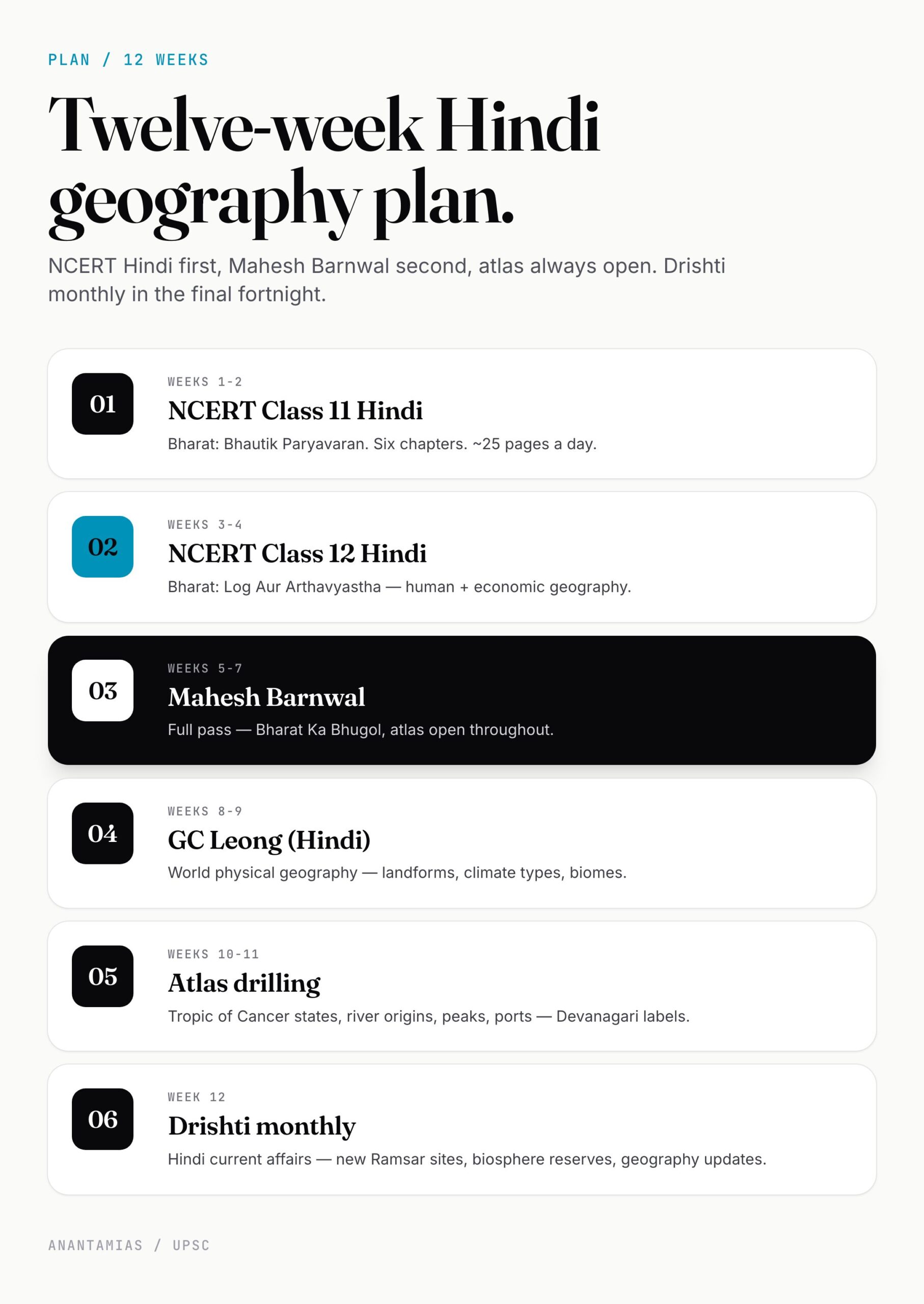
| English | Hindi | Transliteration |
|---|---|---|
| Geography | भूगोल | Bhugol |
| Latitude | अक्षांश | Akshansh |
| Longitude | देशांतर | Deshantar |
| Equator | भूमध्य रेखा | Bhumadhya Rekha |
| Tropic of Cancer | कर्क रेखा | Kark Rekha |
| Tropic of Capricorn | मकर रेखा | Makar Rekha |
| Standard Time | मानक समय | Manak Samay |
| Plate tectonics | प्लेट विवर्तनिकी | Plate Vivartaniki |
| Earthquake | भूकंप | Bhukamp |
| Volcano | ज्वालामुखी | Jvalamukhi |
| Monsoon | मानसून | Mansoon |
| Rainfall | वर्षा | Varsha |
| Drought | सूखा | Sookha |
| Flood | बाढ़ | Baadh |
| Cyclone | चक्रवात | Chakravat |
| River | नदी | Nadi |
| Tributary | सहायक नदी | Sahayak Nadi |
| Delta | त्रिभुजाकार मुहाना | Tribhujakar Muhana |
| Glacier | हिमनद | Himnad |
| Lake | झील | Jheel |
| Wetland | आर्द्रभूमि | Aardr Bhumi |
| Forest | वन | Van |
| Wildlife | वन्यजीव | Vanyajeev |
| Biosphere reserve | जीव मंडल आरक्षित क्षेत्र | Jeev Mandal Aarakshit Kshetra |
| National park | राष्ट्रीय उद्यान | Rashtriya Udyan |
| Sanctuary | अभयारण्य | Abhayaranya |
| Population | जनसंख्या | Jansankhya |
| Density | घनत्व | Ghanatva |
| Urbanisation | शहरीकरण | Shahrikaran |
| Agriculture | कृषि | Krishi |
12-week study plan for Hindi-medium aspirants
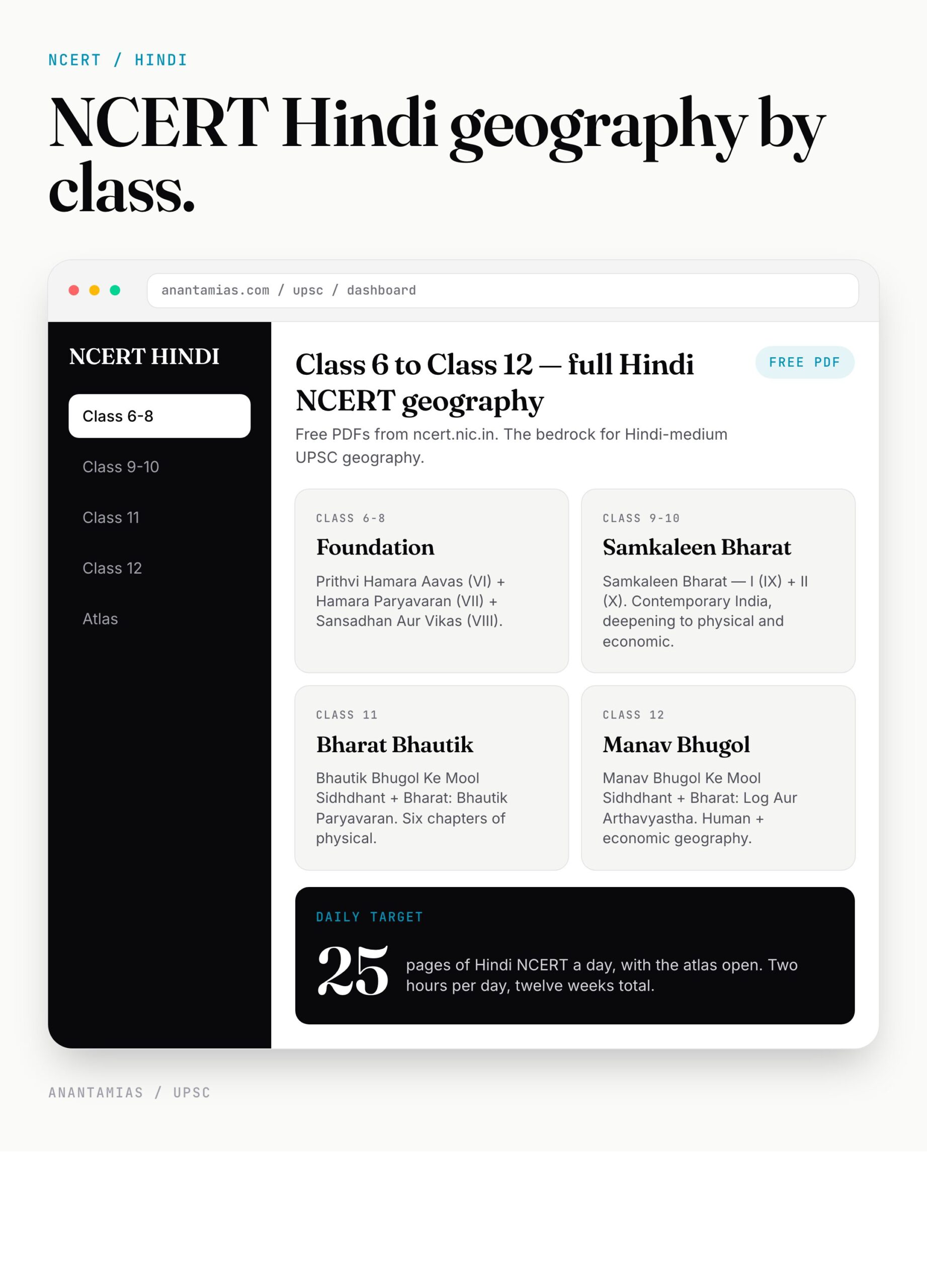
Week-by-week — assuming 1 hour/day on geography:
- Weeks 1–2 — NCERT Class 6–8 (Hindi). Foundation. Don’t rush.
- Weeks 3–4 — NCERT Class 9–10 (Hindi). Contemporary India.
- Weeks 5–6 — NCERT Class 11 Bhautik Bhugol Ke Mool Sidhdhant. Earth’s basics.
- Weeks 7–8 — NCERT Class 11 Bharat: Bhautik Paryavaran. India’s physical geography.
- Week 9 — NCERT Class 12 Manav Bhugol Ke Mool Sidhdhant. Human geography concepts.
- Week 10 — NCERT Class 12 Bharat: Log Aur Arthavyastha. Indian human + economic.
- Weeks 11–12 — Mahesh Barnwal Bharat Ka Bhugol. Revision + integration.
After 12 weeks, switch to Drishti Hindi monthly + atlas drills + previous year question (PYQ) practice. Target: 1 hour daily on geography for 6 months total.
Why study geography in Hindi (and when to switch)
Some aspirants hesitate to commit to Hindi-medium because they’ve internalised the myth that English is “more reliable.” Here’s the honest reading:
- Reliability is fine — UPSC publishes both English and Hindi question papers. Hindi medium gets equal evaluation, equal cut-offs, equal opportunity.
- Speed is real — if you grew up in Hindi medium, your reading + comprehension + writing speed in Hindi is 1.5–2x faster than in English. That compounds over 9 hours of GS papers.
- Source quality is now strong — NCERT Hindi has caught up. Bipan Chandra, Mahesh Barnwal, GC Leong, Majid Hussain — all available in faithful Hindi anuvad. The “Hindi books are bad” complaint is outdated.
When to switch (or supplement with English):
- Optional subject — Geography optional has more depth in English (Savindra Singh’s depth in English exceeds the Hindi anuvad). Some toppers read English source + write Hindi answers.
- Current affairs — Indian Express and The Hindu have no Hindi equivalent of equal quality. Use Drishti Hindi or PIB Hindi as your primary, but skim English headlines.
Common misconceptions
- “Hindi medium loses 5–10 marks” — UPSC’s official data shows no systematic disadvantage. Hindi-medium pass-rate matches English-medium for the past five years.
- “GC Leong is too tough in Hindi” — The Hindi anuvad is well-translated. The challenge is GC Leong’s content density, not the language.
- “You should write Mains in English even if you study in Hindi” — Wrong. Pick one medium and stick with it for entire Mains. Mixing causes terminology confusion that costs 2–3 marks per answer.
How to revise this in 30 minutes
- NCERT Class 11 Bharat: Bhautik Paryavaran — chapter headings + key tables (10 min).
- Mahesh Barnwal — soil and vegetation chapters (10 min).
- Atlas — Tropic of Cancer states, major rivers, monsoon arrows (5 min).
- Drishti monthly Hindi — geography section (5 min).
Frequently Asked Questions
Indian geography hindi language mein kaun si kitab best hai?
NCERT Class 11 Bharat: Bhautik Paryavaran + NCERT Class 12 Bharat: Log Aur Arthavyastha + Mahesh Barnwal Bharat Ka Bhugol — this combination is the standard.
GC Leong hindi mein milti hai?
Yes — Praman Bhautik Avum Manav Bhugol — translated and widely available. Used for world physical geography basics.
Hindi medium se geography optional sahi hai?
Bilkul. Hindi-medium toppers regularly clear with Geography optional. Source stack — NCERT + Mahesh Barnwal + Majid Hussain + Savindra Singh (Hindi anuvad).
Bharat ka sabse uncha shikhar hindi mein kya kahalata hai?
Kanchenjunga (कंचनजंगा) — Sikkim mein — 8,586 meter — vishv ka teesra sabse uncha shikhar.
Mansoon hindi mein kya hai?
Mansoon (मानसून) ya Mausami Pavan (मौसमी पवन) — seasonal winds that bring monsoonal rainfall to India.
Indian geography pdf hindi mein kahan se download kare?
NCERT website (ncert.nic.in) — free, official. Drishti IAS, Vision IAS bhi PDF Hindi mein dete hain.
Kya Hindi medium se UPSC interview Hindi mein de sakte hain?
Yes — UPSC’s interview language is the candidate’s choice. Hindi medium ke aspirant Hindi mein interview de sakte hain. Translator nahi chahiye.
Geography ke liye atlas Hindi mein milti hai?
Yes — Orient Blackswan and NCERT both publish Hindi atlas editions. Maps are universal; only labels differ.
Tell Google you want more of this.
Add Anantam IAS as a preferred sourceOne tap, and this site shows up more often in your own Top Stories, AI Overviews and AI Mode. Remove it any time.