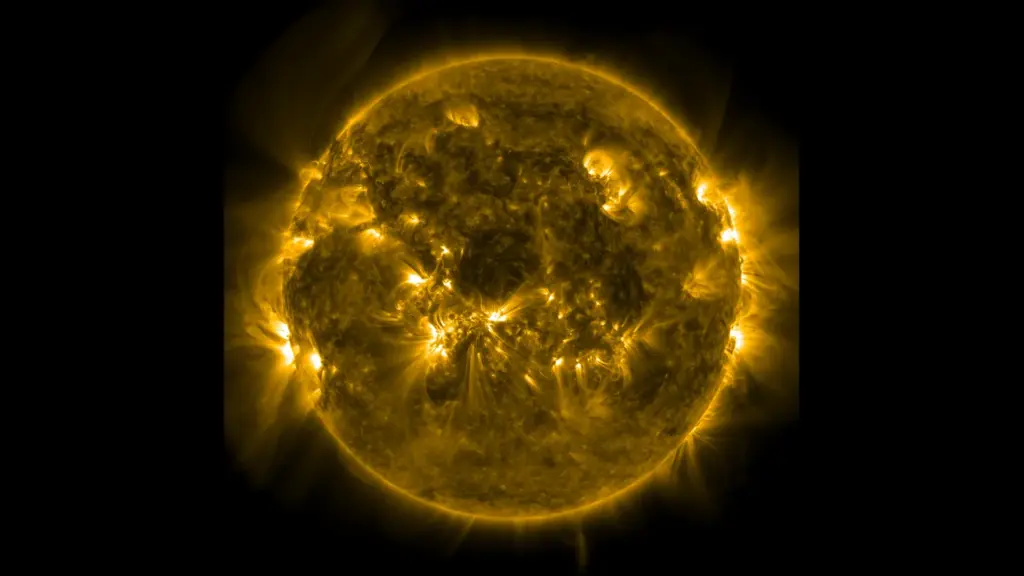
The structure of the Sun is a set of seven nested layers: three inside that make and carry its energy, and four outside that form its atmosphere. At the center, hydrogen fuses into helium at about 15 million °C; at the visible surface the gas is down to about 5,500 °C; and in the outermost layer, the corona, it climbs back above 1 million °C. These layers decide how sunlight is made, why the Sun has dark spots and where the eruptions that disturb Earth’s satellites come from, and India’s Aditya-L1 observatory has watched the outer layers from its post in space since January 2024.
Two ideas about the Sun don’t survive a closer look. The first is that it has a surface. It doesn’t; it’s a ball of plasma, and what we call the surface is the photosphere, a glowing layer about 100 km thick. The second is that it should get cooler as you move away from the core. It does, until the photosphere, and then the temperature rises again by a factor of more than a hundred, for reasons nobody has fully settled. This note gives each layer with NASA’s figures and keeps the settled physics apart from the open question.
What is the structure of the Sun?
The Sun is a G2 V yellow dwarf, an ordinary star in the middle of its life, made almost entirely of hydrogen and helium held together by its own gravity. NASA divides it into an interior of three regions and an atmosphere of four, and gas that escapes the outermost layer becomes the solar wind. The figures below come from NASA’s Sun fact sheet and its Sun facts page.
| Fact | Detail |
|---|---|
| Type of star | G2 V yellow dwarf, a main-sequence star |
| Age | Formed about 4.6 billion years ago from a collapsing cloud of gas and dust |
| Mean distance from Earth | 149.6 million km; light covers it in about 8 minutes 20 seconds |
| Radius | 695,700 km, about 109 times Earth’s |
| Mass | About 332,900 Earths, or 99.8% of the solar system’s mass |
| Photosphere composition | Hydrogen about 91% and helium about 8.9% of the atoms |
| Core temperature | About 15 million °C |
| Visible surface | The photosphere, at about 5,500 °C (effective temperature 5,772 K) |
| Corona | Above 1 million °C, reaching about 2 million °C |
Layers of the Sun from inside to outside
Read from the center outward, the Sun has seven layers, and the solar wind flows beyond the last of them. The table uses a single source, NASA’s Marshall Space Flight Center, so its rows can be compared directly.
| Layer | Where it lies | Temperature | What happens there |
|---|---|---|---|
| Core | Center to about 25% of the radius (175,000 km) | About 15,000,000 °C at the center, half that at its edge | Hydrogen nuclei fuse into helium and release the Sun’s energy |
| Radiative zone | From 25% to 70% of the radius | From 7,000,000 °C down to about 2,000,000 °C | Energy moves outward as light that bounces from particle to particle |
| Tachocline | Thin boundary at about 70% of the radius | About 2,000,000 °C, the value on both sides of it | Thought to be where the Sun’s magnetic field is generated |
| Convection zone | Outer 30%, from a depth of about 200,000 km to the surface | About 2,000,000 °C at the base, 5,700 K at the top | Hot plasma rises, spreads, cools and sinks again |
| Photosphere | A layer about 100 km thick | About 5,700 K | Emits most of the visible light; sunspots, faculae and granules appear here |
| Chromosphere | Irregular layer above the photosphere | Rises from 6,000 °C to about 20,000 °C | Red hydrogen glow; prominences, spicules and plage |
| Transition region | Thin, very irregular layer | Jumps from about 20,000 °C to 1,000,000 °C | Gives off ultraviolet light that can be seen only from space |
| Corona | The outer atmosphere, stretching far into space | Above 1,000,000 °C | Pearly white crown in a total eclipse; streamers, plumes and loops |
| Solar wind | Flows outward from the corona in all directions | Coronal gas too hot for the Sun’s gravity to hold | About 400 km/s; 800 km/s over coronal holes, 300 km/s over streamers |
Thickness is where NASA’s own pages part ways, because hot gas has no sharp edges. Marshall puts the photosphere at about 100 km, the Sun facts page at about 400 km and the Sun fact sheet at about 500 km. Each draws the boundary at a different point, and all agree on what matters: even 500 km is less than a thousandth of the Sun’s radius, so the visible surface is a skin.
How energy moves from the core to the surface
Energy is made in the core, crawls through the radiative zone as light and is carried the last stretch by rising plasma in the convection zone.
The core runs on nuclear fusion. Hydrogen nuclei are positively charged and repel each other, so they fuse only when heat and pressure drive them together hard enough; NASA gives the core’s density as about 150 g/cm³, around 8 times that of gold. In a star like the Sun the fusion follows the proton-proton chain, which NASA Marshall sets out in three steps:
- two protons collide to make deuterium, a positron and a neutrino;
- a proton strikes the deuterium to make helium-3 and a gamma ray;
- two helium-3 nuclei collide to make helium-4 and release two protons.
The helium weighs slightly less than the hydrogen that went in, and the missing mass leaves as energy. NASA’s fact sheet puts the Sun’s mass loss at 4,260 million kg every second, a little over 4 million tonnes turned into light each second. The same process, and the effort to copy it on Earth, is covered in the note on nuclear fusion.
In the radiative zone that energy travels as light, but not in a straight line. A photon is absorbed and re-emitted in a random direction so often that NASA’s pages disagree on how long the crossing takes: about a million years to the tachocline on Marshall’s figure, about 170,000 years to the top of the convection zone on the Sun facts page. The last 150 million km to Earth then take about 8 minutes 20 seconds.
At about 70% of the radius, where the gas has cooled to about 2 million °C, convection takes over. Picture a pot of water on a stove: hot water rises, spreads across the top, cools and sinks at the edges. The analogy holds for the motion, and the tops of these cells are visible as granules on the photosphere. It breaks in one place that matters. Solar plasma is threaded with magnetic field, which the water in a pot is not, and that field is what later makes sunspots, flares and the cycle of activity. Marshall places its source, the solar dynamo, in the thin tachocline between the two zones.
The photosphere: why the Sun seems to have a surface
The photosphere is the layer where the Sun’s gas turns from opaque to see-through, so its light escapes to space and our eyes read it as a surface. It is about 100 km thick on Marshall’s figure, set against a radius of 700,000 km. Look at the middle of the disk and you see deeper, hotter gas; look at the edge and your line of sight grazes only the cooler upper part. That is why the Sun’s edge looks dimmer, an effect called limb darkening.
Four features show up on the photosphere through a filtered telescope:
- Granules: cells about 1,000 km across that each last about 20 minutes; they are the tops of convection cells, with flows faster than 7 km/s.
- Supergranules: much larger cells, about 35,000 km across, that last a day or two.
- Sunspots: dark patches whose centers drop to about 3,700 K, against 5,700 K around them; their magnetic fields are thousands of times stronger than Earth’s, and they last days to weeks.
- Faculae: bright magnetic patches seen best near the edge of the disk.
A sunspot looks black, which tempts people to call it a hole or a burnt patch. It’s neither. It is gas that is cooler, not missing, held back by a strong magnetic field that blocks the convection bringing up heat from below.
Put numbers on it. 3,700 K is about two-thirds of 5,700 K. The light a hot surface gives off rises with the fourth power of its temperature, and two-thirds raised to the fourth power is about 0.18, so each patch of sunspot sends out roughly a fifth of the light of the photosphere beside it. On its own it would glow brightly; next to the photosphere it looks dark.
Here’s the objection a careful reader raises: if sunspots are dark, a Sun covered in them should be dimmer. Marshall says the opposite happens. The faculae that come with sunspots win out, and at sunspot maximum the Sun is about 0.1% brighter than at minimum.
The Sun’s atmosphere: chromosphere, transition region and corona
Above the photosphere the temperature does the unexpected thing: it climbs. The chromosphere warms to about 20,000 °C, the thin transition region leaps to 1 million °C and the corona stays above that.
The chromosphere, the color sphere, gets its name from the red light hydrogen gives off at these temperatures, called H-alpha. Normally the photosphere drowns it out. During a total eclipse, when the Moon covers the photosphere, the chromosphere shows as a thin red rim and the corona as a white crown around it; the geometry is in the note on the solar eclipse. The chromosphere is also where prominences hang: dense, cooler clouds held above the surface by loops of magnetic field. Seen against the bright disk the same clouds look dark and are called filaments. Short jets called spicules shoot up through it and last only a few minutes.
The transition region is the thin, irregular layer where the temperature jumps from about 20,000 °C to a million. Its ultraviolet light is absorbed by Earth’s atmosphere, so it can be studied only from space.
The corona of the Sun is the outer atmosphere, seen in eclipses as streamers, plumes and loops whose shape changes with the solar cycle. Early spectra of the corona showed bright lines that matched no known element, so astronomers proposed a new one and called it coronium. There was no coronium. The lines came from iron and calcium stripped of many electrons, and that only happens at temperatures above 1 million °C. The corona then keeps going as the solar wind, which blows a magnetic bubble called the heliosphere past the orbits of all the planets. As NASA puts it, Earth sits inside the Sun’s atmosphere.
Why is the corona hotter than the photosphere?
No one knows for certain. This is the coronal heating problem, and NASA calls it a major unsolved puzzle in the study of the Sun. It’s a puzzle because heat normally flows from hot to cold, so layers farther from the core should be cooler, and up to the photosphere they are. The transition region makes it sharper: NASA Marshall notes that heat there flows downward, out of the corona, so the corona cannot be warmed by heat conducted up from below. Something must deliver energy to it directly.
NASA Marshall names the two explanations proposed most often:
- Wave heating: magnetic waves carry energy up from the churning surface and deposit it in the corona.
- Nanoflare heating: countless tiny flares, each far too small to see alone, release stored magnetic energy all the time.
Neither has been proven, and both put the magnetic field at the center. That open question is a large part of why Aditya-L1, Parker Solar Probe and Proba-3 were built.
Sunspots, flares, CMEs and the 11-year solar cycle
The Sun’s activity rises and falls on a cycle of about 11 years, and counting sunspots is the oldest way to track it. NASA explains that the magnetic poles swap roughly every 11 years as the Sun swings from quiet to violently active and back. Marshall gives the counting rule still in use: the sunspot number is the number of individual spots plus ten times the number of groups.
Two patterns in the sunspot record are worth holding:
- The Maunder Minimum: very few sunspots were seen from about 1645 to 1715, a quiet spell that overlaps the Little Ice Age; Marshall calls the link between solar activity and climate ongoing research.
- The butterfly diagram: spots form in two bands at mid-latitudes, and the bands move toward the equator as each cycle goes on.
Flares and coronal mass ejections are easy to blur, so keep them apart:
- Solar flare: a burst of light and particles set off by the sudden release of magnetic energy; its light reaches Earth in about 8 minutes.
- Coronal mass ejection (CME): a cloud of magnetized plasma thrown out at more than a million miles per hour, often after a flare; at 1.6 million km/h it needs about four days to cover 150 million km, and faster ones arrive sooner.
- Prominence eruption: a prominence whose magnetic support breaks, flinging its plasma out as a CME.
Aimed at Earth, a CME can light up the sky with auroras and disturb satellites and power grids. NASA records the strongest geomagnetic storm on record, the Carrington Event, set off by a flare on 1 September 1859, and a storm on 13 March 1989 that left 6 million people in Quebec without power for 9 hours. The Earth end of these events is covered in the notes on the solar storm and the aurora borealis.
The current cycle, Solar Cycle 25, began at solar minimum in December 2019. A 2019 panel co-sponsored by NASA and NOAA expected a modest peak, a smoothed sunspot number of 105 to 125, between November 2024 and March 2026. The Sun ran ahead of the forecast. On 15 October 2024, NASA, NOAA and the Solar Cycle Prediction Panel announced that the Sun had reached its solar maximum period, and in 2025 the Royal Observatory of Belgium’s sunspot index service confirmed that the smoothed monthly sunspot number peaked at 161 in October 2024. NOAA expects Solar Cycle 26 to begin between January 2029 and December 2032. The peak year itself is covered in the note on solar maximum and the solar cycle.
The structure of the Sun today: Aditya-L1 and other missions
India now watches these layers with an observatory of its own. Aditya-L1, India’s first space-based solar observatory, was launched by PSLV-C57 on 2 September 2023 and inserted into a halo orbit around the Sun-Earth Lagrange point L1 on 6 January 2024. L1 is about 1.5 million km from Earth, roughly 1% of the way to the Sun, and a spacecraft there sees the Sun without interruption by eclipses. The mission is covered in full in the note on Aditya-L1, and ISRO’s mission page lists its seven payloads:
- VELC (Visible Emission Line Coronagraph): images and spectra of the corona.
- SUIT (Solar Ultraviolet Imaging Telescope): images of the photosphere and chromosphere in near-ultraviolet light.
- SoLEXS (Solar Low Energy X-ray Spectrometer): soft X-rays from the whole Sun.
- HEL1OS (High Energy L1 Orbiting X-ray Spectrometer): hard X-rays from the whole Sun.
- ASPEX (Aditya Solar wind Particle Experiment): protons and heavier ions in the solar wind.
- PAPA (Plasma Analyser Package for Aditya): electrons and heavier ions in the solar wind.
- Magnetometer: the magnetic field at L1.
The first four look at the Sun; the last three sample the particles and fields that reach L1. Among the mission’s objectives ISRO lists coronal heating, space weather and the start of flares and CMEs. Its results so far, each with its date:
- 7 November 2023: HEL1OS recorded its first high-energy X-ray view of solar flares, while the craft was still on its way to L1.
- 22 February 2024: SUIT observed an X6.3 flare and captured its ‘kernel’, the brightening in the photosphere and chromosphere, in the 200 to 400 nm range; PIB announced the result on 28 February 2025.
- 16 July 2024: VELC recorded the onset of a CME linked to an X1.9 flare; the brief on Aditya-L1’s look at coronal mass ejections has the detail.
- 28 August 2026: ISRO reported that SUIT, SoLEXS and HEL1OS had caught short-lived brightenings that cluster where a major flare later erupts, a possible early warning; the brief on Aditya-L1’s flare precursors covers it.
Two other missions sit beside it. NASA’s Parker Solar Probe flies through the corona itself: on 24 December 2024 it passed about 6.1 million km from the solar surface at 692,000 km/h, the closest any human-made object has come to a star.
ESA’s Proba-3 was launched by ISRO on PSLV-C59 on 5 December 2024 from Sriharikota, a commercial mission of NewSpace India Limited; the note on the PSLV covers the rocket. Its two spacecraft fly 150 m apart so that a 1.4 m disc on one shades the other’s coronagraph, and ESA released the first artificial eclipse images on 16 June 2025. A fault cut contact with the Coronagraph spacecraft on 14 and 15 February 2026; ESA restored it in March 2026.
How to study the structure of the Sun for exams
The structure of the Sun sits in three places in the syllabus:
- GS Paper I, in physical geography, where the solar system, insolation and the Sun’s effect on Earth begin;
- GS Paper III, in science and technology, through India’s space missions and space weather;
- Prelims, in general science and in space-related current affairs.
It is tested more often through its effects than by name. Mains 2024 GS Paper I asked “What are aurora australis and aurora borealis? How are these triggered?“, and a full answer runs from the corona through the solar wind and CMEs to Earth’s magnetic field. On the Prelims side, 192 of the 1,403 questions from 2013 to 2026 in the site’s Prelims question bank are tagged Science and Technology.
Revise these until they’re automatic:
- Order: core, radiative zone, convection zone, photosphere, chromosphere, transition region, corona; solar wind beyond.
- Temperatures: about 15 million °C in the core, about 5,500 °C at the photosphere, above 1 million °C in the corona.
- Fusion: the proton-proton chain turns hydrogen into helium in the innermost 25% of the radius.
- Sunspots: about 3,700 K against 5,700 K, dark by contrast and strongly magnetic.
- Solar cycle: about 11 years; Solar Cycle 25 began in December 2019 and its smoothed peak came in October 2024.
- Aditya-L1: PSLV-C57 on 2 September 2023, halo orbit around L1 on 6 January 2024, 7 payloads (4 remote sensing, 3 in situ).
Five confusions cost marks:
- Surface or photosphere. The Sun has no solid surface. The photosphere is the visible layer and the first layer of the atmosphere.
- Red rim or white crown. In a total eclipse the red rim is the chromosphere and the white crown is the corona.
- Prominence or filament. They are the same cloud of plasma, seen at the edge of the disk or against it.
- Flare or CME. A flare is a burst of light that arrives in minutes; a CME is a cloud of matter that arrives in days.
- Where L1 is. At 1.5 million km, L1 is about 1% of the way to the Sun; Aditya-L1 watches from there, while Parker Solar Probe flies close.
It also helps to set India’s mission beside the other two:
| Mission | Agency | Where it observes from | What it studies |
|---|---|---|---|
| Aditya-L1 | ISRO | Halo orbit around Sun-Earth L1, about 1.5 million km from Earth | Photosphere, chromosphere and corona, plus solar wind and magnetic field at L1 |
| Parker Solar Probe | NASA | Passes through the corona, about 6.1 million km from the surface at closest | The corona and the solar wind where it starts |
| Proba-3 | ESA | Highly elliptical Earth orbit, reached on PSLV-C59 | The inner corona, through artificial eclipses made by two spacecraft in formation |
The structure of the Sun rewards the aspirant who learns it as one temperature curve instead of seven names: falling from the core to the photosphere, then rising into the corona. Hold that curve and the coronal heating problem, the eclipse colors and the purpose of Aditya-L1 all follow from it. Miss it, and an answer on auroras or space weather has nowhere to start.
Frequently Asked Questions
What are the layers of the Sun from inside to outside?
From the center outward, the layers of the Sun are the core, the radiative zone, the convection zone, the photosphere, the chromosphere, the transition region and the corona. The first three form the interior and the last four the atmosphere. Beyond the corona, gas streams away as the solar wind.
Which is the hottest layer of the Sun?
The core is the hottest layer, at about 15 million °C, hot enough for hydrogen to fuse into helium. In the atmosphere the hottest layer is the corona, above 1 million °C and up to about 2 million °C, far hotter than the photosphere at about 5,500 °C.
Why is the corona hotter than the surface of the Sun?
Nobody knows for certain; this is the coronal heating problem, which NASA calls a major unsolved puzzle. Heat flows down from the corona into the layers below it, so the corona must be heated directly. The two leading explanations are energy carried up by magnetic waves and a constant stream of tiny flares called nanoflares.
What is the photosphere of the Sun?
The photosphere is the layer that gives off most of the Sun’s visible light, so it is what we see as the surface. NASA Marshall puts it at about 100 km thick and about 5,700 K. Sunspots, faculae and granules all appear on it.
What are sunspots and why do they look dark?
Sunspots are magnetic regions on the photosphere where strong fields block the rising heat from below. Their centers are about 3,700 K, against about 5,700 K around them, so they give off much less light and look dark only by contrast. They come and go with the 11-year solar cycle.
What is the 11-year solar cycle, and where is Solar Cycle 25 now?
The solar cycle is the rise and fall of the Sun’s activity over about 11 years, during which its magnetic poles swap. Solar Cycle 25 began in December 2019, and its smoothed sunspot number peaked at 161 in October 2024. NOAA expects Solar Cycle 26 to begin between January 2029 and December 2032.
Which parts of the Sun does Aditya-L1 study?
Aditya-L1’s four remote-sensing payloads observe the photosphere, the chromosphere and the corona in visible, ultraviolet and X-ray light. Its three in-situ payloads measure the solar wind particles and the magnetic field at L1. The mission’s aims include coronal heating, the start of flares and CMEs, and the drivers of space weather.
Does the Sun have a solid surface?
No. The Sun is a ball of plasma, electrically charged gas, and it has no solid surface anywhere. The photosphere looks like a surface because it is the layer where the gas becomes transparent enough for light to escape into space.
Practice Questions
Prelims
1. Consider the following statements about the Sun: 1. The transition region lies between the chromosphere and the corona. 2. The photosphere is hotter than the upper chromosphere. Which of the statements given above is/are correct?
- (a) 1 only
- (b) 2 only
- (c) Both 1 and 2
- (d) Neither 1 nor 2
Answer: (a) The chromosphere warms to about 20,000 °C at its top, well above the photosphere’s 5,700 K.
2. Arrange the following layers of the Sun from the inside outward: 1. Convection zone 2. Radiative zone 3. Chromosphere 4. Photosphere. Select the correct answer using the code given below.
- (a) 2-1-4-3
- (b) 1-2-4-3
- (c) 2-1-3-4
- (d) 1-2-3-4
Answer: (a) Energy passes from the radiative zone to the convection zone, then to the photosphere and the chromosphere above it.
3. Consider the following statements about Aditya-L1: 1. It was launched by PSLV-C57. 2. It observes the Sun from a halo orbit around the Sun-Earth L1 point. 3. All seven of its payloads point directly at the Sun. Which of the statements given above are correct?
- (a) 1 and 2 only
- (b) 2 and 3 only
- (c) 1 and 3 only
- (d) 1, 2 and 3
Answer: (a) Four payloads view the Sun; the other three measure particles and fields at L1.
4. Sunspots appear dark mainly because they:
- (a) are holes through which the interior can be seen
- (b) are cooler than the surrounding photosphere
- (c) are hidden behind the corona
- (d) have no magnetic field
Answer: (b) Their centers are about 3,700 K against 5,700 K, so they give off far less light.
5. Consider the following statements about Proba-3: 1. It is a European Space Agency mission launched on an Indian PSLV. 2. It creates artificial solar eclipses with a single spacecraft carrying its own disc. Which of the statements given above is/are correct?
- (a) 1 only
- (b) 2 only
- (c) Both 1 and 2
- (d) Neither 1 nor 2
Answer: (a) Proba-3 uses two spacecraft flying 150 m apart, one shading the other’s coronagraph.
Mains
- What are aurora australis and aurora borealis? How are these triggered? (15 marks, 250 words) Previous year: Mains 2024, GS Paper I.
- The corona of the Sun is far hotter than the photosphere beneath it. Explain why this is considered a problem and discuss the explanations proposed. (10 marks, 150 words)
- Explain how the energy produced in the Sun’s core reaches its visible surface, naming the layers involved and the way energy moves through each. (10 marks, 150 words)
- What is the solar cycle? Discuss its implications for satellites, power grids and communication systems with reference to Solar Cycle 25. (15 marks, 250 words)
- Discuss the scientific objectives of Aditya-L1 and explain why the Sun-Earth L1 point suits a solar observatory. (15 marks, 250 words)
Tell Google you want more of this.
Add Anantam IAS as a preferred sourceOne tap, and this site shows up more often in your own Top Stories, AI Overviews and AI Mode. Remove it any time.