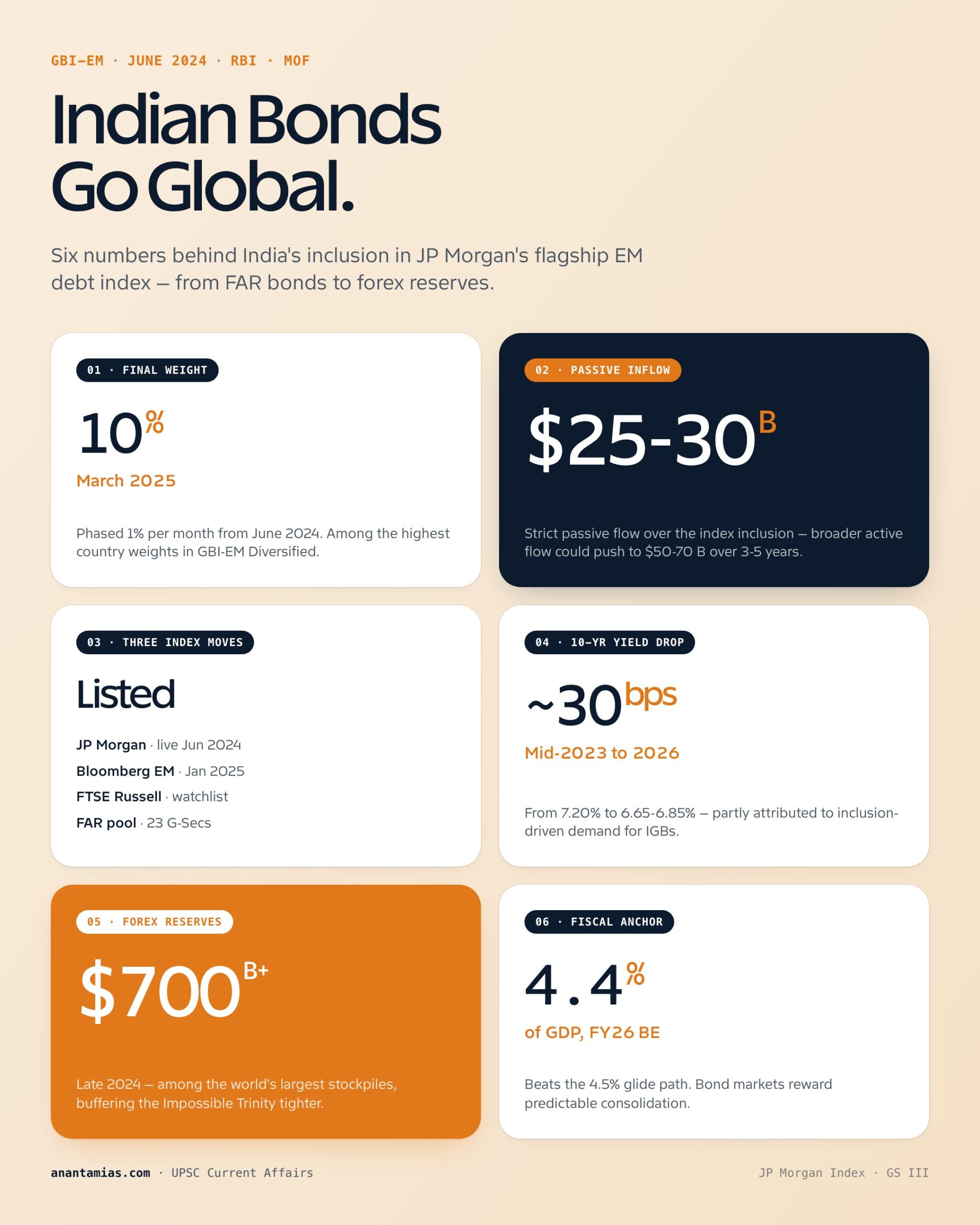
In September 2023, JP Morgan announced that Indian Government Bonds (IGBs) would be included in its flagship emerging-markets debt index, the GBI-EM Global Diversified Index, starting June 28, 2024. The phased inclusion, completed by March 2025, gave India a target weight of 10 percent — among the highest country weights in the index. This is among the most consequential events in India's bond market history, with Bloomberg following suit (inclusion in its EM Local Currency Index from January 2025) and FTSE Russell putting India on its watchlist. The move is expected to bring USD 25-30 billion in passive inflows annually, deepen India's bond market, and reduce sovereign borrowing costs. But it also exposes India to global capital cycles, currency volatility, and monetary policy constraints. This article unpacks the benefits, risks, mechanism, and 2024-26 data — essential UPSC GS-III material on financial markets, capital flows, and external sector.
What Is the JP Morgan GBI-EM Global Diversified Index
The JP Morgan Government Bond Index — Emerging Markets (GBI-EM) family tracks local-currency sovereign bonds issued by emerging market countries. The Global Diversified variant caps individual country weights at 10 percent to ensure diversification.
Why It Matters
- Tracks roughly USD 240 billion in passive funds globally.
- Inclusion makes a country's bonds automatically purchased by index-tracking ETFs and mutual funds.
- Asset managers and sovereign wealth funds benchmark to it; inclusion means forced demand for the country's bonds.
India's Long Road to Inclusion
For years, India had been the largest emerging market outside the index. The barriers were:
- Capital controls — limits on foreign portfolio investment in government securities.
- Tax friction — capital gains and TDS on foreign bond holders.
- Settlement and custody — operational difficulties with foreign settlement systems.
- Limited issuance liquidity in any specific bond series.
The Fully Accessible Route (FAR) for FPI investment in G-Secs, introduced by RBI in 2020, and the launch of Specified Securities without quantitative caps was the breakthrough. By 2023, FAR bonds met JP Morgan's eligibility tests on liquidity, accessibility, and operational ease.
The Inclusion Process
| Phase | Date | Weight Increment |
|---|---|---|
| Inclusion announcement | September 22, 2023 | – |
| Inclusion start | June 28, 2024 | +1% |
| Monthly increments | Jul 2024 – Mar 2025 | +1% per month |
| Final weight | March 31, 2025 | 10% |
Bonds eligible: 23 IGBs designated under the FAR route, with outstanding face value of about USD 350 billion (India's eligible pool is larger than the index can absorb).
Benefits for India
1. Lower Cost of Borrowing for Government
- Increased demand for IGBs from global passive flows pushes prices up and yields down.
- A 15-30 basis point reduction in 10-year G-sec yields was estimated by RBI Bulletin (May 2024) and CRISIL.
- Lower G-sec yields mean lower interest outgo for the government — significant given India's interest payments are about 24 percent of total central government expenditure.
2. Lower Domestic Interest Rates
Indian banks benchmark lending rates (MCLR, EBLR) to G-sec yields and policy rates. As G-sec yields fall:
- Corporate bond spreads compress, lowering corporate borrowing costs.
- Bank lending rates ease, supporting private investment.
- Housing loans, MSME credit, and retail credit can become marginally cheaper.
3. Forex Reserves Accumulation
- Estimated USD 25-30 billion of passive inflows over the index inclusion period.
- Adds to India's forex reserves, which crossed USD 700 billion in 2024 (RBI Weekly Statistical Supplement, late 2024) — among the world's largest.
- Provides buffer against external shocks like oil price spikes or capital flight episodes.
4. Deepening of Corporate Bond Market
- During fiscal expansions, government borrowing crowds out corporate bond issuance.
- Foreign demand at the sovereign end vacates domestic space for corporates, who can then issue at competitive rates.
- This addresses a long-standing structural weakness — India's corporate bond market is around 18 percent of GDP versus 60-100 percent in US/UK.
- SEBI's Limited Purpose Clearing Corporation and reforms in 2024 also support corporate bond depth.
5. Internationalisation of the Rupee
- Foreign investor confidence in INR-denominated debt is a step toward rupee internationalisation.
- Complements RBI's parallel push: Special Vostro Accounts for INR trade settlement with 22+ countries by 2024.
- Reduces long-term forex risk for Indian firms by encouraging rupee-denominated trade.
Risks and Concerns
1. Currency Appreciation Pressure
- Large foreign inflows can appreciate INR, hurting export competitiveness.
- REER (Real Effective Exchange Rate) — INR was already overvalued by 6-7 percent as per IMF estimates in 2024.
- RBI's intervention to absorb dollar inflows can cause excess liquidity in the banking system, complicating monetary policy.
2. Vulnerability to External Cycles
- Index-tracking flows are passive but not permanent — when global risk appetite turns (Fed tightening, geopolitical shocks), capital can reverse rapidly.
- 2013 Taper Tantrum showed how quickly EM flows can flip; India was among the "Fragile Five."
- Monetary tightening in advanced economies between 2022-24 saw EM debt outflows; FAR bonds proved relatively resilient but the lesson stands.
3. Monetary Policy Constraints
- With foreign holdings of G-secs rising, MPC's rate decisions must consider the volatility implications for foreign holders.
- A sudden rate cut could trigger outflows; rate hikes could appreciate the rupee further.
- Impossible Trinity — open capital account, fixed/managed exchange rate, and independent monetary policy — becomes more binding.
4. Sovereign Spread Sensitivity
- Index inclusion anchors Indian yields to global EM spreads, reducing the autonomy of domestic factors in pricing.
- Any fiscal slippage or rating downgrade signal would now propagate faster through the bond market.
5. Concentration Risk
- A 10 percent weight in GBI-EM means substantial specific-country exposure for global EM debt funds, who may rebalance away in stressed scenarios.
Recent Developments (2024-26)
- Inclusion completed — March 31, 2025, India reached 10 percent target weight in JP Morgan GBI-EM Global Diversified.
- Bloomberg EM Local Currency Index — India inclusion confirmed in 2024 for January 2025 onwards.
- FTSE Russell placed India on the EMGBI watchlist in March 2024; final inclusion decision pending as of late 2025.
- Foreign holding of G-Secs rose from ~1.7 percent (Sep 2023) to over 3 percent (early 2025) — still below the FAR ceiling.
- FPI debt inflows — USD 14.5 billion in CY2024 (NSDL data), the highest in over a decade.
- 10-year G-sec yield fell from around 7.20 percent (mid-2023) to 6.65-6.85 percent (early 2026) — partly attributable to JP Morgan inclusion-driven demand.
- RBI Operations — Variable Rate Reverse Repo (VRRR) auctions used in 2024 to absorb excess liquidity created by foreign inflows.
- Union Budget 2024-25 lowered TDS on interest from G-Secs paid to FPIs to ease compliance.
- Union Budget 2025-26 continued fiscal-deficit consolidation — fiscal deficit target of 4.4 percent of GDP — supporting bond-market confidence.
- Capital gains tax rationalisation (Budget 2024-25) clarified the regime for foreign investors in debt securities.
- Bond futures and IFSC products at GIFT City — RBI permitted FPIs to trade INR-INR pairs and bond derivatives at GIFT-IFSC, deepening the offshore market.
How India's Bond Market Has Changed
| Indicator | 2020 | 2024-25 |
|---|---|---|
| Foreign holding of G-Secs (% of total) | 1.5% | ~3.0% |
| FPI debt inflows (annual, USD bn) | 5-7 | 14-15 |
| 10-year G-sec yield | 6.0% (low) | 6.7% |
| Forex reserves | $475 bn | >$700 bn |
| Corporate bond outstanding (% of GDP) | 17% | 18-19% |
| FAR-eligible G-Secs (face value, USD bn) | <50 | ~350 |
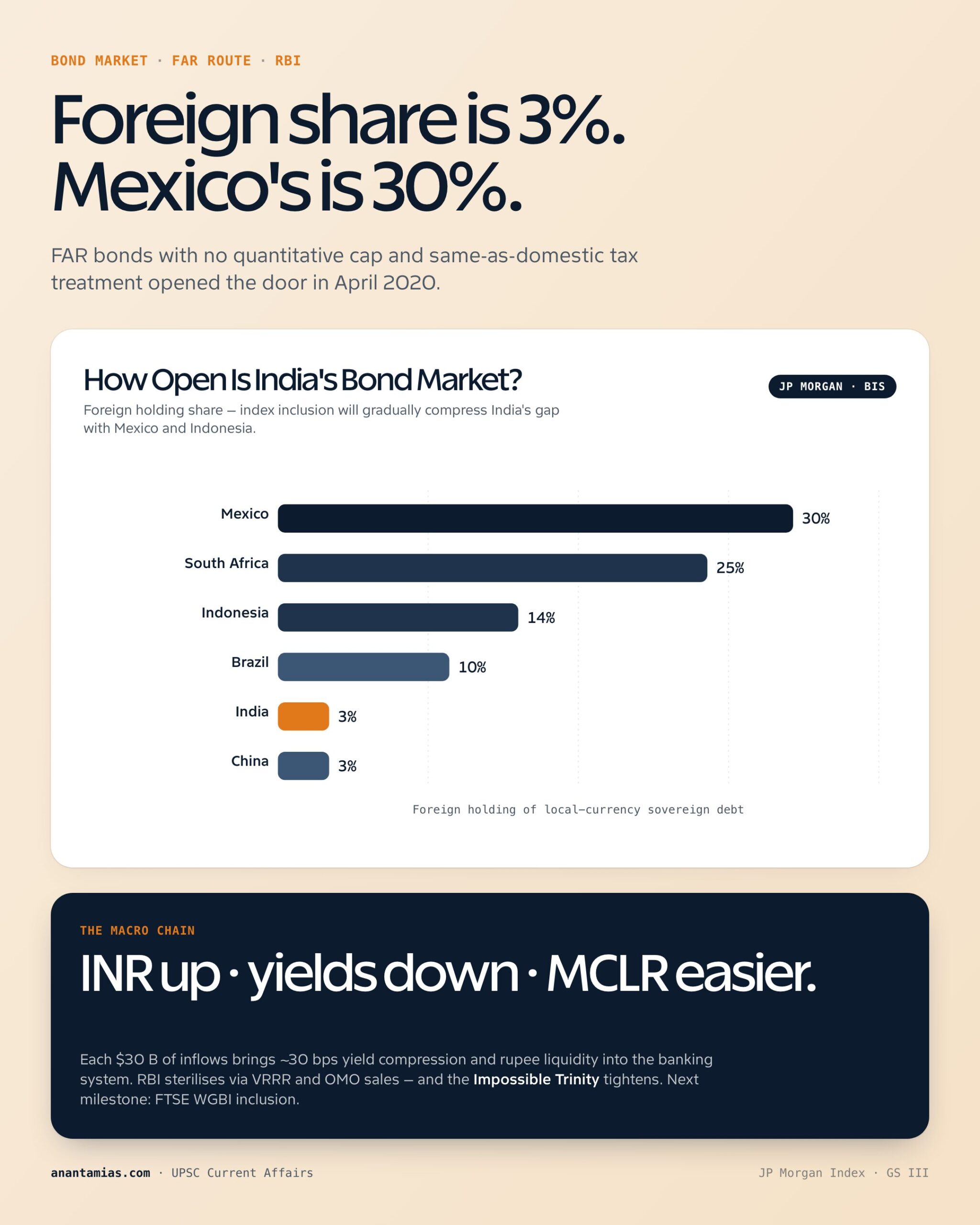
The structural shift is real — but the scale of foreign holding is still small versus large emerging peers (Mexico, Indonesia have 15-30 percent foreign holding).
International Comparisons
| Country | Foreign Holding of Local-Currency Sovereign Debt | Index Inclusion |
|---|---|---|
| Mexico | ~30% | GBI-EM, Bloomberg |
| Indonesia | ~14% | GBI-EM, Bloomberg, FTSE |
| South Africa | ~25% | GBI-EM, Bloomberg, FTSE |
| Brazil | ~10% | GBI-EM, Bloomberg |
| China | ~3% | Bloomberg, FTSE WGBI |
| India | ~3% | GBI-EM (2024-25), Bloomberg (2025), FTSE (watchlist) |
India's foreign-holding share has room to rise; the inclusion will gradually push it up as actively managed funds also follow passive flows.
Way Forward
- Sustained macro discipline — fiscal-deficit consolidation, low inflation, predictable monetary policy.
- Deepen liquidity — more issuance in benchmark FAR bonds, reduce fragmentation.
- Tax certainty for FPIs in G-Secs and corporate bonds.
- Develop derivative markets — credit default swaps, corporate bond ETFs, bond futures at GIFT-IFSC.
- Sterilise inflows efficiently through OMOs, VRRR; build forex reserves prudently.
- Watch the impossible trinity: as openness deepens, careful management of currency interventions and policy rates is essential.
- Push for FTSE WGBI inclusion — the next milestone — by addressing residual settlement and tax frictions.
UPSC Relevance
GS-III Mapping
- Indian economy — mobilization of resources, growth.
- Government budgeting — interest costs, fiscal-deficit financing.
- Effects of liberalization on the economy.
- External sector — capital flows, exchange rates.
Prelims Pointers
- GBI-EM Global Diversified — JP Morgan flagship EM bond index.
- FAR bonds — Fully Accessible Route, RBI 2020.
- India inclusion start: June 28, 2024; final weight 10 percent by March 2025.
- Bloomberg Emerging Markets Local Currency Index — India inclusion January 2025.
- FTSE EMGBI — India on watchlist (March 2024).
- Foreign holding of G-Secs ceiling under FAR: no quantitative cap.
Mains Hooks
- "Discuss the implications of India's inclusion in JP Morgan's GBI-EM Global Diversified Index for the Indian bond market and macroeconomy." (GS-III)
- "Examine how integration into global bond indices affects monetary policy autonomy." (GS-III)
- "What does internationalisation of the rupee require beyond bond-market openness?" (GS-III)
The inclusion in JP Morgan's index is not a one-time event but the start of a new phase in India's external integration. The benefits — lower yields, deeper bond markets, larger reserves, rupee internationalisation — are real but accompanied by new risks of currency volatility and reduced monetary autonomy. For UPSC, master the mechanism (FAR bonds, GBI-EM weight, phased inclusion), the data (USD 25-30 billion inflows, foreign-holding share, yields), and the policy implications (Impossible Trinity, OMO/VRRR, GIFT-IFSC reforms) to write authoritative GS-III answers on India's external sector and financial markets.
The Mechanics of Index Tracking
When a country is included in a major index, three categories of money flow in:
- Passive funds (ETFs and index trackers) — must hold the country's bonds proportional to the index weight. Roughly USD 100-120 billion of strictly passive money tracks GBI-EM.
- Index-aware active funds — benchmarked to the index but with discretion; tend to overweight or underweight individual countries based on their views.
- Sovereign wealth funds and pension funds — gradually rebalance into the country once it is in their reference index.
For India, the strict passive flow is around USD 25-30 billion; the broader, slower active flow could push cumulative foreign holdings to USD 50-70 billion over 3-5 years.
Why FAR Bonds Were the Breakthrough
The Fully Accessible Route (FAR) introduced by RBI in April 2020 was the structural reform that made index inclusion possible:
- No quantitative cap on FPI investment in designated G-Secs.
- No lock-in period or tenure restrictions.
- Same tax treatment as domestic investors (but with TDS).
- Clear list of eligible securities updated periodically by RBI.
By 2023, around 23 G-Secs were under FAR with face value of USD 350 billion — well above the index can absorb at 10 percent weight. This eligible pool surplus assured JP Morgan that liquidity would be deep regardless of inclusion-driven demand.
Macroeconomic Linkages: A Worked Example
Suppose USD 30 billion flows in via JP Morgan inclusion over a year:
- INR appreciation pressure: Without RBI intervention, INR could appreciate by 2-3 percent. RBI typically intervenes to prevent excess appreciation.
- Forex reserves rise: USD 30 billion adds to reserves (already >USD 700 bn).
- Money supply expansion: USD bought in dollar-rupee market means rupee liquidity injected into banking system.
- Sterilisation needed: RBI conducts Variable Rate Reverse Repo (VRRR), CRR adjustments, OMO sales to sterilise the liquidity.
- Yield impact: 10-year yields fall by 15-30 basis points; corporate bond spreads compress.
- Lending rate impact: Bank MCLR/EBLR easing slightly, supporting credit demand.
The chain shows how a single capital-account event reverberates through monetary policy, fiscal cost of borrowing, and corporate credit markets.
A Roadmap for Deeper Integration
- FTSE WGBI inclusion as the next milestone — addresses tax certainty, settlement timeliness.
- Sovereign green bonds scaled to attract ESG-focused passive flows.
- Corporate bond ETFs and bond futures at GIFT-IFSC to deepen secondary market.
- Standardised settlement via Euroclear or Clearstream.
- MIBOR transition to a new Indian benchmark with global recognition.
- Rupee invoicing in trade with willing partners — UAE, Sri Lanka, Russia, Africa pilots — for natural rupee demand abroad.
These steps would gradually internationalise the rupee without compromising macroeconomic stability.
Tell Google you want more of this.
Add Anantam IAS as a preferred sourceOne tap, and this site shows up more often in your own Top Stories, AI Overviews and AI Mode. Remove it any time.