India and Iran share a 2,500-year civilisational relationship — Persian was the court language of Mughal India, and modern Iran sits on India’s extended neighbourhood, providing the only overland access to Afghanistan and Central Asia that bypasses Pakistan. The relationship is shaped by a triangle of pressures: US sanctions, Iran-Israel tensions, and Iran’s deepening ties with China and Russia. In May 2024, India signed a 10-year agreement to operate the Chabahar port — a signal that strategic autonomy survives sanctions pressure. For UPSC GS II, India-Iran tests connectivity diplomacy and strategic autonomy.
Historical context
Formal diplomatic ties began in 1950. Cold War-era Iran under the Shah had pro-US, anti-USSR orientation; India-Iran ties stayed cordial. The 1979 Islamic Revolution initially complicated relations, but the two countries developed a functional cooperation through the 1990s. Iran was India's second-largest oil supplier in 2009-10; this dropped to under 1% share after 2020 due to US sanctions following the Trump administration's 2018 withdrawal from the JCPOA.
Importance of Iran for India
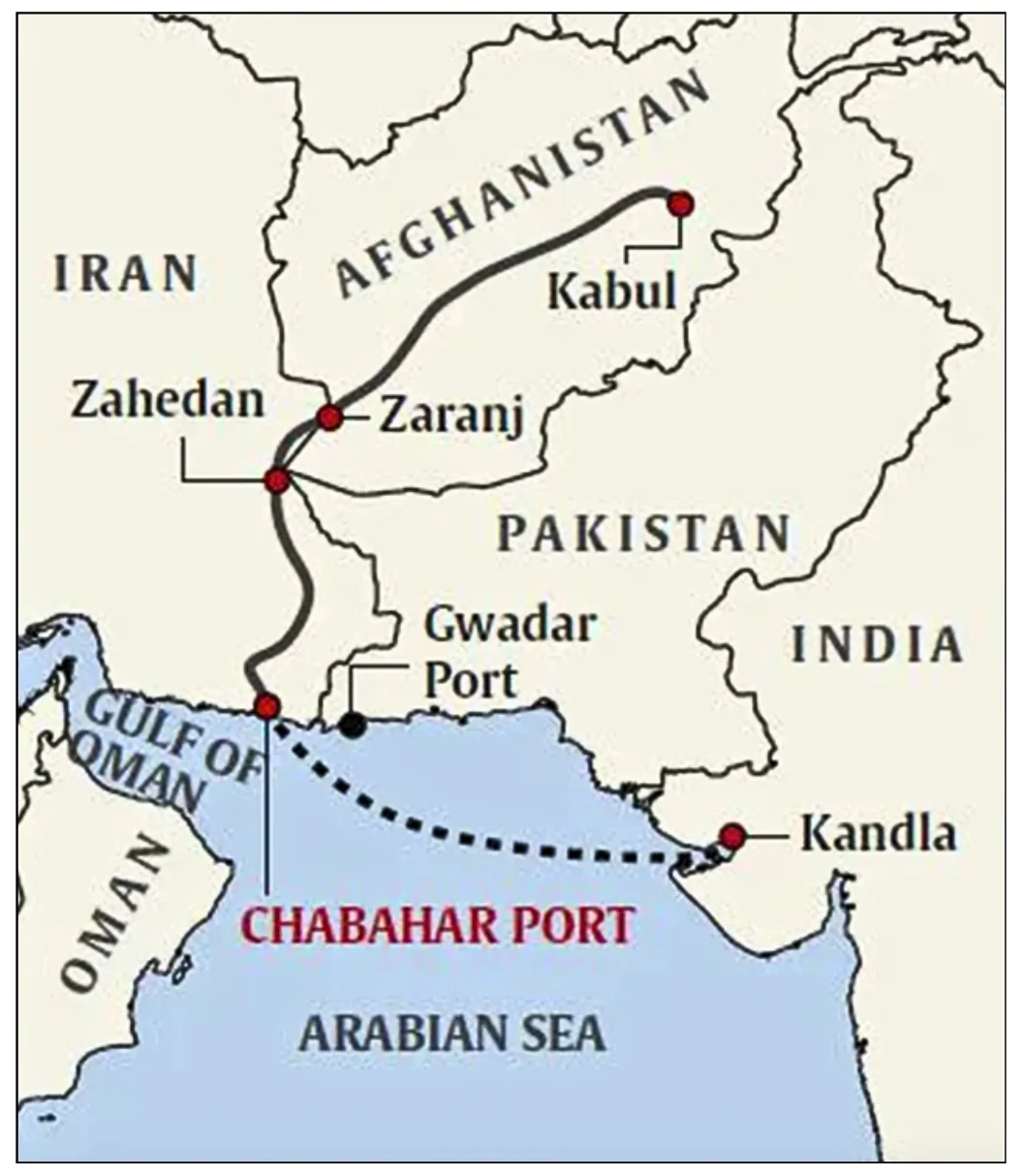
- Connectivity — Chabahar port, INSTC, Afghan transit.
- Energy — historically a major supplier; significant reserves of oil and gas.
- Security — cooperation against the Taliban in the 1990s, ISKP now.
- Cultural — Persian literature, Shia community links.
- Extended neighbourhood — Iran borders the Gulf, Caspian, South Asia and Central Asia.
Chabahar port
The Shahid Beheshti terminal at Chabahar on Iran's Makran coast, outside the Strait of Hormuz, is India's flagship Iran investment.
| Milestone | Year |
|---|---|
| Tripartite MoU (India-Iran-Afghanistan) | 2016 |
| First operational phase; India Ports Global Limited (IPGL) | 2018 |
| US sanctions exemption for Chabahar | 2018-24 |
| 10-year agreement — IPGL operates Shahid Beheshti | May 2024 |
| USD 120 million investment + USD 250 million credit line | 2024 |
Strategic value
- Access to Afghanistan and Central Asia bypassing Pakistan.
- INSTC western corridor anchor.
- Counter to Gwadar (Pakistan, Chinese-developed) 76 km away.
- Taliban-led Afghanistan has also invested in Chabahar (~USD 35 million).
- Potential bilateral trade via Chabahar estimated at USD 200 billion+ for India-Central Asia.
US sanctions posture
The US historically granted Chabahar a national security exemption from CAATSA. In 2024, with the new 10-year deal, Washington signalled possible sanctions — an issue New Delhi is managing through sustained diplomacy.
Areas of cooperation
Oil and gas
- Imports collapsed from USD 17 billion (2018-19) to USD 2.33 billion (2022-23) due to sanctions.
- Farzad-B gas field — discovered by ONGC Videsh (OVL); Iran awarded development to a domestic firm in 2021 — a setback for India.
Trade
- Basmati rice, tea, pharmaceuticals are major Indian exports.
- Rupee-rial trade mechanism used during sanctions; has unutilised balances issues.
Connectivity
- Chabahar-Zahedan railway — originally Indian offer; Iran reportedly awarded to a domestic firm, now India is re-engaged on phase-two equipment.
- INSTC — operational through Iran.
Diplomatic engagement
- PM Modi visit (2016).
- Vice-President Jagdeep Dhankhar's visit to Tehran (2024) for President Raisi's funeral after his helicopter crash.
- Regular EAM visits.
Regional cooperation
- Engagement with Taliban-led Afghanistan through Tehran.
- Shia-Sunni balance — Iran helps manage sectarian extremism.
- Counter-narcotics cooperation.
Challenges
Geopolitical pressure
- US sanctions regime (CAATSA).
- Iran-Israel tensions — direct confrontation in April and October 2024.
- Iran's support to Houthis, Hezbollah, Hamas — affects Indian maritime interests.
Regional rivalries
- Iran-Saudi detente (2023) helps but tensions persist.
- Iran-Pakistan air strikes (January 2024) — India stayed neutral.
China factor
- 25-year Iran-China strategic agreement (2021) — USD 400 billion potential investment.
- Iran joined BRICS (2024).
- Iran joined SCO (2023).
- China mediated Iran-Saudi normalisation — India watched carefully.
Iran's political positions
- Criticised India's Article 370 abrogation (Supreme Leader Khamenei, 2020).
- Supports Pakistan's Kashmir stance occasionally.
Farzad-B setback
Despite OVL's discovery work, Iran awarded the development contract to a domestic firm.
Project implementation
India has a poor track record on rapid project delivery in Iran — Chabahar expansion, Zahedan rail.
Latest developments (2024-26)
- Chabahar 10-year agreement (May 2024).
- President Ebrahim Raisi's death (helicopter crash, May 2024); Masoud Pezeshkian elected President (July 2024) — signals reformist opening.
- Iran-Israel strikes — April 2024 and October 2024 — direct missile attacks.
- BRICS expansion (January 2024) — Iran joined.
- Red Sea crisis (late 2023-) — Iran-backed Houthi attacks on shipping affected Indian trade; Indian Navy's Operation Sankalp with 12+ ships.
- G20 New Delhi (2023) — Iran not invited.
- Quad Summit Wilmington (2024) — indirect references.
- Russia-Ukraine update — Iran supplied Shahed drones to Russia; complicates India's balancing.
- AI Action Summit Paris (2025) — Iran sanctions discouraged participation.
- Operation Sindhu Thakur / Ajay style NEOs — India evacuated citizens from Israel during October 2023 escalation.
- JCPOA revival stalled; Iran's enrichment levels at near-weapons grade.
- Indian Naval Ship visits to Bandar Abbas continue.
- Pezeshkian's outreach to India (2024) emphasised Chabahar and INSTC.
Way forward
- Operate Chabahar at volume — logistics, storage, India-Central Asia cargo flows.
- Manage US sanctions risk — maintain exemptions via diplomatic engagement.
- Revive gas cooperation where possible; explore LNG.
- Use Chabahar-INSTC as complement to IMEC.
- Balance Iran with Israel, Saudi, UAE — no choosing sides.
- People-to-people — cultural diplomacy, education scholarships.
- Track the Pezeshkian reformist opening — support openings where feasible.
Bilateral trade snapshot
| Year | India-Iran trade (USD bn) | Note |
|---|---|---|
| 2018-19 | 17.03 | Pre-sanctions peak |
| 2019-20 | 4.77 | Sharp drop after US sanctions |
| 2020-21 | 2.11 | COVID + sanctions |
| 2021-22 | 1.9 | Low baseline |
| 2022-23 | 2.33 | Slight recovery |
| 2023-24 | 2.5 | Chabahar stimulus |
Iran's external alignments
- BRICS member (2024).
- SCO member (2023).
- 25-year strategic agreement with China (2021) — ~USD 400 billion potential.
- Russia partnership — drones, trade, sanctions-busting.
- Saudi rapprochement (2023) — China-brokered.
- Growing EAEU ties — FTA potential.
JCPOA and the nuclear file
The Joint Comprehensive Plan of Action (2015) — between Iran, P5+1 (US, UK, France, Russia, China, Germany) — limited Iran's nuclear programme in exchange for sanctions relief. Trump withdrew the US in 2018; Iran progressively reduced compliance. Iran's enrichment reached 83% purity in 2023 — near weapons-grade. Revival talks have stalled; Pezeshkian's government has signalled willingness.
For India, the JCPOA matters because:
- Its collapse triggered sanctions that ended Iranian oil imports.
- A revival would open energy and trade channels.
- Nuclear proliferation in West Asia would destabilise the region further.
India's Shia community
India has approximately 20-30 million Shia Muslims, one of the largest populations globally. Ayatollah Khamenei's comments on Indian Muslims (particularly after the 2020 Delhi riots and the 2024 statement) have been diplomatic irritants. India's response: firm pushback on internal affairs, separated from bilateral cooperation.
Chabahar in operational terms
- Shahid Beheshti Terminal — Phase 1 commissioned 2018.
- IPGL (India Ports Global Limited) — operational since 2019.
- Cargo handled (2023-24): 2+ million tonnes, up from 0.6 million tonnes (2020-21).
- Afghan traffic — wheat shipments to Afghanistan routed through Chabahar.
- Equipment supplied by India — mobile harbour cranes, conveyors.
Iran's regional proxy network
Iran leads the Axis of Resistance:
- Hezbollah (Lebanon)
- Hamas (Gaza) — reportedly some distance after October 2023
- Houthis (Yemen)
- Popular Mobilisation Forces (Iraq)
- Syrian government forces (post-Assad, uncertain)
This network directly affects India's Red Sea shipping, Gulf diaspora, and oil imports. Managing Iran means engaging Tehran while maintaining ties with Saudi Arabia, UAE, and Israel.
2024-25 regional escalations
- April 2024: Iran-Israel direct missile exchange; India coordinated NEO for its citizens.
- October 2024: Israeli retaliation on Iranian military sites.
- Houthi Red Sea attacks: 100+ vessel incidents in 12 months.
- Iran-Pakistan exchange (January 2024): cross-border strikes; India stayed neutral.
- Hezbollah-Israel escalation (September-October 2024): Nasrallah killed; wider conflict brief.
UPSC Relevance
India-Iran is tested in GS II — bilateral relations, effect of policies of developed countries. Prelims has asked about Chabahar, INSTC, JCPOA. Mains prompts rotate between sanctions navigation, Chabahar, and strategic autonomy.
Practice question (Mains): "India-Iran relations are shaped by geography but constrained by sanctions." Examine the Chabahar port agreement of 2024 in this context. (250 words)
Tell Google you want more of this.
Add Anantam IAS as a preferred sourceOne tap, and this site shows up more often in your own Top Stories, AI Overviews and AI Mode. Remove it any time.