In November 1895, in a hall in Calcutta, a Bengali physics professor sent an invisible signal through two walls, rang a bell in the next room, and set off a small charge of gunpowder some twenty-three metres away — with nothing connecting transmitter and receiver but the air. The audience saw no wire, no spark crossing the gap, only the result. What they were watching, though they could not have named it, was one of the earliest public demonstrations of wireless transmission anywhere in the world.
The man at the bench was Jagadish Chandra Bose, and the demonstration is only the most dramatic moment in a career that refuses to fit any single box. He worked on radio waves before radio was a business, then turned around and tried to prove that a carrot has a nervous response. He refused to patent the inventions that could have made him rich. He built India’s first serious research institute out of his own conviction that science belonged to everyone. And he did most of it inside a colonial system that paid him a third of what it paid his European colleagues. For a UPSC aspirant, Bose is the rare figure who sits across physics, biology, the freedom-era awakening of Indian science, and even the history of Bengali literature.
A Life Between Two Worlds
Bose was born on 30 November 1858 in Mymensingh, in what was then eastern Bengal and is now Bangladesh. His father, Bhagawan Chandra Bose, was a deputy magistrate who made an unusual choice: rather than send his son straight to an English-medium school, he put him first in a Bengali-medium village pathshala, alongside the children of farmers and fishermen. Bose later said this early grounding in the vernacular and in ordinary life shaped his curiosity about the natural world more than any laboratory could. Only afterwards did he move to St. Xavier’s College in Calcutta, taking his degree from the University of Calcutta in 1879.
He then sailed for England. The plan was medicine at the University of London, but recurring illness — and a deeper pull toward the physical sciences — sent him instead to Christ’s College, Cambridge, where he studied under figures like Lord Rayleigh and earned a Natural Sciences degree in 1884, along with a BSc from London. So by his mid-twenties Bose had been trained by some of the best experimental physicists in the world, and he carried that training home.
Returning to India in 1885, he joined Presidency College, Calcutta, as a professor of physics. And here he ran straight into the colour bar of empire. As an Indian, he was offered a salary far below that of his British peers — by some accounts a third of theirs. Bose’s response was quiet but absolute: he taught for three years without drawing any salary at all, refusing to accept unequal pay. The college eventually relented and gave him his full salary with retrospective effect. It was a small act of resistance, but a telling one. Long before he was famous, Bose had decided that dignity was not negotiable.
The Physicist Who Anticipated the Wireless Age
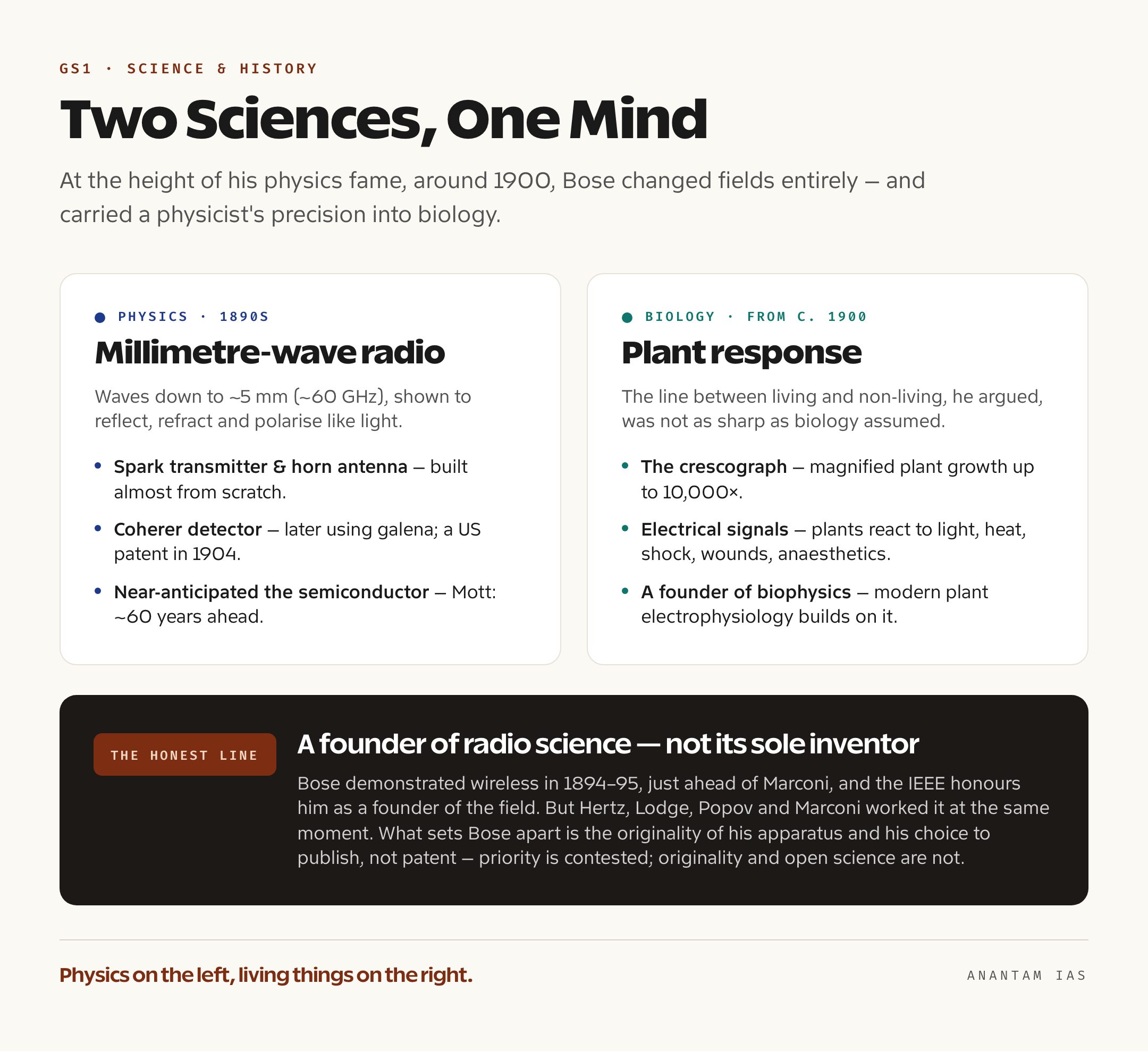
Bose’s first great body of work was in physics, and it was startlingly ahead of its time. In November 1894 he began generating very short electromagnetic waves — what we now call microwaves, with wavelengths down to about 5 millimetres, corresponding to a frequency near 60 gigahertz. To study them he had to build, almost from scratch, an entire toolkit that radio engineers still recognise: a spark transmitter, a self-recovering “coherer” to detect the waves, a dielectric lens, a wire-grid polariser, a horn-shaped antenna, and a diffraction grating to measure wavelength. He used these to demonstrate that radio waves could be reflected, refracted and polarised, exactly like light — proving they were the same kind of thing, just longer.
That work led to the public demonstration of 1895, when he transmitted a signal through walls to ring a bell and trigger gunpowder at a distance. He published his findings, including a paper read at the Royal Society in 1897 on measuring the wavelength of electric radiation, and lectured to packed rooms in London. Crucially, he chose millimetre waves not because they were practical for long-distance signalling but because their short wavelength let him study their optical behaviour inside a small laboratory. He was a pure scientist asking how the waves behaved, not an entrepreneur asking how to sell them.
His detector work matters just as much as the waves. Bose developed a coherer using a point-contact between metals and, later, the mineral galena (lead sulphide) — in effect an early semiconductor junction. In 1904 he was granted a United States patent for a “detector for electrical disturbances” using galena, making him one of the first people to patent a solid-state diode detector. Decades later the Nobel laureate Sir Nevill Mott, a pioneer of semiconductor theory, remarked that Bose had been about sixty years ahead of his time and had effectively anticipated the existence of p-type and n-type semiconductors. The man chasing invisible waves in the 1890s had brushed against the physics of the transistor age.
The Priority Question, and the Choice Not to Patent
Here is where Bose’s story gets tangled, and where a careful answer matters more than a patriotic one. Bose was demonstrating wireless transmission in 1894-95, slightly ahead of Guglielmo Marconi’s first patents and public demonstrations. His self-recovering coherer was reported to the Royal Society in 1899, and there is a long-standing claim — repeated by the IEEE and by historians of radio — that the very receiver Marconi used to pick up the first transatlantic signal in 1901 relied on an iron-mercury-iron coherer of the kind Bose had described. On that basis the Institute of Electrical and Electronics Engineers has honoured Bose as one of the founders of radio science, and a 1998 paper in its proceedings revisited his contribution as an unsung pioneer.
But the honest framing is this: Bose did not invent radio single-handedly, and Marconi did not simply steal it. Heinrich Hertz had already proved electromagnetic waves existed; Oliver Lodge, Alexander Popov, Marconi and others were all working the same field at the same moment. What sets Bose apart is not a clean claim of “first” but the depth and originality of his apparatus, and above all what he chose to do with it. Bose was almost hostile to the idea of owning knowledge. He told audiences that the discoveries of science should be free to all, and he largely refused to patent his work; the one US patent he did take, he reportedly allowed to lapse. So while Marconi built a company and won a Nobel Prize, Bose published, demonstrated, and walked away from the commercial gold rush.
That choice cost him fame in his own lifetime and has fed a tidy nationalist legend ever since — the Indian genius robbed by the West. The truth is more interesting and more useful. Bose’s open-science stance was a principled position, not an oversight, and it is exactly why his name faded from the commercial story of radio while staying central to the scientific one. For an exam answer, that distinction — priority is contested, but originality and open science are not — is the mature line to take.
From Waves to Living Things: The Crescograph
Around 1900, at the height of his physics reputation, Bose did something almost no scientist does: he changed fields entirely. He had noticed that his metal coherers seemed to grow “tired” and recover, behaving almost like living tissue, and this pushed him toward a radical idea — that the line between the living and the non-living was not as sharp as biology assumed, and that plants too could feel and respond.
To test it he invented the crescograph, an instrument of extraordinary sensitivity that magnified the growth and movement of a plant by as much as ten thousand times, letting him record changes as small as a hundred-thousandth of an inch. With it, and with electrical recording devices, Bose showed that plants respond to light, heat, cold, electric shock, wounds and chemicals — including anaesthetics — with measurable electrical and mechanical signals, much as an animal nerve does. He demonstrated these experiments at the Royal Institution and the Royal Society in London, and laid them out in books such as Response in the Living and Non-Living (1902) and The Nervous Mechanism of Plants (1926).
The reception was mixed. Physicists admired the instruments; many physiologists thought he had overreached in claiming something like a nervous system in plants, and parts of his interpretation were genuinely disputed. But the core empirical claim — that plants generate electrical signals in response to stimuli — has aged well. Modern plant electrophysiology and the field sometimes called plant neurobiology rest on exactly the kind of measurements Bose pioneered, and he is now widely regarded as a founder of biophysics. He had used the precision of a physicist to open a question biologists are still answering.
The Institute, the Honours, and a Life in Letters
Bose’s deepest legacy is not an instrument but an institution. On 30 November 1917 — his fifty-ninth birthday — he founded the Bose Institute (Basu Bigyan Mandir) in Calcutta, dedicating it, in his own words, not just to the advancement of science but to its diffusion. He conceived it as a place of open, interdisciplinary research, often described as the first such research centre in Asia, where lectures were free to the public and discoveries were not to be locked up in patents. It survives today as an Institute of National Importance under the Department of Science and Technology, still carrying his name and his ethos.
The honours, when they came, were substantial. He was made a Companion of the Order of the Indian Empire in 1903 and of the Order of the Star of India in 1912, knighted in 1917, and in 1920 elected a Fellow of the Royal Society — the first Indian to be so honoured for work in the physical sciences. A crater on the far side of the Moon is named Bose in his memory.
And there is a final, surprising facet. Bose was a writer. His 1896 Bengali story Niruddesher Kahini (“The Story of the Missing One”), later reworked as Palatak Tuphan, is reckoned one of the earliest works of Bengali science fiction — a tale in which a brewing cyclone is calmed by, of all things, a bottle of hair oil poured on the sea. He moved easily among the great minds of the Bengal Renaissance, counting Rabindranath Tagore as a close friend, and was sustained in his research by the support of the Irish reformer Sister Nivedita. The same man who measured the pulse of a plant also helped invent a literary genre.
Why Bose Still Matters
So what does a scientist who died in 1937 have to say to India in 2026? More than his dates suggest. His refusal to patent reads almost prophetically in an age arguing over open-access journals, open-source software and who should own the fruits of publicly funded research. India’s own push for open science and for making government-funded research freely available echoes a stance Bose took a century early, and at real personal cost.
His career is also the founding chapter of indigenous science in India. Working in a colonial laboratory that doubted Indians could do original research, he produced work that the Royal Society could not ignore, and he built an institution to make sure the next generation would not have to leave the country to do serious science. That lineage runs straight to today’s network of national laboratories, the IISERs and the institutes of national importance. When India debates its research culture, its dependence on foreign journals, or its ambition to be a science power, Bose is the historical anchor.
Most of all, he is a model of integrity over advantage. He chose principle over patents, curiosity over a single discipline, and dignity over a colonial pay scale. In a culture that increasingly measures scientists by citations and patents, Bose’s quiet insistence that knowledge is a commons — to be given away, not fenced off — is the part of his legacy most worth keeping alive.
For Your Mains Answer
Bose is a flexible figure for GS Paper 1 (modern Indian history and the social-cultural awakening of the colonial period) and GS Paper 3 (science and technology, indigenous research, and the history of India’s scientific institutions). He also works in the Essay paper on themes like science and society, open versus proprietary knowledge, or dignity under colonial rule. Treat him as a case study, not a hero — examiners reward a candidate who can weigh the contested priority claim honestly rather than just asserting that Bose “invented radio.”
How to Build the Answer
Open with the dual identity — a physicist who became a biophysicist — because that span is what makes him distinctive. Then move in order: the colonial context and salary protest; the microwave and coherer work with its near-anticipation of semiconductors; the priority debate and the open-science choice; the crescograph and plant-response research; and finally the institutional and contemporary legacy. Close by connecting his open-science stance to today’s debates. That arc — context, physics, the patent choice, biology, legacy — fits almost any “contribution of Indian scientists” question.
Common Mistakes to Avoid
Don’t overclaim that Bose alone invented radio or that Marconi simply plagiarised him — the priority is genuinely contested, and an informed examiner will mark you down for the legend. Don’t reduce him to the crescograph; the physics is half the story. Don’t drown the answer in honours and dates; two or three anchors are enough. And don’t miss the open-science angle, which is the point that lifts the answer from a biography to an argument.
A Compact Answer Spine
Polymath physicist-turned-biophysicist in colonial Bengal → salary protest at Presidency College → millimetre-wave and coherer work (1894-95), near-anticipation of semiconductors → contested radio priority with Marconi, but a principled refusal to patent → the crescograph and proof that plants respond to stimuli → Bose Institute (1917), FRS (1920), founder of indigenous science → relevance to today’s open-science debate.
Diagram or Flowchart Idea
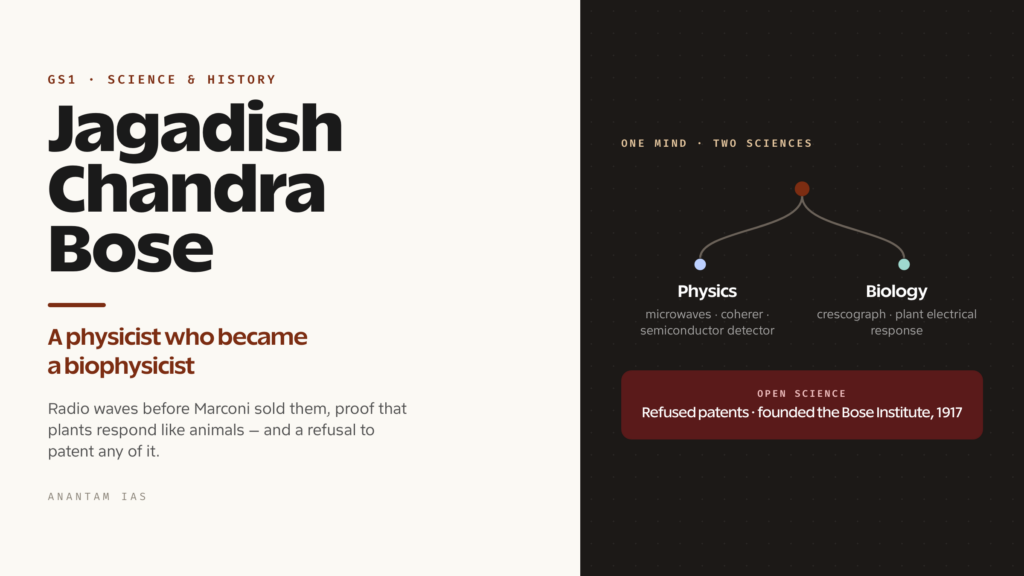
Draw a single mind splitting into two streams. Left stream: “Physics — microwaves, coherer, polariser, semiconductor detector.” Right stream: “Biology — crescograph, plant electrical response, biophysics.” Below, a shared base box: “Open science — refused patents, founded Bose Institute (1917).” A clean two-branch diagram like this shows you grasped the breadth, not just one half.
A Balanced-Conclusion Line
Close with the idea that Bose’s true legacy is not a disputed claim to have invented radio but a settled example of how to do science — across disciplines, in the open, and for the public good — which is exactly why a scientist of the colonial era still speaks to India’s research culture today.
How to Use Data Without Cramming
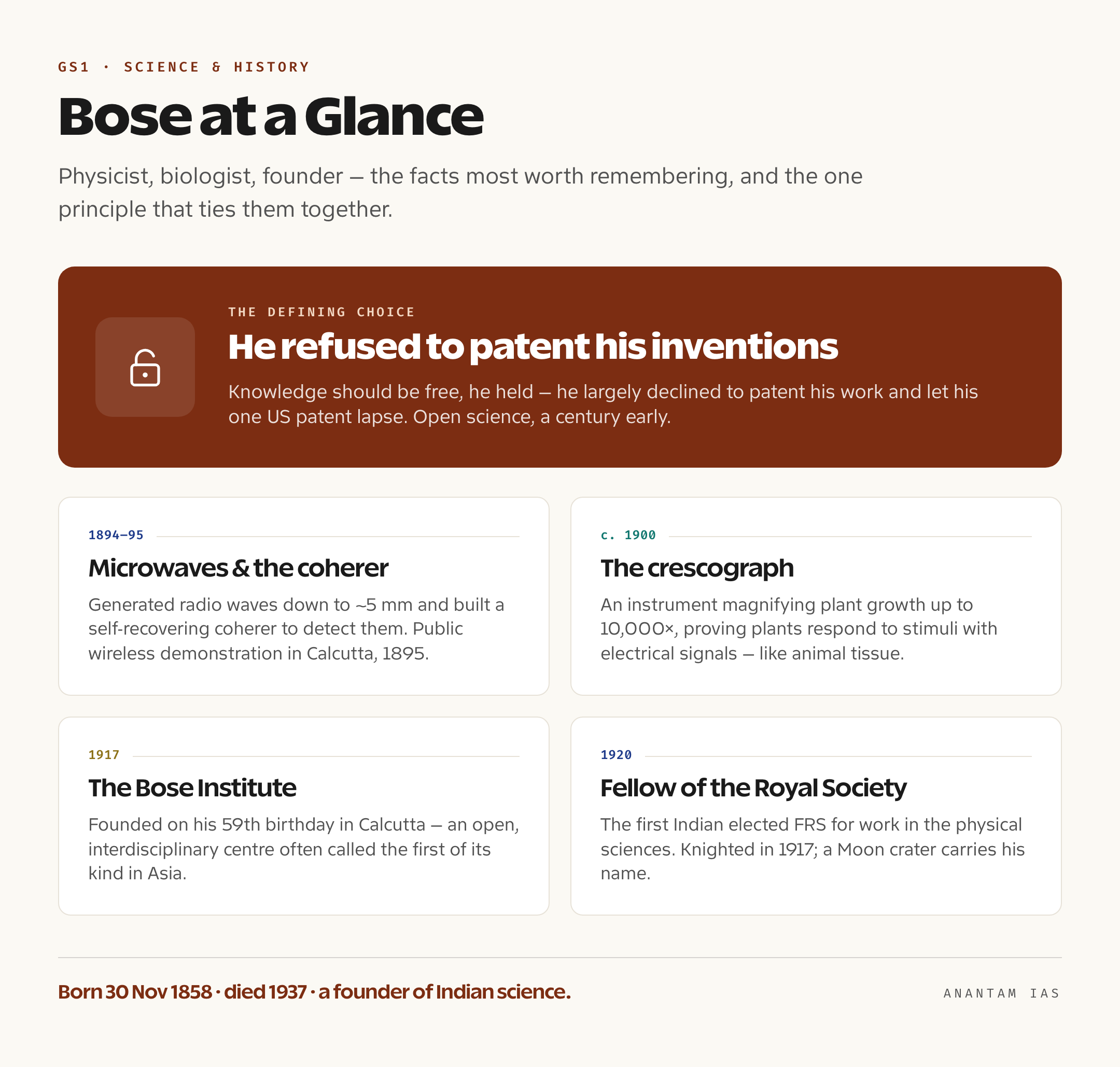
You don’t need a wall of figures. Four anchors carry the answer: 1894-95 (the microwave demonstrations), 1904 (the US patent for a solid-state detector), 1917 (the Bose Institute), and 1920 (Fellow of the Royal Society). Drop those precisely and let the argument do the rest.
FAQ
Did Jagadish Chandra Bose invent radio before Marconi? Bose demonstrated wireless transmission of microwaves in 1894-95, slightly ahead of Marconi’s first public work, and the receiver Marconi used for the 1901 transatlantic signal is widely said to have relied on a coherer of the kind Bose designed. But radio had several near-simultaneous pioneers — Hertz, Lodge, Popov, Marconi and Bose — so it is more accurate to call Bose one of the founders of radio science, as the IEEE has, than to say he alone invented radio.
What is the crescograph, and what did it show? The crescograph is an instrument Bose invented around 1900 that could magnify a plant’s growth and movement up to about ten thousand times, recording changes as small as a hundred-thousandth of an inch. With it he showed that plants respond to light, heat, electricity, wounds and chemicals with measurable electrical signals, much as animal tissue does — an early foundation of modern plant electrophysiology.
Why did Bose refuse to patent his inventions? Bose held that scientific knowledge should be free and shared, not owned for profit. He largely declined to patent his work, and even allowed the one US patent he took to lapse. That open-science stance cost him commercial fame but is central to his reputation today, and it foreshadows current debates about open access and publicly funded research.
What is the Bose Institute and when was it founded? Bose founded the Bose Institute (Basu Bigyan Mandir) in Calcutta on 30 November 1917, his fifty-ninth birthday, as an open, interdisciplinary research centre often called the first of its kind in Asia. It remains an Institute of National Importance under India’s Department of Science and Technology and still carries his name.
Practice Questions
Prelims MCQs
- With reference to the scientific work of Jagadish Chandra Bose, consider his contributions to physics. He is best known in this field for his pioneering research on which of the following?
(a) X-rays and radioactivity
(b) Very short electromagnetic (millimetre) waves and their detection
(c) Cosmic rays
(d) Nuclear fission
Answer: (b) Bose generated and studied millimetre-wavelength microwaves in the 1890s and built detectors such as the coherer to receive them. - The crescograph, an instrument associated with Jagadish Chandra Bose, was used to:
(a) Detect radio waves over long distances
(b) Measure the wavelength of electric radiation
(c) Magnify and record the minute growth and responses of plants
(d) Record seismic activity
Answer: (c) The crescograph magnified plant growth up to about ten thousand times, letting Bose record how plants respond to stimuli. - Consider the following statements about Jagadish Chandra Bose:
1. He was elected a Fellow of the Royal Society in 1920.
2. He founded the Bose Institute in Calcutta in 1917.
3. He received a Nobel Prize for his work on radio waves.
Which of the statements given above are correct?
(a) 1 and 2 only
(b) 2 and 3 only
(c) 1 and 3 only
(d) 1, 2 and 3
Answer: (a) Bose was elected FRS in 1920 and founded the Bose Institute in 1917; he never received a Nobel Prize. - Jagadish Chandra Bose is also remembered as a pioneer of which literary tradition?
(a) Bengali science fiction
(b) Urdu ghazal
(c) Tamil Sangam poetry
(d) Hindi detective fiction
Answer: (a) His 1896 Bengali story Niruddesher Kahini, later reworked as Palatak Tuphan, is regarded as one of the earliest works of Bengali science fiction. - With reference to Bose’s detector research, in 1904 he was granted a United States patent for a device using galena, making him an early pioneer of which technology?
(a) The vacuum tube
(b) The solid-state (semiconductor) diode detector
(c) The cathode-ray tube
(d) The induction coil
Answer: (b) His galena point-contact detector was an early solid-state diode, and the Nobel laureate Nevill Mott later said Bose had anticipated p-type and n-type semiconductors.
Mains Practice Questions
- “Jagadish Chandra Bose was a founder of radio science, not merely a claimant to the invention of radio.” Critically examine his contribution to wireless research in light of the contested priority debate with Marconi. (15 marks, 250 words)
- Discuss how Jagadish Chandra Bose used the precision of experimental physics to open new questions in biology, with reference to the crescograph and his work on plant response. (15 marks, 250 words)
- Bose’s refusal to patent his inventions is often read as a principled commitment to open science. Examine this stance and its relevance to contemporary debates on open access and publicly funded research in India. (15 marks, 250 words)
- Trace the role of Jagadish Chandra Bose in the rise of indigenous scientific research in colonial India, and assess the institutional legacy of the Bose Institute. (10 marks, 150 words)
- “Bose embodied integrity over advantage — across disciplines, against the colonial pay bar, and against the commercialisation of knowledge.” Comment on how his life illustrates the relationship between science, society and personal principle. (10 marks, 150 words)
Tell Google you want more of this.
Add Anantam IAS as a preferred sourceOne tap, and this site shows up more often in your own Top Stories, AI Overviews and AI Mode. Remove it any time.