Lachit Borphukan was the Ahom commander who recovered Guwahati from the Mughals in 1667 and led the defense of the Brahmaputra that forced Aurangzeb’s general Raja Ram Singh to withdraw in 1671, after the engagement remembered as the Battle of Saraighat. Born in 1622, he served the Ahom kings of Assam as Borphukan, their viceroy and commander for lower Assam. He is the reason the Mughal frontier in the north-east stayed at the Manas river instead of moving up the valley.
Most readers carry one tidy story: one battle, one general, one decisive day. The record is messier and more interesting. The war against Ram Singh ran from 1669 to 1671 with Ahom defeats as well as victories, the Ahom chronicles that describe it are confused in places, and Guwahati was lost again eight years later. This note follows what the chronicles and the official record actually support.
Lachit Borphukan at a Glance
Lachit’s career is short and dated mainly through the Ahom Buranjis (court chronicles) and the Mughal side’s brief notices. The table pulls together the facts that hold up.
| Fact | Detail |
|---|---|
| Born | 1622; 24 November is observed as Lachit Divas |
| Father | Momai Tamuli, who held the office of Borbarua |
| Kingdom | Ahom kingdom of Assam |
| Office | Borphukan, commander and viceroy for lower Assam, based at Guwahati |
| Appointed by | Swargadeo Chakradhwaj Singha, 1667 |
| Main campaign | Recapture of Guwahati, 1667; war against Ram Singh, 1669 to 1671 |
| Opponent | Raja Ram Singh of Amber, sent by Aurangzeb |
| Died | About a year after Saraighat, usually dated 1672 |
| Resting place | Lachit Maidam, Hoolungapara, Jorhat district |
The Ahom Kingdom Before Lachit
Lachit’s war only makes sense against the defeat that came before it. In the early 1660s, the Mughal governor of Bengal, Mir Jumla, invaded Assam, occupied the Ahom capital Garhgaon and forced King Jayadhwaj Singha into a humiliating peace.
That settlement, the Treaty of Ghilajharighat of January 1663, cost the Ahoms dearly. Gait lists its terms from the chronicles:
- a large indemnity in gold, silver and elephants, part at once and the rest within twelve months;
- the country west of the Bharali river on the north bank and of the Kalang on the south bank ceded to the Mughal emperor, which put Guwahati in Mughal hands;
- sons of the leading nobles handed over as hostages, and a daughter of the king sent to the imperial household.
Each side soon accused the other of breaking the terms. The Mughals said the indemnity wasn’t being paid; the Ahoms said the Mughals hadn’t withdrawn or released prisoners. Jayadhwaj Singha’s successor, Chakradhwaj Singha, rebuilt his forts and his army and decided to fight. He chose Lachit, son of a senior minister, to lead.
What was a Borphukan? It was one of the highest offices of the Ahom state: the officer who governed the lower part of the kingdom and commanded its forces there. Think of a frontier viceroy with an army, a navy of river boats and a court of his own at Guwahati.
Recapturing Guwahati in 1667
The first campaign was Lachit’s clearest success. Edward Gait’s History of Assam, built on the Buranjis, records that an Ahom army set out in August 1667 under Lachit, newly appointed Borphukan, to take Guwahati back.
The campaign moved in three stages:
- The Mughal outposts at Kajali on the south bank and Bansbari on the north fell at the first assault.
- The Ahoms built forts and advanced, losing one small stockade on the Barnadi but winning most engagements.
- Guwahati and Pandu were besieged for about two months and captured, and Mughal reinforcements that arrived by river in November were beaten back to the Manas.
An Assamese rock inscription in Kamrup records an Ahom fort built in Saka 1589 (1667 CE) after the defeat of the Mughal commander Firuz Khan. Guwahati became the Borphukan’s headquarters, and the Ahoms took a census and surveyed the recovered land. In four months, the losses of 1663 had been reversed.
The Battle of Saraighat and the War with Ram Singh
Aurangzeb heard of the loss in December 1667 and sent Raja Ram Singh of Amber, a senior Rajput commander, to restore the frontier. The answer to “who won Saraighat?” is the Ahoms, but the road there ran through two hard years.
A long war, not a single day
Ram Singh reached Rangamati, the Mughal base in western Assam, in February 1669. The Buranjis give his force as 18,000 cavalry, 30,000 infantry and 15,000 archers from Koch Bihar; the Mughal chronicle doesn’t state the number, so treat the figure as the Ahom estimate.
The fighting then swung back and forth:
- the Ahoms lost two land battles in the spring of 1669 but won a river battle and held their forts;
- Ram Singh pulled back to Hajo and quarrelled with his own officers;
- in a later clash Ram Singh routed the Ahom army, Lachit lost all his ships, and King Chakradhwaj censured him severely;
- talks for peace began, and during the pause Chakradhwaj died and his brother Udayaditya Singha took the throne.
Notice that Lachit was reprimanded in the middle of the war. Heroes in textbooks rarely are, and the detail tells you how close the Ahoms came to losing.
Why the river decided it
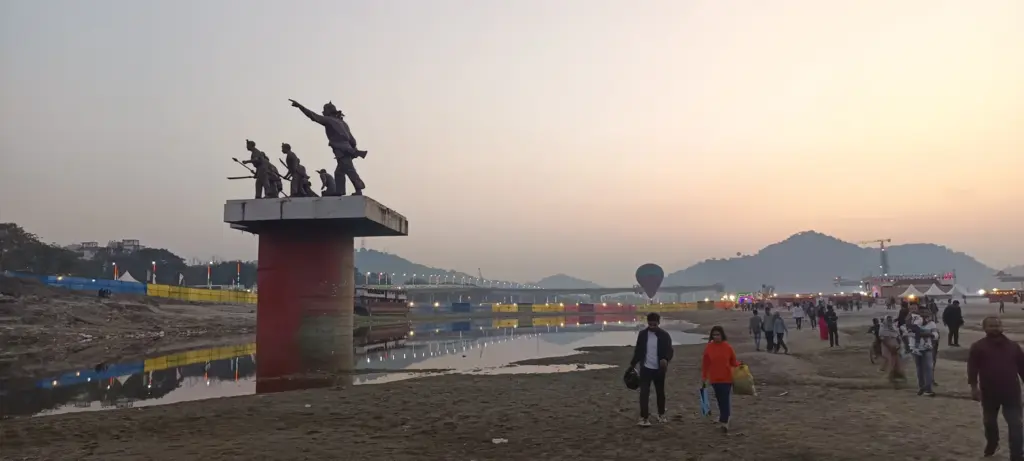
When fighting resumed, Lachit fought on ground he chose. He held the narrow stretch of the Brahmaputra at Saraighat near Guwahati, where the river runs between hills, and lined the banks with earthen ramparts. The Mughals were strong in cavalry and heavy guns; the Ahoms were strong in light, fast boats and local knowledge. In a narrow channel with fortified banks, the Mughal advantage shrank. IGNOU’s account describes exactly this: earthen walls along the banks to block the Mughal navy, and a fleet of armed boats harrying the enemy.
The decisive fighting came in March 1671. Gait notes that the Buranjis are too confused to follow every operation, but the result is clear: Ram Singh, weakened by repeated losses, retreated to Rangamati that month. Popular accounts say Lachit was seriously ill and still led the final attack from a boat; that story belongs to the tradition rather than to the dated record, and it should be written that way.
The live note on the Brahmaputra river system shows why the Saraighat narrows, where Guwahati’s bridges stand today, were the natural gate to upper Assam.
What Came After Saraighat
Saraighat stopped the Mughal advance, but it did not end the contest. Lachit died about a year after the battle, usually dated to 1672, and was buried in a maidam (an Ahom burial mound) at Hoolungapara near Jorhat, built by Udayaditya Singha.
The Ahom court then entered a decade of instability. In March 1679, a later Borphukan, Laluk, surrendered Guwahati to the Mughals as part of a court intrigue. It took King Gadadhar Singha to retake it in 1682, after which the Manas river became the accepted boundary and the Mughals made no further serious attempt on Assam. Saraighat bought time and morale; 1682 settled the frontier.
That sequence is the honest version of the story. Lachit’s victory was real and decisive for its moment, and it showed that Mughal armies could be beaten on Assam’s rivers. The permanent result came eleven years later, under a different king.
Legacy and How Assam Remembers Him
Lachit is now Assam’s central military hero. Each year on 24 November, his birth anniversary, the state observes Lachit Divas, and the Prime Minister’s tribute on Lachit Diwas has cited his leadership at Saraighat.
The most widely told story about him is about duty over family. When a rampart was not finished in time, the story goes, Lachit beheaded his own maternal uncle, who was in charge of the work, saying his uncle was not greater than his country. It is a popular tradition and appears in speeches and school texts, but the dated sources used here don’t record it, so cite it as tradition if you use it at all.
The national record has grown in recent years:
- 2022: year-long celebrations of his 400th birth anniversary, inaugurated in Guwahati in February 2022 and closed in New Delhi on 25 November 2022, when the book “Lachit Borphukan – Assam’s Hero who Halted the Mughals” was released.
- 9 March 2024: a large statue of Lachit Borphukan was dedicated in Jorhat by the Prime Minister.
- November 2024: the Ministry of Ports, Shipping and Waterways marked his 402nd birth anniversary in New Delhi, presenting Saraighat as a lesson in the strategic use of inland waterways.
His maidam belongs to a wider Ahom burial tradition. The royal Moidams of Charaideo were inscribed on the UNESCO World Heritage List in 2024; Lachit’s own maidam at Hoolungapara is a separate site and is not part of that property.
What Historians Dispute
Three points are open, and naming them makes an answer stronger.
Exact dates. The Buranjis and later accounts differ in detail. The Jorhat district administration’s page dates Saraighat to 1672, while Gait and the IGNOU unit put the decisive fighting and Ram Singh’s retreat in March 1671. The majority view, and the one used in official commemorations, is 1671. His death is usually given as 1672, about a year later.
How decisive was Saraighat? It ended Ram Singh’s campaign, but Guwahati fell again in 1679. Historians who stress the long view give equal weight to Gadadhar Singha’s recovery in 1682.
Single hero or collective effort? Gait’s narrative credits the king, the Borphukan and several other commanders, and records help from the Garos and a neighboring Raja. Lachit was the field commander, but the victory belonged to a whole state at war.
How to Study Lachit Borphukan for Exams
Lachit sits in GS Paper I medieval history, under the Mughal frontier and regional kingdoms, and in questions on the north-east’s place in Indian history. Read him with Aurangzeb and the wider Mughal Empire, because Saraighat is part of the same reign that saw the Maratha and Bundela revolts. The site’s Prelims question bank counts 184 of the 1,403 questions under History; Ahom names appear there mostly through Art and Culture and current events such as the Moidams.
Revise these facts:
- Born 1622; Lachit Divas on 24 November.
- Ahom general with the office of Borphukan under Chakradhwaj Singha, then Udayaditya Singha.
- Treaty of Ghilajharighat, January 1663, after Mir Jumla’s invasion.
- Recaptured Guwahati in 1667.
- Opposed Raja Ram Singh of Amber, sent by Aurangzeb; decisive fighting at Saraighat in March 1671.
- Died about 1672; maidam at Hoolungapara, Jorhat district.
- Guwahati lost in 1679, regained by Gadadhar Singha in 1682; Manas became the boundary.
Common confusions are worth fixing now. Lachit Divas marks his birth, not the battle. Ram Singh of Amber, the Mughal commander, is a different man from Ram Singh of Jaintia, who appears later in Ahom history. And Mir Jumla’s invasion of 1662-63 came before Lachit’s war, not during it.
Lachit is often set beside other leaders who resisted the Mughals in the same decades:
| Leader | Region | Key date | Method |
|---|---|---|---|
| Lachit Borphukan | Assam (Ahom) | Saraighat, 1671 | River warfare and fortified banks |
| Shivaji | Maharashtra (Maratha) | Coronation, 1674 | Hill forts and mobile cavalry |
| Chhatrasal | Bundelkhand (Bundela) | Revolt from 1671 | Guerrilla raids from forest and hill |
| Rana Pratap | Mewar | Haldighati, 1576 | Hill warfare from the Aravallis |
The note on Chhatrapati Shivaji Maharaj covers the Maratha case; the IGNOU unit itself quotes the description of Lachit as the Shivaji of eastern India.
The useful lesson from Lachit is geographic. A smaller state beat a larger one by choosing ground where the larger army’s strengths didn’t count. If your answer explains why the Saraighat narrows mattered, it already says more than one that only praises his courage.
Frequently Asked Questions
Who was Lachit Borphukan?
Lachit Borphukan was a 17th-century commander of the Ahom kingdom of Assam. He recaptured Guwahati from the Mughals in 1667 and led the defense that forced Raja Ram Singh’s army to withdraw after the fighting at Saraighat in 1671. He is remembered as Assam’s greatest military hero.
What was the Battle of Saraighat?
The Battle of Saraighat was the decisive phase of the Ahom-Mughal war, fought on the Brahmaputra near Guwahati in March 1671. The Ahoms used fortified river banks and fast boats to defeat a larger Mughal force led by Raja Ram Singh of Amber. After it, Ram Singh retreated to Rangamati.
Why is Lachit Divas celebrated on 24 November?
Lachit Divas is held on 24 November because that is observed as Lachit Borphukan’s birth anniversary; he was born in 1622. It does not mark the date of the Battle of Saraighat. Assam observes the day statewide, and national leaders pay tribute on it.
What does the title Borphukan mean?
Borphukan was one of the great offices of the Ahom state. The holder governed the lower part of the kingdom and commanded its forces there, with headquarters at Guwahati after 1667. Lachit’s father held another high office, that of Borbarua.
Who was the Mughal commander at Saraighat?
The Mughal commander was Raja Ram Singh of Amber, a senior Rajput general whom Aurangzeb sent after the Ahoms recaptured Guwahati in 1667. He reached Rangamati in February 1669 and fought the Ahoms for two years before withdrawing in March 1671.
When did Lachit Borphukan die and where is he buried?
Lachit died about a year after the Battle of Saraighat, a date usually given as 1672. His remains lie in the Lachit Maidam at Hoolungapara in Jorhat district, built by King Udayaditya Singha. A maidam is an Ahom burial mound.
Did the Ahoms keep Guwahati after Saraighat?
Not continuously. A later Borphukan surrendered Guwahati to the Mughals in March 1679 during a court intrigue. King Gadadhar Singha recovered it in 1682, and the Manas river then became the lasting boundary between the Ahoms and the Mughals.
Practice Questions
Prelims
1. Consider the following statements about Lachit Borphukan: 1. He commanded the Ahom forces that recaptured Guwahati in 1667. 2. Lachit Divas is observed on the anniversary of the Battle of Saraighat. 3. The Mughal commander he faced at Saraighat was Mir Jumla. Which of the statements given above is/are correct?
- (a) 1 only
- (b) 1 and 2 only
- (c) 2 and 3 only
- (d) 1, 2 and 3
Answer: (a) Lachit Divas marks his birth anniversary on 24 November, and the Mughal commander at Saraighat was Raja Ram Singh.
2. The Treaty of Ghilajharighat (1663) was concluded between the Ahoms and:
- (a) the Mughal commander Mir Jumla
- (b) the Koch king of Cooch Behar
- (c) the Burmese king of Ava
- (d) the Kachari king
Answer: (a) It followed Mir Jumla’s invasion and imposed an indemnity and loss of territory on the Ahoms.
3. Consider the following statements: 1. The Ahom king at the time of the Battle of Saraighat was Udayaditya Singha. 2. After Saraighat, Guwahati remained in Ahom hands without interruption. Which of the statements given above is/are correct?
- (a) 1 only
- (b) 2 only
- (c) Both 1 and 2
- (d) Neither 1 nor 2
Answer: (a) Guwahati was surrendered to the Mughals in 1679 and regained by Gadadhar Singha in 1682.
4. The Battle of Saraighat was fought on which river?
- (a) Barak
- (b) Brahmaputra
- (c) Teesta
- (d) Subansiri
Answer: (b) It was fought on the Brahmaputra near Guwahati, where hills narrow the river.
5. The Lachit Maidam, the resting place of Lachit Borphukan, is located in which district of Assam?
- (a) Sivasagar
- (b) Kamrup Metropolitan
- (c) Jorhat
- (d) Dibrugarh
Answer: (c) It is at Hoolungapara (Meleng-Hulungapar) in Jorhat district.
Mains
- How did geography shape the outcome of the Ahom-Mughal conflict in the 17th century? Illustrate with the Battle of Saraighat. (15 marks, 250 words)
- “Saraighat stopped the Mughals, but 1682 settled the frontier.” Examine. (10 marks, 150 words)
- Discuss the causes of the Ahom-Mughal wars from the Treaty of Ghilajharighat to the recovery of Guwahati in 1667. (10 marks, 150 words)
- Compare the resistance of the Ahoms, the Marathas and the Bundelas to Mughal expansion under Aurangzeb. (15 marks, 250 words)
- How far do the Ahom Buranjis help historians reconstruct the career of Lachit Borphukan, and what are their limits? (15 marks, 250 words)
Tell Google you want more of this.
Add Anantam IAS as a preferred sourceOne tap, and this site shows up more often in your own Top Stories, AI Overviews and AI Mode. Remove it any time.