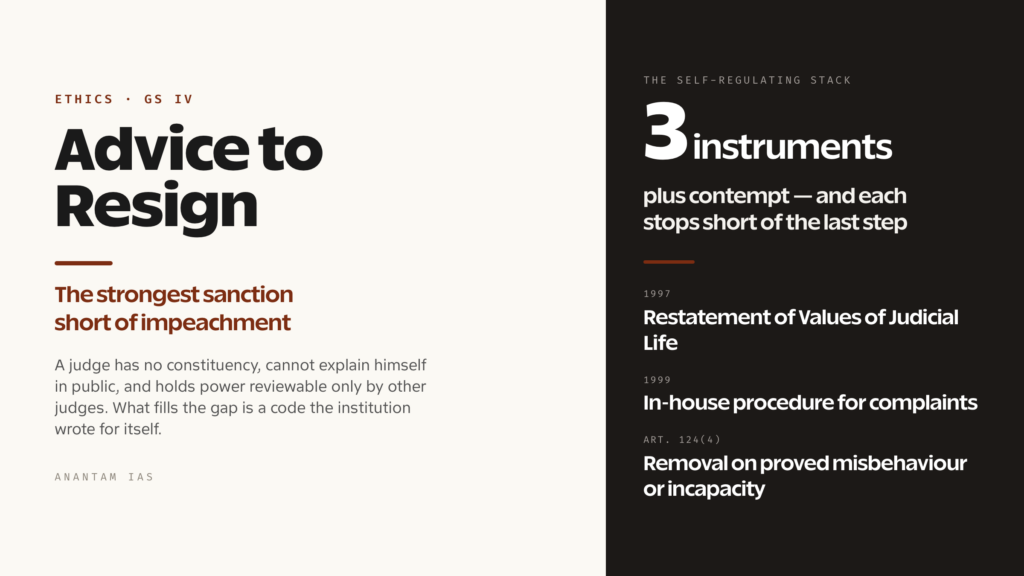
Accountability normally runs through one of three channels: an electorate that can remove you, a superior who can move you, or a public that can be told your reasons. A judge is insulated from all three by design, and that insulation is the condition on which judicial independence rests.
That leaves a genuine problem. A judge holds power over life, liberty and property, exercises it in the name of the state, and is reviewable in practice only by other judges. Indian judicial ethics is a series of attempts to fill that space, none of which has filled it.
Why Judicial Ethics Is a Different Problem
Three features set the judicial case apart.
There is no constituency. An MLA answers to voters, a secretary to a minister, a district officer to a hierarchy that can move him. The security of tenure that makes impartial adjudication possible also removes the ordinary lever.
The judge cannot explain. Public justification is the standard remedy for opaque power, and it is closed here: a judge who defends a judgment in a newspaper has compromised the next case. The reasoned order is his only permitted speech — a narrow channel for a wide power.
Review runs through peers. Complaints against judges are examined by judges, appointments recommended by judges, contempt punished by the court whose authority is at issue. The result is an institution that assesses itself — the condition accountability and responsibility exists to prevent everywhere else.
The Restatement of Values of Judicial Life, 1997
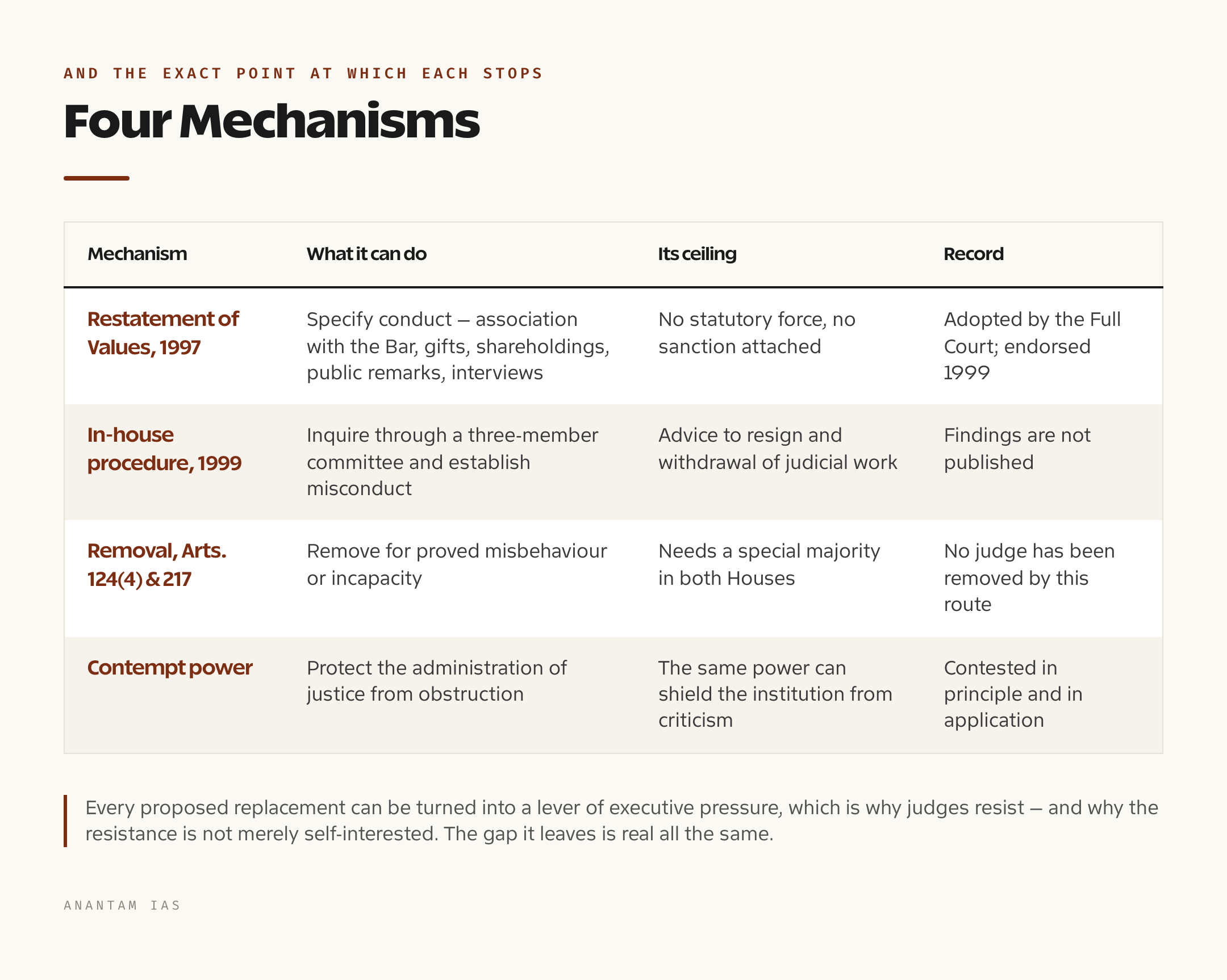
The Supreme Court’s Full Court adopted the Restatement of Values of Judicial Life in May 1997, and the Chief Justices’ Conference endorsed it in 1999. It is not a statute and carries no sanction; what makes it worth reading is its specificity about conduct rather than aspiration.
Its opening proposition is that justice must not merely be done but be seen to be done: a judge must be, and be seen to be, independent. Close association with members of the Bar practising in the same court is to be avoided. A judge shall not hear a matter in which a family member, close relation or friend is concerned, and no relative who is an advocate may appear before him. Gifts and hospitality are not to be accepted except from family and close friends. He shall not speculate in shares, engage in trade, or hold office in any club except one connected with law. He shall not express views in public on political matters or on questions likely to come before him. And he is to let his judgments speak for themselves rather than give interviews.
Read as a list, it catalogues how impartiality is actually lost — not by a bribe but through a friendship, a shareholding, a dinner, a remark.
The In-House Procedure and Its Ceiling
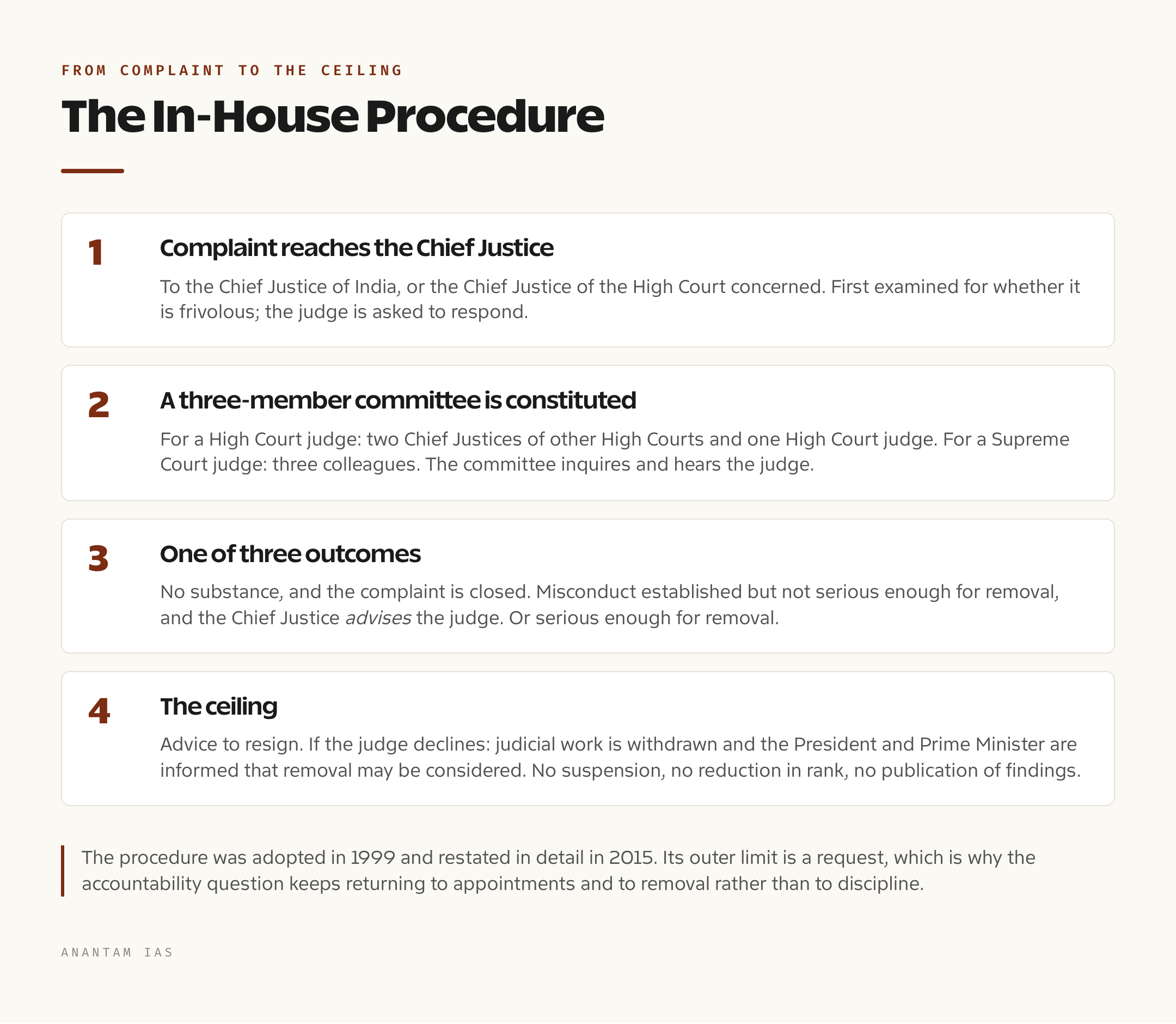
The Supreme Court adopted an in-house procedure in 1999 for complaints against higher-judiciary judges, and restated it in detail in 2015.
A complaint reaching the Chief Justice of India or a High Court Chief Justice is first examined for whether it is frivolous, and the judge is asked to respond. If it survives, the Chief Justice of India constitutes a three-member committee — for a High Court judge, two Chief Justices of other High Courts and one High Court judge; for a Supreme Court judge, three colleagues. The committee inquires and reports.
Three outcomes are possible. The complaint has no substance and is closed. The misconduct is established but not serious enough for removal, and the Chief Justice advises the judge. Or it is serious enough for removal, and the Chief Justice advises resignation — if the judge declines, the remaining steps are to withdraw judicial work and inform the President and Prime Minister that removal may be considered.
The ceiling sits in that last step. Short of impeachment, the strongest thing the institution can do to a judge whose serious misconduct its own committee has established is to ask him to leave and stop giving him cases — no suspension, no reduction in rank, no publication of the findings.
Removal Under Articles 124(4) and 217
The constitutional route is deliberately narrow. Article 124(4) permits removal of a Supreme Court judge only by order of the President, after an address by each House supported by a majority of its total membership and by not less than two-thirds of those present and voting, on the ground of proved misbehaviour or incapacity. Article 217 read with Article 218 applies the same to High Court judges. Article 124(5) leaves the procedure to the Judges (Inquiry) Act, 1968: a motion signed by 100 Lok Sabha or 50 Rajya Sabha members, admitted or refused by the presiding officer, then inquired into by a committee of a Supreme Court judge, a High Court Chief Justice and a jurist.
No judge has been removed under it. “Proved misbehaviour” sets an evidentiary standard close to a criminal one for conduct rarely provable in that form; the special majority requires a consensus that no misconduct short of the spectacular will generate; and the process is damaging enough that everyone prefers a quiet resignation.
In 1993 an inquiry committee found a sitting Supreme Court judge guilty of misbehaviour, and the motion failed in the Lok Sabha when a large bloc abstained. In 2011 the Rajya Sabha passed a motion against a High Court judge who resigned before the Lok Sabha took it up. The mechanism has produced resignations and no removals.
What the Bar May and May Not Do
Most real cases sit in the gap below removable misbehaviour, and the Bar has repeatedly tried to occupy it. In C. Ravichandran Iyer v. Justice A. M. Bhattacharjee (1995) the Supreme Court held that it may not: Bar associations cannot resolve that a judge should resign, strike, or agitate against a named judge, because the pressure that creates is itself a threat to independence.
The Court’s answer to the gap it had just identified was the in-house mechanism, with the Chief Justice as head of the judicial family and the Bar confined to a representation to him. That places the whole burden on an institution regulating itself, and where the Chief Justice does not act there is no second route.
Contempt: Protecting Justice, or the Institution
Article 129 makes the Supreme Court a court of record with power to punish for contempt, Article 215 does the same for High Courts, and Article 19(2) lists contempt as a ground for restricting speech. The Contempt of Courts Act, 1971 defines criminal contempt to include scandalising the authority of a court, prejudicing judicial proceedings, and obstructing the administration of justice.
The defensible core is narrow — proceedings must not be prejudiced, orders must be obeyed, witnesses must not be intimidated. The difficulty is “scandalising the court”, which protects the institution’s standing rather than any case, and puts the court in the position of judging criticism of itself. A 2006 amendment made truth a defence where the statement is bona fide and in the public interest, narrowing the problem without resolving it — and the same power reaches a critic while it cannot reach a colleague.
Appointments as an Accountability Question
Appointment secrecy is distinct from misconduct, and does more to determine the quality of the judiciary. The collegium was built by judicial decision — the 1993 and 1998 rulings that made the Chief Justice’s recommendation, formed with senior colleagues, binding in substance on the executive. In 2015 the Supreme Court struck down the Ninety-ninth Constitutional Amendment and the National Judicial Appointments Commission as compromising judicial primacy, a history traced in judicial appointments, collegium and NJAC.
The ethical question is not who should choose but what is owed to the public by whoever does. A body that selects judges without stated criteria, without published reasons for preferring one name, and without a record of why a recommendation was dropped is exercising public power in a form that would be criticised anywhere else in government. The Court’s own judgment invited improvements to the Memorandum of Procedure; that revision has not been settled. Collegium resolutions are now published — a real improvement and a thin one, since the outcome is disclosed and the reasoning is not. The structural arguments are set out in the collegium and appointments.
Recusal, Assets and Life After Retirement
Recusal has no stated standard. Whether to hear a matter in which one has an interest or a prior association is decided by the judge alone, who need give no reasons. That produces both failures: judges who should recuse do not, and unexplained recusals let litigants object tactically. A reasoned recusal order stating the connection would address both.
Asset declaration is voluntary. Supreme Court judges resolved to declare their assets, but the practice rests on a resolution rather than a statute. In 2019 a Constitution Bench held that the office of the Chief Justice is a public authority under the Right to Information Act and that asset information may be disclosed subject to a public-interest test — clarifying the law without making disclosure a duty.
Post-retirement work raises a pre-retirement concern. Article 124(7) bars a retired Supreme Court judge from practising before any court in India, but tribunals, commissions and inquiry appointments are open and mostly in the government’s gift. The worry is that a judge deciding a case involving the government in his last year decides it while the government holds something he may want. A cooling-off period is the standard proposal and has not been adopted.
Delay as an Accountability Failure
Judicial delay is usually discussed as a resource problem. It is also an ethical one. A litigant whose case has not been heard in twelve years has been denied the thing the court exists to provide, and no single decision in the chain was wrong enough to be called misconduct. An honest judge with an unmanaged docket therefore faces no consequence while the harm accumulates. The systemic dimension is examined in judicial pendency and reform.
A judge who argues through remarks quoted in the press, or gives interviews about matters he has decided, converts adjudication into advocacy for his own record — a failure of restraint rather than of honesty, which codes of integrity reach only indirectly.
The Honest Difficulties
Every proposed mechanism can be turned into a lever. A statutory complaints body, a penal asset regime or an external appointments commission can each be captured, and a judiciary that must worry about an inquiry begun by the litigant it rules against is not independent. Judicial resistance is self-interested in part and correct in part; describing it as only the first misstates the problem.
The comparative record does not transfer cleanly. Systems with strong external oversight of judges built it around an executive that is not itself the largest litigant. In India the state is the biggest litigant by a wide margin, which changes the risk of any mechanism giving the executive a role.
The gap is still there. A judge whose serious misconduct has been established by a committee of his peers can decline to resign and retire on schedule. A Judicial Standards and Accountability Bill passed the Lok Sabha in 2012 and lapsed. The institution has named the gap, rejected the available ways of closing it, and not produced its own.
FAQ
What is the Restatement of Values of Judicial Life? Principles of judicial conduct adopted by the Supreme Court’s Full Court in 1997 and endorsed by the Chief Justices’ Conference in 1999. It has no statutory force, and covers association with the Bar, relatives appearing before a judge, gifts, shareholdings and public comment.
What is the in-house procedure? The 1999 mechanism for complaints against higher-judiciary judges: preliminary examination by the Chief Justice, a response from the judge, and where needed a three-member committee that inquires and reports — outcomes running from closure to advice to resign.
Why has no judge been removed under Article 124(4)? Because “proved misbehaviour or incapacity” sets a high evidentiary bar, the special majority requires a consensus that rarely forms, and the process is damaging enough that resignation is preferred.
What did C. Ravichandran Iyer decide? That Bar associations cannot demand a judge’s resignation or agitate against a named judge, because such pressure threatens independence. The gap below removable misbehaviour was left to the in-house mechanism.
Why is recusal an ethical problem in India? Because there is no stated standard and no requirement of reasons, permitting both non-recusal where a judge should step aside and unexplained recusal that litigants exploit.
Are judges required to declare their assets? Not by statute. Declaration rests on a resolution of the judges themselves. A 2019 Constitution Bench held that asset information held by the Chief Justice’s office falls under the RTI Act, subject to a public-interest test.
Practice Questions
Prelims MCQs
- The Restatement of Values of Judicial Life was adopted by: (a) Parliament in 1968 (b) The Supreme Court’s Full Court in 1997 (c) The Law Commission (d) The NJAC — Answer: (b) endorsed by the Chief Justices’ Conference in 1999, with no statutory force.
- Under the in-house procedure, the strongest outcome short of removal is: (a) Suspension without pay (b) Reduction in seniority (c) Advice to resign, with judicial work withdrawn (d) A gazetted censure — Answer: (c) hence the criticism of its ceiling.
- Removal of a Supreme Court judge under Article 124(4) requires: (a) A simple majority in both Houses (b) A majority of total membership and two-thirds of those present and voting in each House (c) A collegium resolution (d) A Presidential reference — Answer: (b) for proved misbehaviour or incapacity.
- C. Ravichandran Iyer v. Justice A. M. Bhattacharjee (1995) held that: (a) Judges must declare assets publicly (b) Bar associations cannot agitate for a judge’s resignation (c) Contempt requires intention (d) Recusal orders must state reasons — Answer: (b) the Bar may only represent to the Chief Justice.
- Truth became a defence in contempt through: (a) Article 19(2) (b) A 2006 amendment to the Contempt of Courts Act (c) The Judges (Inquiry) Act, 1968 (d) Article 129 — Answer: (b) provided the statement is bona fide and in the public interest.
Mains Practice Questions
- “A judge has no constituency, cannot explain himself in public, and is reviewed only by other judges.” Examine how these features shape judicial ethics. (150 words)
- Evaluate the in-house procedure as an accountability mechanism, with reference to its ceiling. (150 words)
- Why has the removal process under Articles 124(4) and 217 produced no removals? Does this indicate success or failure? (250 words)
- “Every mechanism of judicial accountability can become a lever of executive pressure.” Critically examine this defence of judicial resistance to reform. (250 words)
- Appointment secrecy is an accountability question distinct from misconduct. Discuss with reference to the collegium. (250 words)
Tell Google you want more of this.
Add Anantam IAS as a preferred sourceOne tap, and this site shows up more often in your own Top Stories, AI Overviews and AI Mode. Remove it any time.