Introduction
On 26 January 2024, India’s Republic Day, Bhavish Aggarwal — the founder of Ola Cabs and Ola Electric — announced a new company called Krutrim. Two days later, after raising a reported USD 50 million in a round led by Matrix Partners, Krutrim crossed a USD 1 billion valuation and became the first Indian artificial intelligence start-up to achieve unicorn status. For a country that has long been a user, integrator and back-office of global AI, the arrival of a home-built foundation-model company was a significant moment, and it has since become a staple reference for UPSC aspirants studying India’s science and technology ambitions under General Studies Paper 3.
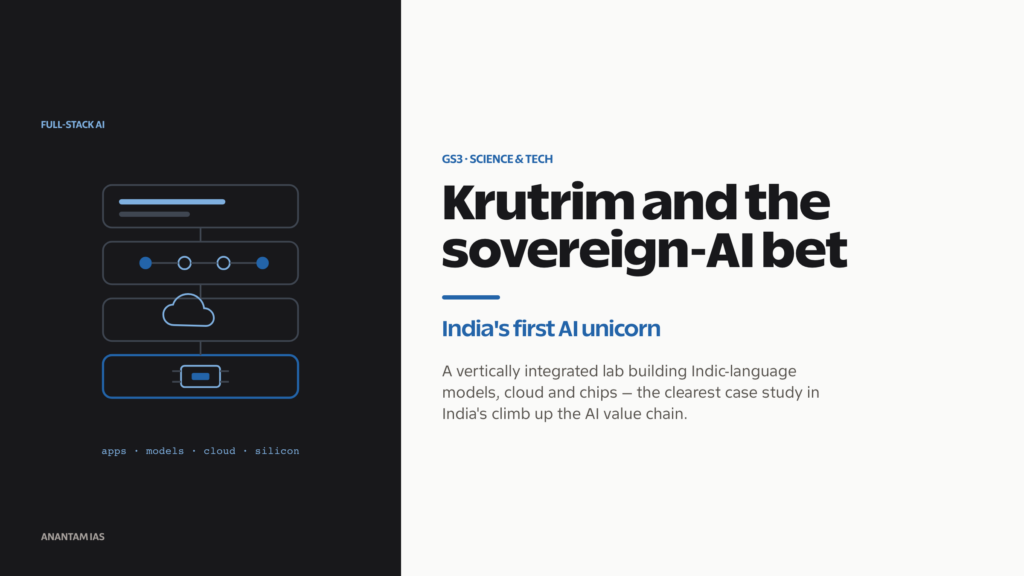
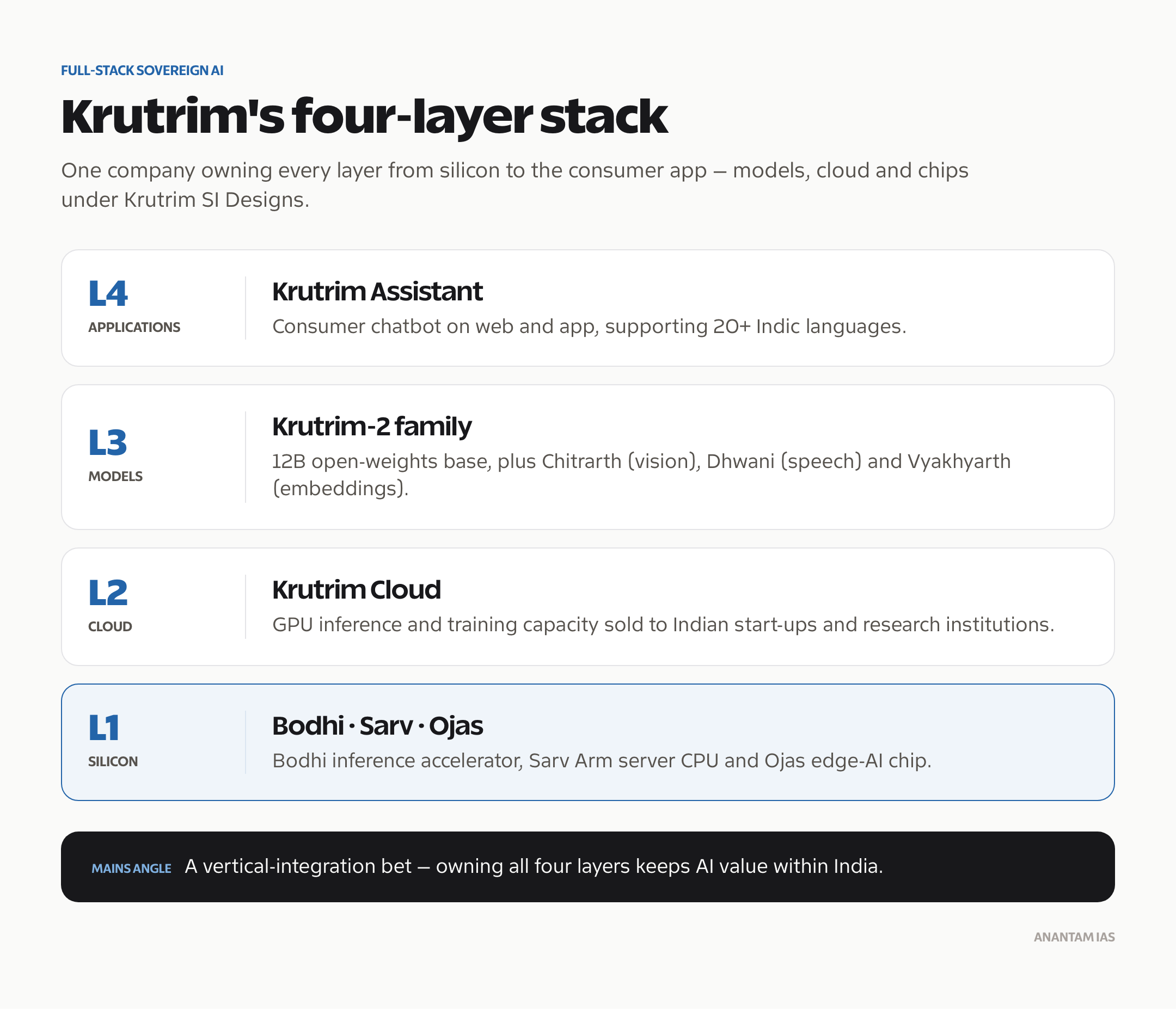
Krutrim — a Sanskrit word meaning “artificial” — is positioned as a full-stack AI company: it builds large language models trained on Indian languages, runs inference infrastructure, and has announced plans to design and fabricate its own silicon for AI workloads. This article explains the founding story, the model family (Krutrim-1 and Krutrim-2), the compute and chip roadmap, the relationship with the IndiaAI Mission, the company’s significance in the sovereign-AI debate, and the challenges it must overcome to become more than a national champion.
Quick Facts at a Glance
| Parameter | Detail |
|---|---|
| Founder | Bhavish Aggarwal (co-founder of Ola) |
| Announced | 15 December 2023 (company), 26 January 2024 (public assistant) |
| Unicorn milestone | January 2024, valuation USD 1 billion |
| Parent entity | Krutrim SI Designs Private Limited |
| Headquarters | Bengaluru, Karnataka |
| First model | Krutrim-1 (base and Pro tiers, December 2023) |
| Second-generation model | Krutrim-2 (announced February 2025) |
| Languages supported | Over 20 Indian languages including Hindi, Tamil, Telugu, Marathi, Kannada, Bengali, Gujarati |
| Open-weights releases | Krutrim-1 Instruct, Chitrarth multimodal, Dhwani speech, Vyakhyarth embeddings |
| Core ambition | Full-stack sovereign AI — models, cloud, silicon |
Background and Historical Context
India’s AI moment has been building for more than a decade. The 2018 NITI Aayog discussion paper on the National Strategy for Artificial Intelligence, the 2020 report of the Kris Gopalakrishnan committee on non-personal data, the 2023 Digital Personal Data Protection Act and the 2024 IndiaAI Mission together outlined a vision in which India would move from being an implementation economy for foreign AI to an originator of foundation technology. The launch of ChatGPT in November 2022 made the gap visible — the most consequential information technology of the decade was being built almost entirely in the United States and China, and India had no foundation-model contender.
Bhavish Aggarwal read this vacuum as both a strategic risk and a commercial opportunity. Through 2023 his team spun up Krutrim SI Designs — SI stands for Silicon Intelligence — and quietly began training a base language model on a curated Indic corpus drawn from publicly available text, licensed content and synthetic data generated through translation pipelines. When Krutrim-1 launched on the eve of Republic Day 2024, it was the first consumer-facing Indian large language model to support more than twenty Indic languages in a single inference endpoint.
The strategic context matters. The Central Government’s IndiaAI Mission, approved by the Union Cabinet in March 2024 with an outlay of Rs. 10,371.92 crore, explicitly funds GPU access, Indic foundation models, safe-AI research and compute subsidies. Krutrim is both a participant in and a commercial beneficiary of this broader push.
Key Features
The Krutrim Assistant and Model Family
Krutrim-1 launched in two tiers — a base model for free public use and a Pro tier aimed at developers and enterprises. The models are trained on a multilingual corpus heavily weighted toward Indic languages, with a deliberate tilt toward written Hindi, Tamil and Bengali alongside colloquial transliterations popular in messaging.
Krutrim-2, announced in early 2025, introduced a 12-billion-parameter open-weights model competitive with international mid-scale models on Indic-language benchmarks. Alongside it, the company open-sourced Chitrarth, a multimodal vision-language model; Dhwani, a speech-recognition model for Indian accents; and Vyakhyarth, an Indic embedding model used for retrieval-augmented generation.
Sovereign Cloud and Compute
Krutrim operates a dedicated Bengaluru-based cloud stack to host its own inference workloads and to sell GPU capacity to Indian start-ups and research institutions. This positions the company as both a model lab and an AI-infrastructure provider — analogous to Anthropic running on its own rails, or to China’s early Baidu ERNIE model running on Baidu Cloud.
Silicon Ambitions — Bodhi, Sarv and Ojas
The SI Designs branding is not decorative. Krutrim has announced a silicon roadmap anchored by three chip families. Bodhi-1 is an inference accelerator, Sarv-1 is a general-purpose server CPU based on Arm, and Ojas is an edge-AI chip designed for Indian-origin devices. The first production samples were targeted for 2026-27, with fabrication expected at a leading-node foundry abroad while the India Semiconductor Mission builds domestic capacity.
Indic-Language Depth
The differentiator Krutrim emphasises most in its marketing is depth across Indic languages. Indian users do not type clean Devanagari — they code-mix, romanise and switch scripts mid-sentence. Krutrim invests heavily in tokeniser design, transliteration cleanup and colloquial style matching, areas where global English-first models routinely underperform.
Open-Source Posture
Unlike closed commercial labs, Krutrim releases a meaningful portion of its work as open-weights on Hugging Face under permissive licences. This choice is both a community strategy and a talent-acquisition signal, and aligns with India’s broader push for AI Commons under the IndiaAI Mission.
Significance for UPSC and General Knowledge
- Krutrim is the textbook example for GS Paper 3 answers on the AI value chain, digital sovereignty and indigenisation of critical technologies.
- The company links directly to IndiaAI Mission, the National Quantum Mission and the India Semiconductor Mission, enabling integrated answers across S&T sub-topics.
- It illustrates the use of private-sector champions to deliver national technology goals, echoing the ISRO-in-space and Reliance-Jio-in-telecom playbooks.
- Krutrim provides case material for Essay paper discussions on technological self-reliance, Atmanirbhar Bharat and the ethics of generative AI.
- It informs GS Paper 2 answers on data governance, DPDP Act implementation and Union Executive regulatory choices.
- The Bhavish Aggarwal story is useful in the Ethics paper for discussions on entrepreneurship as public service and the leadership role of founder archetypes.
Detailed Analysis: India’s Sovereign AI Bet
The case for a sovereign Indian AI stack rests on three arguments. First is national security — foundation models will increasingly mediate government communication, defence situational awareness and critical-infrastructure automation, and dependence on a foreign stack creates a structural vulnerability that is harder to unwind than a software-licensing dispute. Second is linguistic justice — global models, trained on English-dominant corpora, quietly encode English-world priors and underperform on Indic languages, which means that two-thirds of Indians who do not transact in English get a diluted experience. Third is economic capture — if the most valuable software stack of the next decade is built abroad, Indian value-added activity gets compressed into system integration and data labelling, with the highest-margin activities happening elsewhere.
Krutrim is the most visible attempt to address all three concerns simultaneously. Its model releases have been benchmarked against Meta’s Llama family, Mistral and Cohere’s Aya, with mixed results on English-world benchmarks but leading scores on Indic-language tasks. The launch of Krutrim-2 in 2025 closed much of the quality gap with international mid-tier open models, and the company has promised a further-scaled third-generation model trained on a larger Indic corpus.
The economics are demanding. Training even a mid-tier foundation model consumes tens of thousands of GPU hours on A100-class and H100-class accelerators, which Indian labs currently import. Inference at scale for a billion-user population requires a domestic GPU fleet and local power, land and water. Krutrim has announced multiple data-centre build-outs, and the IndiaAI Mission has committed to subsidise GPU capacity for Indian start-ups, but at current chip prices the economics still rely on patient capital.
A second commercial question is distribution. Krutrim must convince Indian enterprises — banks, telcos, government departments — to prefer a domestic model over the Microsoft-OpenAI, Google and Anthropic offerings embedded in existing enterprise contracts. The government’s preference for sovereign solutions in public procurement is a helpful tailwind, but only if the product quality meets the bar.
Comparative Perspective
| Lab | Country | Flagship Model | Open-Weights | Language Focus | Vertical Integration |
|---|---|---|---|---|---|
| Krutrim | India | Krutrim-2 (12B) | Yes, partial | Indic-first, multilingual | Model + cloud + chip |
| OpenAI | United States | GPT-5 | No | English-dominant, multilingual | Model + API |
| Anthropic | United States | Claude Opus 4 | No | English-dominant | Model + API |
| Mistral | France | Mistral Large 2 | Yes, partial | European | Model + API |
| Zhipu AI | China | GLM-4 | Yes, partial | Chinese-first | Model + cloud |
| Cohere (Aya) | Canada | Aya-23 | Yes, full | Multilingual research | Model + enterprise |
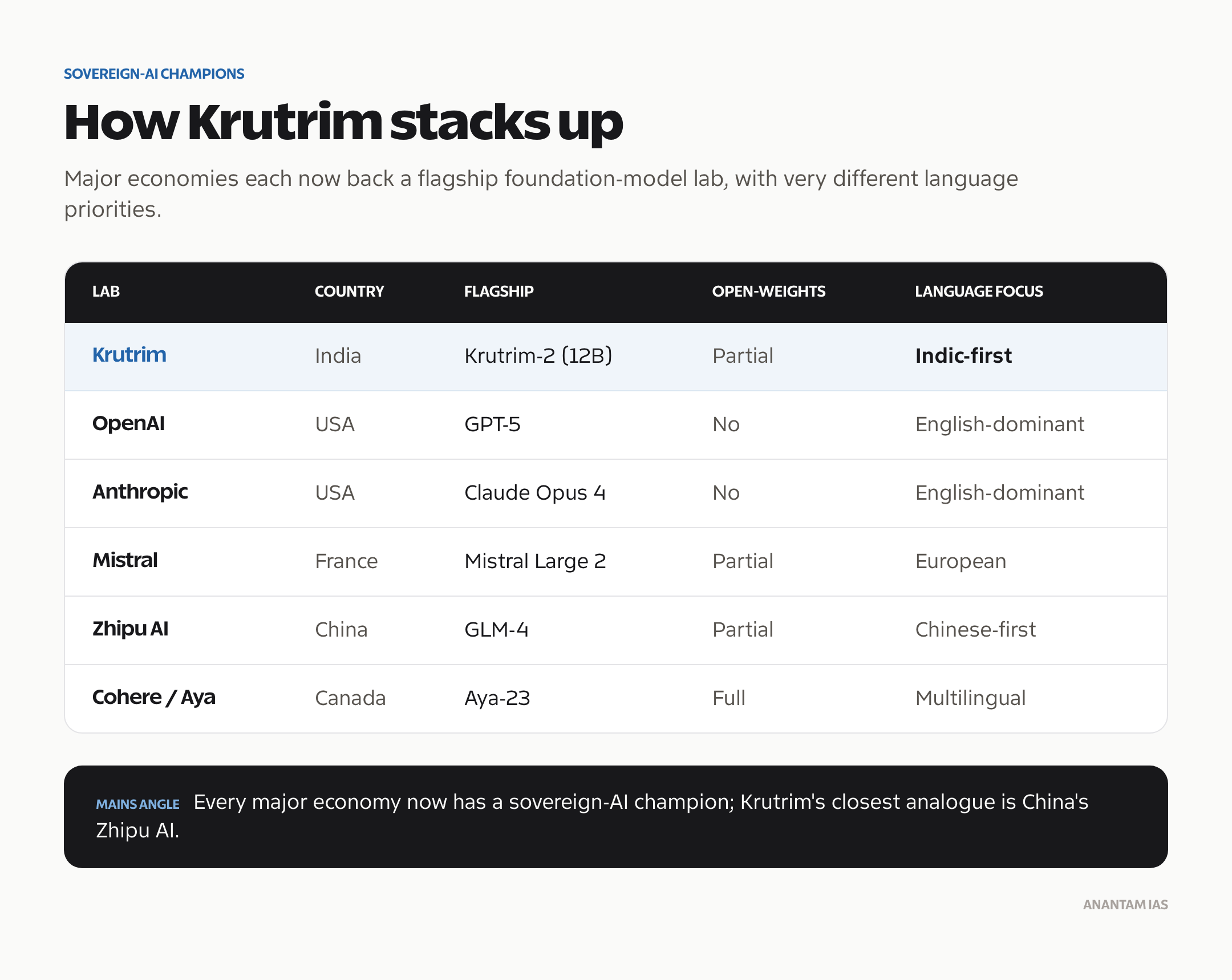
The comparison suggests Krutrim’s closest international analogue is Zhipu AI in China — a national-champion lab pairing a domestic language focus with vertical integration into cloud and, prospectively, silicon.
Challenges and Criticisms
Krutrim has faced sharp criticism since its launch. The first Krutrim Assistant release suffered from classic early-model hallucinations and factual errors, some of which were widely circulated on Indian social media and embarrassed the company during launch week. Reviewers pointed out that on English-language benchmarks Krutrim-1 trailed Llama-2 and Mistral substantially, and that on some Indic-language tasks the marketed superiority did not hold up against carefully-evaluated baselines.
A second critique concerns concentration. Placing sovereign AI hopes inside a single founder-led company creates an execution risk that India cannot afford to repeat from the telecom playbook. Policy experts have argued for a more pluralistic funding model that backs multiple teams — academic labs at IIT Madras and IISc, the non-profit Sarvam AI and other private firms — rather than anointing one champion.
A third concern is the silicon roadmap. Designing AI chips is hard; manufacturing them at leading nodes is harder still. The India Semiconductor Mission has approved several fabrication plants, but leading-node capacity sufficient for frontier AI will not exist domestically for several years. Krutrim’s chip ambitions may therefore depend on fabrication partnerships with TSMC or Samsung for the foreseeable future.
Prelims Pointers
- Krutrim is India’s first artificial intelligence unicorn, valued at USD 1 billion in January 2024.
- The company was founded by Bhavish Aggarwal, co-founder of Ola Cabs and Ola Electric.
- Krutrim means “artificial” in Sanskrit and is the product brand of Krutrim SI Designs Private Limited.
- Krutrim-2, a 12-billion-parameter open-weights Indic model, was announced in February 2025.
- Associated open-weights models include Chitrarth (multimodal), Dhwani (speech) and Vyakhyarth (embeddings).
- Silicon roadmap includes Bodhi-1 (inference accelerator), Sarv-1 (Arm server CPU) and Ojas (edge AI).
- IndiaAI Mission was approved by the Union Cabinet in March 2024 with an outlay of Rs. 10,371.92 crore.
- The mission funds GPU access, Indic foundation models, safe-AI research and skilling.
- Krutrim’s models support more than 20 Indian languages in a unified inference endpoint.
- Krutrim Cloud sells GPU capacity to Indian start-ups and research institutions.
- Matrix Partners India led the 2024 funding round that vaulted Krutrim to unicorn status.
- Krutrim is headquartered in Bengaluru, Karnataka.
Mains Practice Questions
- “The emergence of indigenous foundation-model companies is central to India’s sovereign AI agenda.” Examine with reference to Krutrim, the IndiaAI Mission and the India Semiconductor Mission.
- Outline the national-security, linguistic and economic arguments for sovereign AI.
- Describe Krutrim’s model, cloud and silicon stack and its role in the IndiaAI Mission.
- Discuss risks of concentration, the quality gap with frontier labs and policy corrections needed.
- Discuss the challenges and opportunities for India in building a globally competitive artificial intelligence ecosystem.
- Identify talent, compute, capital and data as the four pillars and map India’s position on each.
- Cite Krutrim, Sarvam AI and public-sector initiatives as evidence of progress.
- Conclude on regulatory choices under the DPDP Act and the Draft Digital India Act.
Conclusion
Krutrim is less a product and more a policy experiment wearing a product wrapper. Its bet is that a single, founder-driven, vertically integrated company can compress the Indian AI stack — foundation models, cloud, silicon — by a decade, much as Reliance Jio compressed the Indian telecom stack between 2016 and 2020. The first two years of the company have shown both the potential of that model and its obvious risks — hallucination-prone early releases, a steep quality gap with frontier labs, and an ambitious silicon roadmap that depends on foreign fabrication partners.
For UPSC preparation, Krutrim is more than a fact in the S&T question bank. It is the clearest current case study of how India is attempting to move up the artificial intelligence value chain from consumer to creator. The outcome of that bet will shape GS Paper 3 answers on technology, GS Paper 2 answers on regulation, and Essay paper arguments on self-reliance for the rest of this decade. Whether Krutrim graduates from national champion to global contender is the single most consequential technology question for India’s 2030 strategic profile.
Frequently Asked Questions
What is Krutrim?
Krutrim is an Indian artificial intelligence company founded by Ola co-founder Bhavish Aggarwal through Krutrim SI Designs Private Limited. It builds large language models optimised for Indian languages, operates a dedicated cloud, and has announced a silicon roadmap. In January 2024 it became India’s first AI start-up to cross a USD 1 billion valuation, making it the country’s first AI unicorn.
Why is Krutrim important for UPSC General Studies?
Krutrim is the most current example for GS Paper 3 answers on digital sovereignty, artificial intelligence, the IndiaAI Mission and the India Semiconductor Mission. It also informs GS Paper 2 answers on data regulation, the DPDP Act and public-private technology partnerships, and supports Essay paper arguments on Atmanirbhar Bharat in critical technologies.
How is Krutrim related to the IndiaAI Mission?
The IndiaAI Mission, approved with a Rs. 10,371.92 crore outlay in March 2024, funds compute, Indic foundation models and safe-AI research. Krutrim is both a commercial beneficiary, drawing GPU subsidies and procurement tailwinds, and a reference implementation of the mission’s goal of indigenous foundation models for Indian languages.
What are Krutrim-1 and Krutrim-2?
Krutrim-1, launched in December 2023, was the company’s first consumer-facing large language model supporting over twenty Indian languages. Krutrim-2, announced in February 2025, is a 12-billion-parameter open-weights model with substantially improved reasoning and Indic-language benchmarks, released alongside multimodal, speech and embedding sister models.
Who founded Krutrim and when?
Krutrim was founded by Bhavish Aggarwal, the co-founder of Ola Cabs and Ola Electric. The parent entity Krutrim SI Designs Private Limited was incorporated in 2023, the consumer assistant was unveiled on 15 December 2023, and the company achieved unicorn status in a Matrix Partners-led funding round announced on 26 January 2024.
What is Krutrim’s chip strategy?
Krutrim SI Designs has announced three chip families: Bodhi-1, an inference accelerator for data-centre AI workloads; Sarv-1, a general-purpose Arm-based server CPU; and Ojas, an edge-AI chip for Indian-origin consumer devices. Production samples were targeted for 2026-27, with fabrication at leading-node foundries abroad while the India Semiconductor Mission builds domestic capacity.
How does Krutrim compare to OpenAI, Anthropic and Mistral?
OpenAI and Anthropic are closed-weights English-first labs with frontier-scale models. Mistral is a French open-weights lab with European language focus. Krutrim is a vertically integrated Indic-first lab open-sourcing mid-scale models, more closely resembling China’s Zhipu AI. On Indic benchmarks Krutrim leads, on English benchmarks it trails the US frontier.
What are the main criticisms of Krutrim?
Early releases were criticised for hallucinations and factual errors. Benchmarks showed Krutrim-1 trailing Llama-2 and Mistral on many English tasks. Policy experts caution against concentrating sovereign AI ambitions in a single founder-led firm, arguing for a pluralistic model that also backs academic labs at IIT Madras, IISc and the Sarvam AI non-profit.
Tell Google you want more of this.
Add Anantam IAS as a preferred sourceOne tap, and this site shows up more often in your own Top Stories, AI Overviews and AI Mode. Remove it any time.