Maharashtra’s Mukhyamantri Majhi Ladki Bahin Yojana puts ₹1,500 a month into the bank account of an eligible woman. The money moves through Direct Benefit Transfer, so the state has to be sure that the woman named in the application, the Aadhaar number on file and the bank account receiving the credit all belong to the same person. That confirmation is what eKYC does.
For most beneficiaries eKYC is a five-minute job with an Aadhaar number and an OTP. For a very large number of women it turned out to be the difference between getting paid and being dropped. When the Women and Child Development Department finished its verification drive, incomplete eKYC was the single biggest reason names disappeared from the list. This guide walks through what the scheme pays, who qualifies, how to finish eKYC online and offline, and how to read your status when the money stops arriving.
What Ladki Bahin Yojana Is and Who Runs It
The scheme was announced in Maharashtra’s July 2024 state budget and launched on 28 June 2024, with the Women and Child Development Department as the implementing agency. Applications, grievances and verification all sit on the official portal at ladakibahin.maharashtra.gov.in, and the state also pushed applications through its Narishakti Doot mobile app during the enrolment drive.
The design is deliberately simple. There is no asset to buy, no loan to service and no training to attend. An eligible woman registers once, the state verifies her, and a fixed monthly amount lands in her Aadhaar-seeded account. With no in-kind component, the integrity of the whole scheme rests on identifying the right beneficiary — which is why eKYC is not a formality here.
Two things are worth understanding before anything else. eKYC is separate from your bank account being Aadhaar-linked: you can pass eKYC on the portal and still not get paid if your bank has not seeded and activated Aadhaar for DBT. And eKYC is not a one-time event. The department has repeated the exercise, and each round asks beneficiaries to re-confirm income, government-employment status and how many women in the household are drawing the benefit.
What the Scheme Offers
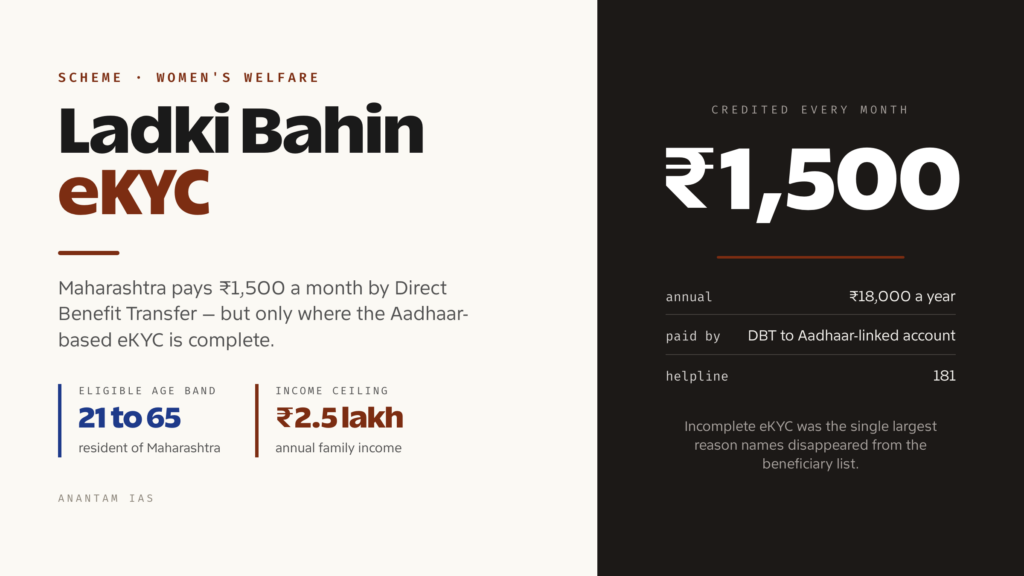
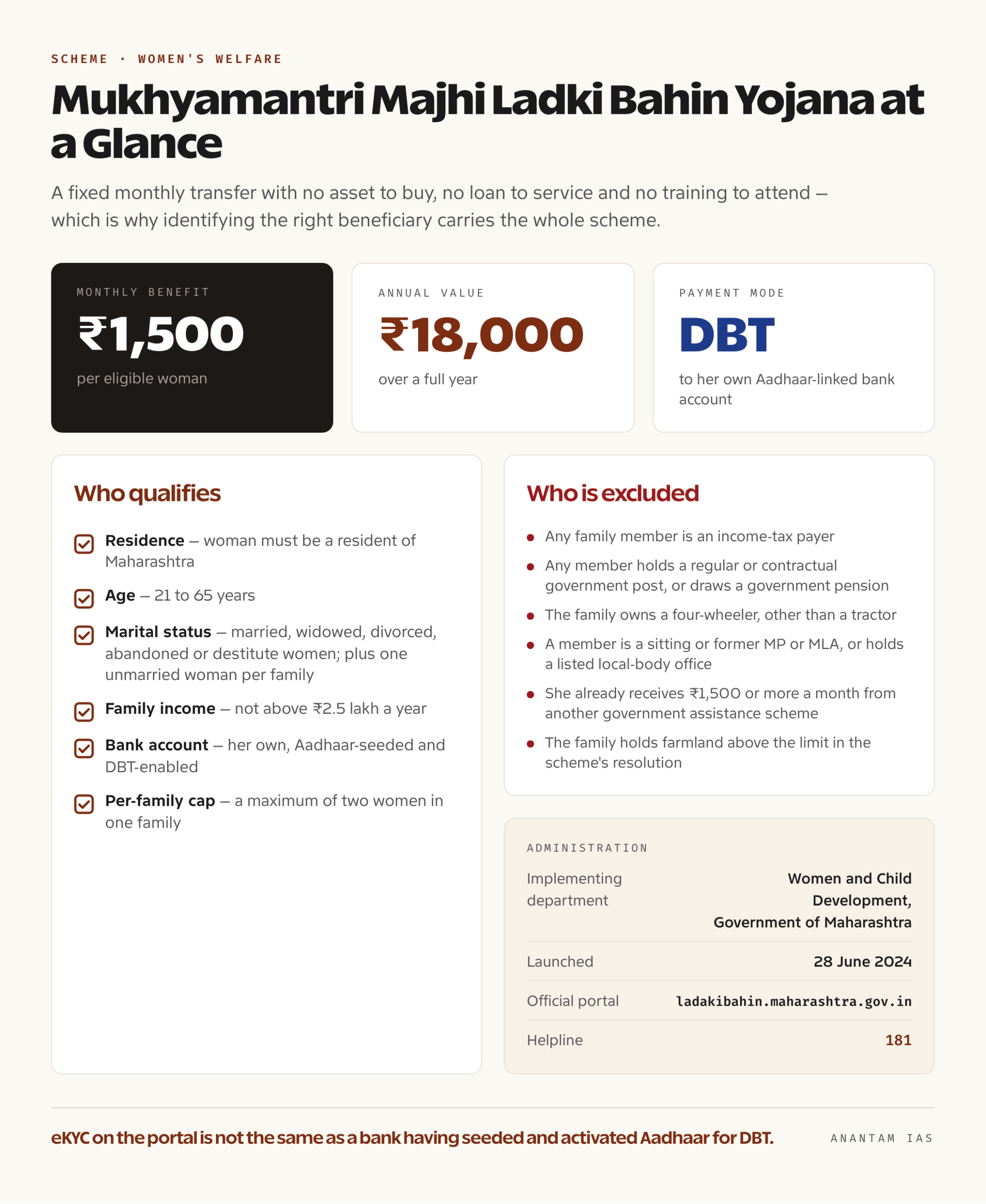
The core benefit is ₹1,500 per month, credited directly to the beneficiary’s own Aadhaar-linked bank account. Over a full year that works out to ₹18,000 — a meaningful sum in a household living under the scheme’s ₹2.5 lakh annual income ceiling, though not a substitute for wages.
Payments have not always arrived monthly. The department has repeatedly bunched instalments and released two or three months together, especially around verification cut-offs. Reporting around the April 2026 deadline noted a combined release of ₹4,500 for women who finished eKYC in time — three months paid at once, not a bonus.
| Feature | Detail (as of the 2026 position) |
|---|---|
| Monthly benefit | ₹1,500 per eligible woman |
| Annual value | ₹18,000 |
| Payment mode | Direct Benefit Transfer to Aadhaar-linked bank account |
| Implementing department | Women and Child Development, Government of Maharashtra |
| Launched | 28 June 2024 |
| Official portal | ladakibahin.maharashtra.gov.in |
| Helpline | 181 |
| State allocation, 2026-27 | ₹26,500 crore, down from ₹36,000 crore in 2025-26 |
The allocation figure tells its own story. Maharashtra budgeted ₹36,000 crore in 2025-26 and cut it to ₹26,500 crore for 2026-27 — a ₹9,500 crore reduction that follows from the shrinking beneficiary base, not from any decision to lower the monthly amount. There has also been persistent talk of raising the benefit to ₹2,100 a month, an amount floated during the 2024 assembly campaign. As of the 2026-27 budget the paid amount is still ₹1,500, so treat any site promising ₹2,100 credits as unverified until the department notifies it.
Who Is Eligible
Eligibility runs on three filters at once: who you are, what your household earns, and what your household owns or draws from the state. Failing any one of them removes you, and the verification drive applied all three retrospectively to women already enrolled.
| Criterion | Requirement |
|---|---|
| Residence | Woman must be a resident of Maharashtra |
| Age | 21 to 65 years |
| Marital status | Married, widowed, divorced, abandoned or destitute women; plus one unmarried woman per family |
| Family income | Annual family income not above ₹2.5 lakh |
| Bank account | Own account, Aadhaar-seeded and DBT-enabled |
| Per-family cap | A maximum of two women in one family may draw the benefit |
The exclusions matter just as much, because most deletions happened here:
- Any member of the family is an income-tax payer.
- Any member holds a regular or contractual post in central or state government, a government undertaking, a board or a corporation, or draws a government pension. Outsourced staff, honorarium workers and voluntary workers are treated differently, and the department has issued clarifications on this category.
- The family owns a four-wheeler, other than a tractor.
- A member of the family is a sitting or former MP or MLA.
- The woman already receives ₹1,500 or more a month from another government financial-assistance scheme.
- The family holds farmland above the limit specified in the scheme’s resolution.
Age is a quiet trap. The upper limit is 65, so women who were 64 at enrolment aged out during the scheme’s second year — roughly 1.8 lakh names went on this ground alone. Nothing has gone wrong in such cases; the entitlement simply ended.
How to Complete eKYC, Step by Step
Two things must be in place before you start: your Aadhaar number, and a mobile number that is actually registered against that Aadhaar. If the OTP does not reach you, the problem is almost always an old mobile number sitting in the UIDAI record, and no amount of retrying on the scheme portal will fix it.
The online route
- Open ladakibahin.maharashtra.gov.in in a browser. Avoid links forwarded on WhatsApp — several look-alike domains harvest Aadhaar numbers.
- Choose Applicant Login and sign in with the mobile number you registered with, your password and the captcha. If you have forgotten the password, use the forgot-password option, which sends a reset OTP to that same registered number.
- On your dashboard, open the applications list and look for the eKYC or “pending eKYC” flag against your application.
- Enter your 12-digit Aadhaar number, tick the consent declaration and request the OTP.
- Enter the OTP delivered to your Aadhaar-linked mobile number.
- Complete the follow-up declarations the portal asks for. In the latest round these include the Aadhaar details of your husband or father, your caste category, and confirmations that no family member holds a government job or pension and that no more than the permitted number of women in the family are drawing the benefit.
- Submit and save or screenshot the confirmation. There is no physical receipt.
Read the declarations slowly. The Marathi wording uses negative phrasing in places, and a mis-ticked box saying a family member does hold a government job gets the application rejected on a technicality — a slip that then needs a correction request rather than a simple re-run of eKYC.
The offline route
If your mobile is not linked to Aadhaar, the OTP fails, or you do not use a smartphone, biometric authentication at a counter does the same job:
- Carry your Aadhaar card, bank passbook, the scheme application number if you have it, and the ration card or a domicile document.
- Visit the nearest Anganwadi centre, a Setu Suvidha Kendra or a Common Service Centre, or the taluka or ward office of the Women and Child Development Department.
- Staff verify the originals and run fingerprint or iris authentication against Aadhaar, then key the declarations into the portal on your behalf.
- Ask for the acknowledgement or application number before you leave.
Anganwadi sevikas were formally roped into the verification drive, so an Anganwadi centre is usually the fastest and cheapest counter. eKYC through official channels is free, and a CSC operator may charge only the notified service fee. Anyone demanding a large “processing” payment is running a scam.
Checking your status
Log in to the portal and open your application. The status line shows one of a few states — approved, eKYC pending, eKYC completed, or rejected with a reason. Payment status is separate: the credit appears in your bank passbook or statement as a DBT entry, not on the scheme portal, so a passbook update or balance check is the real confirmation. For anything the portal will not explain, the 181 helpline and the district Women and Child Development office are the official grievance routes.
If your name has been dropped, find out which ground was applied first. A deletion for failed eKYC can usually be cured by completing authentication and filing a request at the taluka office. A deletion on income, government service or the two-woman cap is a substantive finding, and reversing it needs documentary proof.
Where the Scheme Stands After Verification
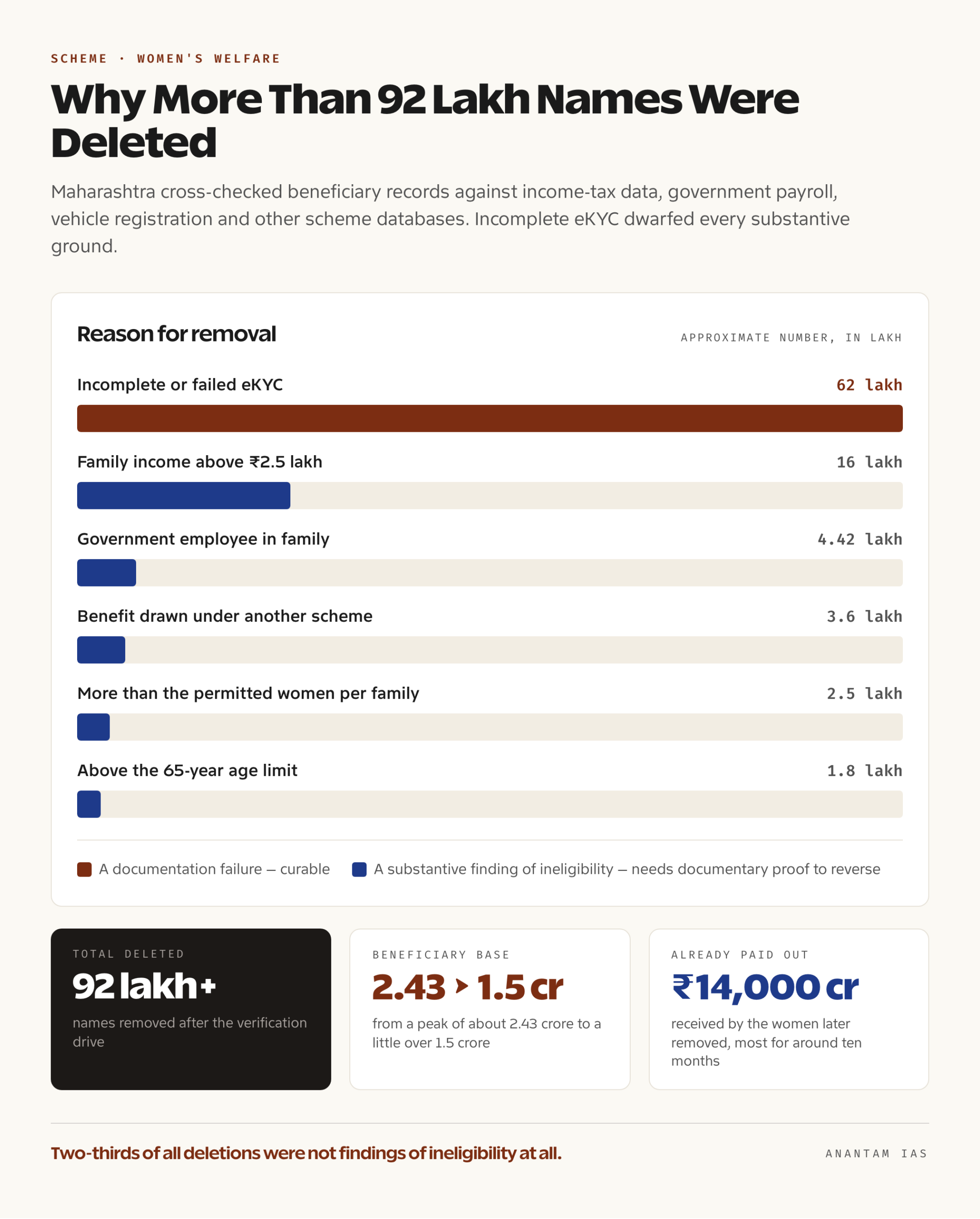
Maharashtra began a statewide verification exercise in September 2025, cross-checking beneficiary records against income-tax data, government payroll records, vehicle registration and other scheme databases. The results, reported in July 2026, were dramatic.
| Reason for removal | Approximate number |
|---|---|
| Incomplete or failed eKYC | 62 lakh |
| Family income above ₹2.5 lakh | 16 lakh |
| Government employee in family | 4.42 lakh |
| Benefit drawn under another scheme | 3.6 lakh |
| More than the permitted women per family | 2.5 lakh |
| Above the 65-year age limit | 1.8 lakh |
In total, more than 92 lakh names were deleted, taking the beneficiary base from a peak of about 2.43 crore to a little over 1.5 crore. Officials associated with the exercise estimated that the women subsequently removed had collectively received close to ₹14,000 crore, most of them for around ten months, before payments stopped.
The eKYC number is the one to sit with. Two-thirds of all deletions were not findings of ineligibility at all. They were failures of documentation — an unlinked mobile number, a lapsed deadline, a portal that would not load, a declaration filled in wrong. The department extended the cut-off from 31 March 2026 to 30 April 2026, and Women and Child Development Minister Aditi Tatkare announced that extension publicly, but the extension did not close the gap.
Challenges and What to Watch
Exclusion errors are the central problem. Aadhaar authentication fails most often for exactly the people a welfare scheme is meant to reach: older women with worn fingerprints, widows whose phone is registered in a dead husband’s name, migrants whose Aadhaar address no longer matches, households that share one handset. Treating non-authentication as evidence of ineligibility converts a technical failure into a benefit denial.
The fiscal question has not gone away. Even at the reduced base, ₹26,500 crore is one of the largest single lines in Maharashtra’s budget, and all of it is untied cash — which is what makes the scheme popular and also the first candidate for compression when revenues tighten.
Verification is now recurring, not a one-off. Expect to re-confirm details periodically rather than assume a completed eKYC is permanent, and watch the official portal and the district office for the current window instead of forwarded messages.
Design questions remain open. A flat ₹1,500 to every qualifying woman is easy to administer and easy to explain, but it makes no distinction between a landless agricultural labourer and a household just under the income line. An income ceiling that is self-declared, in a state with limited household-income records, is only as good as the cross-checks behind it — which is what the 16 lakh income-based deletions eventually revealed.
The information environment is hostile. A large ecosystem of unofficial “yojana” websites publishes invented deadlines, fake beneficiary lists and links that ask for Aadhaar numbers. The department’s own portal, the 181 helpline and the local Anganwadi or taluka office are the only sources worth acting on.
FAQ
Is eKYC compulsory for every Ladki Bahin beneficiary? Yes. Aadhaar-based eKYC is mandatory for the monthly credit to continue. Verification data shows about 62 lakh names were removed for not completing it, which is the largest single category of deletions.
My OTP is not arriving. What do I do? The OTP goes to the mobile number registered with Aadhaar, not the number you gave the scheme. Update your mobile number at an Aadhaar enrolment or update centre first, then retry, or use biometric authentication at an Anganwadi centre or Setu Suvidha Kendra instead.
How do I check whether my payment has been credited? The scheme portal shows application and eKYC status, but the money itself shows up as a DBT credit in your bank account. Check your passbook, statement or bank’s balance-enquiry service. If eKYC is complete and no credit appears, the usual cause is that Aadhaar is not seeded or DBT is not enabled at the bank.
My name has been removed. Can I get it back? It depends on the ground. If the deletion was for incomplete eKYC, completing authentication and filing a request with the taluka or ward Women and Child Development office is the route. If it was for income, government employment or the per-family cap, you will need documents that disprove the finding.
Does the scheme still pay ₹1,500, or has it gone up to ₹2,100? The paid amount is ₹1,500 a month. A higher figure was discussed politically, but the 2026-27 state budget continues to fund the scheme at ₹1,500 per beneficiary. Ignore sites that claim otherwise until the department notifies a change.
Practice Questions
Prelims MCQs
- The Mukhyamantri Majhi Ladki Bahin Yojana is implemented by which state government? (a) Madhya Pradesh (b) Maharashtra (c) Karnataka (d) Gujarat — Answer: (b) The scheme is run by Maharashtra’s Women and Child Development Department and was launched in June 2024.
- What is the monthly benefit paid under the scheme as of the 2026-27 budget? (a) ₹1,000 (b) ₹1,250 (c) ₹1,500 (d) ₹2,100 — Answer: (c) The credited amount remains ₹1,500 a month, or ₹18,000 a year.
- Which of the following is the eligible age band for a beneficiary? (a) 18 to 60 years (b) 21 to 65 years (c) 25 to 60 years (d) 18 to 55 years — Answer: (b) Women aged 21 to 65 qualify, and crossing 65 ends the entitlement.
- The annual family income ceiling for eligibility is: (a) ₹1 lakh (b) ₹2 lakh (c) ₹2.5 lakh (d) ₹3 lakh — Answer: (c) Families with annual income above ₹2.5 lakh are excluded, and income was a major ground for deletion during verification.
- Which was the largest single reason for removal of beneficiaries during Maharashtra’s verification drive? (a) Ownership of a four-wheeler (b) Incomplete eKYC (c) Crossing the age limit (d) Duplicate bank accounts — Answer: (b) Roughly 62 lakh of the more than 92 lakh deletions were attributed to incomplete or failed eKYC.
Mains Practice Questions
- Direct cash transfers to women have become the dominant form of state welfare innovation in India. Examine their strengths and limitations as instruments of gender-responsive budgeting. (15 marks, 250 words)
- “Aadhaar-based authentication reduces leakage but raises exclusion.” Critically evaluate this proposition with reference to the verification of a large state cash-transfer scheme. (15 marks, 250 words)
- Discuss the fiscal implications for state governments of large untied cash-transfer schemes, and suggest safeguards that preserve both fiscal prudence and welfare commitments. (15 marks, 250 words)
- Evaluate the role of frontline functionaries such as Anganwadi workers in the delivery and verification of welfare entitlements. What institutional support do they need? (10 marks, 150 words)
- Self-declared income remains the basis for targeting in many welfare schemes despite weak household income records. Suggest a workable framework for verifying eligibility without creating fresh exclusion. (15 marks, 250 words)
Tell Google you want more of this.
Add Anantam IAS as a preferred sourceOne tap, and this site shows up more often in your own Top Stories, AI Overviews and AI Mode. Remove it any time.