Sand is the second-most-consumed natural resource on Earth after water. India alone uses an estimated 700 to 800 million tonnes of construction sand a year, and the demand keeps rising as cities expand, highways multiply, and the affordable-housing pipeline scales up. For most of India’s industrial history, that demand was met by river sand: the rounded, weather-graded grains scooped from the beds of the Ganga, Yamuna, Cauvery, Krishna, and a hundred smaller rivers. The cost has been ecological devastation. Riverbeds are dropping, banks are collapsing, aquatic species are vanishing, and the legal sand-mafia nexus has become one of India’s most violent black markets.
M-Sand, or manufactured sand, is the alternative the construction industry has begun to embrace. M-Sand is produced by mechanically crushing hard rocks — typically granite, basalt, or limestone — into fine aggregates that meet the same engineering specifications as river sand. The grains are angular rather than rounded, the grading is controllable, and the supply is independent of monsoon and river flow. Several southern states, led by Karnataka and Tamil Nadu, have moved decisively in favour of M-Sand. The push has begun nationally as well, with the [Bureau of Indian Standards’ IS 383 specification] revised in 2016 to formally recognise M-Sand as equivalent to river sand for most structural concrete uses.
For UPSC, M-Sand is a useful entry into multiple syllabus zones: environmental degradation from extractive industries, riverine ecology, sustainable urbanisation, the Construction and Demolition Waste Management framework, and the larger conversation about responsible mineral sourcing. This guide builds out every layer.
Quick Facts
- Definition: M-Sand is a synthetic alternative to natural river sand, produced by mechanically crushing hard rocks into fine aggregates
- Source rocks: Typically granite, basalt, gneiss, and limestone
- Manufacturing process: Three-stage — crushing, screening, and washing
- Grain shape: Angular and sharp-edged (vs rounded river-sand grains)
- Particle size range: Less than 4.75 mm (matches IS 383 fine aggregate)
- Standardisation: Indian Standard IS 383:2016 formally recognises M-Sand as equivalent to river sand
- Concrete strength: Generally produces stronger concrete than river sand because of better mechanical interlocking
- Water demand: Slightly higher than river sand (10–15 percent more) because of the angular surface
- Cost: Typically 20–40 percent cheaper than river sand at the project site
- State leaders: Karnataka, Tamil Nadu, Andhra Pradesh, and Telangana
- Environmental advantage: Eliminates the need for in-stream sand mining and its associated ecological damage
What Is M-Sand
M-Sand stands for Manufactured Sand. It is a synthetic fine aggregate engineered to match or exceed the performance of natural river sand in concrete, mortar, and plaster. Unlike river sand, which is the cumulative product of millennia of weathering, transport, and deposition, M-Sand is made on demand at a quarry-side crushing plant.
The defining feature of M-Sand is the angular shape of its grains. River sand grains are typically rounded because they have been tumbled along river channels for years before deposition. M-Sand grains are produced by impact crushing, which leaves sharp, irregular edges. This angularity is sometimes seen as a disadvantage — the grains pack less densely and demand slightly more water to make a workable concrete mix — but it is actually the basis of M-Sand’s principal advantage. Angular grains interlock mechanically when set in cement paste, producing concrete with higher compressive strength and better resistance to lateral shear.
M-Sand can be produced in graded specifications. The three main classes used in Indian construction are M-Sand for concreting, M-Sand for plastering (finer than concreting M-Sand), and M-Sand for brickwork. Each is screened to a different particle-size distribution. River sand, by contrast, is deposited by nature in whatever grading the local hydrology produces, and contractors often have to pay for sieving and washing before use.
Background and Historical Context
The first manufactured sand was produced in the early twentieth century in Europe and North America, primarily for railway ballast and concrete in regions where river sand was scarce. India remained heavily dependent on river sand through most of the twentieth century because riverine resources seemed inexhaustible.
The shift began in the 1990s and accelerated through the 2000s. Several developments drove the change. The Union Territories and southern states began experiencing severe river sand shortages. Bangalore, Chennai, and Hyderabad faced supply disruptions and price spikes during the construction boom of the 2000s. The Ministry of Environment, Forest and Climate Change tightened regulation of in-stream sand mining through the Sustainable Sand Mining Management Guidelines, 2016 (revised 2020). The National Green Tribunal began to issue major orders restricting riverbed mining, particularly along the Yamuna, Sone, and Cauvery basins.
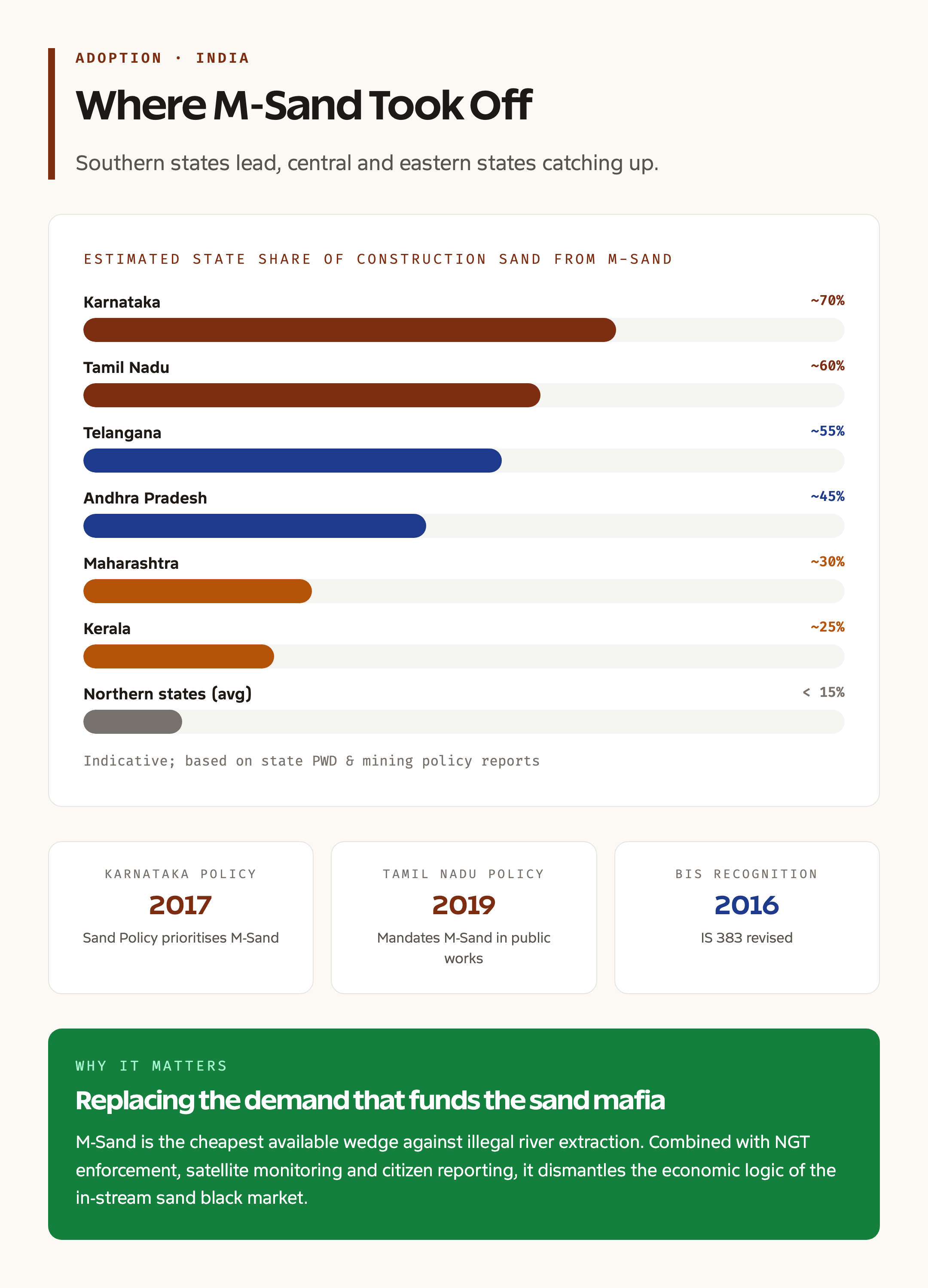
The Bureau of Indian Standards revised IS 383 in 2016 to formally include manufactured sand as a category of fine aggregate, alongside river sand and crushed stone sand. This standardisation was decisive: it gave architects, engineers, and government departments confidence to specify M-Sand in their tender documents. Karnataka introduced a comprehensive Sand Policy in 2017 that explicitly prioritised M-Sand. Tamil Nadu followed with its own framework in 2019. The shift is now visible in any major construction project in southern India, from metro tunnels to housing colonies.
Manufacturing Process: From Rock to Aggregate
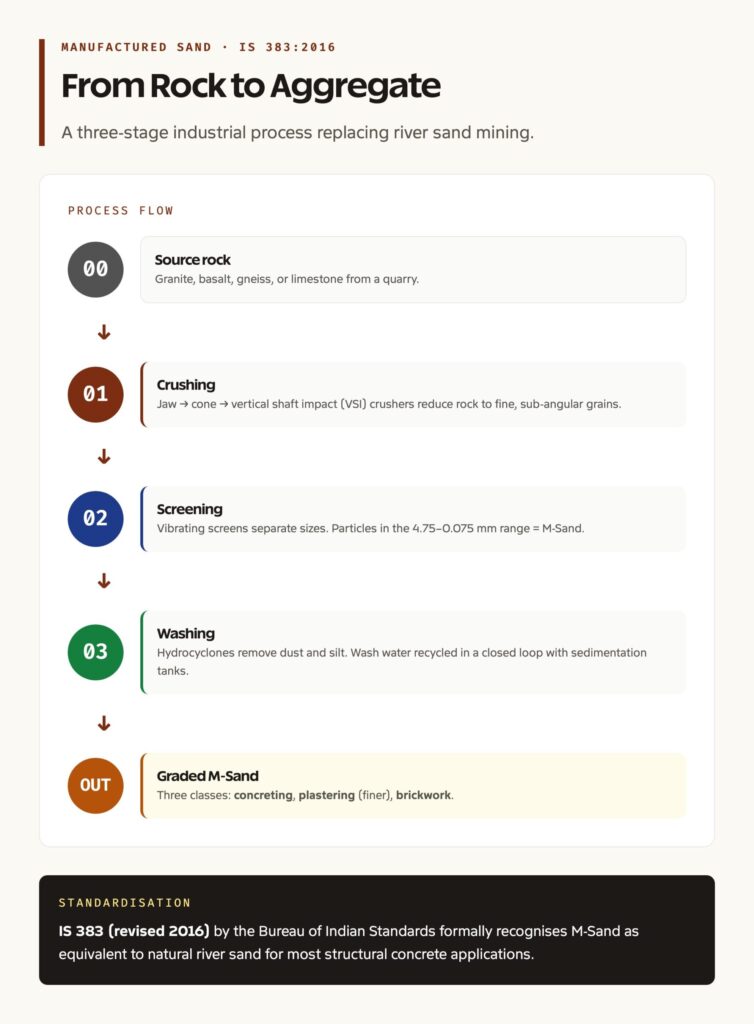
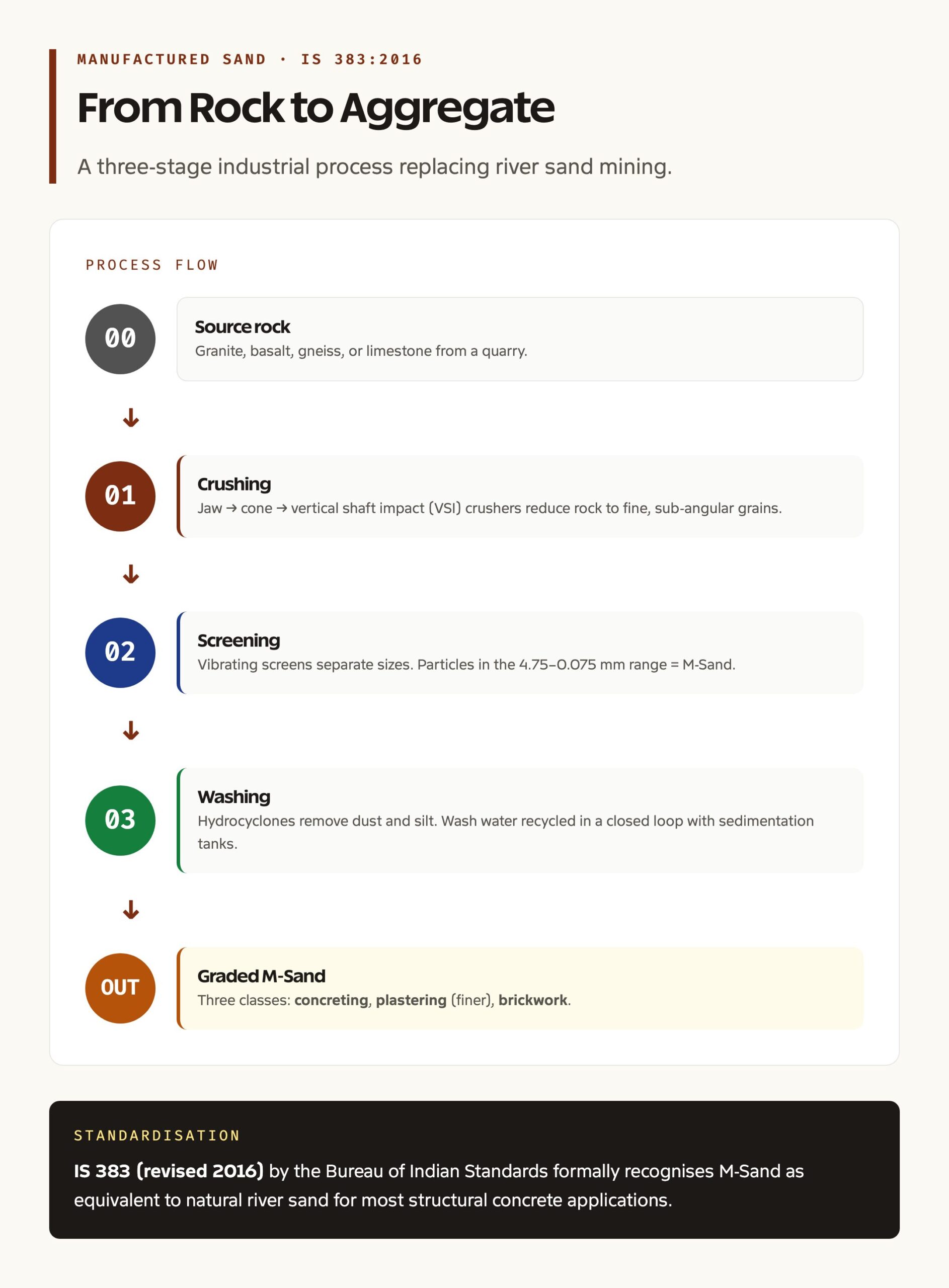
M-Sand production is a three-stage process designed to match the gradation requirements of construction-grade fine aggregate.
Stage 1: Crushing. The source rock — typically granite from a hard-rock quarry — is fed into a primary crusher (jaw crusher) that breaks it down to about 100 mm pieces. A secondary cone crusher reduces this further to about 40 mm. A vertical shaft impact (VSI) crusher then accelerates the rock against itself, producing the finer fraction with the cubical, sub-angular shape that the construction industry prefers. The VSI is the heart of any modern M-Sand plant: its rotor speed and feed rate determine the final grain shape.
Stage 2: Screening. The crushed material is passed through multi-deck vibrating screens that separate it into different size fractions. Material above 4.75 mm goes back into the crusher. Material in the 4.75 to 0.075 mm range is the M-Sand. Material below 0.075 mm is “fines” or “filler,” which can be used in concrete (in small proportions) or in road construction.
Stage 3: Washing. Modern plants include a washing stage to remove dust and very fine particles that would otherwise increase water demand and reduce concrete strength. Hydrocyclones and dewatering screens recover the washed sand. The wash water is recycled in a closed loop with sedimentation tanks to remove the fines and ensure water reuse — a key sustainability requirement under state pollution control board norms.
Some plants add a fourth optional stage of magnetic separation to remove iron impurities, particularly for high-strength concrete grades. The final product is consistent in grading, free of organic matter (which can compromise cement hydration), and ready to use without further preparation.
Comparison: M-Sand vs River Sand
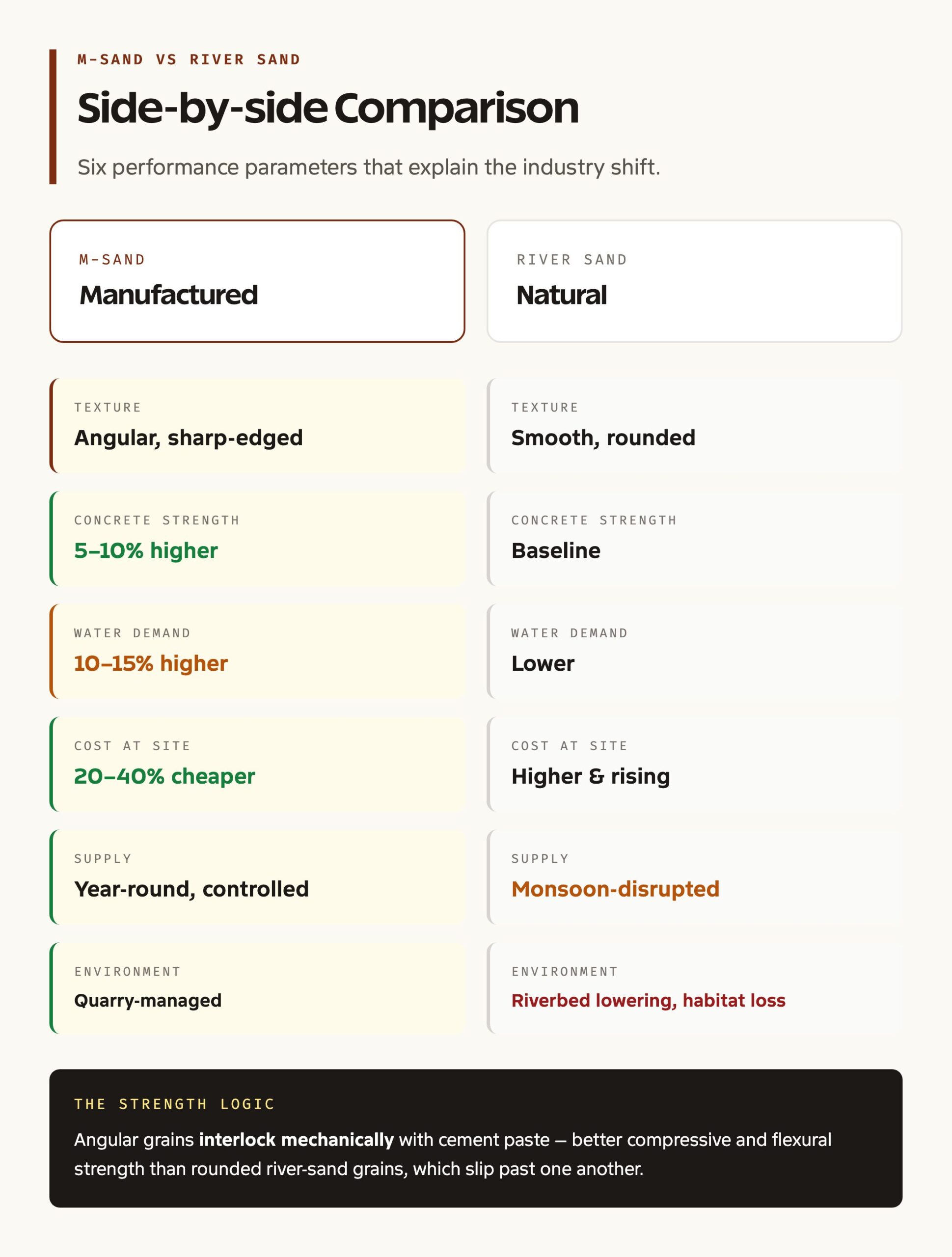
| Feature | M-Sand (Manufactured Sand) | River Sand (Natural Sand) |
|---|---|---|
| Origin | Crushed from granite or other hard rocks | Deposited by rivers over geological time |
| Texture | Angular, sharp-edged grains | Smooth, rounded grains |
| Concrete strength | Higher (better mechanical interlock) | Lower comparative strength |
| Water demand | Slightly higher (10–15 percent) | Lower water demand |
| Grading consistency | Controllable, plant-engineered | Variable, depends on river dynamics |
| Environmental impact | Quarry-related; managed under MMDR Act | River bed depletion, bank erosion, habitat loss |
| Supply seasonality | Year-round availability | Reduced supply in monsoon |
| Cost (project site) | Typically 20–40 percent cheaper | Higher and rising |
| Organic content | None (rock-derived) | May contain silt, clay, and organics |
| Shrinkage in concrete | Slightly higher | Slightly lower |
The comparison is decisive on three of the four dimensions that matter most for large-scale construction: cost, consistency, and environmental impact. The remaining dimension, water demand, is a manageable trade-off through admixtures and mix design.
Why It Matters
The matter is not simply an engineering one. Sand mining from rivers in India has become an ecological crisis with severe knock-on effects on aquatic biodiversity, groundwater recharge, and flood dynamics. Riverbed mining lowers the bed level, drops the water table in adjacent aquifers, undermines bridge piers and embankments, and destroys breeding habitats for aquatic species like the Gangetic dolphin and gharial. The Yamuna, the Sone, the Cauvery, and the Pennar have all suffered measurable bed lowering attributable to sand mining.
Beyond ecology, sand mining is one of India’s most violent illegal economies. Investigative journalism has documented dozens of murders linked to the sand mafia in Madhya Pradesh, Uttar Pradesh, Tamil Nadu, and Maharashtra. Rule of law collapses where extraction is banned but profitable. M-Sand offers a way out by replacing the demand that sustains the illegal market.
There is also a federal dimension. River sand is a state subject under the Mines and Minerals (Development and Regulation) Act, 1957, and state revenue interests have often blocked stricter mining controls. M-Sand is also a state subject through the same act, but its rents flow to organised quarry operators rather than informal extractors, which makes regulation easier and tax collection more transparent.
Detailed Analysis: Engineering Performance
The most rigorous comparison of M-Sand with river sand has been carried out by the Indian Concrete Institute, IIT Madras, and the Construction Industry Development Council. The summary findings:
Compressive strength: M-Sand concrete generally achieves 5–10 percent higher 28-day compressive strength than river sand concrete at the same water-cement ratio, because the angular grains interlock mechanically with the cement paste matrix.
Flexural strength: Improvements are similar, in the range of 5–8 percent, for the same reason.
Workability: M-Sand mixes are slightly less workable for the same water-cement ratio, requiring either small adjustments to the mix design or the use of plasticisers. This is the single technical adjustment that practitioners need to make.
Durability: Long-term durability tests show comparable or better performance against carbonation, chloride penetration, and freeze-thaw cycling.
Surface finish: Plastering with M-Sand requires slightly more skilled trowelling because of the angular grain texture. Finer grades of M-Sand specifically engineered for plaster work address this.
The implication is clear. For structural concrete, M-Sand is a direct substitute or improvement on river sand. For finishing applications, the choice depends on the specific finer M-Sand grade available.
Environmental and Economic Comparative
The lifecycle environmental burden of M-Sand is concentrated at the quarry. Quarrying involves blasting, dust emission, noise, and waste rock generation. These impacts are real but are spatially contained and can be managed under the existing Mining Plan and Environmental Clearance framework. Modern plants with dust suppression, controlled blasting, and waste rock backfilling can operate with limited residual impact.
River sand mining, by contrast, has a diffused and largely irreversible environmental footprint. Once the river bed has been lowered, restoration is impossible on human timescales. Aquatic habitats lost are gone permanently.
Economically, M-Sand is now consistently cheaper than river sand at the construction site in Karnataka, Tamil Nadu, and Telangana. River sand prices have risen partly because of stricter regulation and partly because of demand. M-Sand prices have fallen because of plant standardisation and economies of scale. The cross-over point was reached around 2018 in most southern markets and is approaching in northern and eastern India.
Challenges in Wider Adoption
The first challenge is mindset. Many contractors and homeowners still consider river sand the gold standard because of decades of practice. Awareness campaigns by state public works departments and central PSUs like NBCC have begun to shift this perception, but slowly.
The second challenge is quality variation across producers. M-Sand is only as good as the plant that makes it. Plants that skip the washing stage produce sand with high silt and dust content that can compromise concrete. Many state governments have introduced certification regimes (such as Karnataka’s BMRDA-approved supplier list) to address this, but coverage is uneven.
The third challenge is the regulatory inertia of state mining departments. Quarry licensing for M-Sand production is governed by the same MMDR Act framework as for limestone or other minerals, and approval timelines can stretch to two or three years. Streamlining this process is a precondition for scale-up.
The fourth challenge is logistics. M-Sand is heavy, and transport over more than 100 kilometres erodes its cost advantage. Ensuring that M-Sand plants are located near demand centres requires coordinated planning between state mining and urban development departments.
Prelims Pointers
- M-Sand stands for Manufactured Sand, a synthetic alternative to river sand
- Source rock is typically granite, basalt, or limestone
- Manufacturing involves a three-stage process: crushing, screening, washing
- Grain shape is angular (vs rounded river sand)
- The standard governing fine aggregates is IS 383:2016 (BIS), which formally recognises M-Sand
- Sand mining is regulated under the Mines and Minerals (Development and Regulation) Act, 1957
- The Sustainable Sand Mining Management Guidelines, 2016 (revised 2020) govern in-stream mining
- Karnataka’s Sand Policy of 2017 prioritises M-Sand
- M-Sand concrete has higher compressive and flexural strength than river sand concrete
- M-Sand has slightly higher water demand (10–15 percent) than river sand
- Excessive in-stream sand mining causes riverbed lowering, bank erosion, and habitat loss for species like the Gangetic dolphin and gharial
Mains Practice Questions
- Discuss the environmental impact of in-stream sand mining in India and evaluate the role of manufactured sand (M-Sand) as a sustainable alternative. (250 words)
- Examine the regulatory framework for sand mining in India under the MMDR Act and the Sustainable Sand Mining Management Guidelines. Critically evaluate implementation. (250 words)
- Analyse the engineering and economic advantages of M-Sand over river sand for India’s construction industry. (150 words)
- The replacement of river sand with manufactured sand is as much a governance reform as an environmental measure. Discuss. (150 words)
Way Forward
A national sand policy framework, harmonising state-level approaches, would accelerate the M-Sand transition. The Niti Aayog’s 2018 report on sustainable sand mining proposed such a framework but implementation has been state-led. A central policy that mandates a minimum percentage of M-Sand in public procurement, coupled with capacity-building for state mining departments, would speed adoption.
Quality assurance is the next priority. A national M-Sand quality certification scheme, run by BIS in coordination with state pollution control boards, would build trust among builders and homeowners. Random sampling at construction sites and penalties for sub-standard supply would close the quality enforcement loop.
R&D investment can push the frontier. The next-generation M-Sand uses construction and demolition waste as feedstock, closing the loop on the urban material cycle. India generates an estimated 150 million tonnes of construction and demolition waste annually, and recovery of fine aggregate from this waste stream could substitute a significant share of M-Sand demand.
Finally, parallel reform of riverbed mining is essential. M-Sand alone cannot solve the sand problem if illegal river extraction continues to undercut its market. Stronger NGT enforcement, satellite-based monitoring of riverbeds, and citizen reporting platforms are necessary complements to the M-Sand push.
Frequently Asked Questions
What is M-Sand?
M-Sand or Manufactured Sand is a synthetic alternative to natural river sand, produced by mechanically crushing hard rocks like granite or basalt into fine aggregates that meet the same engineering specifications as river sand for use in concrete, mortar, and plaster.
How is M-Sand made?
M-Sand is made in a three-stage process: crushing of source rock to progressively finer sizes (typically using jaw, cone, and vertical shaft impact crushers), screening to separate the desired particle size range below 4.75 mm, and washing to remove fine dust and silt that would compromise concrete performance.
Is M-Sand stronger than river sand?
Yes. M-Sand concrete typically achieves 5 to 10 percent higher compressive and flexural strength than river sand concrete at the same water-cement ratio, because the angular grain shape provides better mechanical interlock with the cement paste matrix.
What are the disadvantages of M-Sand?
M-Sand has a slightly higher water demand than river sand (10 to 15 percent more), which can be managed through plasticisers or small mix design adjustments. Plastering with M-Sand requires a finer grade specifically engineered for finishing work. Quarry-related impacts must be managed under the Mining Plan and Environmental Clearance framework.
Why is river sand mining environmentally damaging?
In-stream river sand mining lowers the riverbed, drops the adjacent groundwater table, destabilises bridge piers and embankments, increases bank erosion, and destroys breeding habitats for aquatic species like the Gangetic dolphin, gharial, and many fish species. The damage is largely irreversible on human timescales.
Which Indian states lead in M-Sand adoption?
Karnataka, Tamil Nadu, Andhra Pradesh, and Telangana lead in M-Sand adoption. Karnataka’s 2017 Sand Policy explicitly prioritised M-Sand. Tamil Nadu followed in 2019. Northern and eastern states are catching up.
Is M-Sand approved by the Bureau of Indian Standards?
Yes. The BIS revised IS 383 in 2016 to formally recognise manufactured sand as a category of fine aggregate, equivalent to natural river sand for most structural concrete applications.
Can M-Sand be used in plastering?
Yes, but a finer grade of M-Sand specifically engineered for plaster work is preferred. Concreting M-Sand has a coarser grading that is unsuitable for fine plastering and finishing.
How does M-Sand pricing compare to river sand?
At most construction sites in southern India, M-Sand is now 20 to 40 percent cheaper than river sand. The cost advantage stems from controlled production, reduced regulatory pressure compared to river extraction, and economies of scale at modern plants.
What is the role of M-Sand in tackling illegal sand mining?
Illegal sand mining persists because river sand demand exceeds legal supply. M-Sand reduces the demand gap and undercuts the economic logic of the sand mafia. Combined with stronger enforcement, satellite-based monitoring, and citizen reporting, M-Sand is one of the most effective levers against illegal river extraction.
Tell Google you want more of this.
Add Anantam IAS as a preferred sourceOne tap, and this site shows up more often in your own Top Stories, AI Overviews and AI Mode. Remove it any time.