Disclosure: this guide contains Amazon affiliate links. As an Amazon Associate, Anantam IAS earns from qualifying purchases — at no extra cost to you.
Mains is an answer-writing exam, not a knowledge exam. You can know everything about the NITI Aayog and still score 60/250 in GS-II because your answer is a Wikipedia dump. Thirty days of focused practice can take your writing from ‘informational’ to ‘examinable’. Here is the daily plan.
Don’t just read the plan — print it, write on it, score it
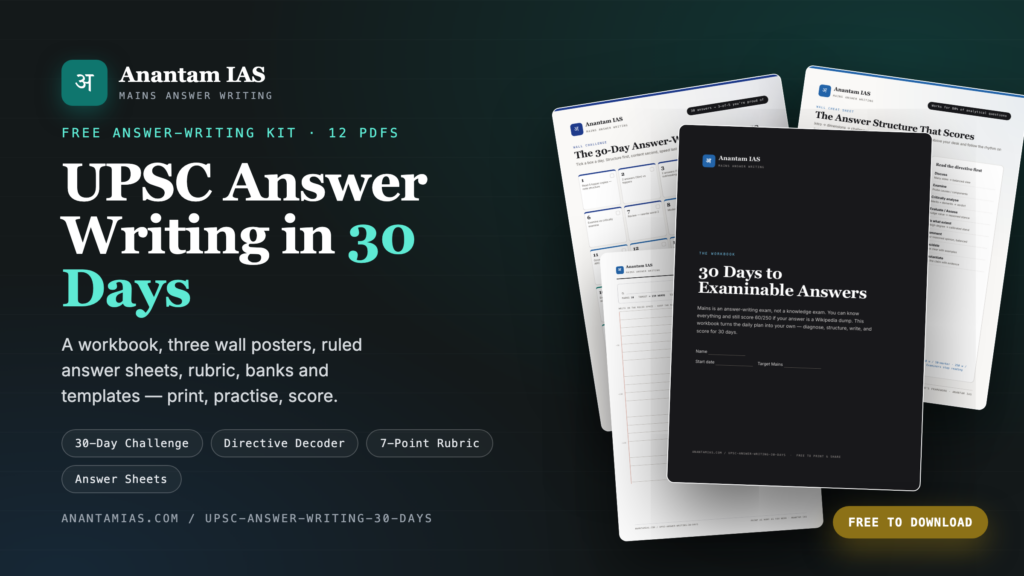
This guide ships with a complete, free toolkit: a fill-in Answer-Writing Workbook, three wall posters (the 30-day challenge, the structure cheat sheet, the directive decoder), UPSC-style ruled answer sheets, a 7-point rubric, and banks for diagrams, value-addition and intros. First, decode the verb that decides every answer.
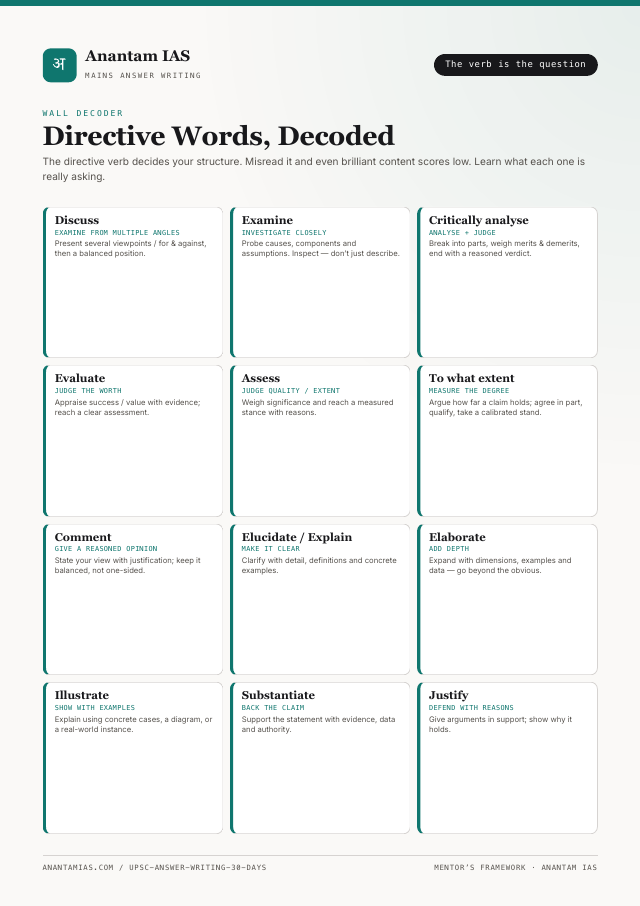
↓ Download the whole kit · ZIPDecodeTap a directive — see what it’s really asking
Wall posters
Print & stick · A4 + phone + desktop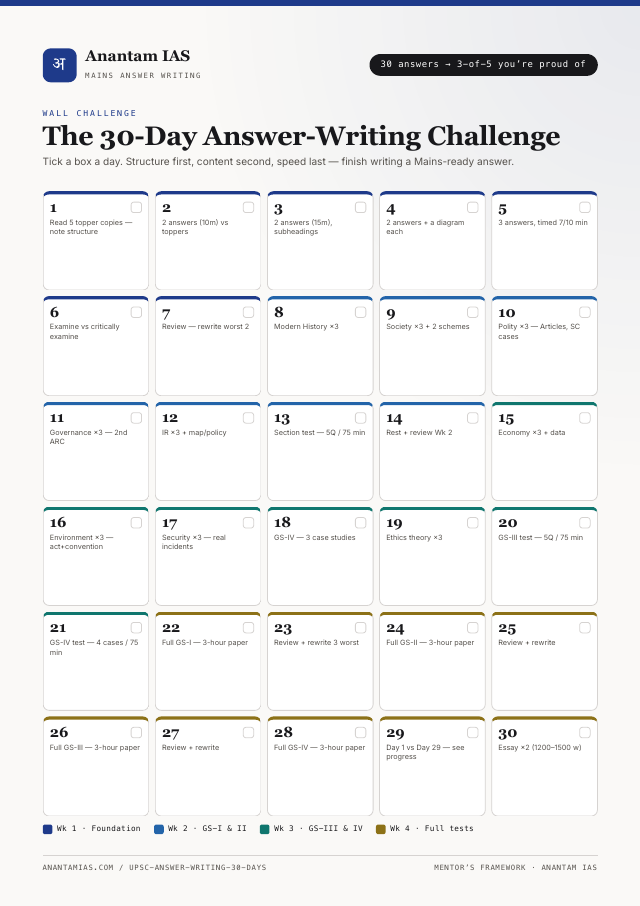
Baseline: Where You Should Be on Day 1
Before starting this plan, ensure you have:
- Covered at least 80% of the GS syllabus once
- A notebook with 150+ previous year Mains questions
- A working pen (actually — most aspirants struggle with pen fatigue in the first exam)
- Access to one test series or toppers’ copies for comparison
→ Use it now: Open the Answer-Writing Workbook and take the Day-0 diagnostic (PDF)
Core Principles of UPSC Answer Writing
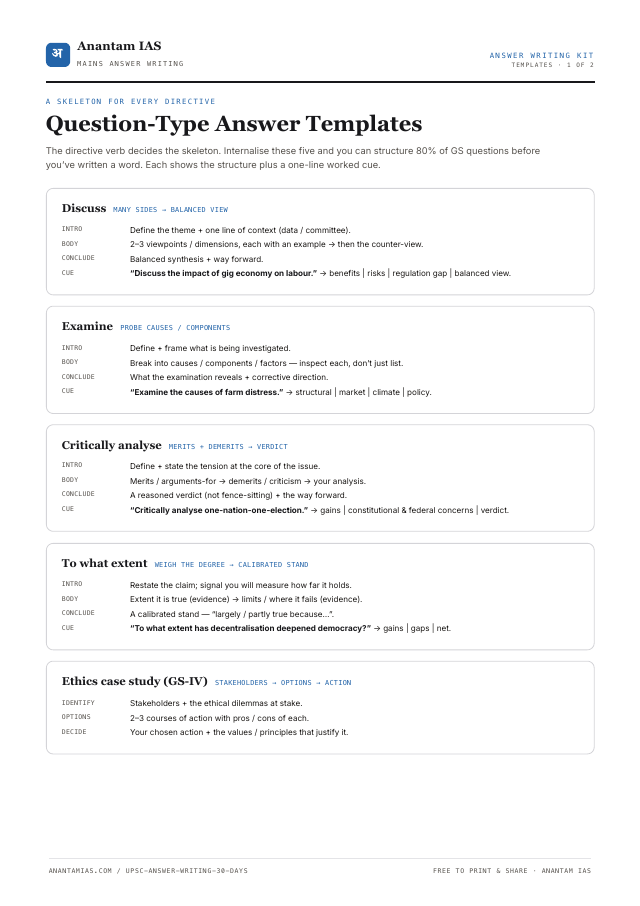
- Directive verb drives the answer. Discuss, examine, critically analyse, evaluate — each demands a different structure.
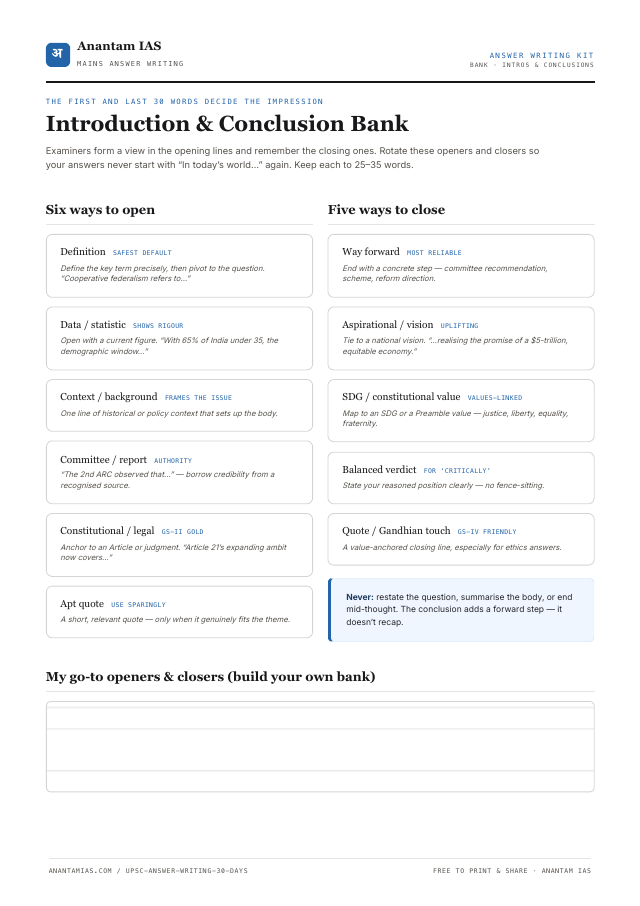
- Introduction: 2–3 lines. Define the term, provide context, or give a data point. Never narrate.
- Body: structured with subheadings. Break into dimensions — social, economic, political, institutional.
- Conclusion: 2–3 lines. Forward-looking, solution-oriented, constitutional or SDG-linked.
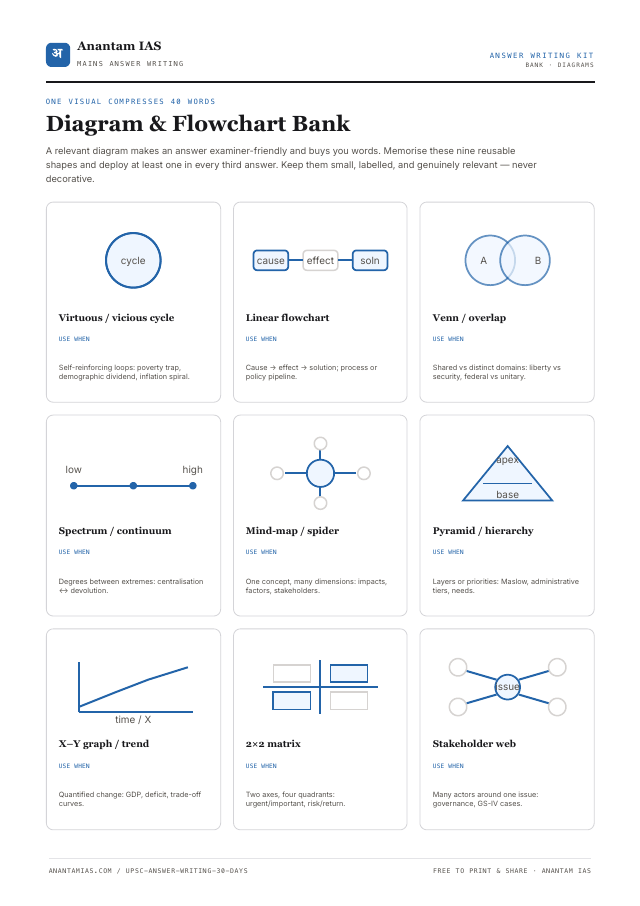
- Diagrams, flowcharts, maps wherever possible. They compress 40 words into one visual.
- Length: 150 words for 10-markers, 250 words for 15-markers. Write exactly that. Examiners stop reading runoff.
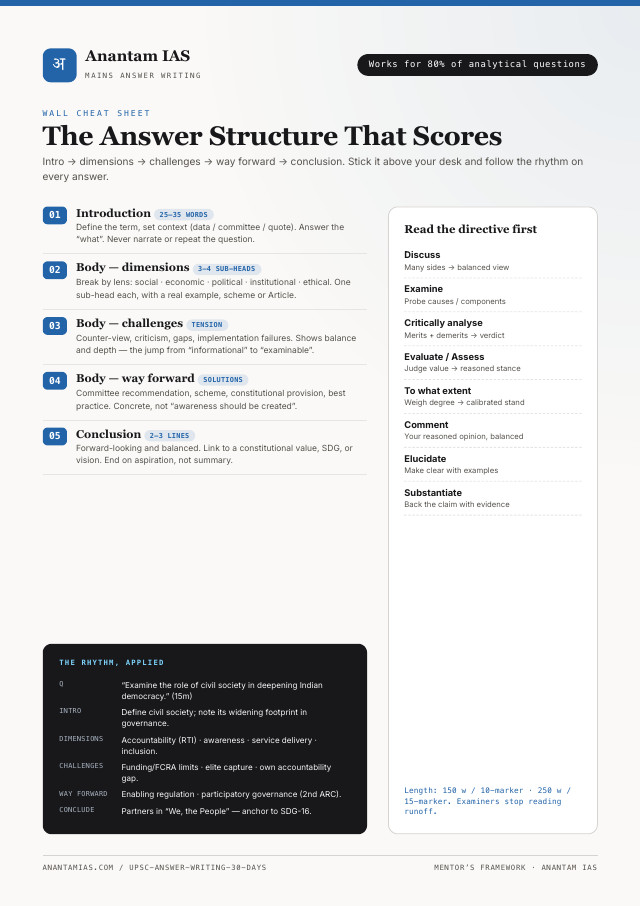
→ Use it now: Download the Answer Structure cheat-sheet poster (PDF)
Week 1: Foundation — Structure First, Content Later
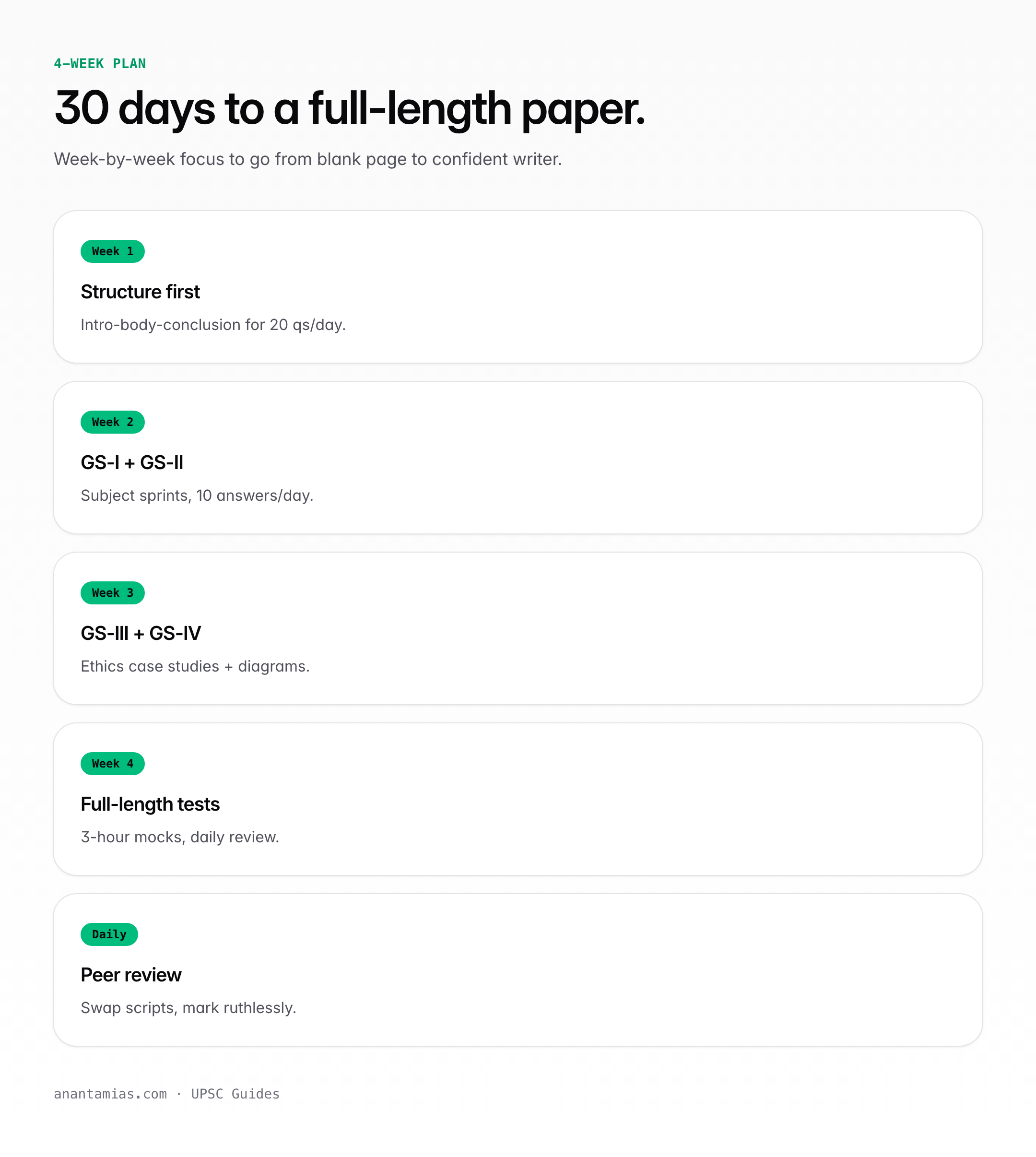
Goal: internalise the introduction–body–conclusion rhythm and directive-verb response.
| Day | Task |
|---|---|
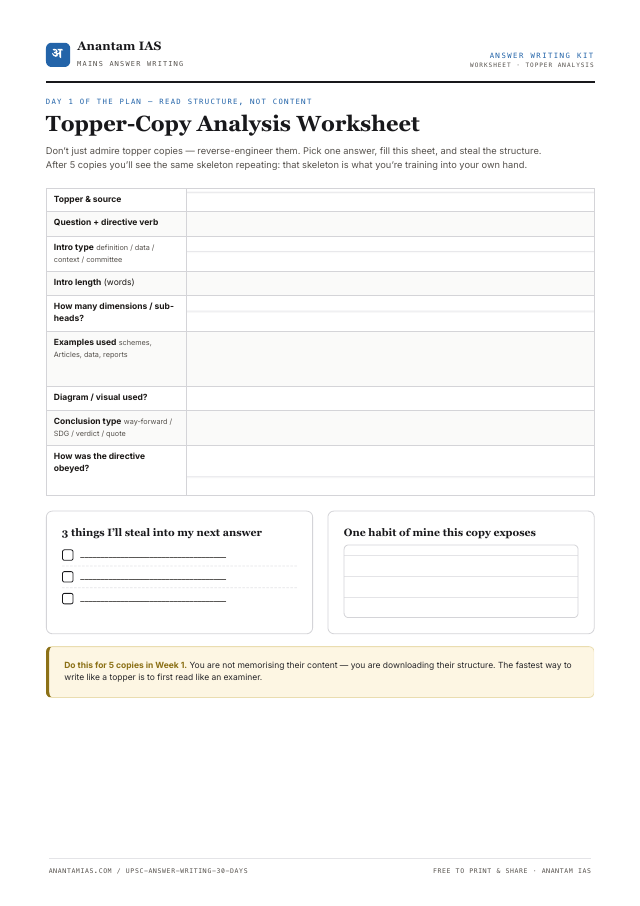
| 1 | Read 5 topper answer copies. Note structure, not content. |
| 2 | Write 2 answers from PYQs (10-marker). Compare with toppers’ copies. |
| 3 | Write 2 answers (15-marker). Focus on subheadings. |
| 4 | Write 2 answers with a diagram each. |
| 5 | Write 3 answers. Time yourself: 7 min for 10-marker, 10 min for 15-marker. |
| 6 | Write 2 answers with different directive verbs (examine vs critically examine). |
| 7 | Weekly review — read all 12 answers, rewrite the worst 2. |
Week 2: Subject-Wise Focus — GS-I and GS-II
Goal: build repertoire of examples, committees, and data for the first two papers.
| Day | Task |
|---|---|
| 8 | 3 answers on Modern History with freedom struggle examples. |
| 9 | 3 answers on Society (women, caste, urbanisation). Add 2 government schemes in each. |
| 10 | 3 answers on Polity — quote Article numbers, SC cases. |
| 11 | 3 answers on Governance — 2nd ARC recommendations. |
| 12 | 3 answers on IR with map/policy references. |
| 13 | Full section test: 5 questions in 75 minutes. |
| 14 | Rest + full review of week 2 copies. |
Week 3: GS-III and GS-IV
| Day | Task |
|---|---|
| 15 | 3 answers on Economy with data (GDP growth, fiscal deficit, current figures). |
| 16 | 3 answers on Environment — act/year + global convention + data. |
| 17 | 3 answers on Security — real incidents + government response. |
| 18 | 3 case studies from GS-IV syllabus. |
| 19 | 3 theoretical ethics questions (define, explain, give example). |
| 20 | Full GS-III sectional test: 5 questions, 75 min. |
| 21 | Full GS-IV sectional test: 4 case studies, 75 min. |
Week 4: Integration and Full-Length Tests
| Day | Task |
|---|---|
| 22 | Full 3-hour GS-I test — write all 20 questions. |
| 23 | Review and rewrite 3 worst answers from Day 22. |
| 24 | Full 3-hour GS-II test. |
| 25 | Review + rewrite. |
| 26 | Full 3-hour GS-III test. |
| 27 | Review + rewrite. |
| 28 | Full 3-hour GS-IV test. |
| 29 | Compare Day 1 answers vs Day 29 answers — note visible progress. |
| 30 | Essay practice: 2 essays (1200–1500 words each). |
→ Use it now: Download the 30-Day Challenge wall calendar (PDF)
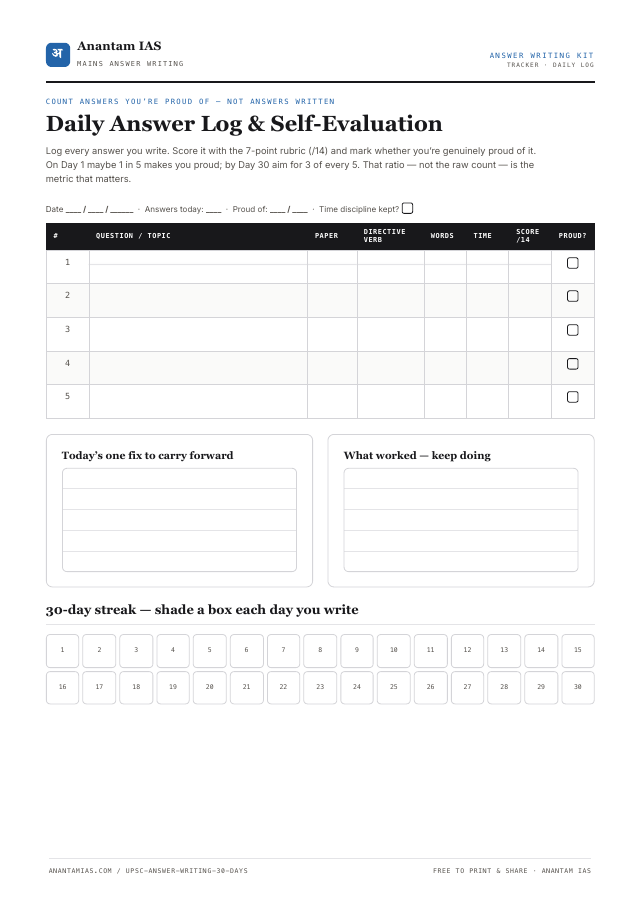
→ Use it now: Track it with the Daily Answer Log (PDF)
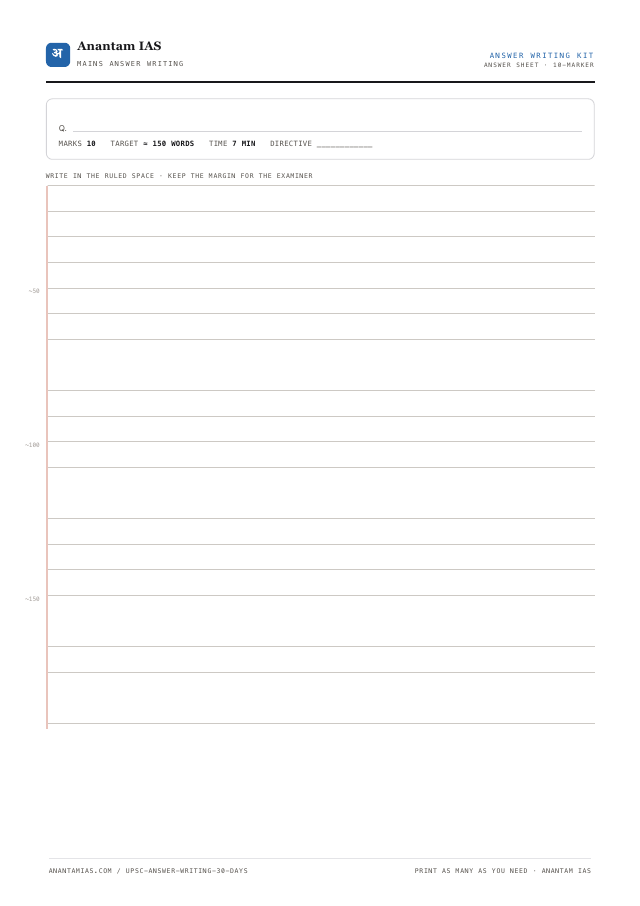
→ Use it now: Practise on printable UPSC-style answer sheets (PDF)
The 4-Step Structure That Works for 80% of Questions
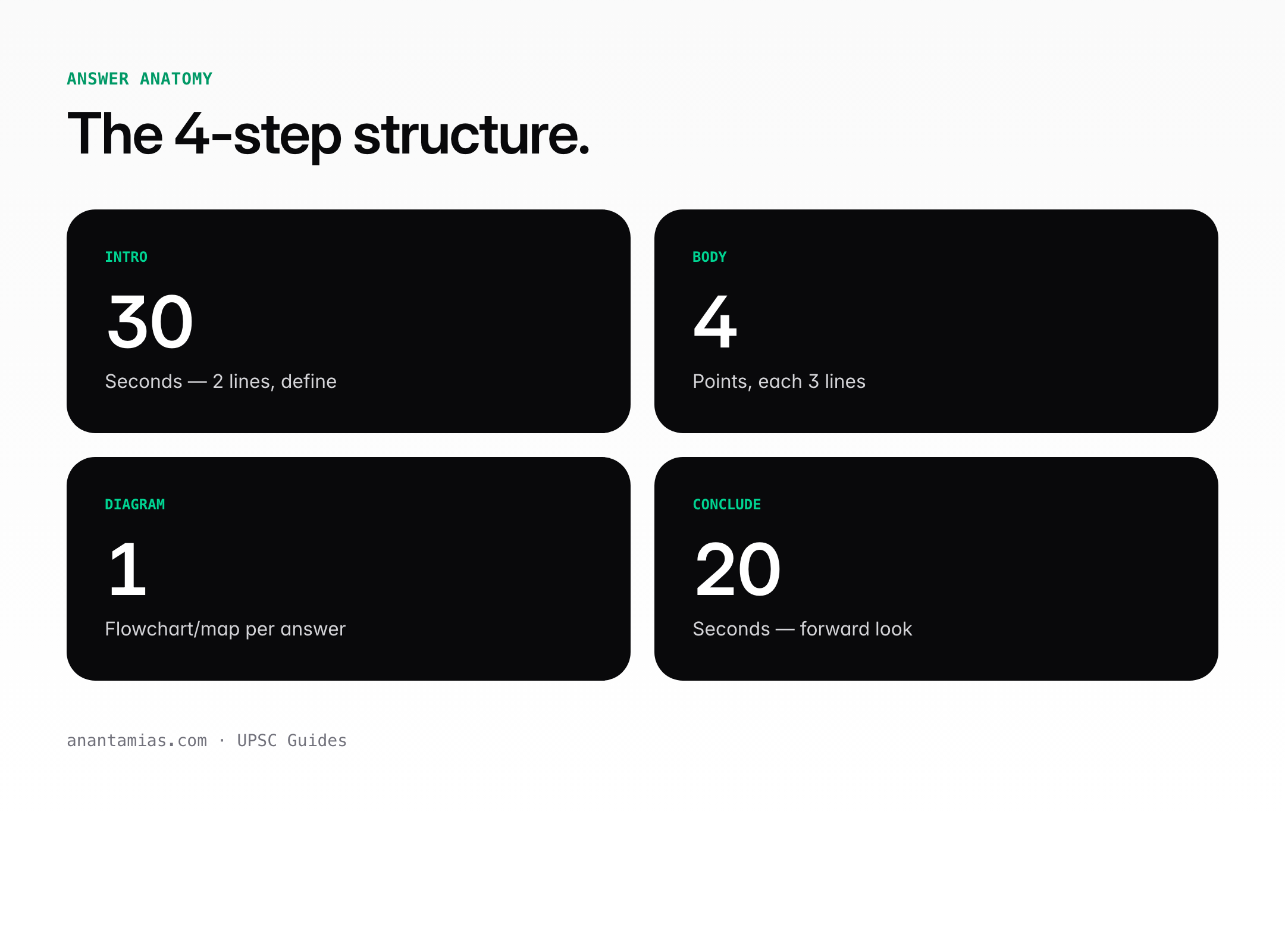
For any standard analytical question:
- Introduction: define the term + give a context (data/quote/committee)
- Body Part 1: 3–4 dimensions of the issue with examples
- Body Part 2: challenges / criticisms / gaps
- Body Part 3: way forward with committee / scheme / constitutional provision
- Conclusion: aspirational sentence aligned with constitutional values or SDGs
→ Use it now: Get a ready skeleton for every question type (PDF)
→ Use it now: Stock your Introduction & Conclusion Bank (PDF)
→ Use it now: Memorise the Diagram & Flowchart Bank (PDF)
Common Mistakes This Plan Fixes
- Writing introductions that take 80 words (aim for 25–35)
- Forgetting to address the directive verb
- Listing without analysis — ‘The reasons are 1, 2, 3, 4, 5’
- No conclusion, or a conclusion that just restates the introduction
- No diagrams when the question practically begs for one
- Running over word limit and losing time for later questions
Tools and Resources
- Toppers’ answer copies — Anudeep Durishetty’s blog, IAS Baba’s toppers’ copies section
- Daily Mains Answer Writing programs — Vision IAS, InsightsIAS (free), ForumIAS
- Ink pens (0.7 mm roller) — your hand will thank you at the 7th hour mark
- An A4 notebook with question on top, answer below — just like the real Mains booklet
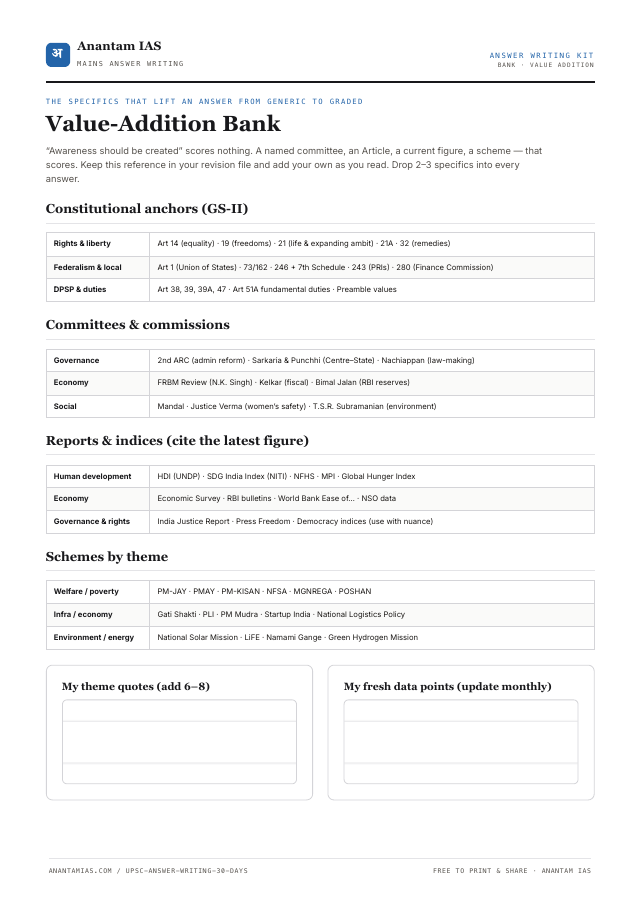
→ Use it now: Build answers with the Value-Addition Bank (PDF)

amblitz Mains Answer Sheets — Pack of 2 (400 pages)
- Two A4 spiral notebooks, 200 pages each, 70 GSM
- Same pre-printed Mains-booklet margins as the single notebook
- Enough pages for the whole build-up at two answers a day
→ Use it now: Dissect a topper copy with the Analysis worksheet (PDF)
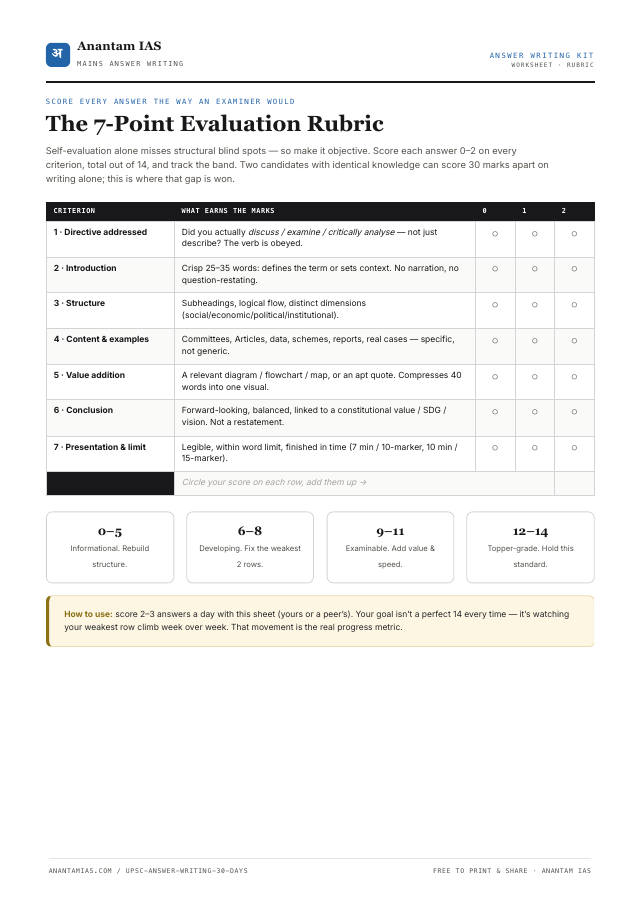
Score Every Answer: The Feedback Loop
Writing answers without scoring them is just journaling. The fastest improvement comes from a tight loop: write → score → fix one thing → rewrite. Self-evaluation alone misses structural blind spots, so make it objective — grade every answer on the same seven criteria (directive, intro, structure, content, value-addition, conclusion, presentation) out of 14, and watch your weakest row climb week over week.
Once a week, rewrite your two worst answers rather than avoiding them — that is where the marks hide. And pair self-scoring with one external check (a test series or a senior’s eye) to catch what you cannot see in your own writing.
→ Use it now: Score with the 7-Point Evaluation Rubric (PDF)
The Metric That Matters
Don’t count answers written. Count answers that made you proud. At the start of this plan, you might write 5 answers you’re happy with. By Day 30, aim for 3 out of every 5. That is the real progress metric. Once you hit that ratio, add speed — write 5 answers in 45 minutes. That’s Mains pace.
Thirty days won’t make you a topper. It will make you a capable answer writer. Then you repeat this every month until Mains.
The complete free toolkit
Workbook + 8 worksheets · grab all 12 PDFs as a ZIP ↓
Frequently Asked Questions
How many answers should I write per day?
Two to three answers daily in the first two weeks, scaling to 4–5 in the fourth week. Quality of review matters more than raw count.
What is the ideal length for a UPSC Mains answer?
150 words for a 10-marker and 250 words for a 15-marker. Exceeding this wastes time and often weakens the answer.
Is it okay to use diagrams and flowcharts?
Yes — strongly encouraged. A relevant flowchart or mind-map can compress 40 words and makes the answer examiner-friendly. Use them in at least one out of every three answers.
Should I join a test series?
Yes. A structured test series (Vision IAS, ForumIAS, InsightsIAS) provides evaluation and peer benchmarking. Self-evaluation alone misses structural blind spots.
How do I improve handwriting speed?
Practise writing 250 words in 10 minutes daily for a month. Use a 0.7 mm roller pen. Hand fatigue is real — build endurance by writing full 3-hour papers weekly.
Can I clear Mains with good content but weak writing?
No. Mains is evaluated on presentation, structure, and clarity as much as on content. Two candidates with identical knowledge can score 30 marks apart on the same paper based on writing alone.
Tell Google you want more of this.
Add Anantam IAS as a preferred sourceOne tap, and this site shows up more often in your own Top Stories, AI Overviews and AI Mode. Remove it any time.