Every democracy that takes a free press seriously eventually has to answer the same uncomfortable question: when journalism gets it wrong – when it defames, intrudes, fabricates or inflames – who decides, and who enforces? India answers that question badly, with a statutory council for print that cannot punish and a broadcast self-regulator that fines in token sums. But India is not alone in the struggle; it simply sits at one end of a long spectrum that runs from near-absolute press freedom to near-total state control. Looking at how other countries hold the pen – Britain after a phone-hacking scandal, the United States behind its constitutional firewall, Europe’s arm’s-length regulators, the Nordic countries’ quiet trust, and Singapore’s state-as-arbiter model – is the fastest way to see both what India is missing and what it should be careful never to import.
This is the comparative chapter in our series on media ethics in the age of virality. The earlier essays diagnosed the disease – the race to be first, manufactured misinformation, the national-security cost, the human cost. This one asks the harder question: across the democratic world, what actually works to keep the press both free and accountable?
The real question is not whether to regulate, but who holds the pen
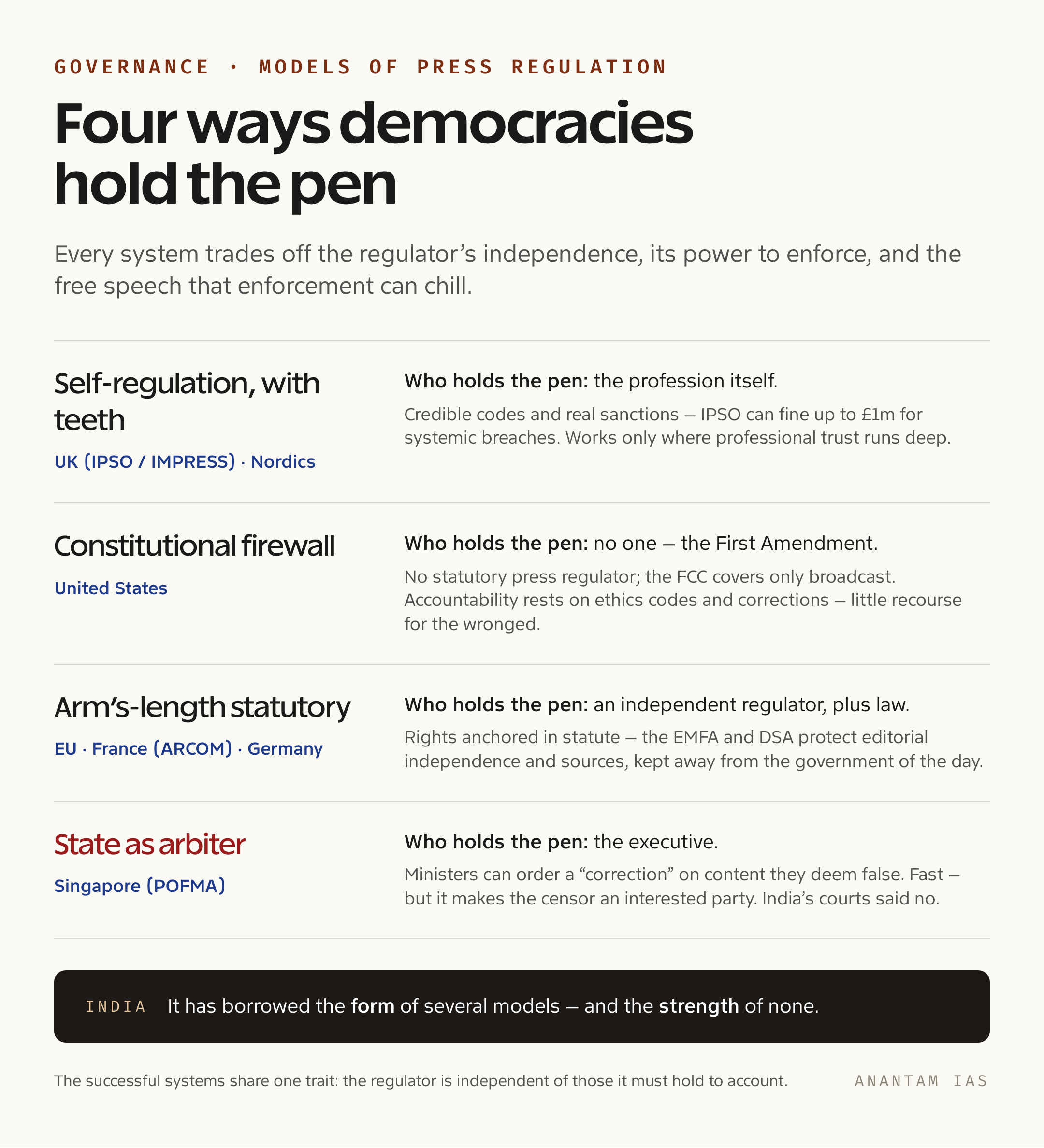
Strip away the national detail and every system is a different answer to a single trade-off between three goods that pull against each other: the independence of the regulator from both the industry and the state, the enforceability of its rulings, and the free speech that any regulation risks chilling. Push too hard on enforcement and you get a censor; lean too far towards freedom and the wronged citizen has no remedy; let the industry police itself without consequence and you get a toothless tiger.
Broadly, the world’s democracies have settled into four families: credible self-regulation (the United Kingdom after Leveson, and the Nordic countries); a constitutional firewall with minimal state involvement (the United States); the arm’s-length statutory regulator anchored in rights-based law (France, Germany and the wider European Union); and the state-as-arbiter model (Singapore). India has borrowed the form of several of these and the effectiveness of none. The comparison is not academic – it is the menu from which any Indian reform will have to choose.
The United Kingdom: self-regulation, rebuilt after a scandal
Britain learned the cost of weak press accountability the hard way. The Leveson Inquiry (2011-12), set up after the phone-hacking scandal that engulfed the News of the World, examined the “culture, practices and ethics of the press” and recommended a new system of independent self-regulation underpinned by statute through a Royal Charter. What emerged is instructive precisely because it is messy.
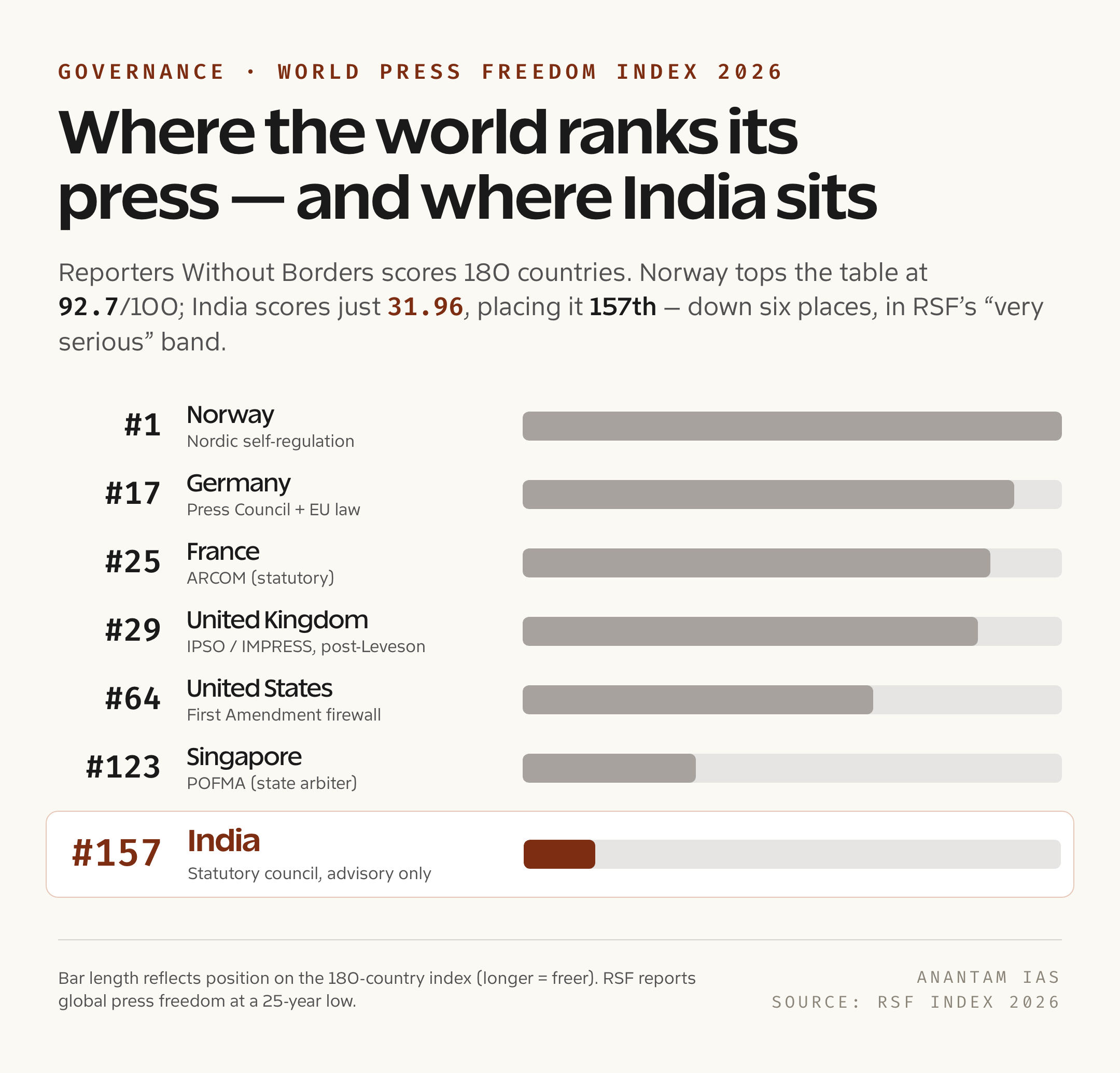
Most national newspapers signed up to the Independent Press Standards Organisation (IPSO), which enforces the Editors’ Code of Practice, investigates complaints, can require corrections and adjudications with specified prominence, and – for serious or systemic breaches – can in principle impose fines of up to £1 million. A smaller group joined IMPRESS, the only regulator formally recognised as “Leveson-compliant” by the Press Recognition Panel in 2016. Broadcasting is regulated separately and with real statutory teeth by Ofcom, which also now enforces the Online Safety Act 2023 against illegal and harmful online content. The British lesson is double-edged: self-regulation can carry credible sanctions if the code and the penalties are real – but critics note IPSO is industry-funded and has never sought official recognition, a reminder that the appearance of independence is not the same as the fact of it.
The United States: a constitutional firewall and the duty to self-correct
The United States sits at the freedom end of the spectrum, almost by constitutional design. The First Amendment bars Congress from making any law “abridging the freedom of speech, or of the press,” and the result is that America has no statutory press regulator at all. The Federal Communications Commission (FCC) licenses and regulates broadcast spectrum – decency, ownership, licensing – but has no authority over newspapers or news websites. The Supreme Court’s decision in New York Times v. Sullivan (1964) set the demanding “actual malice” standard, making it very hard for a public figure to win a defamation suit, deliberately protecting robust, even mistaken, criticism of the powerful.
What fills the vacuum is ethics, not law. Bodies like the Society of Professional Journalists publish a widely adopted Code of Ethics built on four pillars – seek truth and report it, minimise harm, act independently, and be accountable and transparent – and serious newsrooms run their own standards desks, ombudsmen and a strong culture of published corrections. The trade-off is stark: maximal freedom buys minimal recourse for the wronged. The American answer to a bad story is more speech, a market correction and a reputational hit – not a regulator’s fine. It is a model that depends almost entirely on the professional conscience of the newsroom, which is exactly why it travels poorly to media cultures where that conscience is thin.
Europe: arm’s-length regulators and a new rights-based law
Continental Europe has built a different machine: independent statutory regulators kept deliberately at arm’s length from the government of the day, increasingly backed by rights written into law rather than left to ministerial discretion. In France, the audiovisual and digital sphere is overseen by ARCOM, created in 2022 by merging the broadcasting regulator (CSA) with the online-rights body (Hadopi); the venerable Press Freedom Law of 1881 and a strong droit de réponse (right of reply) shape print. In Germany, print is governed by the voluntary Deutscher Presserat (Press Council) and its Pressekodex, while the once-pioneering NetzDG hate-speech-takedown law of 2017 has now been largely superseded by EU rules.
The most significant shift is at the Union level. The Digital Services Act (DSA), fully applicable since February 2024, obliges very large online platforms to act against illegal content with real transparency and audit obligations. Alongside it, the European Media Freedom Act (EMFA) – Regulation (EU) 2024/1083, in force from May 2024 with most provisions applying from August 2025 – protects the editorial independence of media outlets, shields journalistic sources (including against spyware), safeguards the independence of public-service media, and limits the arbitrary removal of professional media content by platforms, overseen by a new European Board for Media Services. Notably, the EMFA leaves fines and enforcement to member states, so its bite still depends on national follow-through. The European lesson is that accountability and freedom can be reconciled when the regulator is independent of the state and the protections are anchored in enforceable rights, not the preferences of whoever is in office.
The Nordic model: when trust does the work of law
The Nordic countries – Sweden, Norway, Denmark and Finland – achieve what India’s statutory council only aspires to, and they do it with the lightest legal touch of all. Their press councils are voluntary, yet authoritative: Norway’s Press Complaints Commission (PFU) adjudicates against the self-written “Be Cautious” code (Vær Varsom-plakaten), and Sweden runs a long-established press-ombudsman system. There is minimal state intervention, and yet these countries consistently rank among the world’s highest for both press freedom and public trust in media.
The reason is that the discipline is internalised rather than imposed. Editors compete on credibility, corrections are routine and unembarrassed, and the council’s moral authority is enough because the public and the profession both take it seriously. This is the model India’s “toothless tiger” was meant to resemble – but it reveals an uncomfortable truth: self-regulation works only where a deep culture of professional trust already exists. You cannot legislate that culture into being; you can only protect the conditions in which it grows.
Singapore and the state-as-arbiter temptation
At the controlled end of the spectrum sits Singapore’s Protection from Online Falsehoods and Manipulation Act (POFMA) of 2019. Its signature tool is the Correction Direction: a minister can require a post deemed false to carry a government notice and a link to the official clarification, with the original content usually left up; non-compliance can attract fines and, for individuals, imprisonment, and in serious cases content can be blocked or taken down. It is fast, efficient and superficially proportionate – the falsehood is labelled, not erased.
The danger is structural, not cosmetic. POFMA makes the executive the arbiter of what is true, and that is precisely the design India’s own courts have rejected. When the Indian government tried to empower a Fact Check Unit under the IT Rules to flag content about its own affairs as fake, the Bombay High Court struck it down in 2024 as unconstitutional. The principle the court drew is the bright line of this whole debate, and it should be read directly against the Singapore template: the cure for misinformation cannot be a censor who is also an interested party. This is the model that looks most tempting during a misinformation crisis and is the most corrosive to free speech over time.
Where India actually sits
Place India against this map and the picture is one of fragments. For print, the statutory Press Council of India (under the Press Council Act, 1978) has only advisory and moral power – it can warn, admonish or censure, but cannot fine or revoke a licence, a limitation the Supreme Court itself acknowledged in Ajay Goswami v. Union of India (2007). For broadcast, the self-regulatory NBDSA can order takedowns and levy modest fines, but its rulings often arrive after the offending content has already gone viral. The Cable Television Networks (Regulation) Act and its Programme Code bar content endangering national security or inciting hatred. The state’s attempt to police online falsehoods was struck down, and the advisory PIB Fact Check can debunk but not compel.
The net effect is a system that has the architecture of several models without the strength of any. India is not a credible self-regulator like the United Kingdom or the Nordics, because its bodies lack either teeth or trust; it is not a rights-anchored, arm’s-length system like the European Union, because its protections are thin and contested; and it has rightly refused to become a state-arbiter like Singapore, because its Constitution will not permit it. India is stuck in the gap between the models – which is exactly why misinformation, media trials and manufactured outrage flourish in the space the rules fail to cover.
What India can borrow, and what it must refuse
The comparison yields a clear, usable agenda. India does not need to invent a model; it needs to make a proven one actually work.
- From the UK and the Nordics – self-regulation with credibility. A reformed council or a unified media regulator needs a code that bites and sanctions that are real, independently funded and trusted enough that the profession polices itself rather than waiting to be policed.
- From the European Union – rights anchored in law. Editorial independence, protection of sources, transparency obligations on the platforms that now distribute most news, and – the gap India most urgently needs to close – a mandatory labelling regime for AI-generated and synthetic media, all kept at arm’s length from the government of the day.
- From the United States – a culture of correction. The discipline of publishing corrections as loudly as the original error, and treating accuracy as the whole of journalism rather than a feature of it.
- The one import to refuse – the Singapore temptation. However efficient it looks during a crisis, India must not make the executive the judge of truth about itself. That is the line the Bombay High Court drew, and it is the right one.
The world offers no single answer, but the systems that succeed share one trait: the regulator, whoever holds the pen, is independent of the people it must sometimes hold to account. For students mapping how this connects to statecraft and reform, our resources on governance and international relations trace the same comparative method, and the ethics notes carry the underlying conflict between freedom and responsibility. A free press and an accountable one are not opposites; the democracies that thrive are simply the ones that found a way to hold the pen in steady, independent hands.
Frequently Asked Questions
Which countries have the strongest press self-regulation?
The United Kingdom and the Nordic countries are the leading examples. After the Leveson Inquiry, Britain built independent self-regulation through IPSO and the Royal-Charter-recognised IMPRESS, with IPSO able to require prominent corrections and, for systemic breaches, fines of up to £1 million. The Nordic countries – Sweden, Norway, Denmark and Finland – run voluntary but highly respected press councils, and consistently rank among the world’s highest for press freedom and public trust, because the discipline is internalised by the profession.
Does the United States have a press regulator?
No. The First Amendment prevents the government from regulating the press, so the US has no statutory press regulator. The FCC oversees only broadcast spectrum, not newspapers or news websites. Accountability rests on self-regulation – codes such as the Society of Professional Journalists’ Code of Ethics, newsroom standards desks, ombudsmen and a strong culture of published corrections – rather than on any state body.
What is the European Media Freedom Act?
The European Media Freedom Act (Regulation (EU) 2024/1083) is an EU-wide law that came into force in May 2024, with most provisions applying from August 2025. It protects the editorial independence of media outlets, safeguards journalistic sources (including against spyware), ensures the independence of public-service media and media pluralism, and limits the arbitrary removal of professional media content by very large online platforms. Enforcement and fines are left to member states, overseen by a new European Board for Media Services.
What is Singapore’s POFMA and why is it controversial?
The Protection from Online Falsehoods and Manipulation Act, 2019 lets ministers issue Correction Directions requiring a post deemed false to carry a government notice and a link to an official clarification, usually without removing the original; non-compliance can bring fines and imprisonment, and serious cases can be blocked. It is fast and proportionate-looking, but controversial because it makes the executive the arbiter of what is “false” – the very design India’s Bombay High Court rejected as unconstitutional when it struck down the IT Rules Fact Check Unit in 2024.
Why is India’s Press Council called a “toothless tiger,” and how do other countries differ?
The Press Council of India is a statutory body under the Press Council Act, 1978, but it can only warn, admonish or censure – it cannot fine, jail or revoke a licence, a limitation the Supreme Court noted in Ajay Goswami v. Union of India (2007). By contrast, the UK’s IPSO can levy substantial fines, Ofcom regulates broadcasting with statutory force, and EU law now anchors media rights directly. India has the legal form of a regulator without the enforcement power, leaving it weaker than both the self-regulatory and the statutory models abroad.
Practice Questions
Prelims MCQs
1. The Leveson Inquiry, which reshaped press regulation, was set up in which country and in response to what?
- (a) The United States, after a defamation verdict
- (b) The United Kingdom, after a phone-hacking scandal
- (c) Australia, after a media-ownership dispute
- (d) France, after a privacy breach
Answer: (b) The Leveson Inquiry (2011-12) examined the culture, practices and ethics of the British press following the phone-hacking scandal, and led to IPSO and IMPRESS.
2. With reference to the European Media Freedom Act (Regulation (EU) 2024/1083), consider the following statements: 1) It protects the editorial independence of media outlets. 2) It safeguards journalistic sources, including against spyware. 3) It centralises all fines and enforcement in the European Commission. Which are correct?
- (a) 1 and 2 only
- (b) 2 and 3 only
- (c) 1 and 3 only
- (d) 1, 2 and 3
Answer: (a) The EMFA protects editorial independence and sources, but leaves fines and enforcement to member states, overseen by a new European Board for Media Services.
3. Singapore’s POFMA is best described as a model in which:
- (a) The press regulates itself through a voluntary council
- (b) The judiciary pre-clears all news
- (c) The executive can direct that a falsehood carry a government correction notice
- (d) There is no regulation of online content
Answer: (c) POFMA’s Correction Directions let ministers require a government notice and link on content deemed false – making the executive the arbiter of truth.
4. Which statement about press regulation in the United States is correct?
- (a) A federal Press Council licenses newspapers
- (b) The First Amendment bars a statutory press regulator, and the FCC oversees only broadcast spectrum
- (c) The FCC regulates newspapers and news websites
- (d) The Supreme Court permits easy defamation suits by public figures
Answer: (b) The US has no statutory press regulator; the FCC regulates broadcast spectrum only, and NYT v. Sullivan (1964) makes defamation suits by public figures hard to win.
5. ARCOM, France’s audiovisual and digital regulator, was formed in 2022 by merging which two bodies?
- (a) The Press Council and the data-protection authority
- (b) The CSA (broadcasting) and Hadopi (online rights)
- (c) Two public broadcasters
- (d) The interior and culture ministries
Answer: (b) ARCOM resulted from the 2022 merger of the Conseil supérieur de l’audiovisuel (CSA) with Hadopi.
Mains Practice Questions
- Press regulation across democracies ranges from constitutional near-absolutism to state control. Compare the major models and examine where India fits, and why. (15 marks, 250 words)
- “The cure for misinformation cannot be a censor who is also an interested party.” Evaluate this principle by contrasting Singapore’s POFMA with the Indian judiciary’s stance on a government Fact Check Unit. (15 marks, 250 words)
- Self-regulation works in the United Kingdom and the Nordic countries but falters in India. Critically analyse why, and what reforms could give Indian media self-regulation genuine credibility. (15 marks, 250 words)
- The European Union has moved towards anchoring media freedom and platform accountability in enforceable law (EMFA and DSA). Should India adopt a rights-based framework, including mandatory labelling of synthetic media? Discuss. (15 marks, 250 words)
- “You cannot legislate a culture of trust into being.” Discuss the relative roles of professional norms and legal enforcement in achieving an accountable yet free press. (10 marks, 150 words)
Tell Google you want more of this.
Add Anantam IAS as a preferred sourceOne tap, and this site shows up more often in your own Top Stories, AI Overviews and AI Mode. Remove it any time.