In June 2026, within hours of the UPSC Civil Services Prelims 2026 results, a hoax became a headline. The charge was not a small one. It alleged that the question paper had been leaked to a coaching institute — ours, Anantam IAS — and that we had cheated thousands of honest aspirants out of their hard-earned attempt. The student wing of a national party put a number on the smear, claiming that 82 of the 100 questions “matched” our study material, and offered as its sole proof a single misread screenshot: a backdated publish date on one of our pages. By that evening several outlets were amplifying it under framings like “After NEET, UPSC Prelims 2026 Leaked Too?” — a question mark quietly doing the work of an accusation. We were tried and convicted in the feed before a single fact had been established.
Here is what almost no one did before broadcasting an allegation grave enough to destroy an institution: check, or ask. The story raced across timelines and into news copy without anyone contacting us for our account, and without a single independent expert being consulted — though any expert would have explained, in under a minute, that a content-management system stamps every page with an immutable creation record. The updated timestamp and the strictly incremental post IDs both showed the explanations had been written after the exam, not before; the screenshot proved nothing. The “82 questions” figure ignored the obvious, too — a serious institute teaches the very syllabus the exam tests, so overlap is expected, not sinister. The government’s own PIB Fact Check unit declared the paper-leak claim “fake” that very day, noting that UPSC papers are set through a confidential process by independent subject experts drawn from across the country. We answered the charge in full, with evidence, here.
We raise our own episode not to relitigate it, but because it is a small, clean specimen of a much larger sickness: an accusation engineered to spread, published without research, without evidence, and without the elementary duty of hearing the accused before condemning them. The lie needed seconds; the truth needed a thirty-second check that almost nobody ran — and the debunk, when it came, travelled a fraction of the distance the headline did. That sickness now infects newsrooms, timelines and the public mind alike.
The sickness has a name: the race to be first. The attention economy has inverted journalism’s oldest hierarchy. Speed and virality now sit where accuracy and accountability once stood, and the bill for that swap is paid in truth, in public trust, and — as we will see — sometimes in lives.
The Inverted Newsroom
Old journalism ran on a simple, unglamorous discipline: verify, then publish. An editor’s first instinct was suspicion. A claim was checked against a second source, a document, a named official, before it earned ink. That discipline was slow by design, and the slowness was the point — it was the cost of being right.
That order has been reversed. The working rule of the viral newsroom is publish first, verify later — if at all. When a screen-grab can reach a million people before a desk editor has even seen it, the institution that pauses to confirm simply loses the audience to the one that does not. The penalty for being wrong has shrunk to a quiet correction nobody reads. The penalty for being slow is extinction. So the verification ethic, the spine of the trade, gets quietly abandoned — not by villains, but by ordinary professionals trapped in an incentive structure that punishes care.
The Engine of Outrage
What replaced the editor’s judgement is the algorithm’s appetite. Engagement metrics — watch time, shares, comments — do not reward what is true. They reward what is arresting, and nothing arrests attention like outrage. A measured, accurate report and a furious, false one are not equal in the eyes of the feed; the second travels further, so the second gets made.
This is the broadcast-era TRP chase ported to the internet and amplified a hundredfold. The screaming primetime panel survived because conflict held eyeballs; the viral clip thrives for the same reason. India’s own self-regulator has named the pattern. In June 2025, the News Broadcasting and Digital Standards Authority (NBDSA) issued an advisory to all broadcasters after ordering Times Now Navbharat to fix misleading thumbnails and tickers on a report, ruling that on-screen text must conform to the actual substance of a broadcast. The lie was not in the footage but in the framing built to make it spread — proof that the manufacture of outrage has become a craft of its own.
Why the Lie Wins the Race
A falsehood has structural advantages a correction can never match. The lie is built to spread: it is simple, emotional, and unburdened by the need to be accurate, so it can be sharpened to whatever shape the moment craves. The correction is complicated, sober, and arrives late — by which time the audience has moved on, and the original claim has already hardened into belief.
Worse, the correction often repeats the lie in order to deny it, lodging the falsehood deeper even as it disputes it. Our own episode followed this script exactly. The fabricated leak charge — flung at us without one call to verify it or one expert asked — took seconds to throw and hours of patient explanation to answer, and a measurable correction still reaches only a fraction of those who saw the accusation. The asymmetry is not a bug of the system. It is the system.
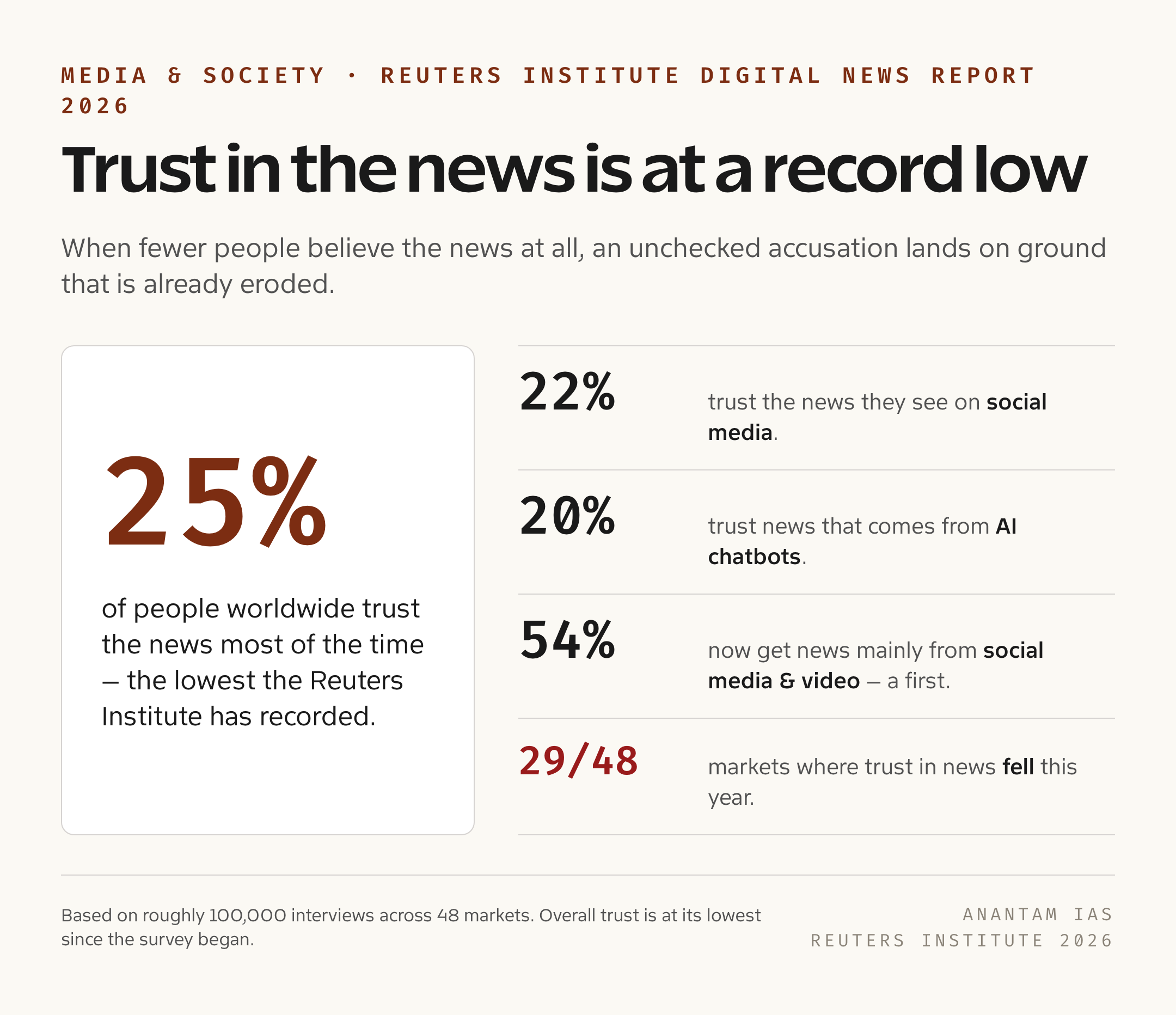
The damage is now measurable. By 2026, only about a quarter of people worldwide said they trusted the news most of the time — the lowest level the Reuters Institute has recorded since it began tracking. Every unchecked accusation spends down a reserve of credibility that is already running dry.
The Four Harms
This is a pillar piece, and the companions in this series will go deep on each wound the run for virality inflicts. Previewed briefly, they are four.
- Manufactured misinformation — the deliberate engineering of false stories, now supercharged by generative tools that produce deepfakes at scale and near-zero cost.
- Damage to national security — false reportage during a crisis that confuses citizens, hands adversaries a weapon, and corrodes the state’s own credibility when it most needs to be believed.
- Harm to foreign relations — fabricated claims that inflame opinion across borders and narrow the space for diplomacy precisely when restraint is most valuable.
- The human cost — the institutions and individuals named in a viral falsehood, who carry the reputational and psychological damage long after the feed has forgotten them.
The clearest recent illustration of the first three at once was Operation Sindoor in May 2025. After the strikes that followed the Pahalgam terror attack, social platforms flooded with manipulated content — among it a deepfake of Pakistan’s prime minister edited to fake a confession of defeat, and recycled footage, including visuals from an unrelated January 2025 air crash in Philadelphia passed off as fresh strikes. India’s Press Information Bureau (PIB) had to repeatedly step in to debunk old and unrelated clips. A war was being fought twice — once on the ground, once in the feed — and the second was waged with lies.
The Ethical Core
Strip away the technology and the same four obligations remain, the ones UPSC aspirants will recognise from the ethics syllabus and every working journalist once swore by.
- Truth — the duty to report what is, not what performs. Accuracy is not a feature of journalism; it is the whole of it.
- Accountability — the willingness to own an error, correct it loudly, and bear the consequence rather than bury it.
- Restraint — the discipline to not publish, to sit on a claim until it is confirmed, even as a rival runs with it.
- Duty to the public — the understanding that the audience is a citizenry to be informed, not an attention supply to be harvested.
Virality does not merely tempt journalists away from these duties. It rewrites the economics so that honouring them becomes a competitive disadvantage. That is why the answer cannot rest on individual virtue alone.
Frameworks, and the Way Forward
India’s regulatory architecture for the press is real but, on its own, inadequate — a point that belongs squarely in any serious discussion of media governance, and one that looks very different once you set it beside how other democracies regulate the press.
The Press Council of India, a statutory body under the PCI Act, 1978, is the headline guardian of print standards — and a famously declawed one. Its powers are advisory and moral: it can warn, admonish or censure an erring publication, but it cannot fine, jail, or revoke a licence. The Supreme Court itself noted this limitation in Ajay Goswami v. Union of India (2007). Critics have long called it a “toothless tiger,” and the label sticks because a guardian that cannot enforce can only plead.
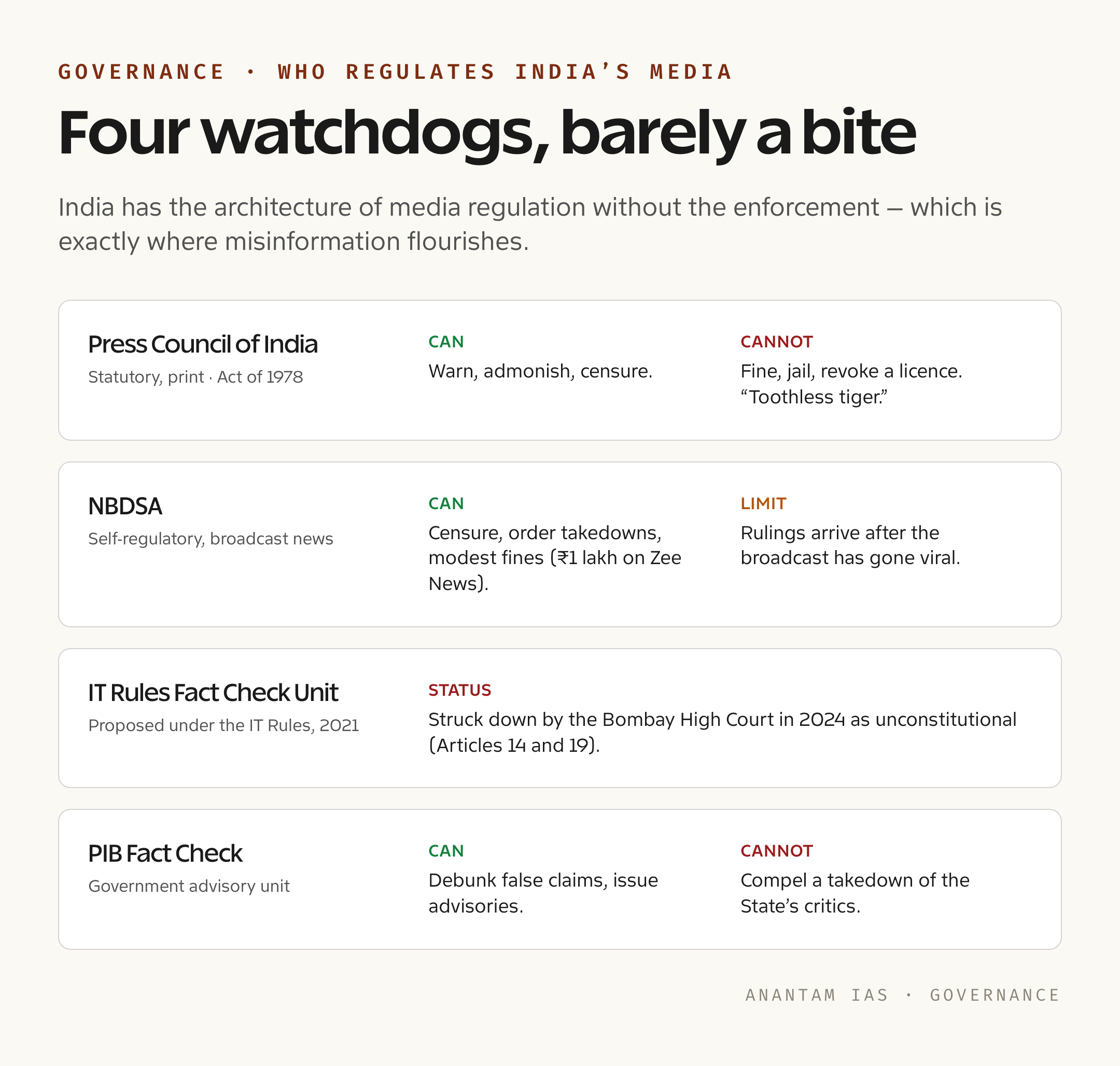
Television leans instead on self-regulation through the NBDSA, which can levy modest fines and order content taken down. In February 2026 it fined Zee News a token sum for airing an unverified viral video that falsely linked a highway traffic jam to a truck driver offering namaz — a routine weather-and-landslide disruption recast as communal provocation. The ruling mattered as a precedent; the penalty, set against the reach of the broadcast, showed the limits of self-policing.
The state’s attempt to fill the gap online has run into the wall of free speech. The government’s bid to empower a Fact Check Unit under the IT Rules, 2021 to flag content about its own affairs as “fake” was struck down by the Bombay High Court in September 2024 as unconstitutional, for offending the rights to equality and free expression. The verdict drew a vital line: the cure for misinformation cannot be a censor who is also an interested party.
If law alone cannot fix this, three things must travel with it. First, credible self-regulation with penalties heavy enough to bite. Second, media literacy taught early, so a population learns to read a timestamp, trace a source, and distrust a screenshot. Third — and this one has no statute — the reader’s own duty to verify before sharing. Every forward is an editorial decision. In an age when anyone can publish to millions, everyone has quietly become an editor, and the verification ethic the newsroom abandoned now has to be relocated in the citizen.
The race to be first was always a race to the bottom; the only question was how far down it went. Speed is cheap and getting cheaper, lies are free and getting freer — which leaves truth, slow and costly and unglamorous, as the one thing worth being last to publish and first to defend.
Frequently Asked Questions
What does “the race to be first” mean in media ethics?
It describes a competitive environment in which publishing speed is valued above accuracy. Because viral content can reach huge audiences before any verification happens, outlets feel pressured to publish unconfirmed claims rather than lose the audience to a faster rival. The ethical cost is that the traditional discipline of “verify, then publish” gets reversed into “publish first, verify later.”
Why does a lie spread faster than its correction?
A falsehood can be made simple, emotional and shareable because it is not bound by accuracy, so it is engineered to spread. A correction is usually complex, sober and late, arriving after the audience has moved on and the original claim has already hardened into belief. Corrections also tend to repeat the lie in order to deny it, which can entrench the falsehood further.
What was the Operation Sindoor misinformation wave?
During and after Operation Sindoor in May 2025, social media was flooded with manipulated content, including deepfake videos and recycled footage from unrelated events passed off as fresh military action. India’s Press Information Bureau repeatedly issued fact-checks debunking old or unrelated clips. It became a leading example of how false reportage during a security crisis can confuse citizens and damage national interests.
Why is the Press Council of India called a “toothless tiger”?
The Press Council of India is a statutory body under the Press Council Act, 1978, but its powers are only advisory and moral. It can warn, admonish or censure a newspaper, editor or journalist, yet it cannot impose fines, order imprisonment, or revoke a publication’s licence. Because it cannot enforce its own findings, critics describe it as a “toothless tiger” — a limitation the Supreme Court itself acknowledged in Ajay Goswami v. Union of India (2007).
What can an ordinary reader do about media misinformation?
Readers carry a real share of the responsibility, because every share is an editorial choice. Before forwarding a claim, check the date and source, look for the same news on an established outlet, and be especially wary of screenshots and emotionally charged clips. Building this verification habit — alongside wider media literacy — is one of the few defences against viral falsehoods that does not depend on regulation.
Practice Questions
Prelims MCQs
1. With reference to the Press Council of India, consider the following statements: 1) It is a statutory body established under the Press Council Act, 1978. 2) It can impose fines on and revoke the licence of an erring newspaper. 3) Its powers over the press are largely advisory and moral. Which are correct?
- (a) 1 and 2 only
- (b) 1 and 3 only
- (c) 2 and 3 only
- (d) 1, 2 and 3
Answer: (b) The PCI is a statutory body under the 1978 Act, but it can only warn, admonish or censure; it cannot fine, jail or cancel a licence — hence the “toothless tiger” tag.
2. The traditional journalistic discipline of “verify, then publish” is best described as having been reversed into which of the following in the attention economy?
- (a) Publish first, verify later
- (b) Verify twice, publish once
- (c) Publish only official statements
- (d) Verify only after a complaint
Answer: (a) The pressure to be first inverts the order, so unconfirmed claims reach the audience before any verification — the core ethical failure examined in the article.
3. The News Broadcasting and Digital Standards Authority (NBDSA) is best described as:
- (a) A statutory regulator created by Parliament
- (b) A self-regulatory body of news broadcasters that can censure, order takedowns and levy modest fines
- (c) A wing of the Press Information Bureau
- (d) A court that can imprison editors
Answer: (b) The NBDSA is the broadcasters’ self-regulatory body; it can order takedowns and impose limited fines, but its reach and timing are limited.
4. In 2024 the Bombay High Court struck down the rule empowering a government Fact Check Unit under the IT Rules as unconstitutional. It was found to violate which fundamental rights?
- (a) Articles 14, 19(1)(a) and 19(1)(g)
- (b) Articles 21 and 22 only
- (c) Articles 25 and 26 only
- (d) Article 32 only
Answer: (a) The court held the rule offended the rights to equality (Art. 14), free expression (Art. 19(1)(a)) and to practise any profession or trade (Art. 19(1)(g)).
5. The limitation of the Press Council of India’s powers was judicially acknowledged in which case?
- (a) Sakal Papers v. Union of India
- (b) Bennett Coleman v. Union of India
- (c) Ajay Goswami v. Union of India (2007)
- (d) Romesh Thappar v. State of Madras
Answer: (c) In Ajay Goswami v. Union of India (2007), the Supreme Court itself noted the advisory and limited nature of the Council’s powers.
Mains Practice Questions
- “The race to be first has displaced the duty to be right.” Critically examine how the attention economy has reshaped the ethics of journalism in India. (15 marks, 250 words)
- Truth, accountability, restraint and a duty to the public are the ethical core of journalism. Discuss how virality turns each of these duties into a competitive disadvantage, and what can restore them. (15 marks, 250 words)
- “The cure for misinformation cannot be a censor who is also an interested party.” In light of the Bombay High Court’s verdict on the IT Rules Fact Check Unit, examine the tension between regulating fake news and protecting free speech. (15 marks, 250 words)
- Why is a falsehood structurally advantaged over its correction in the digital public sphere? Suggest measures — institutional and individual — to narrow this asymmetry. (10 marks, 150 words)
- “In an age when anyone can publish to millions, everyone has quietly become an editor.” Discuss the citizen’s responsibility in checking the spread of misinformation, and the role of media literacy in a democracy. (10 marks, 150 words)
Tell Google you want more of this.
Add Anantam IAS as a preferred sourceOne tap, and this site shows up more often in your own Top Stories, AI Overviews and AI Mode. Remove it any time.