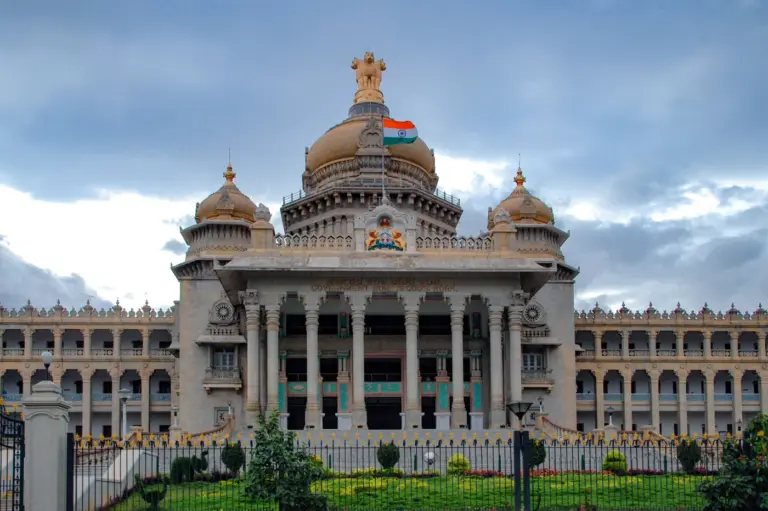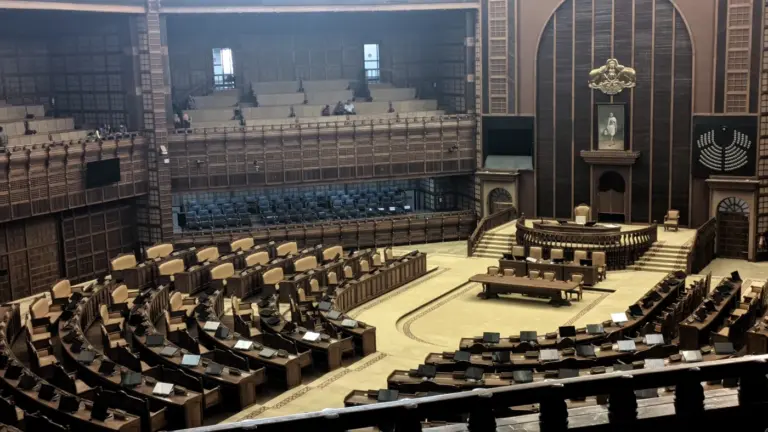

A free press isn’t a luxury a democracy switches on once it feels secure. It’s part of the wiring. So when Reporters Without Borders released its 2026 World Press Freedom Index on 30 April and placed India 157th of 180 countries, down six places from 151st a year earlier and its lowest position yet, the number landed like a verdict. And almost immediately a second, equally important fact reasserted itself: the Government of India has for years rejected that index as small-sample and perception-driven. Both are on the record, and the honest place to stand, the one a Mains answer should occupy, holds both at once.
That’s the whole tension of this topic. A global ranking says India’s press is under strain; the State says the ranking is built on a flawed method and doesn’t reflect reality. You don’t resolve that by picking a side. You resolve it by reaching for a yardstick that doesn’t depend on either, and India’s own constitutional law, the Constitution, the Supreme Court, and a recent High Court ruling, gives us exactly that.
The Issue, Framed
Let’s fix the vocabulary first, because half the confusion around this topic comes from loose language.
The fourth estate is the press treated as an informal fourth check on power, alongside the legislature, executive, and judiciary. It has no formal constitutional status; its authority comes from a function, informing citizens so they can hold the other three to account. So a weak press isn’t only a media problem. It’s an accountability problem for the whole system.
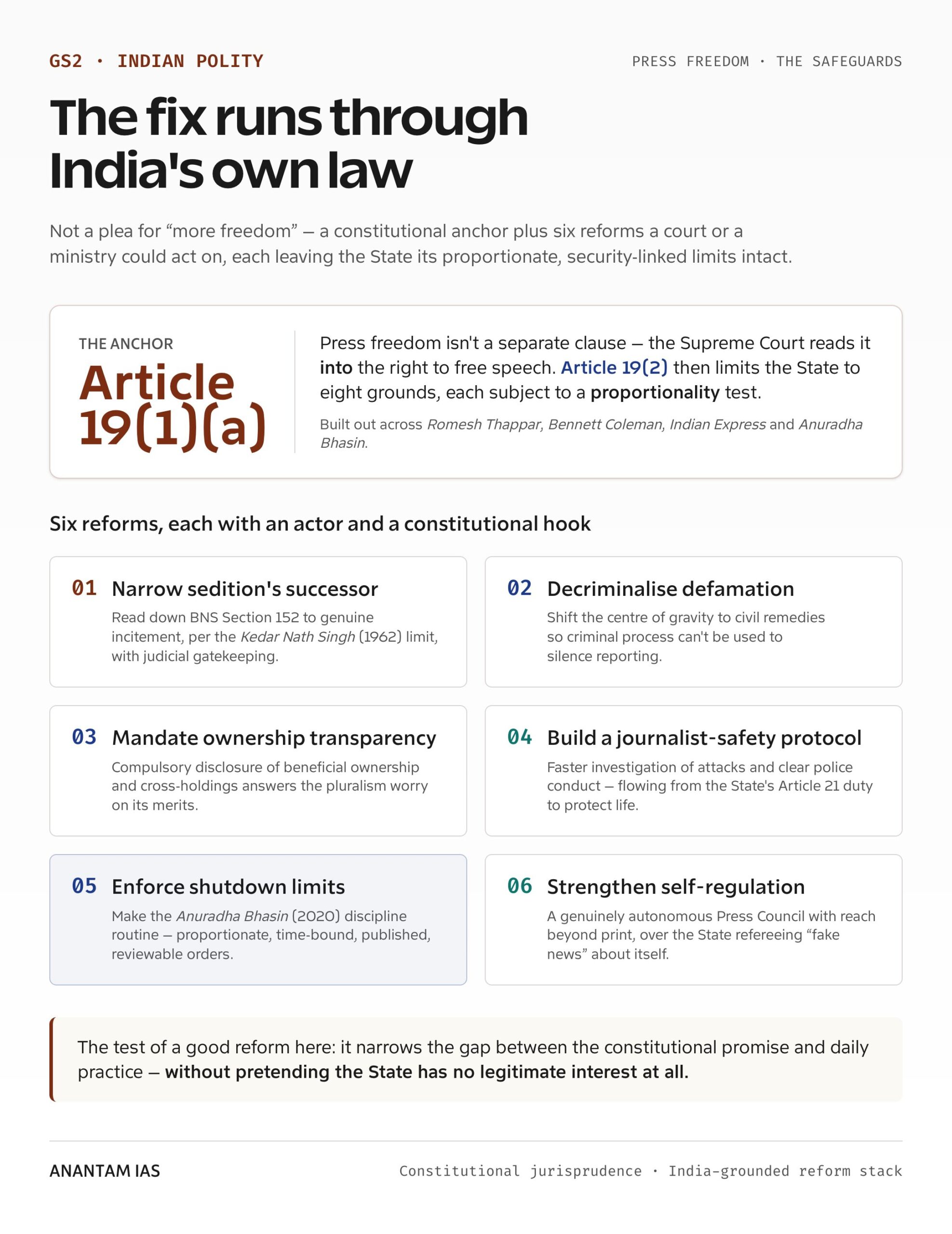
Here’s the part many people get wrong. The Indian Constitution contains no explicit “freedom of the press.” You can search Part III and you won’t find the phrase. What you find is Article 19(1)(a), the fundamental right to freedom of speech and expression. The Supreme Court has consistently held that press freedom is included within 19(1)(a), read into it as a core component rather than written out as a separate clause. The right to publish, to circulate, and to receive information all flow from that single guarantee of free speech.
But 19(1)(a) is not absolute, and this is the second pillar you need. Article 19(2) lets the State impose “reasonable restrictions” on speech through a closed list of eight grounds: sovereignty and integrity of India, security of the State, friendly relations with foreign States, public order, decency or morality, contempt of court, defamation, and incitement to an offence. No restriction is valid unless it fits one of those eight, and even then it must be reasonable, proportionate, and not excessive. “Sovereignty and integrity of India” was added later, by the Sixteenth Amendment in 1963, but the principle holds: the list is sealed, and the State can’t invent a ninth ground.
So the frame is this. India’s press freedom isn’t a slogan and it isn’t an RSF score; it’s a constitutional right with a built-in limit. The live question is whether those limits are being applied as the narrow exceptions the Constitution intended, or whether they’ve started to crowd the right itself.
What the Data Says
Start with the peg, and attribute it carefully, because a ranking is not a fact about reality. It’s a measurement, and measurements have methods.
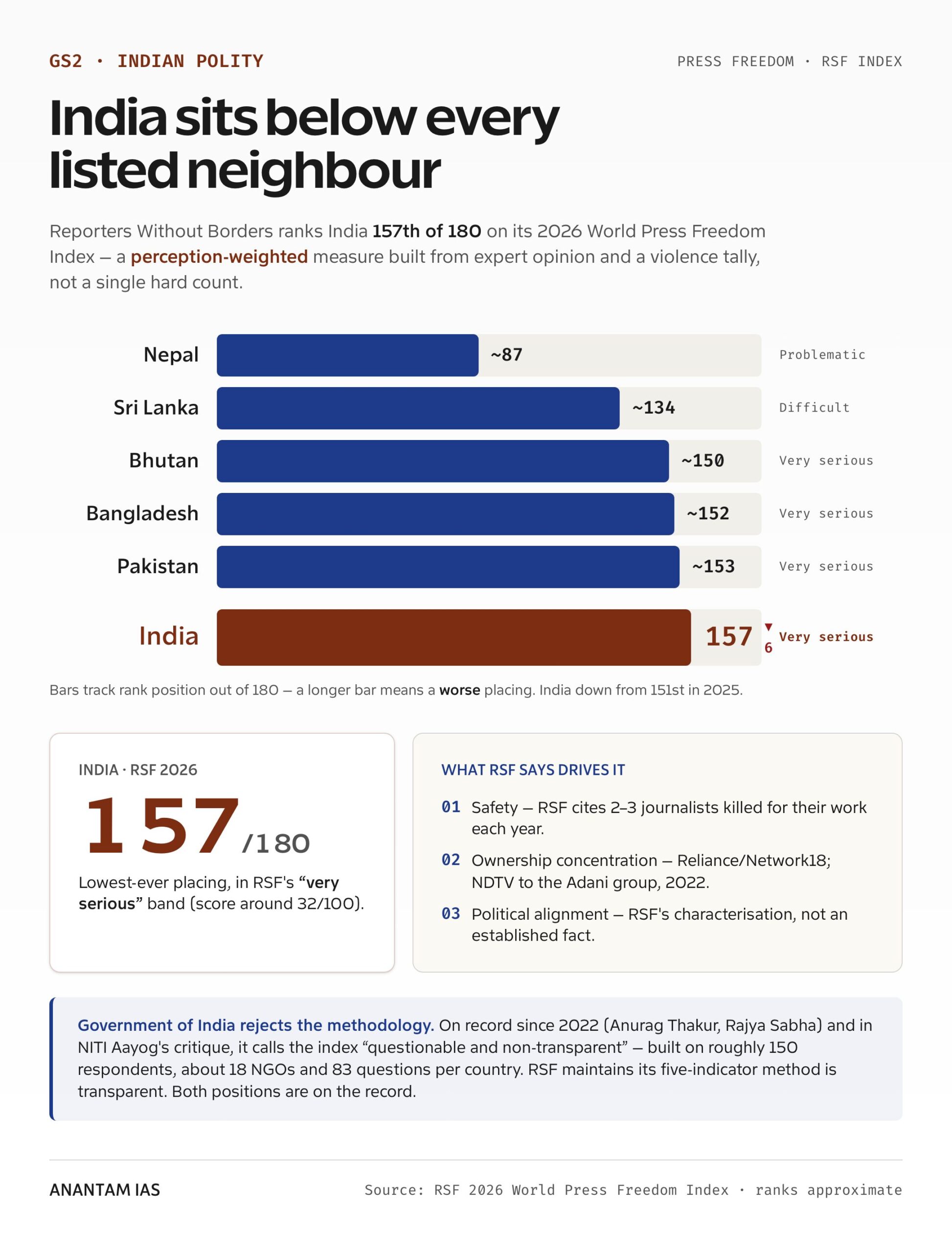
RSF’s 2026 World Press Freedom Index ranks India 157th out of 180 countries and territories, down from 151st in 2025, a six-place fall and its worst showing since the index began. RSF places India in its “very serious” band, and the widely reported overall score of around 32 out of 100 is consistent with that band. RSF’s global headline for 2026 is grim across the board: it says the world average press-freedom score has fallen to the lowest level in the index’s 25-year history, with more than half of all countries now in the “difficult” or “very serious” categories for the first time.
The neighbourhood comparison is the detail that stings in coverage. On RSF’s 2026 numbers, India sits below all five of its listed South Asian neighbours: Nepal around 87th, Sri Lanka around 134th, Bhutan around 150th, Bangladesh around 152nd, and Pakistan around 153rd. Only Nepal escapes the bottom tiers.
What does RSF say is driving India’s position? It points to three things. First, safety: RSF states that with an average of two to three journalists killed for their work each year, India is one of the world’s most dangerous countries for media professionals, and that critical journalists face harassment, intimidation, and criminal prosecution. Second, ownership concentration, which is RSF’s signature India concern. It describes Mukesh Ambani’s Reliance and Network18 as controlling more than 70 outlets reaching at least 800 million Indians, and it reads Gautam Adani’s end-2022 acquisition of NDTV as signalling, in its words, “the end of pluralism in the mainstream media.” Third, what RSF characterises as political alignment, including its use of the term “godi media.” Treat that last point as RSF’s characterisation, not as established fact.
Now the texture an honest answer has to add. Several of these are RSF’s own estimates and framings. The “70-plus outlets, 800 million reach” figure is RSF’s calculation, and the “godi media” label is its interpretive language. What’s a matter of public record, separate from any ranking, is the underlying ownership change: NDTV passed to the Adani group in 2022, and Network18 sits within Reliance. So you can hold the consolidation as fact while treating the reach figures and the capture framing as RSF’s assessment.
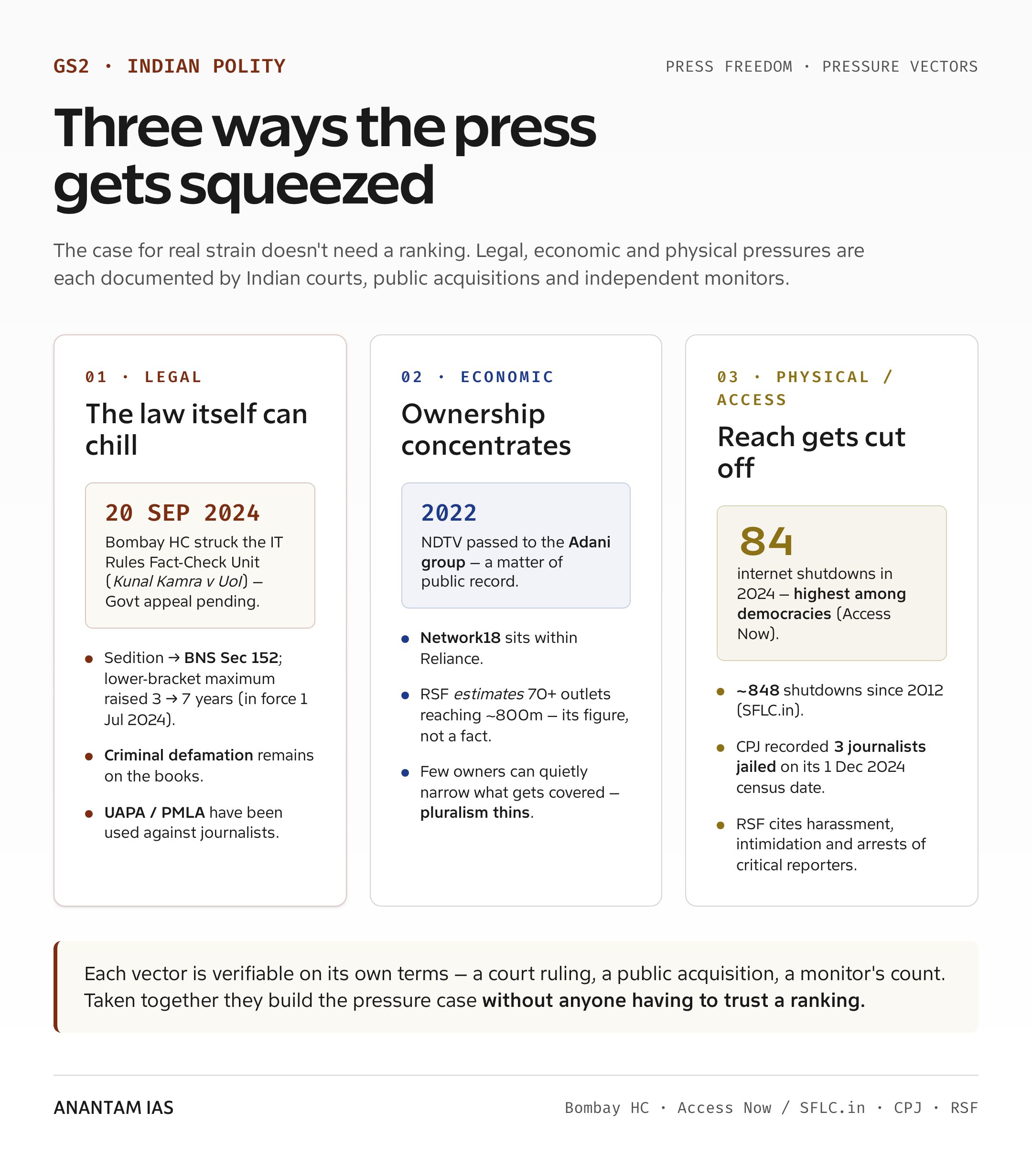
And there’s domestic data that doesn’t depend on RSF at all. On internet shutdowns, the kind of executive order that suspends mobile or broadband access in an area and so cuts off digital news, Access Now’s #KeepItOn count recorded 84 shutdowns in India in 2024, the second-highest in the world that year and the highest of any democracy, and 65 in 2025, lower but still the most among democracies. SFLC.in’s tracker logs roughly 848 shutdowns from 2012 to 2024. On jailed journalists, the Committee to Protect Journalists, which takes an annual census on 1 December, recorded 3 imprisoned in India on its 2024 census date and 2 on its 2025 date, snapshots that undercount the year’s full pressure.
The Case For
The case that India’s press faces real, documented pressure is strong, and it doesn’t need RSF to make it. So let’s build it from evidence a court or a statute could verify, starting with the legal toolkit, because law is where chilling effects begin. Sedition, the old Section 124A of the Indian Penal Code, was a colonial-era offence the Supreme Court paused in May 2022 pending review. But it wasn’t abolished. The Bharatiya Nyaya Sanhita, in force from 1 July 2024, drops the word “sedition” yet introduces Section 152, which penalises acts “endangering sovereignty, unity and integrity of India,” including words and electronic communication exciting secession or subversive activity. The lower-bracket maximum punishment rose from three years to seven, with life imprisonment available for the higher bracket. Critics say the offence survives in substance and can still reach routine critical journalism; that’s a fair worry to record. Add criminal defamation, which remains on the books, and the use of anti-terror and money-laundering statutes against journalists, and you have a legal environment where the process itself becomes the punishment.
The most concrete piece of evidence, though, came from an Indian court, not a foreign NGO. In 2024 the Government amended the IT Rules of 2021 to create a Fact Check Unit, a body under the Ministry of Electronics and Information Technology empowered to flag “fake, false or misleading” information about the Central Government’s own business on social platforms. On 20 September 2024, in Kunal Kamra v Union of India, the Bombay High Court struck that amendment down as unconstitutional, holding it violated Articles 19(1)(a), 19(1)(g), and 14, that its terms were vague, and that it carried a chilling effect, with the tie-breaking judge objecting that the Government couldn’t be the final judge of “fake news” about itself. The Supreme Court later declined to stay that order. When the country’s own High Court reads a recent press measure as overreaching the Constitution, that’s a domestic signal of strain, independent of any ranking.
Then there’s the economic structure. Ownership concentration isn’t merely RSF’s allegation; the acquisitions are public, with NDTV moving to the Adani group in 2022 and Network18 sitting within Reliance. When a handful of large conglomerates control much of the reach, the worry isn’t a conspiracy. It’s structural: commercial and political incentives can quietly narrow what gets covered, and pluralism, the existence of many independent voices, thins out.
And the digital chokepoint matters most for a country going online. Internet shutdowns suspend digital news access at source, and India’s count, second in the world in 2024 and highest among democracies in both 2024 and 2025, means that in some districts, at some moments, the press simply can’t reach its audience. Taken together, the legal exposure, the documented consolidation, and the shutdown record build a case for real pressure without anyone having to trust RSF’s ranking.
The Case Against
Now steelman the other side, and give it real force, because the Government’s position is not a dodge. It rests on a genuine methodological argument.
The strongest point is that RSF’s index is contestable on its own terms. The Government has said so on the record. Replying in the Rajya Sabha in 2022, the then Information and Broadcasting Minister, Anurag Thakur, said the Government doesn’t subscribe to RSF’s views or agree with its conclusions, citing “very low sample size, little or no weightage to fundamentals of democracy,” and “a methodology which is questionable and non-transparent.” NITI Aayog, the Government’s policy think-tank, built that out in a published critique titled “Deciphering the World Press Freedom Index.” Its argument is precise: when roughly 150 respondents and about 18 NGOs answer 83 questions per country, the room for bias and disconnect from reality is large; the per-question and per-category scores aren’t made public; the list of respondents isn’t disclosed; and there’s no clearly defined, verified source for the quantitative data on violence against journalists. A perception-weighted index, one built partly from expert opinion rather than only hard counts, is an input to debate, not a final verdict. That’s a defensible critique, and a Mains answer should grant it. In fairness, RSF maintains a public methodology document and argues its five-indicator design is transparent and applied consistently across 180 territories, so both characterisations are on the record. There’s no fresh 2026 line-by-line Government rebuttal of the 157 rank; the standing position rests on the 2022 statement and the NITI Aayog critique, which the Government has held to consistently.
The second point is that the State has legitimate interests the press freedom debate sometimes glosses over. Disinformation is a real harm; viral falsehoods have fed mob violence and communal tension, and countering deliberate misinformation was the stated rationale for the Fact Check Unit. You can think the FCU was the wrong instrument, as the Bombay High Court found, and still accept the problem it aimed at is real.
Third, press integrity isn’t only threatened by the State. The Press Council of India has itself flagged “paid news,” where coverage is quietly bought, and undisclosed sponsored content. Concentrated commercial pressure cuts both ways, and some of it is a case for regulation, not against it.
Fourth, and constitutionally decisive, national security is not an extra-legal concern. Article 19(2) expressly permits restrictions for sovereignty, security of the State, public order, and friendly relations, so a security-linked limit on speech is not unconstitutional in principle. The only question the Constitution asks is whether it’s proportionate, necessary, and the least-restrictive means. That reframes the whole debate: it’s rarely “restriction versus freedom,” and almost always “is this particular restriction proportionate.”
Finally, the institutions that protect the press are working. The same courts that decided Romesh Thappar and Bennett Coleman struck down the Fact Check Unit in 2024, and an active judicial check is itself evidence of a rights architecture that holds, not one that has collapsed.
The Deeper Structural Read
Step past the ranking row and the real architecture comes into view. The neutral spine of this topic isn’t RSF at all. It’s seven decades of Supreme Court jurisprudence that built press freedom out of Article 19(1)(a), and that’s the part your answer should be made of.
The line starts in 1950. In Romesh Thappar v State of Madras, the Supreme Court struck down a Madras law that had banned circulation of the journal Cross Roads, holding that the freedom to circulate is part of free speech under 19(1)(a) and that the restriction swept wider than 19(2) allowed. The same year, in Brij Bhushan v State of Delhi, the Court struck down pre-censorship of the Organiser, ruling that prior restraint on a newspaper violates free speech. Those two set the foundation: press freedom is real, it lives inside 19(1)(a), and prior restraint is presumptively bad.
The economic-pressure cases came next, and they’re the most relevant to today’s ownership worries. In Sakal Papers v Union of India in 1962, the Court struck down a law fixing the pages a paper could publish relative to its price as an unconstitutional curb on circulation and so on speech. In Bennett Coleman & Co v Union of India in 1973, it struck down a newsprint control order that limited pages and titles, and gave us the “direct effect” test, which looks at what a measure actually does to speech rather than what it claims to regulate. In Indian Express Newspapers v Union of India in 1985, it accepted that the press isn’t immune from general laws like taxes, but held it can’t be singled out with prohibitive burdens that curtail circulation. Read together, these three say what the ownership debate needs: the State can’t strangle the press economically, through page limits, newsprint quotas, or punitive levies.
The digital-age case matters most for shutdowns. In Anuradha Bhasin v Union of India in 2020, the executive editor of Kashmir Times challenged the internet blockade in Jammu and Kashmir. The Court held that access to information over the internet is tied to 19(1)(a), that an indefinite suspension is impermissible, and that shutdown orders must be proportionate, time-limited, backed by recorded reasons, published, and open to periodic review and judicial scrutiny. Those are now the Anuradha Bhasin guidelines, and they give India a home-grown, court-made standard for exactly the practice the shutdown data flags.
So here’s the structural read. India’s problem isn’t an absence of protections; the doctrine is rich and the courts are live. The problem is an implementation gap between a strong constitutional standard and weaker administrative practice. Anuradha Bhasin set a clear shutdown test, yet the count stays among the world’s highest. The Fact Check Unit was created and only then struck down. The narrow exceptions of 19(2) keep getting reached for as routine tools. The fault line, in other words, runs between what the Constitution promises and how the executive behaves day to day, which is a far more useful diagnosis than any single ranking. There’s an institutional weakness underneath too: the Press Council of India is statutory and quasi-judicial, but its powers are only advisory, it can warn or censure but not penalise, and its writ covers print alone, leaving television, radio, and online news outside its reach.
What Should Be Done
So what does a serious, India-grounded fix look like? Not a plea for “more freedom,” but reforms a court or a ministry could act on, each one keeping the State’s legitimate interests intact.
- Apply sedition’s successor strictly to incitement, with judicial gatekeeping. Section 152 of the Bharatiya Nyaya Sanhita should be read down to genuine incitement to violence or secession, in line with the long-standing Kedar Nath Singh (1962) limit on sedition, so that critical journalism isn’t swept in. The Supreme Court’s own jurisprudence on press freedom supports this narrowing: https://anantamias.com/media-freedom-press-india/
- Shift criminal defamation toward civil remedies. Decriminalising defamation, or at least moving the centre of gravity to civil suits, stops criminal process from being used to silence reporting, a reform that press bodies and law-reform voices have pressed for years. The constitutional case for it tracks the same free-speech logic: https://anantamias.com/media-freedom-press-india/
- Enforce the Anuradha Bhasin discipline on internet shutdowns. Proportionality, strict time limits, published reasoned orders, and periodic review aren’t aspirational; they’re already the law. Making them routine practice is the single cleanest way to bring down a shutdown count that stays the highest among democracies: https://anantamias.com/media-freedom-press-india/
- Mandate media-ownership transparency. Compulsory disclosure of beneficial ownership and cross-holdings, plus a serious look at cross-media ownership limits, addresses concentration on its merits rather than by argument over a ranking. This answers the pluralism worry directly: https://anantamias.com/media-freedom-press-india/
- Build a journalist-safety protocol. Faster investigation of attacks on journalists, a clear standard for police conduct, and protection in conflict and communal settings flow from the State’s own duty to protect life under Article 21. Safety is a precondition for free reporting, not a favour to it: https://anantamias.com/media-freedom-press-india/
- Strengthen independent self-regulation over State fact-checking. After the Fact Check Unit was struck down, the constitutional path is independent, multi-stakeholder fact-checking and a genuinely autonomous, better-resourced Press Council with reach beyond print, rather than the Government judging “fake news” about itself. That keeps the disinformation fight alive without making the State its own referee: https://anantamias.com/media-freedom-press-india/
Every one of these strengthens both sides of the ledger. They protect the press while leaving the State the proportionate, security-linked restrictions that Article 19(2) was always meant to allow. That’s the test of a good reform here: it narrows the gap between the constitutional promise and the daily practice without pretending the State has no legitimate interest at all.
Prasar Bharati: India’s Public-Service Broadcaster
Any discussion of media freedom in India sits incomplete without Prasar Bharati, the country’s public-service broadcaster. Established under the Prasar Bharati (Broadcasting Corporation of India) Act, 1990 and made operational in 1997, it is a statutory autonomous body that runs Doordarshan and All India Radio (Akashvani). The Act was meant to insulate state broadcasting from direct government control, a long-standing demand traced to the Supreme Court’s 1995 ruling that the airwaves are public property to be used in the public interest.
The corporation is steered by a Prasar Bharati Board, headed by a Chairman appointed by the President on the recommendation of a selection committee. The Chairman, a part-time office, sets the broadcaster’s strategic direction, while a Chief Executive Officer handles day-to-day operations. Writer, lyricist, and former advertising executive Prasoon Joshi was appointed Chairman in 2026, succeeding a line of public figures drawn from media, arts, and academia.
Prasar Bharati’s mandate is to inform, educate, and entertain while upholding the unity and integrity of the nation and the values enshrined in the Constitution. It reaches audiences that private channels often bypass, broadcasting in dozens of languages across rural and remote regions. Yet its autonomy remains contested: it depends heavily on government grants, and questions persist over editorial independence in its news output. For students weighing press freedom, the broadcaster is a useful case study in how a statutory shield works in law versus how funding and appointment levers shape it in practice.
For Your Mains Answer
This is a high-value GS2 topic. It sits at the intersection of fundamental rights, statutory and quasi-judicial bodies, government interventions, the functioning of the judiciary, and the reading of global indices, so it can be set as a rights question, a governance question, or an institutions question.
GS paper mapping: GS2: Indian Constitution and fundamental rights; statutory, regulatory, and quasi-judicial bodies; government policies and their implementation; functioning of the judiciary; transparency and accountability. GS4 crossover: media ethics, truth, objectivity, and the freedom-versus-responsibility tension.
Likely question frames:
- “Freedom of the press in India is a derived right, not an express one.” Examine the constitutional basis of press freedom under Article 19 and the limits the State may place on it.
- Global press-freedom rankings are contested, yet the concerns they raise deserve a domestic answer. Critically analyse the state of media freedom in India with reference to its own constitutional jurisprudence.
- Discuss how internet shutdowns, the regulation of digital news, and media-ownership concentration test India’s guarantee of free speech under Article 19(1)(a).
Quotable data points:
- RSF’s 2026 World Press Freedom Index ranks India 157th of 180, down from 151st in 2025, its lowest yet, in the “very serious” band, with a score around 32 out of 100. Attribute to RSF.
- On RSF’s 2026 figures, India sits below Nepal (around 87th), Sri Lanka (around 134th), Bhutan (around 150th), Bangladesh (around 152nd), and Pakistan (around 153rd).
- Access Now recorded 84 internet shutdowns in India in 2024 (second-highest in the world, highest among democracies) and 65 in 2025; SFLC.in logs roughly 848 since 2012.
- The Bombay High Court struck down the Fact Check Unit on 20 September 2024 in Kunal Kamra v Union of India as violating Articles 19(1)(a), 19(1)(g), and 14; the Supreme Court declined to stay it.
- Sedition (IPC 124A) was paused in 2022 and replaced in substance by BNS Section 152 from 1 July 2024, with the lower-bracket maximum raised from three to seven years.
- The Government, through Anurag Thakur in the Rajya Sabha in 2022 and the NITI Aayog critique, rejects the RSF index as “questionable and non-transparent,” built on roughly 150 respondents, about 18 NGOs, and 83 questions per country.
Keywords to use: Article 19(1)(a), Article 19(2), reasonable restrictions, fourth estate, prior restraint, proportionality, pluralism, perception-based index, internet shutdowns, criminal defamation, media-ownership concentration, self-regulation.
Syllabus linkages: fundamental rights and their reasonable restrictions; statutory and quasi-judicial bodies (Press Council of India); government policies and implementation (IT Rules and the Fact Check Unit); functioning of the judiciary as a rights safeguard; transparency, accountability, and reading global indices critically.
Balanced conclusion line: A press is free not when a foreign index says so, but when the State applies the narrow exceptions of Article 19(2) as exceptions and not as everyday tools; the surest path runs through India’s own jurisprudence, not through any ranking it disputes.
How to Build the Answer
Open with the double truth, not the ranking alone. The strongest first line names both facts at once: a global index reports a slide, and the Government rejects the index’s method. That single sentence signals to the examiner that you understand this is a contested perception, not a settled measurement. Define Article 19(1)(a) and the derived nature of press freedom in the second or third sentence, so the structure is constitutional from the start.
Anchor the body in Indian law, not in RSF. The ranking is the news peg; the marks are in the jurisprudence. Move quickly from the index to Romesh Thappar, Bennett Coleman, Indian Express, and Anuradha Bhasin, because those are the neutral, India-grounded yardsticks that don’t depend on any contested survey.
Steelman both sides in turn. Give the pressure case its documented evidence (the struck-down Fact Check Unit, the shutdown count, BNS Section 152) and give the Government case its real force (the methodology critique, the disinformation problem, the security ground in 19(2)). An answer that argues only one side reads like an editorial, not analysis.
Group the way forward. Cluster reforms under the heads they belong to: narrow the sedition successor, civilise defamation, enforce the shutdown discipline, mandate ownership transparency, protect journalists, strengthen independent self-regulation. Each should name an actor and a constitutional hook.
Close on judgment, not slogan. The reliable pattern is “free not because X says so, but when the State treats Y as the exception it was meant to be.” That balances the right against its legitimate limit and shows the examiner you can hold a contested topic steadily.
Common Mistakes to Avoid
- Don’t assert the ranking as fact. Always write “RSF ranks India 157th,” never “India is the 157th-freest.” The number is a measurement, and the Government disputes the method; pair the two wherever you can.
- Don’t say sedition was “abolished.” It was paused in 2022 and continued in substance as BNS Section 152 from 2024. Precision here separates a prepared answer from a hazy one.
- Don’t write a political attack. This is a constitutional and governance question. Keep every contested claim attributed to its source, and keep the tone analytical.
- Don’t lean only on RSF. The internal evidence, the shutdown data, the Fact Check Unit ruling, the Article 19 cases, is what makes the answer neutral and credible.
- Don’t forget the limit. Article 19(1)(a) is meaningless in an answer that skips Article 19(2). The eight grounds and proportionality are half the topic.
A Compact Answer Spine
- Introduction: Name both truths, the RSF slide and the Government’s methodology objection; define press freedom as derived from Article 19(1)(a).
- Constitutional base: Article 19(1)(a) plus the eight grounds of 19(2); no express press-freedom clause.
- Jurisprudence: Romesh Thappar, Sakal Papers, Bennett Coleman, Indian Express, Anuradha Bhasin as the neutral spine.
- Both sides: The pressure case (FCU struck down, shutdowns, BNS 152) and the State case (methodology critique, disinformation, 19(2) security ground).
- Way forward: Grouped reforms, each with an actor and a constitutional hook.
- Conclusion: Adapt the balanced line to the exact question wording.
Diagram or Flowchart Idea
For a 15-marker, draw the derivation chain: Article 19(1)(a) free speech → press freedom read in → Article 19(2) eight grounds → proportionality test → applied via jurisprudence (Bhasin on shutdowns, Kunal Kamra on the FCU). It shows the examiner the whole logic in one glance.
For a 10-marker, a two-column table does more work: “The right (Art 19(1)(a), fourth estate, pluralism)” against “The limits (Art 19(2) eight grounds, proportionality).” It’s faster to evaluate and forces you to show both halves.
Ethics and Governance Angle
Add one ethical line even in a GS2 answer. Press freedom is a public good, but it carries a duty: truth, verification, and the responsibility not to spread the very disinformation that the State then cites to justify restriction. The freedom-versus-responsibility tension is the heart of media ethics, and naming it shows maturity.
Then convert it into governance. The ethical answer to disinformation isn’t the State refereeing “fake news” about itself, which is why the Bombay High Court struck the Fact Check Unit down. It’s independent, multi-stakeholder fact-checking and a credible self-regulator. That’s the move from moral language to institutional design, and it’s exactly what the examiner rewards.
A sentence pattern that travels well: “The aim is legitimate, but its legitimacy depends on who exercises the power and under what check.” It grants the State its interest in countering falsehood without handing it a blank cheque over what counts as true.
How to Use Data Without Sounding Mechanical
Use fewer numbers than you know. Three well-placed figures beat ten scattered ones. Lead with the rank (157th of 180, attributed to RSF), use the shutdown count for contrast (84 in 2024, highest among democracies), and use a date for the legal turn (the Fact Check Unit struck down on 20 September 2024). One ranking, one operational metric, one legal milestone is usually enough.
Never leave a statistic standing alone, and never leave a ranking unattributed. Follow each with “RSF says,” “Access Now records,” or “the Bombay High Court held,” and then with “which means.” That tiny move turns a fact sheet into analysis and keeps a politically sensitive topic safely neutral.
Finish with one test: could a tired examiner read this in a single pass and see both sides clearly? If a sentence sounds impressive but does no work, cut it and put a fact, a case, or a reform in its place. On this topic especially, clarity and balance are how depth becomes visible.
FAQ
Does the Indian Constitution explicitly guarantee freedom of the press?
No. There’s no separate “freedom of the press” clause. The Supreme Court has consistently held that press freedom is included within the freedom of speech and expression under Article 19(1)(a), as a core component of that right. It’s a derived right, and like all free speech it’s subject to the reasonable restrictions listed in Article 19(2).
What are the eight grounds of reasonable restriction under Article 19(2)?
Article 19(2) lets the State restrict speech only on eight grounds: sovereignty and integrity of India, security of the State, friendly relations with foreign States, public order, decency or morality, contempt of court, defamation, and incitement to an offence. The list is closed, and any restricting law must also be reasonable, proportionate, and not excessive.
Why does the Government of India reject the RSF World Press Freedom Index?
The Government, through then Minister Anurag Thakur in the Rajya Sabha in 2022 and the NITI Aayog critique “Deciphering the World Press Freedom Index,” calls the index “questionable and non-transparent.” Its objections are that the ranking rests on a small sample of roughly 150 respondents and about 18 NGOs answering 83 questions per country, that per-question scores and the respondent list aren’t disclosed, and that the violence data isn’t verified. RSF, for its part, maintains its method is transparent and indicator-based.
What did the Bombay High Court decide about the Fact Check Unit?
On 20 September 2024, in Kunal Kamra v Union of India, the Bombay High Court struck down the 2023 amendment to the IT Rules that created a Fact Check Unit to flag “fake, false or misleading” information about the Central Government’s business. It held the amendment unconstitutional for violating Articles 19(1)(a), 19(1)(g), and 14, found its terms vague and chilling, and objected to the Government being the final judge of “fake news” about itself. The Supreme Court later declined to stay the order.
Tell Google you want more of this.
Add Anantam IAS as a preferred sourceOne tap, and this site shows up more often in your own Top Stories, AI Overviews and AI Mode. Remove it any time.