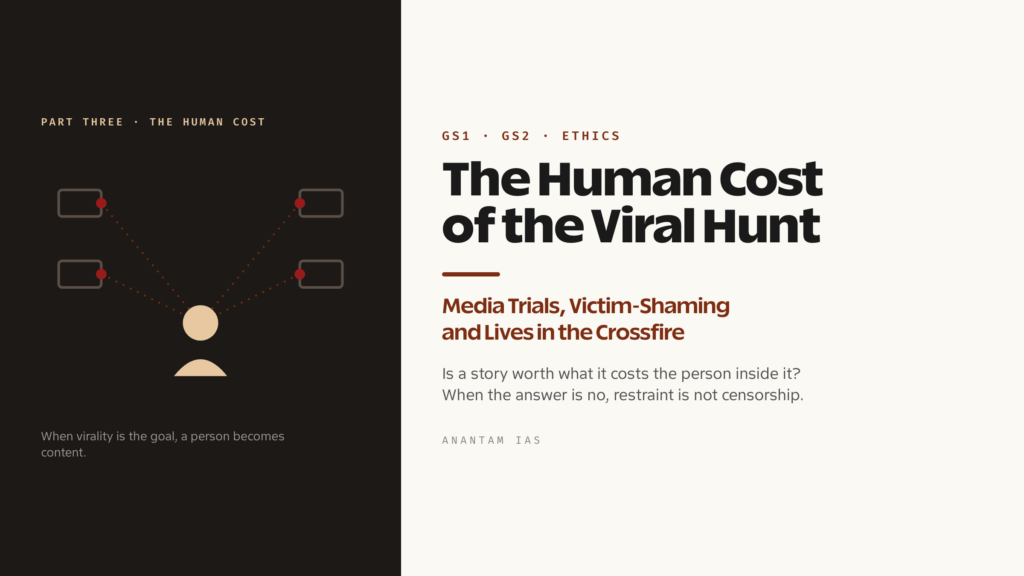
Somewhere between the breaking-news chyron and the trending hashtag, a person stops being a person. They become a thumbnail. A reaction shot. A name to chant on a panel show. When virality is the goal, the camera does not pause to ask whether the man it is convicting has been tried, whether the woman it is naming wanted to be named, or whether the family it is door-stepping for a “reaction” has even finished grieving. The hunt does not pause. It cannot. Pausing does not trend.
This is the part of the virality economy we rarely tally: its human cost. Not the abstract harm to “press credibility,” but the concrete damage done to specific people who never asked to be content. An accused declared guilty on prime time months before a court hears a word of evidence. A bereaved family hounded for tears on camera. A survivor of sexual violence whose name, school and photograph are splashed across screens in plain breach of the law. The toll is measured in dignity, in mental health, and sometimes in lives.
Trial by Media: The Verdict Before the Verdict
The clearest recent illustration is the coverage that followed the death of actor Sushant Singh Rajput in 2020. For weeks, channels ran a parallel investigation of their own, complete with reconstructions, leaked call records, and confident pronouncements of guilt against people who had been charged with nothing. The reporting did not inform the public so much as it staged a spectacle, and named individuals paid the price in reputation and peace of mind.
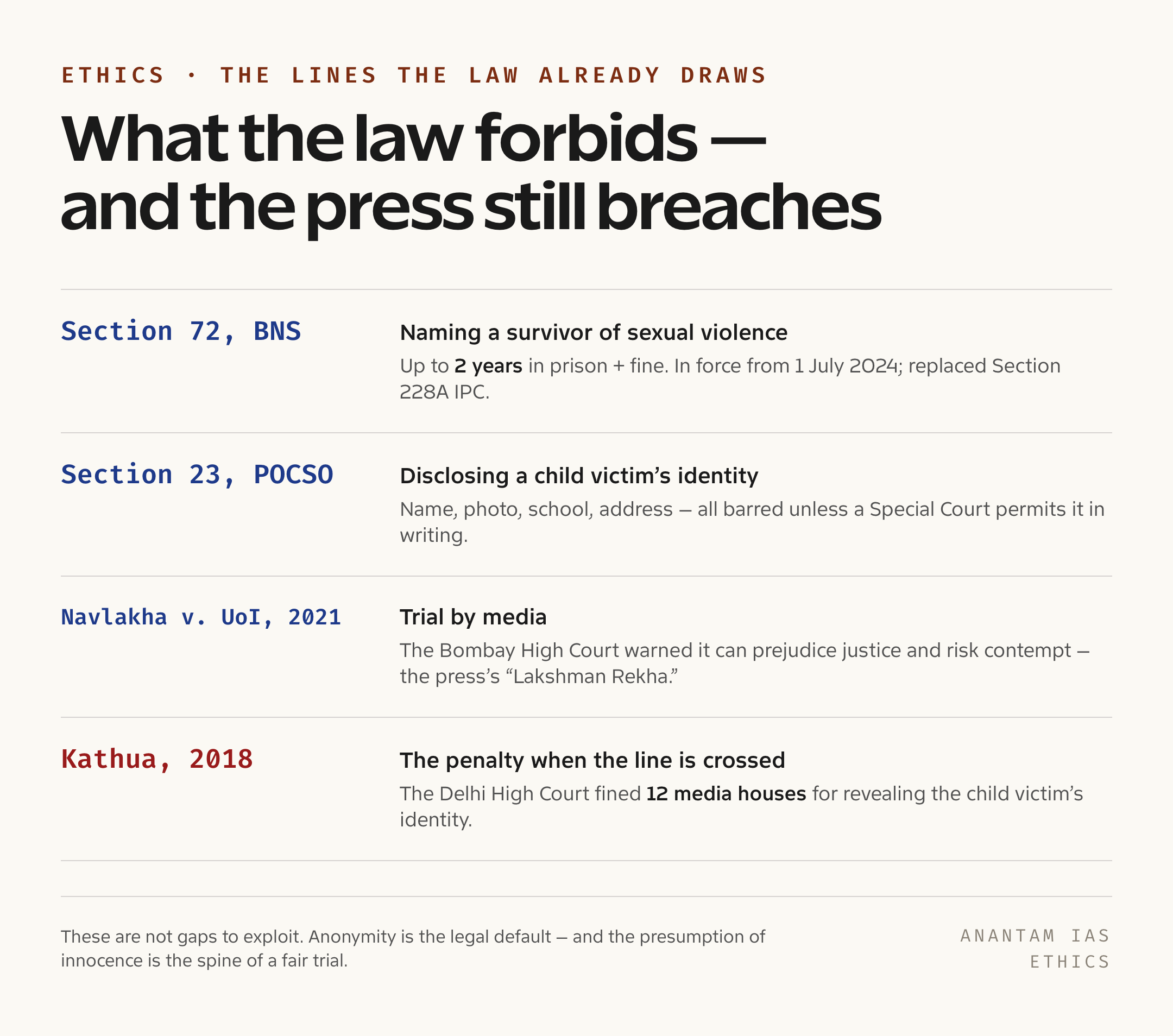
A court eventually said so. In Nilesh Navlakha v. Union of India (decided 18 January 2021, reported as 2021 SCC OnLine Bom 56), the Bombay High Court examined this coverage and held that sensational, speculative reporting of the kind aired around the case amounted to a “media trial” that could prejudice a fair investigation and risk contempt of court. The bench found such broadcasts ran afoul of the Programme Code under the Cable Television Networks (Regulation) Act, and it laid down guidelines urging the press to exercise restraint and stay within what it memorably called the “Lakshman Rekha”. The court was careful not to muzzle the press; it affirmed that free speech is vital to democracy. What it rejected was the idea that freedom includes a licence to pronounce guilt.
The principle the judgment protects is older than television. The presumption of innocence is the spine of any fair system: a person is innocent until a court, on evidence, says otherwise. A media trial inverts that. It convicts first and lets the actual trial catch up later, by which time the damage to a name and a life is already done. An acquittal years on rarely trends. The brand of “accused” sticks long after the legal label has fallen away.
Naming the Unnameable: When Coverage Breaks the Law
If media trials trample the accused, victim-identification tramples the most vulnerable people in any story. And here the line is not a matter of taste or editorial judgment. It is the law, and it is plainly written.
Indian law has long forbidden publishing the name or any detail that could identify a survivor of sexual violence. The old provision was Section 228A of the Indian Penal Code, now carried forward as Section 72 of the Bharatiya Nyaya Sanhita (in force from 1 July 2024). The rule is simple: whoever prints or publishes the name, or any matter that might make known the identity, of a victim of rape and related offences faces imprisonment of up to two years and a fine. There are narrow, carefully guarded exceptions, such as authorisation by the survivor in writing, but the default is anonymity, and the default exists to protect the survivor from a second wound delivered by publicity.
For child victims the protection is stricter still. Section 23 of the POCSO Act bars any media report from disclosing a child’s identity, which it defines expansively to include name, address, photograph, family details, school and neighbourhood, unless a Special Court permits it for reasons recorded in writing and in the child’s own interest. The law does not leave a loophole for “but everyone already knows.”
These protections are broken anyway. After the 2018 Kathua case, in which an eight-year-old was raped and murdered, the Delhi High Court issued notices to and imposed fines on twelve media houses for revealing the child’s identity in breach of Section 228A. In the Hathras case of 2020, petitions sought directions to take down material that exposed the victim’s identity on the same ground. The pattern is grimly familiar: a horrifying crime breaks, the rush to humanise the victim collides with the rush to be first, and a name that the law commands be protected is broadcast to millions.
The unwritten cousin of illegal naming is victim-shaming: the panel discussion that interrogates what a survivor wore, where she was, why she was out, who she trusted. It puts the wronged person on trial and lets the wrongdoer fade into the background. The law against naming exists precisely because Indian society still extracts a social penalty from the survivor rather than the offender. Reporting that forgets this does not just bend an ethical rule. It feeds the very stigma the law was written to defuse.
The Self-Regulator Keeps Finding the Same Breaches
If anyone imagines these are stray lapses by a few rogue editors, the rulings of the industry’s own self-regulator say otherwise. The News Broadcasting and Digital Standards Authority (NBDSA), the body television news set up to police itself, has repeatedly found channels in breach and ordered offending content taken down.
- The NBDSA ordered Zee News to remove its broadcasts on an alleged “Mehendi Jihad”, finding the programmes amplified one-sided communal claims without seeking the response of those targeted. In a separate matter it fined the channel one lakh rupees over a “Truck Par Namaz” segment that falsely linked a highway traffic jam, caused by weather, to a driver offering namaz.
- It pulled up Times Now Navbharat for tickers in its coverage of a Bareilly court judgment, including a “love jihad toolkit” caption that formed no part of the actual judgment, and ordered the channel to remove the material from its telecast and digital archives.
- It acted against India TV over a prime-time show aired days after communal violence in Bahraich, on a complaint that the broadcast sensationalised the tragedy and vilified a community.
The detail to hold onto is not any single channel. It is the repetition. When a self-regulator keeps issuing the same finding, content that is sensational, communal or unverified, broadcast in pursuit of attention, the takedown order stops being an exception and starts looking like a business model. The complaints that trigger these rulings often come from civil-society groups and fact-checkers rather than from within the newsroom.
What the Hunt Actually Costs
It is tempting to treat all this as a debate about journalistic standards, a quarrel among professionals. It is not. The cost lands on people who had no say in the matter.
Three principles get trampled, and each one has a human face. The presumption of innocence protects the accused who is later cleared but never gets his old life back. Privacy and dignity protect the survivor who is named, the family that is filmed mid-grief, the bystander whose worst day becomes someone’s highest-rated bulletin. And the duty of care toward the vulnerable, children, survivors of violence, the bereaved, protects exactly those people least able to fight a national broadcaster. When coverage chases virality, these three are the first costs cut, because restraint is expensive and outrage is free.
The deepest cost is the one hardest to photograph: the toll on mental health, and at the extreme, on life itself. A person convicted by acclamation, or shamed for a crime committed against them, does not simply log off. There is a reason the law and the courts treat dignity not as a courtesy but as a protected interest. For some, it is the thing that holds a life together.
The Way Forward: Restraint With Teeth
None of this argues for a muzzled press. A free press is a load-bearing wall of democracy, and the same courts that censured the media trials said so in the same breath. The argument is narrower and harder: that freedom carries a duty of care, and that the duty needs enforcement, not just exhortation.
Honour the lines that already exist
The NBDSA and Press Council guidelines on crime and victim reporting, the contempt-of-court limits the Bombay High Court reaffirmed, and the statutory shields of Section 72 BNS and Section 23 POCSO are not gaps to be exploited. They are settled commitments. A newsroom that treats anonymity as the default, and treats an accused as accused rather than guilty, is not surrendering a scoop. It is doing the job correctly.
Report trauma like it is trauma
Trauma-informed reporting is a discipline, not a mood. It means seeking consent before filming the bereaved, refusing the door-stepped “reaction,” resisting the close-up of grief, and asking before every broadcast whether the public interest served outweighs the harm done to a real and identifiable person. Most of the time, the honest answer disciplines the coverage.
Give the rules consequences
A takedown ordered months after a broadcast has already gone viral is a remedy that arrives after the harm is complete. Self-regulation works only when its findings carry consequences with teeth, timely enough and costly enough that breaching the line is no longer cheaper than respecting it. Until then, the incentive runs one way: toward the hunt.
This is the human cost at the centre of our series on media ethics in the age of virality — the part of the bill that real people, not institutions, are made to pay. It sits at the heart of how India debates the relationship between the media and the courts, and how a society polices both crime and the moral panics that crime can unleash. For the deeper questions of duty, dignity and the conflict between public interest and harm, our notes on ethics trace the same ground; for the social currents that turn a tragedy into a spectacle, see Indian society.
The question worth carrying away is not whether the press should be free. It should. The question is whether a story is worth what it costs the person inside it. When the answer is no, restraint is not censorship. It is the minimum we owe a stranger whose worst day we have decided to broadcast.
Frequently Asked Questions
What is a “media trial” and why is it a problem?
A media trial is coverage that effectively pronounces a person guilty before any court has decided the case. It is a problem because it violates the presumption of innocence, can prejudice a fair investigation, and may amount to contempt of court. In Nilesh Navlakha v. Union of India (2021), the Bombay High Court held that the sensational coverage around the Sushant Singh Rajput case amounted to a media trial and laid down guidelines urging restraint within the press’s “Lakshman Rekha”.
Is it illegal to publish the name of a rape or sexual-assault victim in India?
Yes. Publishing the name or any identifying detail of a victim of rape and related offences is an offence under Section 72 of the Bharatiya Nyaya Sanhita (which replaced Section 228A IPC from 1 July 2024), punishable with up to two years’ imprisonment and a fine. Narrow exceptions exist, such as written authorisation by the survivor, but anonymity is the legal default.
How does the law protect child victims differently?
Section 23 of the POCSO Act bars any media report from disclosing a child’s identity, defined broadly to include name, address, photograph, family details, school and neighbourhood. Disclosure is permitted only if a Special Court allows it, for reasons recorded in writing, and only where it is in the child’s own interest.
What is the NBDSA and what can it actually do?
The News Broadcasting and Digital Standards Authority (NBDSA) is the self-regulatory body for India’s news broadcasters. It hears complaints and can censure channels, order the takedown of offending broadcasts from telecast and digital archives, and impose fines, as it did with a one-lakh-rupee penalty on Zee News over a misleading “Truck Par Namaz” segment. Its main limit is timing and enforcement: orders often arrive after content has already gone viral.
Why does this matter for UPSC preparation?
It threads through several papers. In GS Paper 4 (Ethics), it tests dignity, privacy, empathy, the presumption of innocence and the conflict between public interest and harm. In GS Paper 2, it raises the relationship between the media and the judiciary, contempt of court, and the rights of victims and witnesses. In GS Paper 1, it connects to society, stigma and moral policing. A grounded answer cites concrete anchors: the Navlakha guidelines, Section 72 BNS, Section 23 POCSO and the role of self-regulators like the NBDSA.
Practice Questions
Prelims MCQs
1. Publishing the name or identifying details of a victim of rape and related offences is an offence under which provision currently in force?
- (a) Section 124A IPC
- (b) Section 72 of the Bharatiya Nyaya Sanhita
- (c) Section 66A of the IT Act
- (d) Section 295A IPC
Answer: (b) Section 72 BNS (in force from 1 July 2024) carries forward the old Section 228A IPC, punishing disclosure of a victim’s identity with up to two years’ imprisonment and a fine.
2. Section 23 of the POCSO Act protects child victims by:
- (a) Allowing disclosure if the child consents
- (b) Barring media from disclosing a child’s identity, including name, photograph, school and neighbourhood, unless a Special Court permits it
- (c) Permitting disclosure once the trial ends
- (d) Applying only to print media
Answer: (b) Section 23 defines identity expansively and allows disclosure only on a Special Court’s written order in the child’s interest.
3. The concept of a “media trial” and the “Lakshman Rekha” for the press was elaborated by the Bombay High Court in which case?
- (a) Sahara v. SEBI
- (b) Nilesh Navlakha v. Union of India (2021)
- (c) Sushil Sharma v. State
- (d) R. Rajagopal v. State of Tamil Nadu
Answer: (b) In Nilesh Navlakha v. Union of India (2021), arising from coverage of the Sushant Singh Rajput case, the court warned against media trials and contempt of court.
4. With reference to the NBDSA, which statement is correct?
- (a) It is a government censor board
- (b) It is a self-regulatory body that can censure channels, order takedowns and impose fines
- (c) It can imprison editors
- (d) It only handles print media complaints
Answer: (b) The NBDSA is the news broadcasters’ self-regulator; it once fined Zee News one lakh rupees over a misleading “Truck Par Namaz” segment.
5. “A person is innocent until a court, on evidence, says otherwise.” A media trial principally violates which principle?
- (a) Doctrine of basic structure
- (b) Presumption of innocence
- (c) Doctrine of pleasure
- (d) Principle of natural monopoly
Answer: (b) A media trial inverts the presumption of innocence by pronouncing guilt before any court has decided the case.
Mains Practice Questions
- “A media trial convicts first and lets the actual trial catch up later.” Examine how sensational crime coverage conflicts with the presumption of innocence and the administration of justice. (15 marks, 250 words)
- The law on victim anonymity exists to prevent a “second wound delivered by publicity.” Discuss the statutory protections under Section 72 BNS and Section 23 POCSO, and why they are routinely breached. (15 marks, 250 words)
- What is trauma-informed reporting? Explain why a duty of care towards the vulnerable must accompany press freedom. (10 marks, 150 words)
- “When a self-regulator keeps issuing the same finding, the takedown order stops being an exception and starts looking like a business model.” Critically analyse the adequacy of media self-regulation in India. (15 marks, 250 words)
- “Restraint is not censorship. It is the minimum we owe a stranger whose worst day we have decided to broadcast.” Comment on the ethical balance between public interest and individual dignity in journalism. (10 marks, 150 words)
Tell Google you want more of this.
Add Anantam IAS as a preferred sourceOne tap, and this site shows up more often in your own Top Stories, AI Overviews and AI Mode. Remove it any time.