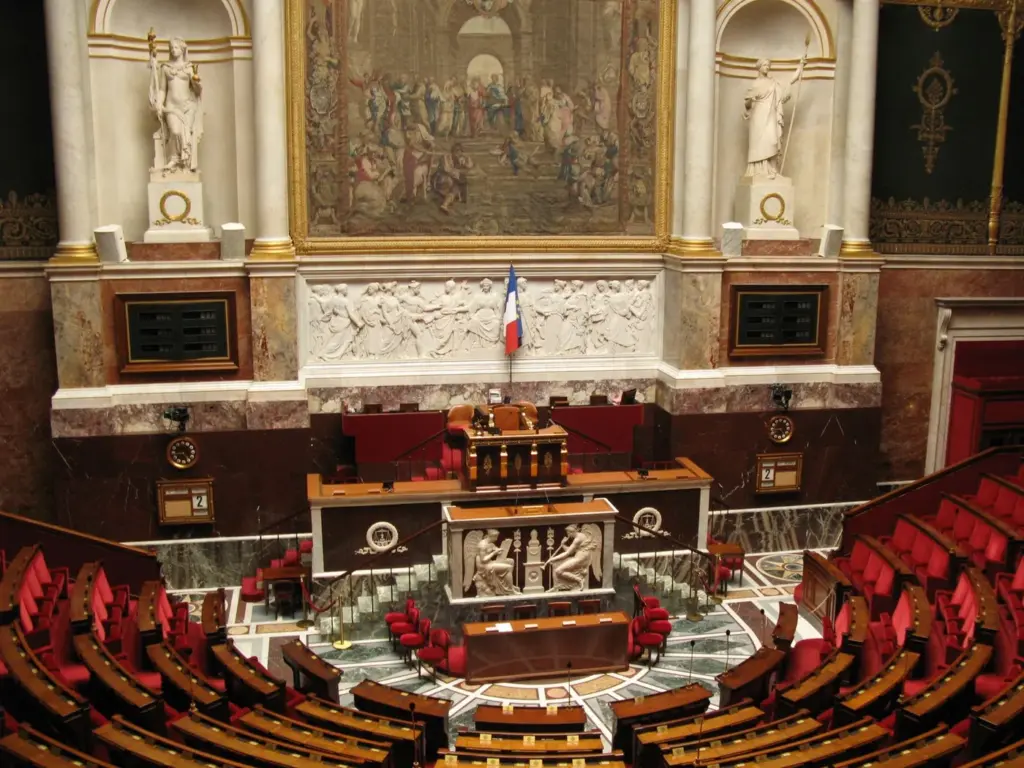
Left wing and right wing are the two ends of the most widely used map of political opinion, and the pair began as a seating plan. In the French National Assembly of 1789, deputies who wanted the king to keep an absolute veto sat to the right of the Assembly’s president, while those who opposed it sat to his left. More than two centuries later the left is usually linked with equality and a larger economic role for the state, and the right with tradition and a freer market.
Most readers carry the two labels as fixed teams, as if every party must belong to one side and every idea had a permanent address. Neither holds. Each label’s content has changed from century to century, and scholars have spent decades adding a second axis because one line can’t hold every question. In India the fit is looser still: the Congress of the 1950s, in NCERT’s description, held “the right, left and all shades of the centre” at the same time. This note separates the stable core of the terms from the parts that move, then follows the pair into Indian politics.
What left wing and right wing mean
Left and right name relative positions on a line, not membership cards. Britannica defines the left by egalitarianism and by popular or state control of the major institutions of political and economic life. It traces the right to conservative thought, which in the 19th century stood for authority and tradition.
NCERT’s Class XII textbook gives a working version for Indian students. The left, it says, prefers state control and regulation of the economy to free competition. The right believes that competition and the market economy ensure progress, and that the government shouldn’t intervene in the economy without need.
| Fact | Detail |
|---|---|
| Where the terms began | The French National Assembly of 1789, during the debate on the king’s veto |
| Who sat where | Supporters of an absolute royal veto to the president’s right; opponents to his left |
| Left, in general use | Egalitarianism and popular or state control of major economic and political institutions (Britannica) |
| Right, in general use | Conservative thought; in the 19th century, support for authority, tradition and property (Britannica) |
| Best-known test | Norberto Bobbio (1994): the attitude to equality divides left from right |
| Two-axis refinement | Hans Eysenck (1954) set tender-mindedness versus tough-mindedness beside radicalism versus conservatism |
| India’s early left | Congress Socialist Party (1934) and the communist movement of the 1920s |
| India’s free-market right | Swatantra Party (1959), led by C. Rajagopalachari |
| Legal position in India | Every registered party must pledge allegiance to “socialism, secularism and democracy” (Representation of the People Act, 1951, s. 29A(5)) |
Each label is relative, so a party can be left of one rival and right of another.
Where the terms came from: the 1789 seating plan
The terms were born as a seating chart. In the summer of 1789, after the fall of the Bastille, France’s new National Assembly argued over how much power King Louis XVI should keep, and above all whether he should hold an absolute veto over its laws. Deputies who backed the veto gathered to the right of the Assembly’s president. Those who opposed it, the more radical camp, took the seats to his left. The historian David A. Bell, quoted by Time, reduces the split to one contrast: tradition on the right, change on the left.
Beyond France the pair spread slowly. The historian Marcel Gauchet, in his essay on right and left, describes a process of more than three quarters of a century before the two words became the main categories of political life in the early 20th century. Reference works date the moment loosely. Britannica places the origin in the French revolutionary parliament of the 1790s, while the veto debate of 1789 is the precise moment historians point to. The wider revolution is covered in the note on the French Revolution of 1789.
Think of the labels as a seating chart that later became a map. The comparison helps because it explains why the words are spatial and relative: you’re always left or right of someone. It breaks at one point. A map is supposed to hold still, and this one never has. The right of 1789 defended a king’s veto. By the 19th century, Britannica notes, the term covered conservatives who defended authority and property, and in the 20th century a radical form of the right took shape as fascism.
What each side usually stands for
The left and the right usually part ways on three questions, and the answers tend to travel together:
- Equality. The left treats large inequalities of wealth and status as the product of social arrangements that public action can reduce; the right is readier to accept them as natural or as the fair outcome of effort.
- Change. The left usually presses for reform of existing institutions; the right puts more weight on tradition and order.
- State and market. The left favors state regulation or ownership in key sectors; the right trusts competition and private property to deliver growth.
NCERT’s Class XI chapter on equality draws the same line between two families of ideas. Socialism, it explains, grew as a response to the inequalities of industrial capitalism, and its main concern is to reduce existing inequality and distribute resources justly, with government regulation and planning in key areas such as education and health care. Liberals don’t object to inequality as such. Their problem is inequality that is unjust and entrenched, and they treat competition as the fairest way to distribute rewards. Both families are taught in detail in the PSIR note on liberalism, socialism and Marxism.
Some Indian socialists stretched the idea of equality beyond class. Rammanohar Lohia, NCERT notes, named five inequalities that had to be fought at the same time:
- between men and women;
- based on skin color;
- based on caste;
- of colonial rule by some countries over others;
- of wealth, the economic inequality that most socialists of his time treated as the only one worth fighting.
He added two more struggles, for civil liberties and for non-violence, and called the seven together the Sapta Kranti, or seven revolutions. Lohia’s list is a reminder that “left” in India was never only about class.
A worked example from the 1960s
A single line works well when every dispute is about the economy. Put two opposition parties of the 1960s on it and watch it fail.
The Swatantra Party was defined by economics: an NCERT exercise lists an economy free from state control among its guiding principles, and Britannica describes it as supporting free enterprise. The Bharatiya Jana Sangh, founded in 1951, is described by NCERT mainly through culture, including the idea of a single nation bound by one culture and a campaign to make Hindi, not English, the official language. Swatantra’s founder, C. Rajagopalachari, wanted English to continue as the official language, as Britannica records.
A one-line map asks only how far each party wanted the state to run the economy, so it has nowhere to record the language quarrel between these two opposition parties. That missing dimension is the whole case for a second axis.
Why one line isn’t enough: Bobbio and the two-axis models
Political scientists keep the left-right line but add a second question, usually about liberty versus authority. The Italian philosopher Norberto Bobbio made the best-known case in Destra e sinistra (1994), published in English in 1996 as Left and Right: The Significance of a Political Distinction. He argued that beneath every shift in what the labels contain, the lasting dividing line is the attitude to equality. The left is the more egalitarian side and the right the less egalitarian one. A second criterion, the attitude to freedom, separates the moderates of each side from its extremists.
Put the two criteria together and Bobbio’s map has four regions:
| Position | On equality | On liberty | Bobbio’s examples |
|---|---|---|---|
| Extreme left | Egalitarian | Authoritarian | Jacobinism |
| Center-left | Egalitarian | Libertarian | Liberal socialism and social-democratic parties |
| Center-right | Inegalitarian | Libertarian | Conservative parties that stay loyal to the democratic method |
| Extreme right | Anti-egalitarian | Anti-liberal | Fascism and Nazism |
The scheme answers a common objection: that the left-right distinction lumps communism with democratic socialism, and fascism with conservatism. Bobbio’s reply is that each pair shares a side on equality but splits on liberty. The same fact explains why such unlike movements can become allies in exceptional moments.
A psychologist had reached a similar picture four decades earlier. In The Psychology of Politics (1954), Hans Eysenck studied the attitudes of British voters and argued that one scale running from radical to conservative wasn’t enough to describe them. He added a second dimension, borrowing William James’s terms, tender-mindedness versus tough-mindedness, which he called the T-factor. He proposed that tough-mindedness placed communists and fascists together at one end, apart from the democratic parties.
This is where a centrist fits. On a one-line map the center is simply the middle. On Bobbio’s map there is a center-left and a center-right, and what they share is loyalty to democratic rules while they disagree about equality. The two values Bobbio works with are themselves contested ideas, set out in the note on equality and freedom.
How the labels came to India
The left organized first in India, inside the national movement. A party that argued openly for markets came only after independence.
The left: socialists and communists
The Congress Socialist Party (CSP) was formed within the Congress in 1934 by younger leaders who wanted the organization to be more radical and more egalitarian. Acharya Narendra Dev was its founding president, and Britannica describes it as a left-wing group within the Congress. Its leaders included Jayaprakash Narayan and Rammanohar Lohia. When the Congress barred dual party membership in 1948, the socialists left to form the Socialist Party. Their harder problem came in 1955, NCERT notes, when the Congress itself adopted a socialist pattern of society as its goal and left the socialists little room to stand apart. The thought of Lohia and Narayan is covered in the PSIR note on M. N. Roy, Lohia and Jayaprakash Narayan.
Communist groups appeared in the early 1920s, inspired by the Bolshevik revolution in Russia. Even the founding date is disputed. The CPI counts from a conference at Kanpur on 26 December 1925, while the CPI(M) dates the party to Tashkent on 17 October 1920. The party’s full history is in the note on the Communist Party of India.
After abandoning the path of violent revolution in 1951, the CPI won 16 seats in the first general election and became the largest opposition party, according to NCERT. In March 1957 it won 60 of the 126 seats in the Kerala assembly and, with the support of five independents, E. M. S. Namboodiripad formed what NCERT calls the first communist government anywhere to come to power through democratic elections. The Union government dismissed it in 1959 under Article 356. In 1964 the party split over the rift between the Soviet Union and China: the pro-Soviet group stayed the CPI and the rest formed the CPI(M).
The right: the Swatantra Party
C. Rajagopalachari, the only Indian to serve as Governor-General, left the Congress in 1957. In June 1959 his Congress Reform Committee merged with the new Swatantra Party in Madras. Britannica calls the party fundamentally conservative and anticommunist, and says it backed free enterprise and a smaller role for the central government over the states. Minoo Masani was among its leaders.
The party did better at the polls than its short life suggests. The Election Commission’s statistical reports show it winning 18 of 494 Lok Sabha seats in 1962 with 7.89 percent of the valid vote. In 1967 it won 44 of 520 seats with 8.67 percent, more than any party other than the Congress.
Why the European labels fit Indian parties poorly
European parties grew up fighting over class and the economy. Indian parties have more often competed over other questions, and scholars have made the point from three directions.
The first is the Congress system. NCERT describes the Congress of the first decade after independence as a social and ideological coalition whose factions took different positions, so that the party looked like a broad centrist party and competition took place inside it more than between parties. The chapter is free on NCERT’s website, and the later party system is traced in the PSIR note on party system, coalition politics and pressure groups.
The second is the argument about class. In In Pursuit of Lakshmi (1987), Lloyd and Susanne Rudolph argued that no national party in India, whether of the right or the left, practices class politics. Their explanation is the state itself: private capital and organized labor face the state as a third actor, and its dominance pulls politics toward a centrist pluralism.
The third is a newer claim, that Indian politics is ideological, just not in the European way. Pradeep Chhibber and Rahul Verma, in Ideology and Identity (2018), used survey data from the Indian National Election Studies and the Constituent Assembly debates to argue that India’s ideological contests run along two lines:
- statism, how far the state should dominate and regulate society;
- recognition, whether and how the state should accommodate marginalized groups and protect minorities.
The law adds a practical reason. Since 15 June 1989, Section 29A(5) of the Representation of the People Act, 1951 has required every association applying to register as a political party to write into its memorandum a pledge of allegiance to the Constitution and to the principles of “socialism, secularism and democracy”. The text is on India Code. A party that campaigns for free markets still commits to socialism on paper, so the word tells you little about a party’s actual economics. The procedure is explained in the note on the registration and deregistration of political parties.
None of this makes the pair useless in India. It is wise to use left and right for the question they measure well, the state against the market, and to treat recognition or language as separate axes when an Indian debate turns on them. Being extreme either way isn’t a good idea at all: throwing the labels out loses a real signal, and forcing every party onto one line hides the disagreements that matter.
Left and right in India today
The pair remains in daily use, but constitutional law has declined to pick a side. On 25 November 2024, a Supreme Court bench of Chief Justice Sanjiv Khanna and Justice Sanjay Kumar dismissed the petitions in Dr. Balram Singh v. Union of India. They had challenged the words socialist and secular, which the 42nd Amendment of 1976 inserted into the Preamble.
The bench held that neither the Constitution nor the Preamble mandates a specific economic policy or structure, “whether left or right”. In the Indian framework, it said, socialism denotes the state’s commitment to a welfare state and to equality of opportunity, and it doesn’t restrict private enterprise or the right to trade and business under Article 19(1)(g). The court rejected the argument that an insertion made during the Emergency was invalid, holding that Parliament’s amending power under Article 368 reaches the Preamble. It also noted that India has consistently followed a mixed economy in which the private sector has grown.
On the party side, the CPI marked its centenary on 26 December 2025, counting from the Kanpur conference, while the CPI(M) continues to date the party’s founding to 1920.
How to study left wing and right wing for exams
The topic sits in four parts of the syllabus:
- GS Paper I: the French Revolution in world history, and the ideological strands of the national movement in modern India.
- GS Paper II: the Preamble’s word socialist and the registration of political parties.
- PSIR Paper I: the political ideologies unit and the concept of equality.
- Essay: questions on capitalism and the role of the state.
Mains rarely asks for a definition; it asks what the ideas did. Mains 2020 GS Paper I asked “Since the decade of the 1920s, the national movement acquired various ideological strands and thereby expanded its social base. Discuss.“, the socialist and communist story of this note in exam form. Mains 2016 GS Paper II asked “‘The Indian party system is passing through a phase of transition which looks to be full of contradictions and paradoxes.’ Discuss.“, a question the Congress-system argument answers well. For Prelims, 240 of the 1,403 questions from 2013 to 2026 in the site’s Prelims question bank are tagged Indian Polity, the subject under which the Preamble and party registration fall.
Revise these until they’re automatic:
- 1789: in the veto debate, supporters of an absolute royal veto sat to the president’s right and opponents to his left.
- Britannica’s core: the left means egalitarianism and popular or state control; the 19th-century right meant defending authority and tradition.
- Bobbio (1994): equality divides left from right; liberty divides moderates from extremists.
- Eysenck (1954): a second axis of tender-mindedness versus tough-mindedness beside radicalism versus conservatism.
- 1934 and 1964: the CSP forms inside the Congress; the CPI splits and the CPI(M) is born.
- Swatantra (1959): 18 Lok Sabha seats in 1962 and 44 in 1967.
- The law: Section 29A(5) of the Representation of the People Act, in force since 15 June 1989, and the Supreme Court’s ruling of 25 November 2024 on socialist in the Preamble.
Three confusions cost marks:
- Left wing and Left Wing Extremism. Left Wing Extremism is the Union government’s term for the Maoist armed movement, a security category covered in the note on Left Wing Extremism. Left parties that contest elections are a different subject.
- Socialist in the Preamble and socialist parties. The Supreme Court reads the Preamble’s word as a commitment to a welfare state, not to any party’s program or to state ownership.
- Extreme and strong. In Bobbio’s sense, extremists are those who reject democratic rules, not people with firm views; a moderate can hold strong opinions on equality.
It helps to place the neighboring ideologies on the line:
| Idea | Usual place | Core concern | Indian example in history |
|---|---|---|---|
| Communism | Far left | Ending class inequality | CPI, founded at Kanpur in 1925 by its own dating |
| Democratic socialism | Center-left | Equality through democratic means | The Socialist Party of 1948, which NCERT says believed in democratic socialism |
| Free-market liberalism | Right on economics | Individual liberty and competition | Swatantra Party (1959) |
| Conservatism | Right | Tradition and order | Swatantra again, which Britannica calls fundamentally conservative |
| Fascism | Extreme right | Rejects both liberty and equality (Bobbio) | No Indian case; Bobbio’s examples are Italian Fascism and Nazism |
Left and right work best as a compass, not a verdict. The compass points reliably on one question, how far the state should shape the economy, and it needs a second axis once identity or language enters the argument. An answer that uses the pair and then shows exactly where it stops reads as understanding rather than recall.
Frequently Asked Questions
What do left wing and right wing mean in simple terms?
Left wing and right wing are labels for two broad sides of political opinion. The left usually favors greater equality and a larger economic role for the state, while the right usually favors tradition and freer markets. The labels are relative, so a party can be left of one rival and right of another.
Where did the terms left wing and right wing come from?
They come from the French National Assembly of 1789. During the debate on whether King Louis XVI should keep an absolute veto, supporters of the veto sat to the right of the Assembly’s president and opponents sat to his left. The spatial labels then spread slowly across Europe and beyond.
What does centrist mean in politics?
A centrist holds positions between the left and the right and avoids the extremes of both. Norberto Bobbio split the middle into a center-left and a center-right, and both accept democratic rules while disagreeing on how much equality to pursue.
Is India’s Constitution left wing because the Preamble says socialist?
No. In Dr. Balram Singh v. Union of India, decided on 25 November 2024, the Supreme Court held that the Constitution mandates no specific economic policy, whether left or right. It read the word socialist as a commitment to a welfare state and equality of opportunity that doesn’t restrict private enterprise.
Is left wing politics the same as Left Wing Extremism?
No. Left wing politics refers to parties and ideas that favor equality and a larger role for the state, and in India such parties contest elections. Left Wing Extremism is the official term for the Maoist armed movement, which is treated as an internal security problem.
What did Norberto Bobbio say about left and right?
Bobbio, an Italian philosopher, argued in his 1994 book that the attitude to equality is the lasting criterion dividing the left from the right. He added the attitude to liberty to separate moderates from extremists, which gave him four positions from the extreme left to the extreme right.
What was the Swatantra Party?
The Swatantra Party was formed in 1959 with C. Rajagopalachari as its leading figure, and Britannica describes it as a conservative party that backed free enterprise. It won 18 Lok Sabha seats in 1962 and 44 in 1967, when it had more seats than any party other than the Congress.
Why don’t the labels left and right fit Indian parties well?
Scholars give several reasons. NCERT describes the early Congress as a coalition broad enough to hold both left and right at once, and the Rudolphs argued that no national party in India practices class politics. Chhibber and Verma add that India’s ideological debates turn on statism and on the recognition of marginalized groups rather than on a European class divide.
Practice Questions
Prelims
1. Consider the following statements about the origin of the terms left and right in politics: 1. They arose from the seating of deputies in the French National Assembly of 1789. 2. Deputies who supported an absolute royal veto sat to the left of the Assembly’s president. Which of the statements given above is/are correct?
- (a) 1 only
- (b) 2 only
- (c) Both 1 and 2
- (d) Neither 1 nor 2
Answer: (a) Supporters of the veto sat to the president’s right and its opponents to his left.
2. Consider the following statements: 1. The Congress Socialist Party was formed within the Indian National Congress in 1934. 2. The Communist Party of India emerged as the largest opposition party in the first general election. 3. The Swatantra Party was founded under the leadership of Jayaprakash Narayan. Which of the statements given above is/are correct?
- (a) 1 and 2 only
- (b) 2 and 3 only
- (c) 1 and 3 only
- (d) 1, 2 and 3
Answer: (a) The Swatantra Party was led by C. Rajagopalachari; Jayaprakash Narayan was a leader of the socialists.
3. According to Norberto Bobbio, the criterion that most consistently distinguishes the left from the right is the attitude toward:
- (a) religion
- (b) equality
- (c) national sovereignty
- (d) foreign policy
Answer: (b) Bobbio made the attitude to equality the dividing line and used the attitude to liberty to separate moderates from extremists.
4. Under Section 29A(5) of the Representation of the People Act, 1951, the memorandum of an association applying for registration as a political party must pledge allegiance to the principles of:
- (a) socialism, secularism and democracy
- (b) liberty, equality and fraternity
- (c) justice, liberty and equality
- (d) federalism, secularism and democracy
Answer: (a) The provision, in force since 15 June 1989, names socialism, secularism and democracy along with the sovereignty, unity and integrity of India.
5. Consider the following statements about the Supreme Court’s decision of 25 November 2024 in Dr. Balram Singh v. Union of India: 1. It struck down the word socialist from the Preamble. 2. It held that socialism in the Indian framework does not restrict the right to trade and business under Article 19(1)(g). Which of the statements given above is/are correct?
- (a) 1 only
- (b) 2 only
- (c) Both 1 and 2
- (d) Neither 1 nor 2
Answer: (b) The court dismissed the challenge and read socialist as a commitment to a welfare state.
Mains
- The terms left and right began as a seating arrangement in 1789, yet they remain the most widely used map of political opinion. Explain why the distinction has survived, with reference to Norberto Bobbio’s argument. (15 marks, 250 words)
- Examine why the European left-right spectrum describes Indian political parties only partially. (15 marks, 250 words)
- Distinguish between the Congress Socialist Party and the Communist Party of India in their ideology and methods during the national movement. (10 marks, 150 words)
- The word socialist in the Preamble does not commit the State to any particular economic policy. Discuss in the light of the Supreme Court’s decision of November 2024. (10 marks, 150 words)
- The French Revolution has enduring relevance to the contemporary world. Explain. (15 marks, 250 words) Previous year: Mains 2025, GS Paper I.
Tell Google you want more of this.
Add Anantam IAS as a preferred sourceOne tap, and this site shows up more often in your own Top Stories, AI Overviews and AI Mode. Remove it any time.