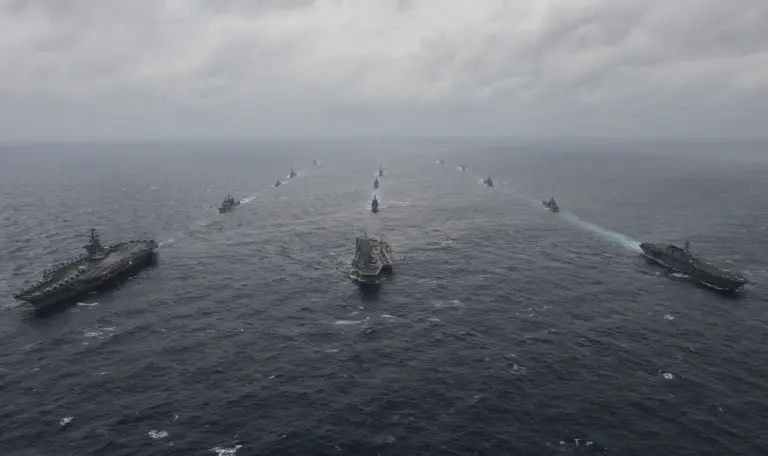

For ten years, India’s “Neighbourhood First” policy had a quiet weakness nobody wanted to name: in Bangladesh, it was really a Sheikh Hasina policy. When a student-led uprising ended her fifteen-year rule in August 2024, the relationship didn’t wobble. It fell off a cliff. An eighteen-month interim government under Muhammad Yunus tilted Dhaka toward China and Pakistan, and India discovered it had built a bridge to one person, not a country. So the swearing-in of a new, India-skeptic-but-pragmatic government in Dhaka on 17 February 2026 isn’t just a news item. It’s the exam India set for itself, and the proctor standing at the back of the room is China, chequebook open.
That’s the whole topic in one frame. Neighbourhood First is India’s policy of treating its immediate neighbours as the first priority of its foreign relations, with generosity that doesn’t demand strict reciprocity. It has real wins. It also has real strain. And the strain isn’t mainly about China outspending India. It’s about whether India can do “neighbourhood first” with institutions and publics rather than with whoever happens to hold power this year.
The Issue, Framed
The argument here isn’t whether India should prioritise its neighbours. Of course it should. Geography doesn’t take a holiday. The argument is whether the way India has run the policy can survive a region where governments now change hard, fast, and against incumbents India befriended.
Let’s fix the vocabulary first, because most confusion about this topic comes from people throwing terms around loosely. Neighbourhood First, articulated at the start of the Modi government in 2014, is usually summed up by five Hindi words, the “5S”: Samman (respect), Samvad (dialogue), Shanti (peace), Samriddhi (prosperity), and Sanskriti (culture). The operative promise is non-reciprocal generosity. As the larger power, India says it’ll give more than it asks back. That’s the doctrine. Whether the practice matched it is exactly the debate.
On the other side sits China’s toolkit. The Belt and Road Initiative (BRI), launched in 2013, is Beijing’s flagship programme of financing ports, railways, roads and power plants across the world, South Asia included. Where India leans on grants and concessional loans, China lends big and sometimes takes equity, port concessions, or long leases when a borrower can’t repay. That pattern earned a label: debt diplomacy, the idea that loans become leverage when repayment fails. Its textbook case is a Sri Lankan port we’ll come to.
Two more terms you’ll need. The “String of Pearls” is an analysts’ phrase, not an official Chinese plan, describing a perceived ring of Chinese-linked facilities around India’s maritime periphery, Gwadar in Pakistan, Hambantota in Sri Lanka, Kyaukpyu in Myanmar. Treat it as a strategic-studies construct, because that’s what it is. And on India’s side, SAGAR (Security and Growth for All in the Region), unveiled by Modi in Mauritius in 2015, is India’s maritime-neighbourhood doctrine, expanded in 2025, again in Mauritius, into MAHASAGAR (Mutual and Holistic Advancement for Security and Growth Across Regions), adding economic diplomacy and tech connectivity to the original security-and-growth pitch.
So the field is set. India offers respect, grants, and regional public goods. China offers scale, speed, and hard infrastructure. And the neighbours, every one of them sovereign and increasingly assertive, get to choose. The question for an aspirant is how India keeps its first-mover advantage when the politics underneath keeps shifting.
What the Data Says
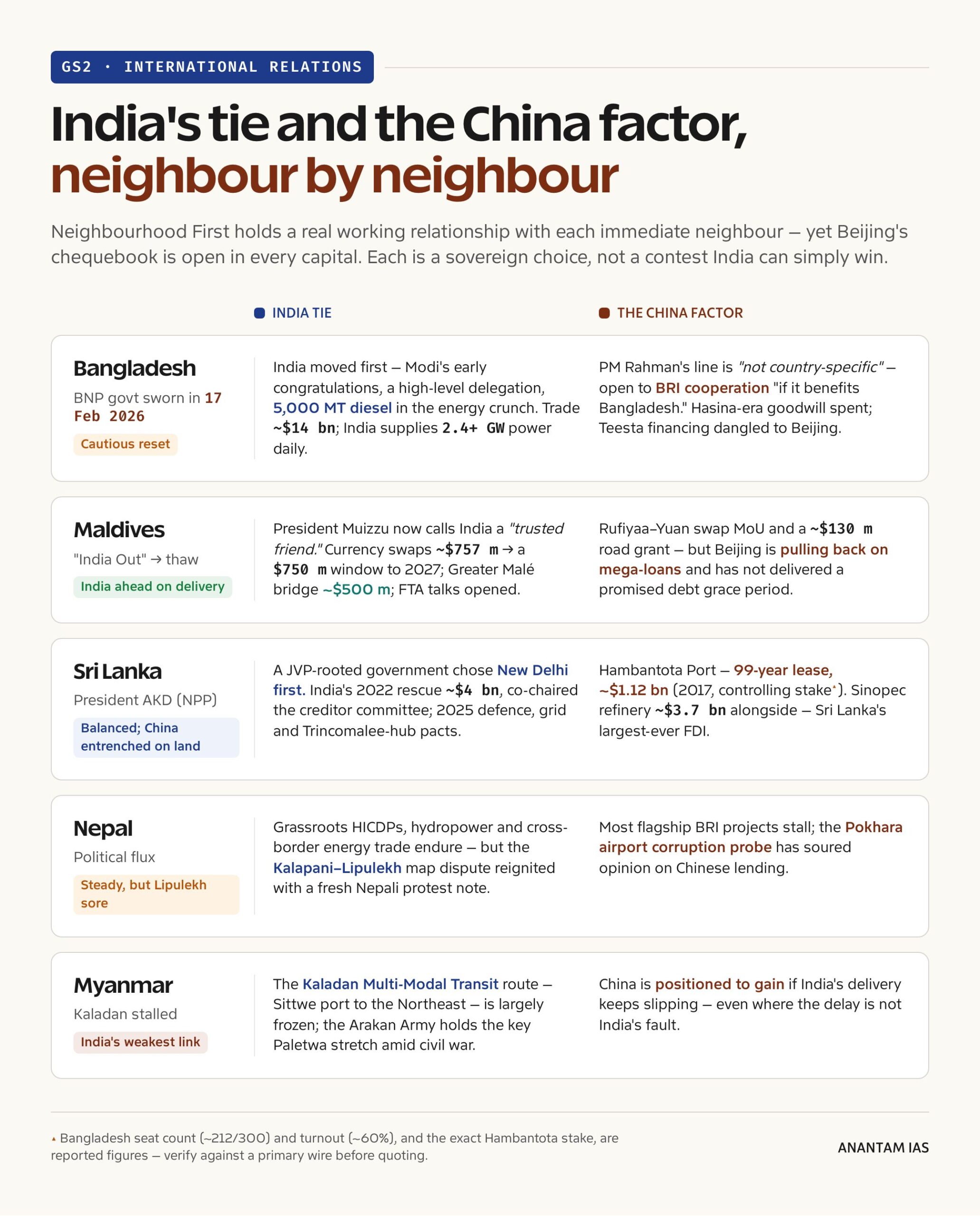
Start with the peg, because it crystallises everything. Bangladesh held a national election in February 2026; the Bangladesh Nationalist Party (BNP) won a sweeping mandate, reported at 212 of 300 parliamentary seats on roughly 60% turnout, and Tarique Rahman was sworn in as Prime Minister on 17 February 2026. This is the party long seen in Delhi as the harder, more China-and-Pakistan-leaning option. And India’s response was telling: PM Modi congratulated the new government early, sent a high-level delegation to the swearing-in, and within days supplied 5,000 metric tons of diesel amid an energy crunch. India moved first, deliberately.
The economic spine is why. Even through the worst of the post-Hasina freeze, India-Bangladesh trade held at about US$14 billion in FY2023-24, with India running a large surplus. India also supplies more than 2.4 GW of electricity to Bangladesh every day under long-term contracts. That’s not sentiment. That’s a working economic relationship too big and too wired-together for either side to torch on principle, which is precisely why Rahman’s stated foreign policy is “not country-specific,” leaving the door open to BRI cooperation “if it benefits Bangladesh’s economy.”
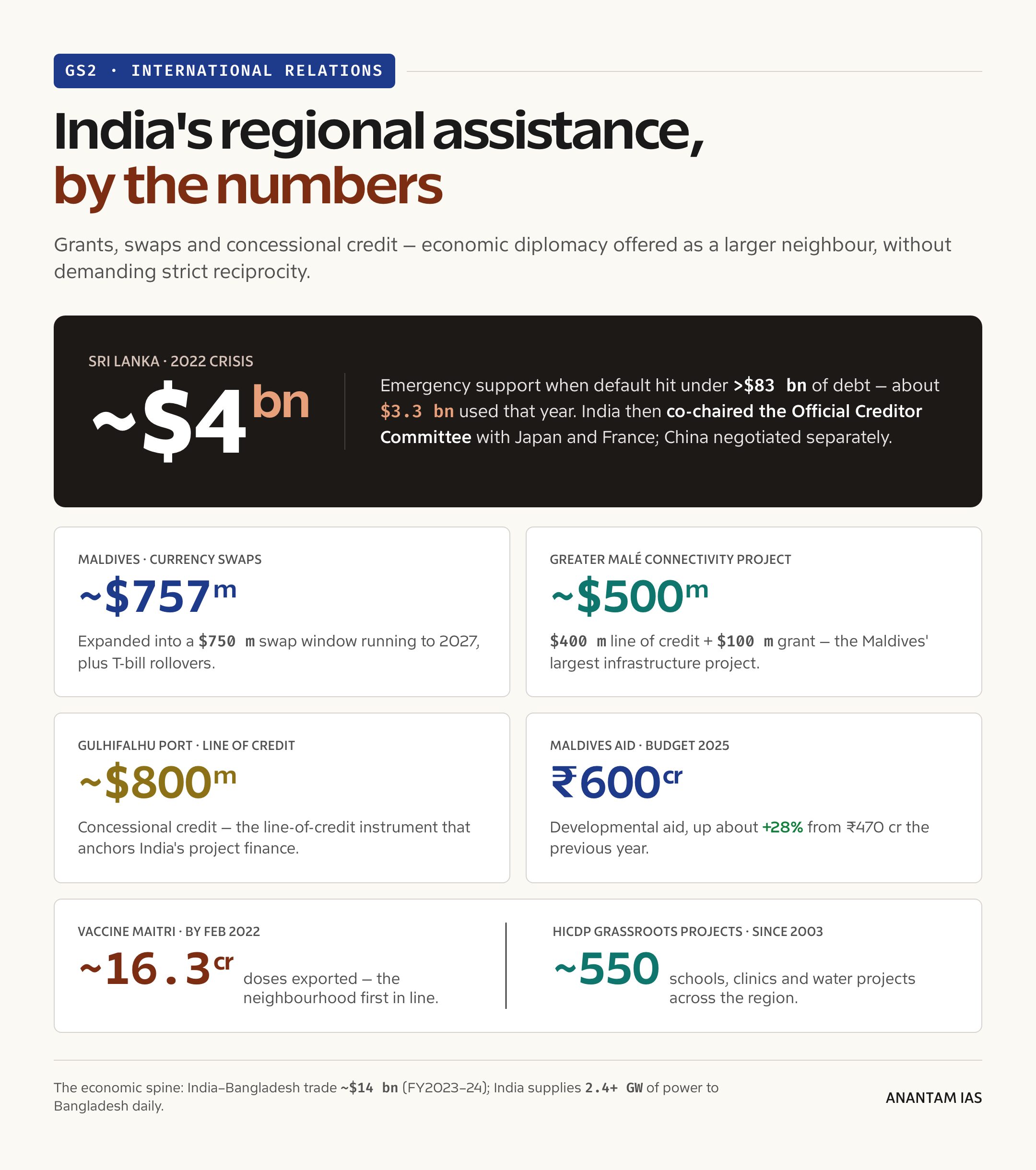
Now look south, where the policy’s best evidence lives. When Sri Lanka collapsed into default in April 2022 under more than US$83 billion of debt, India extended about US$4 billion in emergency support, of which roughly US$3.3 billion was used that year, equal to about 85% of that year’s India-Sri Lanka trade deficit. India then co-chaired the Official Creditor Committee with Japan and France that unlocked Sri Lanka’s IMF programme, restructuring about US$5.9 billion of debt. China, Sri Lanka’s largest single bilateral creditor, stayed outside that committee and negotiated separately. When the wall came, India was the first responder, and the contrast did the talking.
The Maldives tells the same story from a different start. President Mohamed Muizzu won in 2023 on an “India Out” platform and had 76 Indian military personnel running medical-evacuation aircraft replaced by HAL civilian technicians by May 2024. Then economic stress forced a recalibration. India extended currency swaps worth about US$757 million, later expanded into a US$750 million swap window running to 2027, rolled over treasury bills, and raised developmental aid to ₹600 crore in Budget 2025, up about 28% from the previous year. By July 2025, Muizzu was calling India a “trusted friend.” “India Out” became, in effect, opting in.
China’s side of the ledger is where the easy “debt-trap” narrative needs care. The canonical case is real: in 2017, China Merchants Port took a 99-year lease and a controlling stake in Hambantota Port for about US$1.12 billion. And China is still building, a Sinopec oil refinery of about US$3.7 billion beside Hambantota, committed January 2025, the largest single FDI in Sri Lankan history. But the 2025-26 trend cuts the other way too: China is slowing new mega-loans, declined to fund Pakistan’s flagship ML-1 railway, and hasn’t delivered a promised debt grace period to the Maldives. The board is more complicated than “China advancing, India retreating.”

The Case For
The case that Neighbourhood First is working is genuinely strong, and a lazy answer that skips it loses marks. So let’s state it at full strength.
India is the partner who shows up when a neighbour hits the wall. Sri Lanka 2022 is the proof: about US$4 billion at speed when no one else moved, then the OCC co-chair that made the IMF deal possible. Compare that to a creditor sitting outside the committee, and the difference between a first responder and a lender of last resort becomes obvious. So when India says it’s a different kind of neighbour, that’s not branding. That’s a balance sheet.
The Maldives U-turn vindicates strategic patience. An “India Out” president became one who calls India a “trusted friend,” and he did it because India was the only partner willing to provide immediate, substantive help, swaps, T-bill rollovers, and the Greater Malé Connectivity Project worth about US$500 million (a US$400 million line of credit plus a US$100 million grant), the largest infrastructure project in the country. Geography and delivery beat a campaign slogan. That’s the lesson, and it’s a hopeful one for India.
Ideology didn’t beat delivery in Sri Lanka either. President Anura Kumara Dissanayake leads the National People’s Power, a bloc with JVP roots historically read as China-leaning. Yet his first state visit was to New Delhi, the first foreign leader he hosted was Modi, and his government signed a defence MoU, a grid-interconnectivity pact, and a tripartite India-Sri Lanka-UAE deal for a Trincomalee energy hub. A government everyone expected to tilt to Beijing chose pragmatic engagement with Delhi. So the “neighbours are all drifting to China” story is, at minimum, too simple.
And India delivers regional public goods that equity-style lending structurally can’t match. Vaccine Maitri put the neighbourhood first in line during the pandemic, about 16.3 crore doses exported by February 2022. The High Impact Community Development Projects model, roughly 550 grassroots schools, clinics and water projects since 2003, builds goodwill at the village level, not just the summit level. Grids, disaster relief, and digital public infrastructure are goods India can offer that a port lease can’t. So at its best, the policy isn’t competing with China’s instrument. It’s offering a different one.
The Case Against
Here’s what the optimistic case walks past. A policy isn’t judged only by its rescues. It’s judged by its baseline, by what happens when there’s no crisis to be a hero in. On that test, Neighbourhood First has real strain.
The Bangladesh shock exposed the core flaw: over-reliance on incumbents. A decade of warmth rode on one leader, and when Hasina fell, India found it had little goodwill among the publics, the opposition, or the institutions that outlast any government. A December 2024 attack on Bangladesh’s assistant high commission in Agartala, and repeated, declined demands to extradite Hasina, fed a cycle of anti-India sentiment during the interim period. Betting on individuals is efficient until the individual is gone. Then you’re starting from zero, or below it.
The “big-brother” perception keeps reigniting. Nepal is the live wire: the Kalapani-Lipulekh-Limpiyadhura map dispute, where both countries claim the same Himalayan tri-junction, flared again when India announced a Kailash Mansarovar Yatra route via Lipulekh, drawing a fresh Nepali protest note on 3 May 2026. Add the India-Nepal Eminent Persons’ Group report, reportedly finished in 2018 but never formally received by New Delhi, a standing Nepali grievance. Sovereignty sensitivities don’t need much to catch fire.
Delivery delays hand China its best argument. India’s flagship Kaladan Multi-Modal Transit Transport Project, meant to give the landlocked Northeast sea access through Myanmar’s Sittwe port and bypass the narrow Siliguri corridor, is largely stalled: since early 2024 the Arakan Army controls the key Paletwa stretch, and Myanmar’s civil war has frozen the route. When India announces big and delivers slow, the contrast with Chinese projects that get built writes itself, even when the delay isn’t India’s fault.
China is structurally embedded in a way that won’t reverse soon. Hambantota’s 99-year lease and the US$3.7 billion Sinopec refinery sit on India’s southern doorstep. And the China-Pakistan Economic Corridor (CPEC), about US$62 billion cumulatively by 2020 across a roughly 3,000-km network from Kashgar to Gwadar, runs straight through Gilgit-Baltistan, part of Pakistan-occupied Kashmir that India claims. That’s not a delivery problem India can out-execute. It’s a permanent sovereignty affront and a fixture on the map. So the “String of Pearls” framing, construct though it is, points at something concrete.
Water is the next flashpoint, and the calendar is unforgiving. The 1996 Ganges Water Treaty expires in December 2026 and is due for renewal, while the Teesta water-sharing pact stays blocked by West Bengal’s objections, and Bangladesh has dangled Chinese financing for the Teesta river project as leverage. A neighbour using a third power to gain bargaining weight on a shared river is exactly the strain the policy was supposed to prevent.
The Deeper Structural Read
Step back from the country-by-country scoreboard and the real fault line appears. It isn’t “India versus China for the neighbourhood.” It’s a contest between two theories of what makes a neighbour stay close, and India’s instinct has been betting on the weaker one.
China’s theory is transactional and physical. Build the port, lay the rail, pour the concrete, and the facts on the ground create dependence that survives elections. It’s expensive, it carries reputational risk, and it’s now slowing as Beijing absorbs its own bad loans. But it leaves something a successor government has to reckon with, because you can’t un-build a refinery. India’s theory, at its best, is relational and institutional, generosity that earns trust across a whole society. The problem is that India too often practised the relational theory as a personal one, trust banked with a leader rather than a system. So when the leader fell, the trust didn’t transfer.
That’s the structural read, and it belongs in your answer: India’s instruments are mostly right, but its aim point was wrong. A grant-heavy, non-reciprocal, public-goods model is genuinely better suited to a region of small, sovereignty-sensitive states than China’s equity-and-lease model. Yet a good instrument aimed at one incumbent behaves like a fragile one. The fix isn’t to copy China’s chequebook. It’s to redirect India’s existing generosity toward parties, publics, militaries, and institutions, so that the next election anywhere in the neighbourhood is a transfer of a relationship, not a reset of it.
There’s a federalism layer underneath, and a future administrator should sit with it. Some of India’s hardest neighbourhood files are domestic before they’re diplomatic. Teesta is stuck not in Dhaka but in a Centre-state disagreement with West Bengal. India’s ability to be the generous larger neighbour the doctrine imagines is sometimes constrained by its own internal coordination, which means “neighbourhood first” is partly a test of cooperative federalism, not only of the MEA.
And here’s the part that should reframe the whole anxiety. The most useful thing India has going for it in 2026 isn’t its own delivery record, strong as parts of it are. It’s that China’s model is visibly fraying, the Pokhara airport corruption probe souring Nepali opinion on BRI, the undelivered Maldives grace period, the withheld ML-1 funding. The smartest version of Neighbourhood First doesn’t try to win a spending race it can’t win. It offers a better, faster, sovereignty-respecting alternative and lets the contrast speak. The neighbours are not pawns choosing a master. They’re customers comparing two offers, and India’s offer is competitive precisely where it stops pretending the contest is zero-sum.
What Should Be Done
So what does a Neighbourhood First policy fit for this decade actually look like? Not a vague call for “more engagement,” but a working list a foreign-policy planner could act on. Seven moves, and none of them require out-spending Beijing.
- Deliver on time, because credibility is the cheapest deterrent. A finished Greater Malé bridge persuades more than ten announced corridors. Build local partnerships and contingency buffers into projects like Kaladan so delivery survives a coup, a flood, or a civil war. Every Indian project that ships on schedule quietly retires one Chinese talking point.
- Engage institutions and publics, not just whoever’s in power. The Bangladesh lesson is unambiguous. Build ties across parties, the military, business chambers, and civil society so a change of government doesn’t reset relations to zero. India’s early outreach to the new BNP government shows it learned this. The habit has to outlast the moment.
- Practise asymmetric generosity, visibly. As the larger power, absorb more cost without demanding strict reciprocity, and be seen doing it. Settle the Ganges renewal and Teesta as a confident big neighbour would, generously and on the front page, not as defensive concessions extracted under pressure.
- Offer regional public goods China structurally can’t. Grid interconnection, disaster response, and the export of India’s digital public infrastructure like UPI are goods a port lease can never provide. Lean into the comparative advantage instead of competing on China’s turf.
- Treat people-to-people ties as strategic infrastructure. Scholarships, health cooperation, pilgrimage and tourism links, the “Sanskriti” leg of the 5S, build a floor under volatile politics. They’re cheap, durable, and impossible for a debt-financed port to replicate.
- De-risk the water and border files diplomatically, now. The Ganges treaty’s December 2026 expiry is a deadline, not a someday. Resolve the Lipulekh friction and the long-pending EPG question as relationship-defining priorities, before a neighbour reaches for Chinese leverage to force the issue.
- Refuse the zero-sum frame in public. Neighbours resent being told to choose. The credible Indian pitch is better, faster, sovereignty-respecting delivery, and then letting China’s own debt-trap reputation and the Pokhara and ML-1 troubles do the contrasting work. Confidence persuades. Insecurity, the “our backyard” reflex, repels.
Every one of these plays to a strength India already has. The policy doesn’t need a new doctrine. It needs to aim the old one at societies instead of individuals, and to deliver what it promises.
For Your Mains Answer
This is a high-value GS2 topic. It folds India and its neighbourhood, regional groupings, the effect of other powers’ policies on India’s interests, and a clean cross-link to GS3 on connectivity and border security, into a single frame.
GS paper mapping: GS2: India and its neighbourhood relations; bilateral and regional agreements involving India; effect of policies and politics of developed and developing countries on India’s interests. Cross-link to GS3: infrastructure, energy security, and internal/border security via Myanmar and PoK.
Likely question frames:
- “Neighbourhood First has succeeded as crisis response but struggled as a steady-state relationship.” Critically examine in light of recent developments in Bangladesh, the Maldives and Sri Lanka.
- The China factor has reshaped India’s strategic environment in South Asia. Discuss how India should recalibrate its neighbourhood policy without framing the region as a zero-sum contest.
- Examine whether India’s grant-and-public-goods model or China’s loan-and-infrastructure model is better suited to the small states of South Asia.
Quotable data points:
- Tarique Rahman sworn in as Bangladesh’s PM on 17 Feb 2026 (BNP, reported ~212/300 seats, ~60% turnout); India engaged first, including 5,000 MT of diesel.
- India-Bangladesh trade ≈ US$14 billion (FY2023-24); India supplies 2.4+ GW of power daily.
- India’s Sri Lanka crisis support ≈ US$4 billion (≈ US$3.3 bn used in 2022); India co-chaired the OCC, China stayed out.
- Hambantota Port: 99-year lease, ≈ US$1.12 billion, 2017, to China Merchants Port; Sinopec refinery ≈ US$3.7 billion alongside (Jan 2025), Sri Lanka’s largest-ever FDI.
- CPEC ≈ US$62 billion (cumulative, ~2020), ~3,000 km through Gilgit-Baltistan/PoK, India’s standing sovereignty objection.
- Maldives: currency swaps ≈ US$757m → US$750m window to 2027; ₹600 cr aid (Budget 2025, +28%); Greater Malé Connectivity Project ≈ US$500m.
- Vaccine Maitri ≈ 16.3 crore doses by Feb 2022; ~550 HICDPs since 2003.
Keywords to use: Neighbourhood First, 5S (Samman, Samvad, Shanti, Samriddhi, Sanskriti), SAGAR to MAHASAGAR, non-reciprocal generosity, BRI, debt diplomacy, String of Pearls, regional public goods, strategic patience.
Syllabus linkages: India and its neighbourhood; bilateral and regional groupings; effect of developed and developing countries’ policies on India; Indian diaspora; energy and border security as GS3 cross-links.
Balanced conclusion line: Neighbourhood First doesn’t fail because China spends more; it strains when India banks trust with leaders instead of societies, and the repair is to aim India’s existing generosity at institutions and publics, offering a better and sovereignty-respecting alternative rather than fighting a zero-sum contest it was never built to win.
How to Build the Answer
Open with the tension, not a definition. The sharpest opening line states that Neighbourhood First’s biggest test isn’t Chinese money, it’s the fragility of betting on incumbents, proven the moment Hasina fell. That single sentence shows the examiner you’ve grasped both the policy and its structural flaw. The definition of the 5S can follow in the second sentence. Lead with the diagnosis, support it with a glossary, never the reverse.
Bring data in early, but ration it. A strong first body paragraph can carry three figures, US$14 bn in trade with Bangladesh, US$4 bn for Sri Lanka, US$1.12 bn for the Hambantota lease, then say what they prove: India is the first responder, China is the landlord. UPSC rewards the move from fact to inference. The number is the anchor, the “this shows” is the mark.
Steelman both sides. If your stance is that the policy is sound, first concede the Bangladesh shock and the Kaladan delays honestly. If your stance is that it’s failing, first credit the Sri Lanka rescue and the Maldives turnaround. A balanced answer earns more than a one-sided one, even a well-argued one.
Group the way forward, never scatter it. Cluster the reforms: on-time delivery, institutions-not-incumbents, asymmetric generosity, regional public goods, water and border de-risking, and a refusal of the zero-sum frame. Use the topic’s own vocabulary, non-reciprocity, public goods, strategic patience, so the answer reads like statecraft analysis, not a current-affairs recap.
Close on judgment, not summary. The last line should not echo the introduction. It should resolve the dilemma with a clear “the goal is not X but X with Y” pattern, here, not out-spending China but out-trusting it, by investing in societies rather than leaders.
Common Mistakes to Avoid
- Don’t make it India-versus-China. The brief and reality both reject zero-sum framing. Neighbours are sovereign actors making national-interest choices, not pieces on a board.
- Don’t condescend to the neighbourhood. Avoid “our backyard” and “small states drifting away.” Frame every neighbour’s choice as legitimate. UPSC marks down jingoism.
- Don’t assert contested figures as settled. Casualty counts, the scale of minority attacks, and exact stake percentages are disputed. Attribute them, don’t headline them.
- Don’t write only the newspaper version. A Mains answer needs the structural read, the institutions-versus-incumbents diagnosis, on top of the events.
- Don’t forget the human and federal layers. Name the migrant worker, the shared river, the West Bengal veto. Policy that names who is affected scores higher than policy in the abstract.
A Compact Answer Spine
- Introduction: Open with the incumbent-dependence flaw exposed by Hasina’s fall; define Neighbourhood First and the 5S in the next sentence.
- Evidence: Two or three attributed figures, each tied to an implication, India as first responder, China as embedded landlord.
- Arguments: The case the policy works (Sri Lanka, Maldives, public goods), then the case it’s strained (Bangladesh shock, Kaladan, CPEC, water). Keep both fair.
- Structural diagnosis: Right instruments, wrong aim point, India backed leaders, not institutions; plus the federalism layer on Teesta.
- Way forward: Six or seven grouped moves, each with a clear actor, MEA, line ministries, the states.
- Conclusion: Adapt the balanced conclusion line to the exact question wording.
Diagram or Flowchart Idea
For a 15-marker, draw one causal chain rather than a decorative map. The cleanest format: decade of incumbent-based ties → leadership change (Hasina, Muizzu’s campaign, Oli) → relationship shock → China offers alternative finance → India’s repair (deliver on time, engage institutions, regional public goods). The examiner reads that logic in five seconds.
For a 10-marker, skip the diagram and use a two-column table: “India’s instruments (grants, swaps, public goods, non-reciprocal)” against “China’s instruments (loans, equity, port leases, BRI).” It does more work and is faster to grade under time pressure.
Ethics and Governance Angle
Even a GS2 answer benefits from one line on values. Neighbourhood diplomacy isn’t only about influence, it’s about whether a larger power can act as a responsible regional steward without slipping into dominance. Name the value: respect for sovereignty and equality among unequal-sized states. The “Samman” in the 5S is an ethical commitment, not just branding.
Then convert it into governance. Don’t just say “respect neighbours.” Say how: receive the pending EPG report, settle shared rivers generously, and route project delays through transparent local partnerships. That’s the move from moral language to administrative maturity.
A sentence pattern that travels across topics: “The aim is legitimate, but its legitimacy depends on how the larger power exercises its advantage.” It credits India’s objective without handing it a blank cheque, which is exactly what a balance question rewards.
How to Use Data Without Sounding Mechanical
Use fewer numbers than you know. Three well-explained figures beat ten scattered ones. Lead with one big contrast (US$4 bn India rescue versus the US$1.12 bn Hambantota lease), use a second for scale (US$14 bn Bangladesh trade), and a third for the China factor (CPEC ~US$62 bn through PoK). One rescue, one relationship, one affront is usually enough.
Never leave a statistic standing alone. Follow it with “this shows” or “the strategic implication is.” That small move turns a fact sheet into analysis. In Mains, figures are raw material; judgment is the finished answer.
Finish by asking one question: can a tired examiner follow this in a single pass? If it needs rereading, simplify. Short introduction, data early, both sides marked cleanly, grouped way forward. For UPSC, clarity is how depth becomes visible. Cut any line that sounds impressive but does no work, and replace it with a fact, a cause, a consequence, or a reform.
FAQ
What is India’s Neighbourhood First policy in simple terms?
It’s India’s policy, articulated in 2014, of treating its immediate neighbours as the top priority of its foreign relations, offering generous, largely non-reciprocal cooperation. It’s summed up by the “5S”: Samman (respect), Samvad (dialogue), Shanti (peace), Samriddhi (prosperity), and Sanskriti (culture), and it leans on grants, concessional loans, energy links, and regional public goods rather than equity stakes.
Why is the policy considered “under strain” in 2026?
Because India built much of its goodwill around incumbent leaders, and the region’s politics has turned against them. Sheikh Hasina’s 2024 ouster left India with little support among Bangladesh’s publics and opposition; the Nepal map dispute keeps reigniting; the Kaladan project is stalled by Myanmar’s civil war; and China is structurally embedded through Hambantota and CPEC. The strain is less about Chinese spending and more about India’s over-reliance on individuals.
Is South Asia a zero-sum contest between India and China?
No, and treating it that way is both inaccurate and counter-productive. Neighbours are sovereign states making national-interest choices, and several, Sri Lanka and the Maldives among them, have chosen pragmatic engagement with India even when ideology pointed elsewhere. China’s own model is fraying, with slowing loans and corruption probes, so India’s stronger play is to offer a better, faster, sovereignty-respecting alternative rather than force a choice.
What is the “String of Pearls” and is it real?
It’s an analysts’ term, not an official Chinese programme, describing a perceived ring of Chinese-linked facilities around India’s maritime periphery, such as Gwadar, Hambantota and Kyaukpyu. Some underlying facts are concrete, Hambantota’s 99-year lease and CPEC’s Gwadar terminus, but the “encirclement” thesis is a strategic-studies construct and should be presented as framing, not as established Chinese policy.
Tell Google you want more of this.
Add Anantam IAS as a preferred sourceOne tap, and this site shows up more often in your own Top Stories, AI Overviews and AI Mode. Remove it any time.