A civil servant looks at a citizen who is simultaneously an entitled welfare beneficiary and a chronic offender against the very rules that secure the welfare. Her attitude is complicated — admiration for resilience, frustration at non-compliance, sympathy for circumstance, irritation at procedural disregard. Is this attitude negative in net? Or is it both strongly positive and strongly negative at once? The answer depends on whether attitudes have one dimension (a single positive-to-negative axis) or two dimensions (separate positive and negative axes that can both be high). UPSC GS-IV places this question among the foundational concepts in attitude theory.
This guide expands the compass extract on the One-Dimensional View vs Two-Dimensional View of Attitude into a Mains-quality reference with theoretical depth and Indian application.
The Two Views — The Core Distinction
The compass extract draws the distinction precisely.
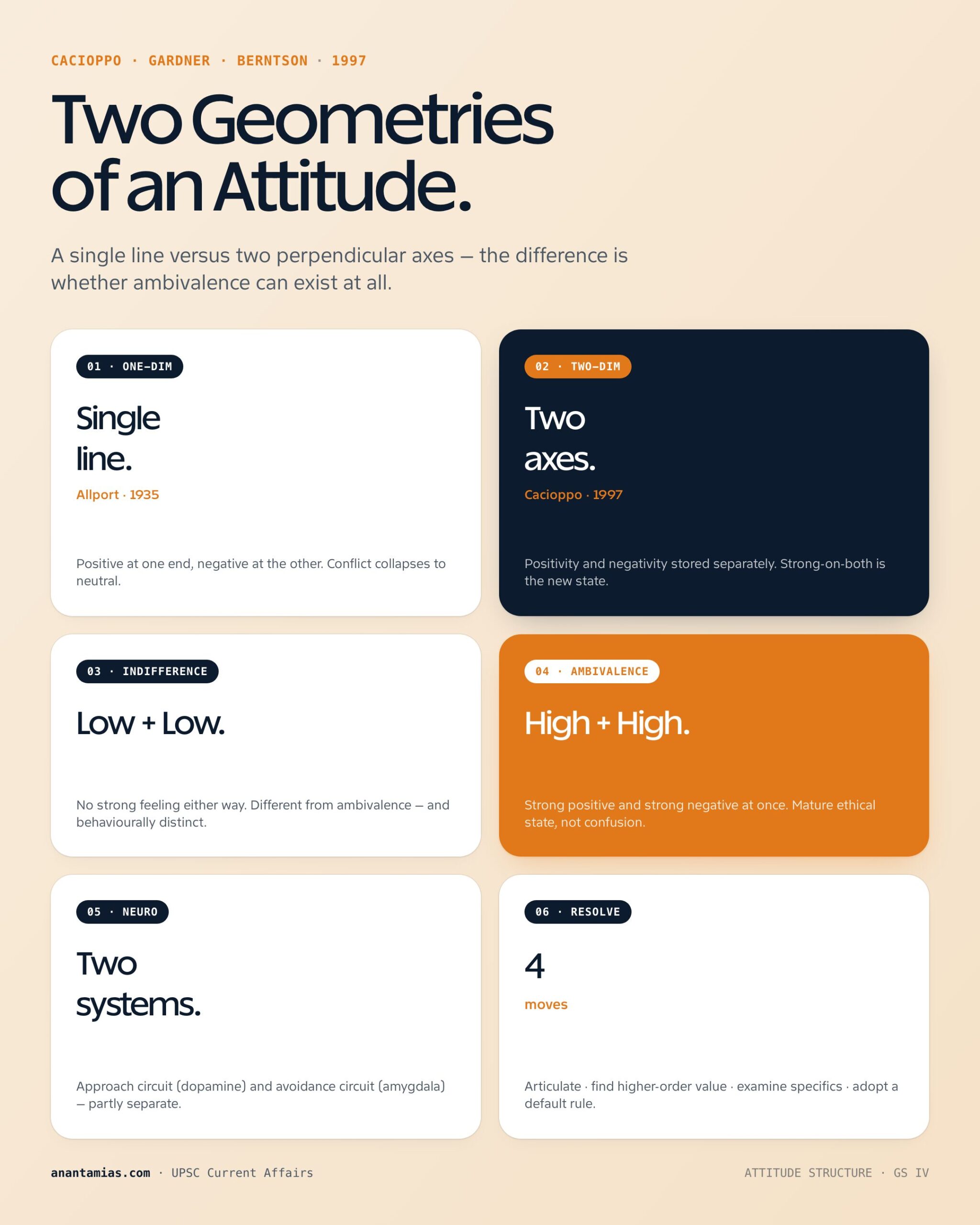
The One-Dimensional View postulates that the positive and negative elements are stored at opposite ends of a single dimension. According to this perspective, the positive and negative elements are at opposite ends, and people tend to experience either end of the dimension or a location in between.
The Two-Dimensional View postulates that positive and negative elements are stored along two separate dimensions. If this view is held, then people can possess any combination of positivity or negativity in their attitudes.
In other words: under the one-dimensional view, you can be positive or negative or somewhere in between; under the two-dimensional view, you can be positive and negative simultaneously, both strongly.
| Dimension | One-Dimensional View | Two-Dimensional View |
|---|---|---|
| Geometry | Single line, positive at one end, negative at the other | Two perpendicular axes; positivity on one, negativity on the other |
| Possible states | Positive, neutral, negative, in-between | Any combination — high P + high N (ambivalence), low P + low N (indifference), high P + low N (positive), low P + high N (negative) |
| Indifference | Zero on the line | Low on both axes |
| Ambivalence | Cannot exist; collapses to neutral | Distinct state — high on both axes |
| Predictive power | Loses information when the agent is conflicted | Captures conflict and predicts behaviour better in such cases |
A Worked Example
A junior officer's attitude toward a populist welfare scheme.
- Positive thoughts: "It reaches the poorest. It legitimises welfare politics. It protects against catastrophic poverty."
- Negative thoughts: "It strains the fisc. It crowds out capital expenditure. It risks dependency."
Under the one-dimensional view, these elements would be averaged into a single net attitude — perhaps mildly positive, mildly negative, or neutral. The averaging destroys information about the underlying conflict.
Under the two-dimensional view, the officer is recognised as having both strong positivity and strong negativity about the same object — a state of ambivalence, not neutrality. The two-dimensional view lets us say: she finds the scheme important to defend in principle but problematic in design. The one-dimensional view collapses this nuance.
"The test of a first-rate intelligence is the ability to hold two opposed ideas in mind at the same time and still retain the ability to function." — F. Scott Fitzgerald
Why the Two-Dimensional View Won
Modern social psychology — Cacioppo, Gardner & Berntson (1997) — has largely accepted the two-dimensional view because it explains phenomena the one-dimensional view cannot.
- Ambivalence is real. People genuinely experience conflicting feelings about the same object. Surveys, neuroscience and behaviour all confirm it.
- Indifference is different from ambivalence. A person who feels nothing about a scheme is in a different state from a person who feels strongly both ways.
- Behaviour patterns differ. Ambivalent agents take more time, seek more information, behave more variably across situations than agents at the same one-dimensional midpoint.
- Neuroscience supports it. The brain processes positive and negative information through partly separate neural systems — the approach system (involving dopaminergic reward circuitry) and the avoidance system (involving the amygdala). Activation of one does not automatically inhibit the other.
The one-dimensional view survives as a useful simplification for cases where positive and negative information are roughly mutually inhibitory. For complex, contested objects, the two-dimensional view is more accurate.
Four States in the Two-Dimensional View
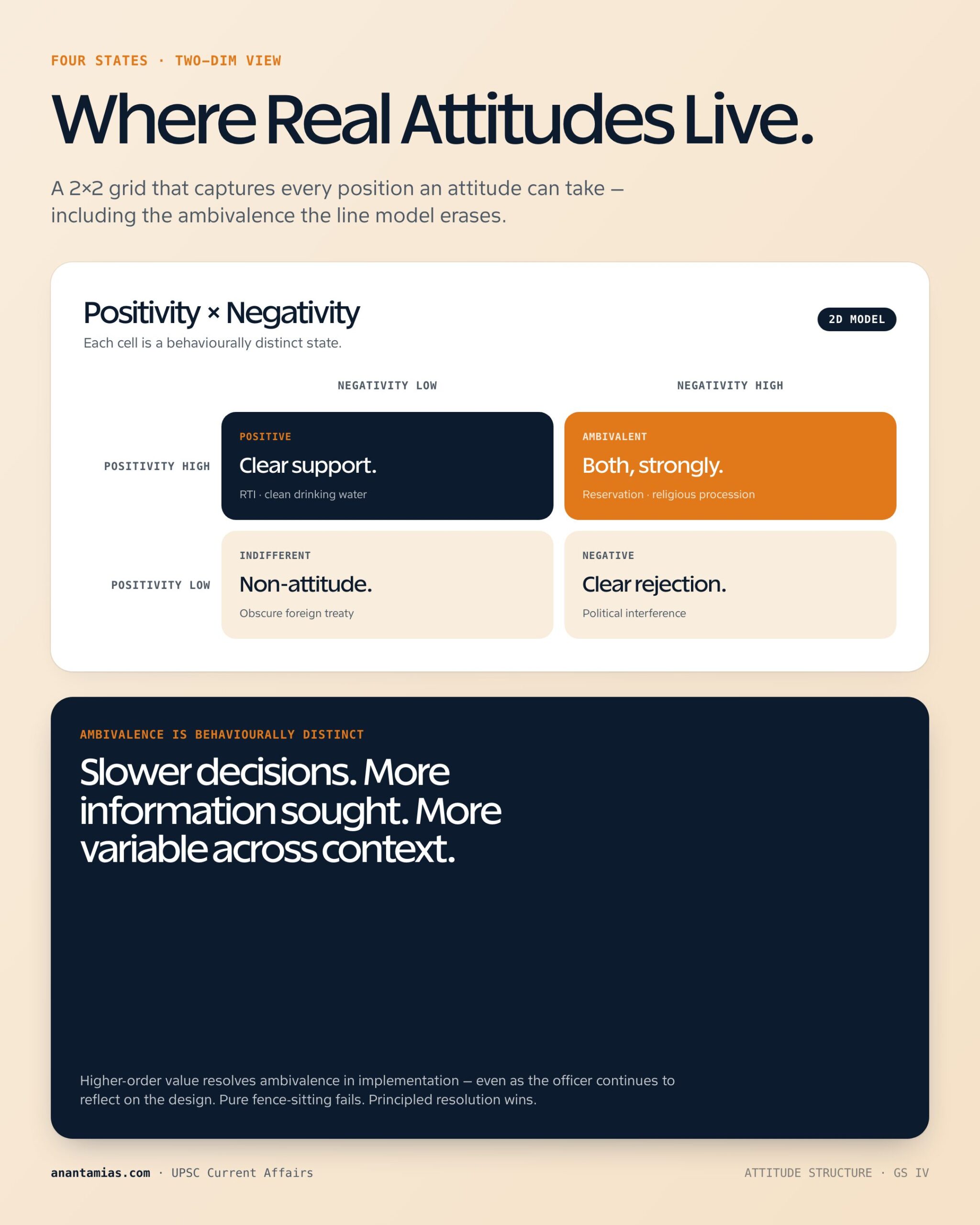
| Positive Component | Negative Component | State | Example |
|---|---|---|---|
| High | Low | Positive attitude | Officer's attitude toward Right to Information |
| Low | High | Negative attitude | Officer's attitude toward unauthorised political interference |
| Low | Low | Indifference / non-attitude | Officer's attitude toward an obscure foreign treaty |
| High | High | Ambivalence | Officer's attitude toward a popular but procedurally problematic scheme |
A clean Mains answer reproduces this four-state matrix to show analytical depth.
Ambivalence — The Special State
Ambivalence is the defining contribution of the two-dimensional view. A few facts about ambivalent attitudes.
Ambivalence Is Common
Most adults hold ambivalent attitudes toward many of their important objects — partner, profession, family, country, religion, government. Pretending otherwise is a form of self-deception.
Ambivalence Is Behaviourally Distinctive
Ambivalent agents:
- Take longer to decide.
- Seek more information before acting.
- Behave more variably across situations.
- Are more persuadable by new evidence.
- Are more vulnerable to mood and context effects.
Ambivalence Is Sometimes Right
The morally serious response to a complex object is often ambivalence rather than confident endorsement or rejection. Tolerance of ambivalence is therefore a sign of mature ethical judgement, not of confusion.
"The mark of an educated mind is to be able to entertain a thought without accepting it." — Aristotle
Ambivalence Has Costs
Ambivalence under time pressure can produce decision paralysis, inconsistency, or capture by whichever side of the ambivalence is salient at the moment of decision. The civil servant has to learn principled resolution of ambivalence — making a decision and standing behind it while acknowledging the merits of the opposing view.
Practical Resolutions of Ambivalence
When the officer is genuinely ambivalent, four moves help.
- Articulate the ambivalence explicitly — write down both sides. Ambivalence half-articulated is more dangerous than ambivalence fully articulated.
- Identify the higher-order value — among the conflicting attitudes, which is anchored in a stronger, more general value? The higher-order value usually decides.
- Look at the case-specific facts — sometimes ambivalence dissolves once the situation is examined closely; the abstract conflict turns out to apply unevenly.
- Adopt a default rule — for repeated ambivalent cases, an officer can adopt a default-rule (in case of doubt, decide in favour of the citizen / decide in favour of the rule / decide in favour of the marginalised). The default rule prevents inconsistency without resolving every case from scratch.
Two Indian Case Studies
Case 1 — The Ambivalent Attitude Toward Reservation
A senior IAS officer's attitude toward caste-based reservation is ambivalent: strong positive for its corrective role in undoing centuries of exclusion, strong negative for the way it is sometimes captured by elites within target groups. The one-dimensional view would force her to be net-positive, net-negative, or neutral — none of which captures her actual position. The two-dimensional view lets her hold both feelings honestly while implementing the law impartially.
The higher-order value — constitutional equality — resolves the ambivalence in implementation: the law is applied as it stands, even as the officer continues to reflect on its design.
Case 2 — The District Magistrate and the Religious Procession
A District Magistrate in a communally sensitive district holds ambivalent attitudes toward large religious processions: positive for their role in cultural-religious freedom (Article 25, Article 19(1)(b)), negative for the security and communal-flashpoint risks. The two-dimensional view lets her recognise both layers honestly. Her decision — permit the procession with route, security, and timing constraints — emerges from principled resolution of ambivalence rather than denial of one side.
The One-Dimensional View Is Not Useless
Three contexts where the one-dimensional view remains useful.
- Survey research at scale, where simple bipolar Likert items are practical instruments.
- Mass-attitude tracking, where average shifts matter more than individual nuance.
- Strong, settled attitudes on uncontested objects — most agents are simply positive about clean drinking water and simply negative about kidnapping; the one-dimensional model captures these adequately.
The two views are therefore not competitors but complements — different lenses for different analytical purposes.
Civil-Service Implications
Recognise Ambivalence in Self
The honest officer notices when she is ambivalent rather than neutral. The two-dimensional view gives her the vocabulary.
Recognise Ambivalence in Citizens and Subordinates
A citizen who supports the scheme in principle but resents its implementation is not the same as a citizen who is uncommitted. Public communication has to address both layers.
Avoid Forced One-Dimensionality
Surveys and feedback forms that force a single positive-to-negative rating lose information. Where the object is genuinely contested, separate positive and negative items produce better data.
Use Ambivalence as a Decision Heuristic
When you find yourself ambivalent, you are usually facing a complex object that deserves more thought, more information, or principled resolution by higher-order value. Ambivalence is therefore an instrument of careful decision-making, not an obstacle to it.
UPSC Syllabus Relevance
GS-IV explicitly names attitude — content, structure, function. The structure of attitude — and the two views — is directly testable.
Past-Year Prompts
- "What do you understand by attitude? Discuss its components and structure." — 2014, 2018 (multiple variants).
- "Distinguish between attitude and aptitude with examples." — 2017 (related distinction).
- "What is the role of cognitive dissonance in maintaining attitude consistency?" — 2020 paraphrased.
- "How does ambivalence in attitudes affect public-decision-making?" — 2022 paraphrased.
Mains Answer-Writing Tips
- Open with the two views as competing geometries — a single line vs two axes.
- Reproduce the four-state matrix (positive / negative / indifference / ambivalence).
- Cite Cacioppo, Gardner & Berntson (1997) for academic anchor.
- Use one Indian case (reservation, procession, welfare-design ambivalence).
- Close with principled resolution of ambivalence as the mature ethical disposition.
Prelims Pointers
- Cacioppo, Gardner & Berntson (1997) — Beyond Bipolar Conceptualizations and Measures: The Case of Attitudes and Evaluative Space.
- John Cacioppo — neuroscientific separation of approach and avoidance systems.
- Gordon Allport (1935) — early bipolar (one-dimensional) attitude conception.
- Daniel Katz (1960) — Functional Theory of Attitudes.
| Component | Description | Civil Services Example |
|---|---|---|
| A — Affective (Feeling) | Emotional response to the attitude object. How one FEELS about it. | A DM feels empathy and sadness towards drought-affected farmers, this drives proactive relief. |
| B — Behavioural (Action) | Predisposition to ACT in a particular way. The intentional component. | The IAS officer conducts relief camps, fast-tracks claims, translating empathy into action. |
| C — Cognitive (Belief) | Beliefs, thoughts, and knowledge about the attitude object. What one THINKS. | The officer believes water scarcity is the root cause this cognition shapes their approach. |
FAQ
Is the two-dimensional view always correct?
For complex, contested objects, yes. For simple, settled objects, the one-dimensional view captures most of the variance. Both views are useful tools; the analyst chooses the right one for the context.
Is ambivalence the same as confusion?
No. Confusion is uncertainty due to lack of information. Ambivalence is clarity that the object has both strong positive and strong negative features. The two states feel similar from inside but require different responses — confusion calls for more information; ambivalence calls for value-based resolution.
Is ambivalence a sign of weak attitudes?
Not necessarily. Ambivalence can coexist with strong positive and strong negative components. The strength is on each axis, not in their net difference.
Should I list ambivalence as my position in a UPSC interview?
For complex policy questions — like reservation design, capital punishment, surrogacy regulation — articulating ambivalence honestly often signals maturity, provided you also describe how you would resolve the ambivalence in practice. Pure fence-sitting without resolution is usually penalised.
Does the two-dimensional view apply to values too?
Less commonly. Values by definition are general preferences; their structure is usually closer to the one-dimensional. Some scholars (Schwartz) propose a circular structure for values — adjacent values are compatible, opposite values are incompatible — which is yet another geometry distinct from both attitudinal models.
The two views of attitude are not abstract psychology trivia. They are the difference between forcing every contested object onto a single positive-negative line and honouring the genuine complexity of the human attitudinal experience. The reflective civil servant uses the two-dimensional view to map her own ambivalences, resolve them with reference to higher-order values, and make decisions that are both honest and consistent.
The two views of attitude are not abstract psychology trivia. They are the difference between forcing every contested object onto a single positive-negative line and honouring the genuine complexity of the human attitudinal experience. The reflective civil servant uses the two-dimensional view to map her own ambivalences, resolve them with reference to higher-order values, and make decisions that are both honest and consistent.
Tell Google you want more of this.
Add Anantam IAS as a preferred sourceOne tap, and this site shows up more often in your own Top Stories, AI Overviews and AI Mode. Remove it any time.