In the open arid stretches of western Rajasthan, where rainfall hovers around 200 millimetres a year and the wind moves dust across the Thar in sheets, small islands of dense vegetation persist. They sit around shrines and stepwells, around cremation grounds and old village wells, sometimes around nothing visible at all except a stone smeared with vermilion. These are the Orans, community-protected sacred groves that have survived centuries of climatic stress, colonial forest expansion, and modern infrastructure pressure because the local community treats them as the abode of a deity. Cutting a tree, killing an animal, or even removing a fallen branch is taboo in most Orans, and the taboo is enforced not by a forest beat guard but by the gram sabha, a temple committee, or the village elder.
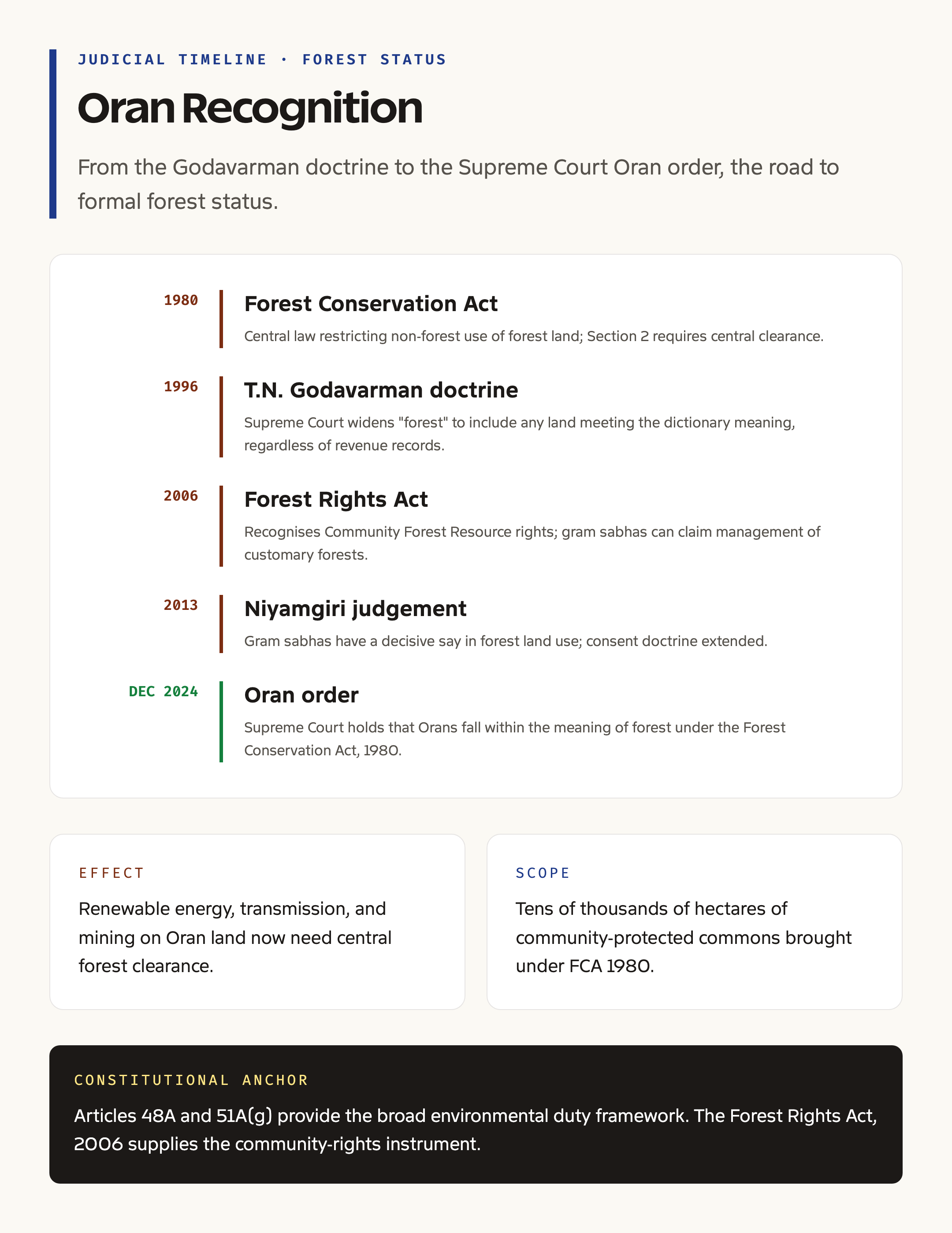
In December 2024, the Supreme Court of India formally recognised Orans as “forests” within the meaning of the Forest Conservation Act, 1980. The order pulled tens of thousands of hectares of community-protected commons under the protective umbrella of the central forest law. It also forced state revenue records, infrastructure planning, and renewable energy clearance processes to reckon with a category of land that for decades had been treated as wasteland. The judgement is one of the most significant recent applications of the T.N. Godavarman doctrine, which holds that any land that meets the dictionary meaning of “forest” qualifies for legal protection, regardless of what the revenue records call it.
For UPSC, Oran preservation sits at the intersection of GS-III environment and ecology, GS-II governance, and GS-I geography. This guide unpacks what Orans are, how they came to be protected, why the recent court order matters, and how the topic fits into prelims and mains preparation.
Quick Facts
- Local name: Oran (Rajasthan); same idea exists across India under different regional names
- Definition: Patches of forest or grassland traditionally protected by a local community as the abode of a deity
- Custodianship: Local clans, gram sabhas, temple committees, sometimes priestly families
- Distribution in India: All major regions, with concentrations in Western Ghats, Aravallis, Thar fringe, Eastern Ghats, Northeast
- Estimated count: Roughly 100,000 to 150,000 sacred groves across India by various community ecology surveys
- Largest Oran network: Jaisalmer and Barmer districts of Rajasthan
- Legal status: Recognised as “forest” under Forest Conservation Act, 1980 by Supreme Court order, December 2024
- Constitutional anchor: Articles 48A and 51A(g), and the Forest Rights Act, 2006
- Key threats: Renewable energy installations, transmission lines, mining leases, urban expansion, neglect of customary management
- UPSC relevance: Sacred grove typology, T.N. Godavarman doctrine, community conservation, biodiversity hotspots, ICCAs
What Is an Oran
An Oran is a patch of land, usually wooded but sometimes a grassland, that has been set aside by a local community as sacred. The land is dedicated to a specific deity, often a folk goddess, a Bhomia (warrior hero), a snake god, or a saint, and the community treats the trees, animals, and water bodies inside as inviolate. The biological consequence is a refuge: in landscapes that have been heavily grazed, cropped, or cleared, the Oran often holds the only surviving stand of native vegetation.
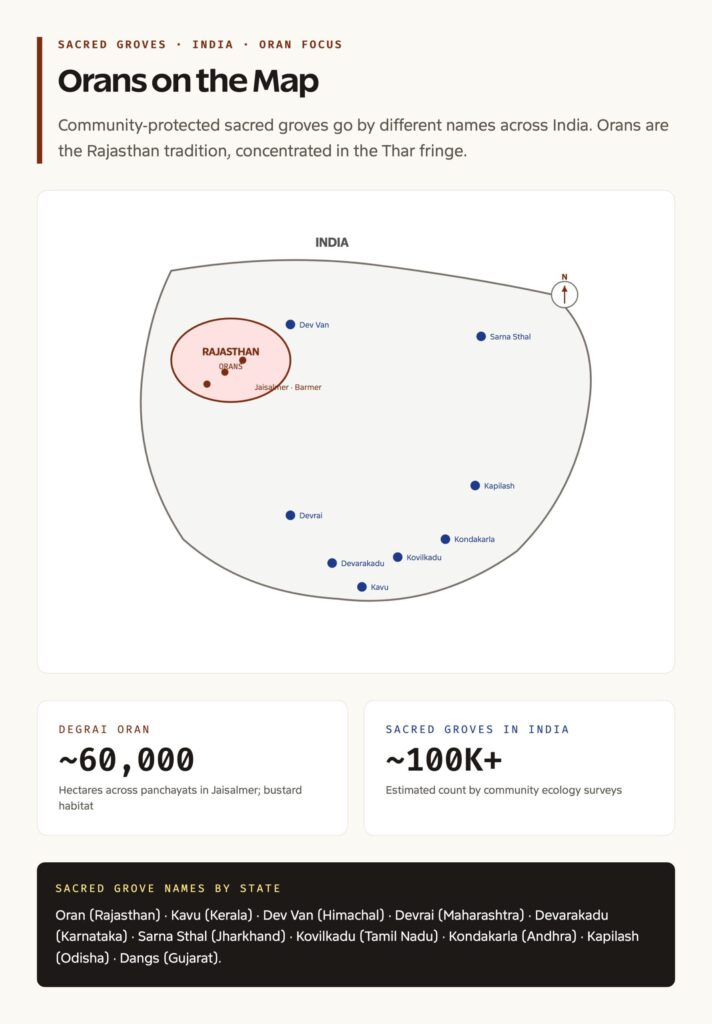
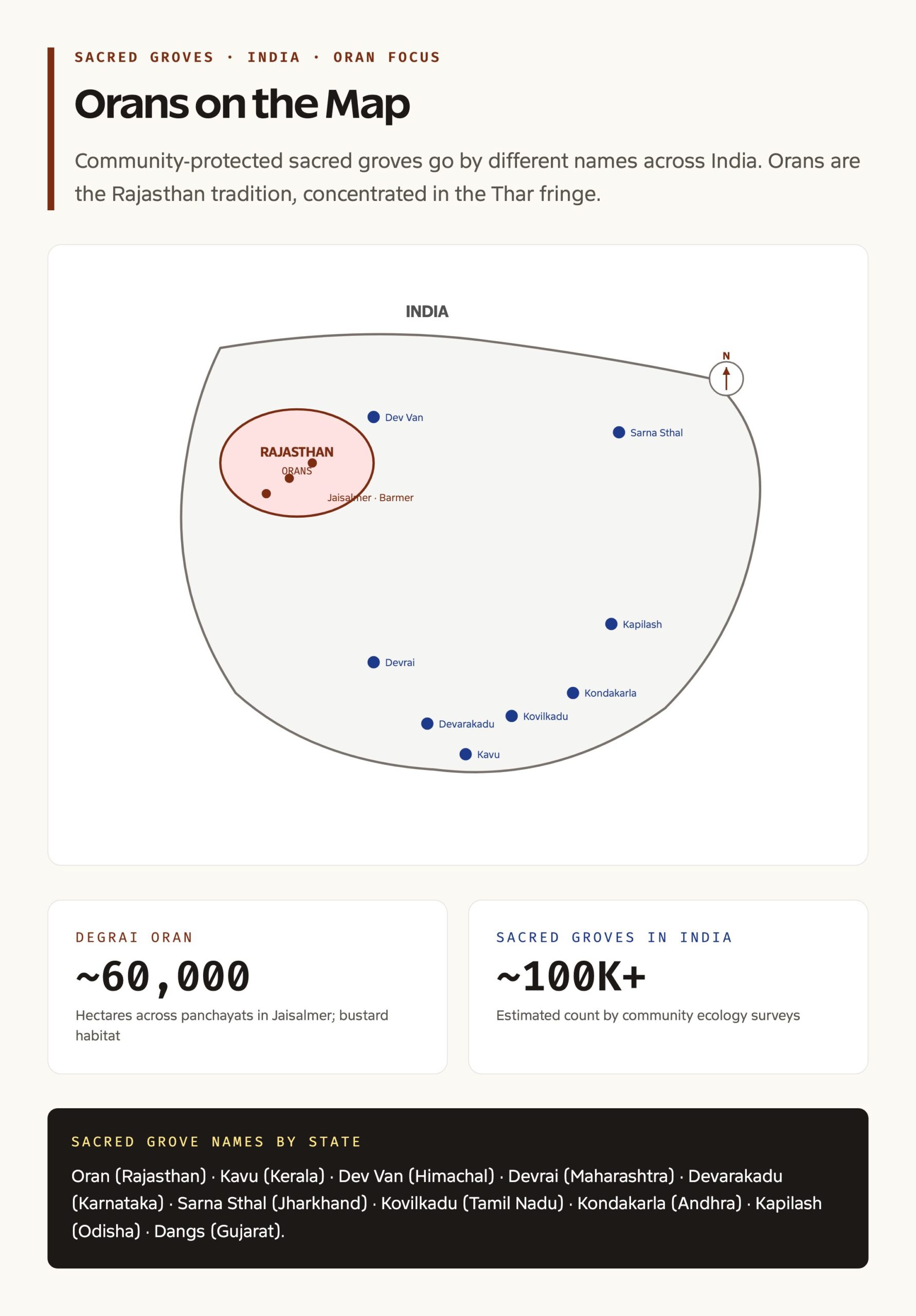
Orans are not a single uniform category. Some are small clusters of half a hectare around a roadside shrine. Others stretch over thousands of hectares across multiple villages, with named subzones, customary grazing rules, and a distinct seasonal calendar. The Degrai Oran near Jaisalmer, for example, is reported to extend over 60,000 hectares across several panchayats and supports the critically endangered Great Indian Bustard along with chinkara, blackbuck, and a long list of dryland bird species.
Custodianship is plural and informal. A typical Oran is managed by some combination of a hereditary priest, a temple committee, a village elder council, and the gram sabha. Disputes are settled at the village level. Customary rules forbid green wood extraction but often permit collection of dead wood, grazing of livestock under controlled rules, and harvesting of medicinal plants for personal use. The system is closer to a commons than to a state-managed protected area.
Background and Historical Context
The sacred grove tradition in India long predates written ecology. Vedic and post-Vedic texts mention groves attached to deities, ascetics’ hermitages, and ancestral burial places. Folk and Shakta traditions across the subcontinent layered local goddess worship onto these spaces. By the medieval period, sacred groves were a stable feature of village landscapes from Kerala to Manipur.
Sacred Groves Across India
Sacred groves go by many names depending on the region. In Rajasthan they are Orans. In Kerala they are Kavu. In Himachal Pradesh they are Dev Van. In Gujarat they are Dangs and sometimes Saka. In Maharashtra they are Devrai or Devrahati. In Karnataka they are Devarakadus. In Tamil Nadu they are Kovilkadu. In Andhra Pradesh they include the Kondakarla and similar groves. In Odisha they are Kapilash and other named groves. In Jharkhand they are Sarna Sthal, central to Adivasi religious life and a major political identity marker. The Sarna identity question has, in recent years, fed into debates over a separate religious code in the census.
The naming variation is not merely linguistic. Each tradition carries its own management norms, its own deities, and its own ecology. Kavus in Kerala typically host serpent deities and are dense with rare lianas. Devarakadus in Coorg are tied to ancestor worship and often sit on shola fragments. Sarna Sthals in central India are typically a single sacred sal tree or a small grove. Despite this diversity, the underlying principle is the same: the community sets aside a patch of land, the deity enforces the rule, and the biology benefits.
Why Orans Matter
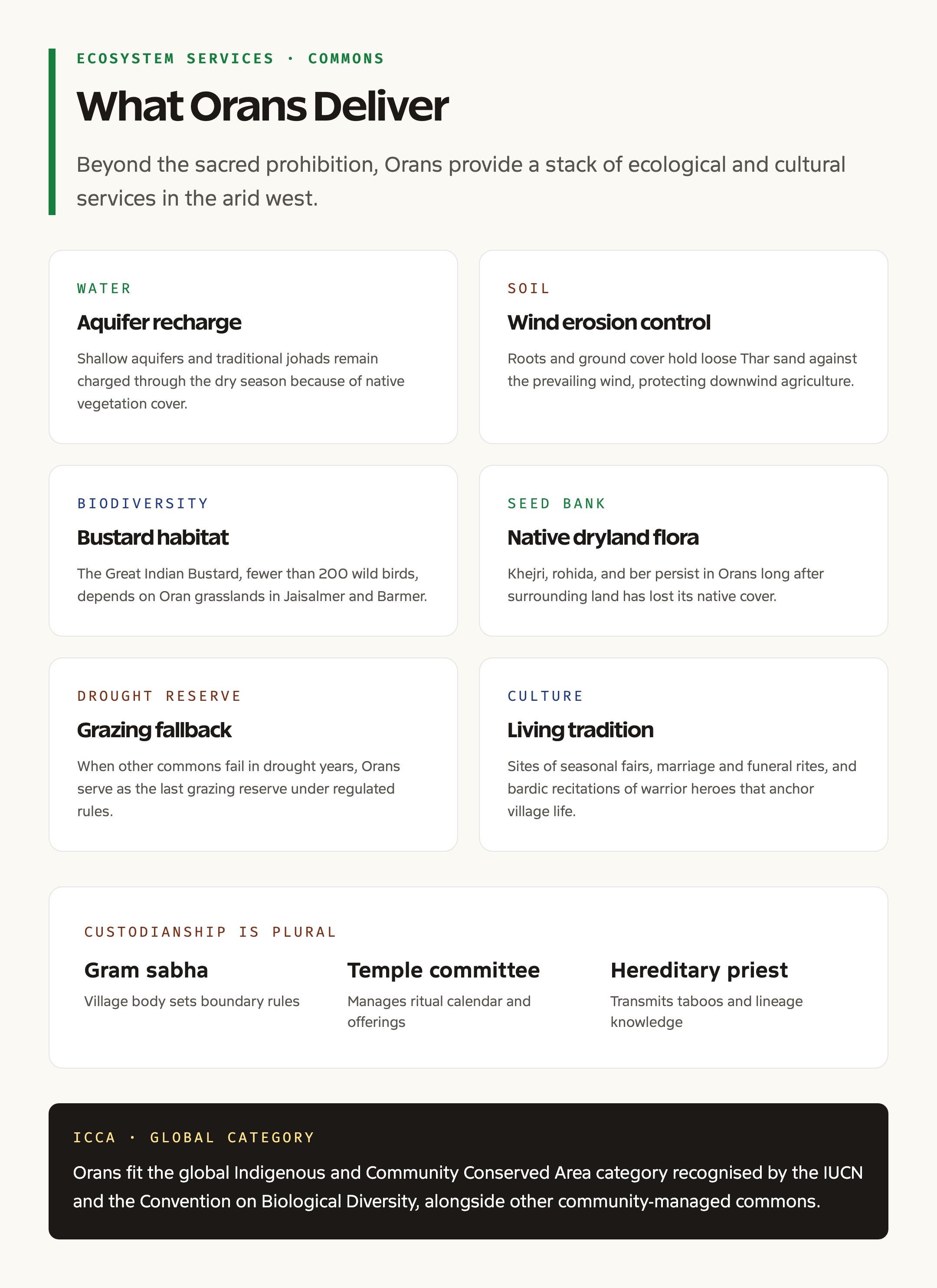
Orans deliver a stack of ecosystem services that would be expensive or impossible to replicate. They store water in shallow aquifers and traditional johads. They hold soil against wind erosion in the Thar. They serve as seed banks for native dryland species like khejri (Prosopis cineraria), rohida (Tecomella undulata), and ber (Ziziphus mauritiana). They support pollinator populations that spill over to surrounding agriculture. They provide grazing reserve in droughts when other commons are exhausted.
The biodiversity value is high and disproportionate. Orans in Jaisalmer and Barmer host the Great Indian Bustard, a critically endangered species with fewer than 200 wild individuals, along with the houbara bustard, the chinkara, and a long list of raptors. Orans in the Aravallis support leopards, hyenas, jackals, and migratory bird assemblages. Orans across India act as stepping stones for wildlife in fragmented landscapes where formal protected areas are far apart.
Carbon sequestration, while not a primary justification, is non-trivial. A mature Oran in semi-arid Rajasthan can sequester several tonnes of carbon per hectare per year in vegetation and soil, a useful contribution to India’s nationally determined contributions under the Paris framework.
The cultural value is integral and not separable. Orans are sites of seasonal fairs, of marriage and funeral rites, of bardic recitations of warrior heroes. Removing the cultural value to “save the biology” tends to fail because the cultural rule is what keeps the biology safe. This insight underpins the global category of Indigenous and Community Conserved Areas (ICCAs), within which Orans sit comfortably.
Detailed Analysis of the 2024 Supreme Court Order
The Supreme Court order of December 2024 emerged from a long-running set of petitions on the protection of the Great Indian Bustard, on overhead transmission line routing through bustard habitat, and on the broader question of whether community-protected commons in Rajasthan deserved formal forest status. The court ruled that Orans, regardless of their classification in revenue records, fall within the dictionary meaning of “forest” laid down in T.N. Godavarman Thirumulpad versus Union of India (1996). Therefore, any non-forest use of Oran land, including renewable energy projects, transmission lines, or mining, requires central forest clearance under Section 2 of the Forest Conservation Act, 1980.
The order builds on a clear judicial line. In Godavarman, the court widened the definition of forest beyond the narrow legal classification. In Lafarge Umiam Mining (2011), it ordered the constitution of a Forest Advisory Committee to scrutinise all forest land diversions. In Niyamgiri (2013), it held that gram sabhas have a decisive say in forest land use. The Oran order knits these threads together for community-protected land.
For Rajasthan, the practical effect is large. Districts like Jaisalmer, Barmer, Bikaner, and Jodhpur have seen rapid deployment of solar parks and high-voltage transmission corridors. Several of these have crossed Oran land. The order does not block renewable energy as such. It requires that forest clearance procedures, including environment impact assessment where applicable, gram sabha consultation under FRA, and bird-friendly design, be applied.
Comparative Frame
| Sacred Grove Tradition | Region | Custodianship | Typical Ecosystem |
|---|---|---|---|
| Oran | Rajasthan, Gujarat fringe | Gram sabha, temple committee, hereditary priest | Dryland thorn forest, grassland |
| Kavu | Kerala | Tarawad family, temple trust | Tropical wet evergreen fragments |
| Dev Van | Himachal Pradesh, Uttarakhand | Village deity council | Temperate oak and deodar |
| Devrai | Maharashtra | Village panchayat | Western Ghats moist deciduous |
| Devarakadu | Karnataka (Coorg) | Family ancestral trust | Shola and evergreen fragments |
| Sarna Sthal | Jharkhand, Odisha | Adivasi traditional council | Sal forest, single sacred tree |
| Kovilkadu | Tamil Nadu | Temple trust | Tropical dry evergreen |
| Kondakarla | Andhra Pradesh | Village deity council | Mixed deciduous, wetland fringe |
Despite the regional spread, the institutional logic is similar: a sacred prohibition backed by a community body, with the deity as the symbolic enforcer.
Challenges to Oran Preservation
Several pressures push against the system. First, demographic and economic transition. As young people leave villages for urban work, the priestly and elder structures that enforce Oran rules thin out. Customary penalties for tree cutting lose their bite when offenders are seasonal migrants outside the social web of the village.
Second, infrastructure. Solar parks, wind turbines, and transmission lines have moved into the Thar at scale because the resource is excellent and population density is low. Orans, treated as wasteland on revenue maps, became attractive sites until the 2024 order changed the calculus.
Third, mining. Limestone, gypsum, sandstone, and minor mineral leases have been issued historically over Oran land in some districts. Reversing these leases is legally and politically slow.
Fourth, land record ambiguity. Many Orans are recorded as charagah (grazing land), gair mumkin (uncultivated), or simply blank in revenue records. Without clear legal title, custodian communities have struggled to defend boundaries against encroachment, even before the 2024 order.
Fifth, shifting religious practice. As folk deities lose social weight to standardised pan-Indian deities, the specific cult that protected an Oran may erode, weakening the sacred prohibition that did the conservation work.
Prelims Pointers
- Orans are sacred groves of Rajasthan, considered abodes of local deities
- Managed by gram sabhas, temple committees, and local clans
- Supreme Court (December 2024) recognised Orans as forests under Forest Conservation Act, 1980
- The order applies the T.N. Godavarman doctrine to community-protected commons
- Sacred groves are called Kavu (Kerala), Dev Van (Himachal Pradesh), Devrai (Maharashtra), Devarakadu (Karnataka), Sarna Sthal (Jharkhand)
- Orans in Jaisalmer are critical for the Great Indian Bustard
- Sacred groves are recognised globally as Indigenous and Community Conserved Areas (ICCAs)
- Articles 48A and 51A(g) of the Constitution provide the broad environmental duty framework
- Forest Rights Act, 2006 recognises community forest resource rights that can apply to Orans
Mains Practice Questions
- Sacred groves are an Indian contribution to the global conservation conversation. Discuss the ecological and cultural significance of Orans in Rajasthan and evaluate the Supreme Court order recognising them as forests.
- Renewable energy expansion in Rajasthan has run into conflict with community-conserved commons. How can India reconcile its climate commitments with the protection of Orans and the Great Indian Bustard?
- Examine the role of community-conserved areas, including Orans, in achieving India’s commitments under the Convention on Biological Diversity and the Kunming-Montreal Global Biodiversity Framework.
Way Forward
A workable path has several components. The state can begin with a comprehensive cadastral survey of all Orans, with boundaries digitised and notified, building on the work already done by NGOs like Krishi Avam Paristhitiki Vikas Sansthan in Rajasthan. The Forest Department can extend statutory recognition under Section 36C of the Wildlife Protection Act (community reserve) where the gram sabha agrees, while preserving customary management. The renewable energy planning process can publish exclusion maps that route solar parks and transmission corridors away from Oran land and bustard habitat. The gram sabha and the Forest Rights Committee can be supported with capacity to file Community Forest Resource claims under the Forest Rights Act. Schools and panchayat-level training programmes can refresh the cultural transmission of Oran rules to younger generations.
The 2024 Supreme Court order is a beginning, not an end. The hard work is administrative: getting the boundaries right, getting the records right, and getting the renewable energy sector to redesign around the new constraint. If India can do this, Orans will move from a quiet, underrated layer of conservation to a visible pillar of biodiversity policy.
Frequently Asked Questions
What is an Oran?
An Oran is a patch of forest or grassland in Rajasthan that a local community has set aside as sacred and protects as the abode of a deity, with rules enforced through customary practice rather than formal forest law.
Are Orans the same as sacred groves?
Yes. Oran is the Rajasthani name for what the rest of India calls sacred groves, with regional names like Kavu in Kerala, Devrai in Maharashtra, Devarakadu in Karnataka, and Sarna Sthal in Jharkhand.
What did the Supreme Court rule about Orans in 2024?
The court held that Orans fall within the meaning of u0022forestu0022 under the Forest Conservation Act, 1980, applying the T.N. Godavarman doctrine. Any non-forest use of Oran land therefore needs central forest clearance.
Why are Orans important for the Great Indian Bustard?
The Orans of Jaisalmer and Barmer hold some of the last viable habitat for the critically endangered Great Indian Bustard. Their grassland and thorn forest mosaic supports nesting and foraging that the wider, more developed landscape no longer offers.
Who manages an Oran?
Custodianship varies. Most Orans are managed jointly by the gram sabha, a temple committee, the local hereditary priest, and village elders, with disputes resolved at the village level rather than by the forest department.
Can renewable energy projects come up on Oran land?
After the 2024 Supreme Court order, any non-forest use, including solar parks, wind farms, and transmission lines, needs forest clearance under the Forest Conservation Act, with environmental and gram sabha consultation requirements.
How are Orans recorded in revenue documents?
Many Orans have been historically recorded as charagah, gair mumkin, or wasteland, which made them vulnerable to reclassification. The 2024 order forces a re-examination of these entries through the lens of forest status.
Are sacred groves recognised under the Forest Rights Act?
The Forest Rights Act, 2006 includes provisions for recognising community forest resource rights, which can apply to Orans where the gram sabha files a claim. Recognition under FRA strengthens customary management without displacing it.
What ecosystem services do Orans provide?
Orans store water in shallow aquifers, hold soil against wind erosion, host pollinators, serve as seed banks for native dryland species, and provide drought-time grazing reserve. They are stepping stones for wildlife in fragmented landscapes.
What is the global category that Orans fit into?
Orans fit the global category of Indigenous and Community Conserved Areas (ICCAs), recognised by the IUCN and the Convention on Biological Diversity as a distinct governance type for protected areas.
Tell Google you want more of this.
Add Anantam IAS as a preferred sourceOne tap, and this site shows up more often in your own Top Stories, AI Overviews and AI Mode. Remove it any time.