Attitudes are not implanted at birth. They are acquired — through specific, identifiable psychological mechanisms that operate from the earliest months of infancy through adulthood. UPSC GS-IV asks the candidate to know how attitudes form because every public-information campaign, every classroom value-education programme, every civil-service training intervention, and every parent's effort to raise a moral child relies on the same underlying procedures.
This guide expands the compass extract on Procedures of Attitude Formation into a Mains-quality reference, drawing on Pavlov, Skinner, Bandura, and the Indian application context.
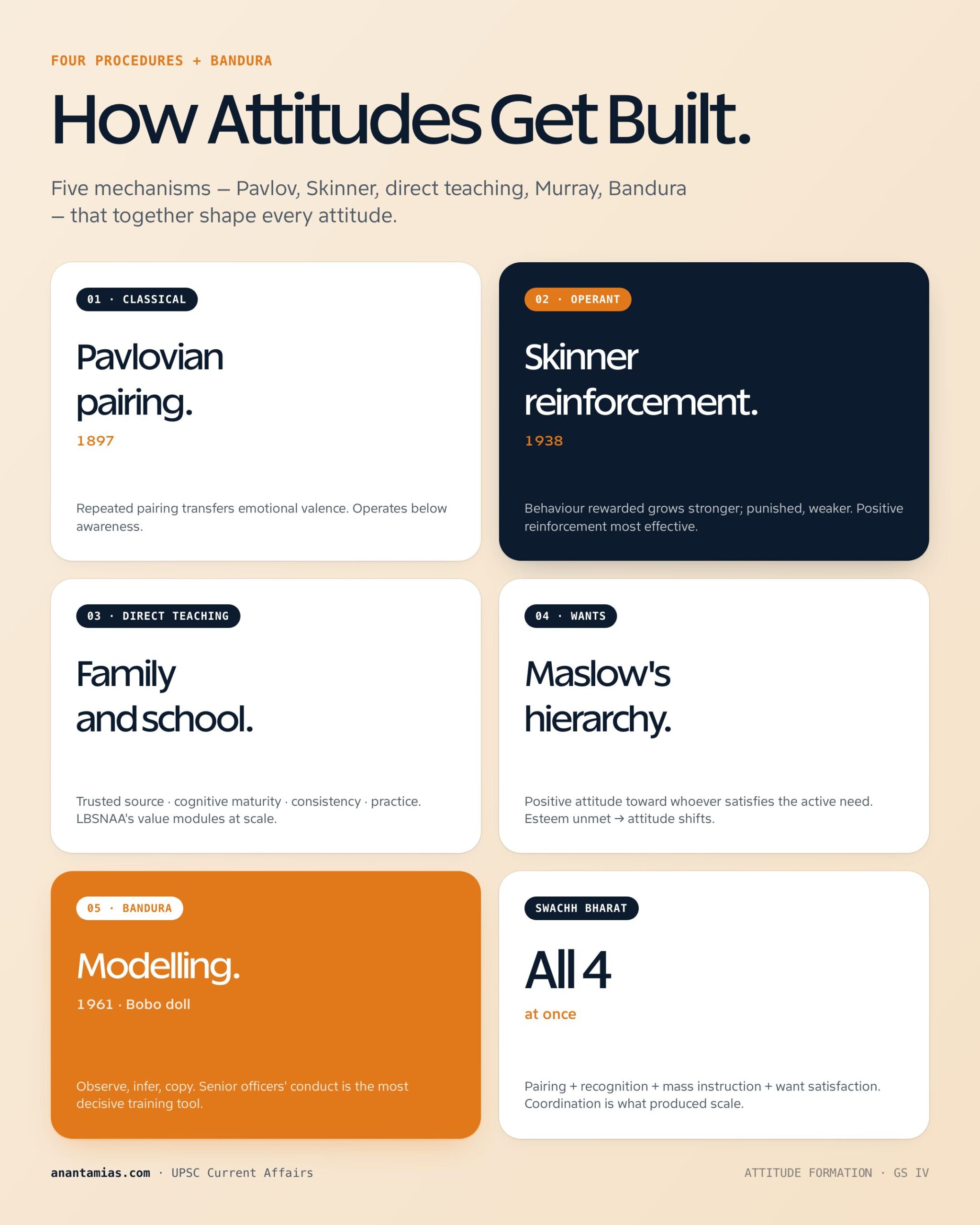
Four Procedures — The Compass Frame
The compass extract identifies four procedures.
| # | Procedure | Theoretical Anchor | Example |
|---|---|---|---|
| 1 | Classical / Pavlovian / Respondent conditioning | Ivan Pavlov (1897) | Learning to be a "boy" or "girl" |
| 2 | Operant / Instrumental conditioning | B.F. Skinner (1938) | Reinforcement and punishment |
| 3 | Direct instruction | Explicit teaching tradition | Rule of waking up at 5 a.m. |
| 4 | Satisfaction of wants | Henry Murray, motivational psychology | Favourable attitude toward what satisfies need |
Below, each procedure is unpacked with theoretical depth and civil-service application.
Procedure 1 — Classical (Pavlovian / Respondent) Conditioning
The Mechanism
Ivan Pavlov's famous experiments with dogs in the 1890s established the basic learning unit: a neutral stimulus repeatedly paired with a stimulus that already produces a response will eventually produce that response on its own.
In attitude formation, the principle is: objects, persons, or ideas repeatedly paired with positive (or negative) emotional experience acquire the same emotional valence.
A child who repeatedly sees her mother greet a particular relative with warmth develops a positive attitude toward that relative even before any direct interaction. A child who repeatedly hears her family disparage a particular community develops a negative attitude toward that community even before any encounter with its members.
The compass example — learning to be a boy or girl — captures this. Gender attitudes are formed through thousands of paired associations — colours, toys, clothes, expectations, praise, prohibition — long before the child can articulate what gender means.
The Civil-Service Implication
Attitudes formed through classical conditioning are emotionally anchored and often operate below conscious awareness. They cannot be undone by reasoned argument alone. The interventions that work are themselves affective and repeated:
- Sustained exposure to positive instances of the negatively conditioned object.
- Pairing of new positive emotional experiences with the object.
- Modelling by trusted figures whose existing positive valence transfers to the object.
This is why public-information campaigns increasingly use respected community figures as ambassadors — the figure's positive valence transfers to the message.
Example — Public-Health Communication
The polio-eradication campaign in north India initially failed because polio drops were classically conditioned to suspicion of the state. Anti-polio messages, however logically argued, ran into the affective wall. The breakthrough came when religious leaders — figures with positive emotional valence in target communities — became the messengers. The same drops, now paired with trusted figures, acquired new positive associations.
Procedure 2 — Operant (Instrumental) Conditioning
The Mechanism
B.F. Skinner's operant conditioning establishes the second great learning unit: behaviour followed by reward becomes more frequent; behaviour followed by punishment becomes less frequent. The same principle, applied to attitudes, is: attitudes that produce rewards strengthen; attitudes that produce punishments weaken.
A child who is praised for sharing develops a positive attitude toward generosity. A young officer who is rewarded for honesty develops a stronger pro-honesty attitude. A citizen who finds that polite engagement produces faster service develops a positive attitude toward government offices.
The compass note — teaching someone through reinforcement or punishment — captures the operant frame.
Four Variants
The operant literature distinguishes:
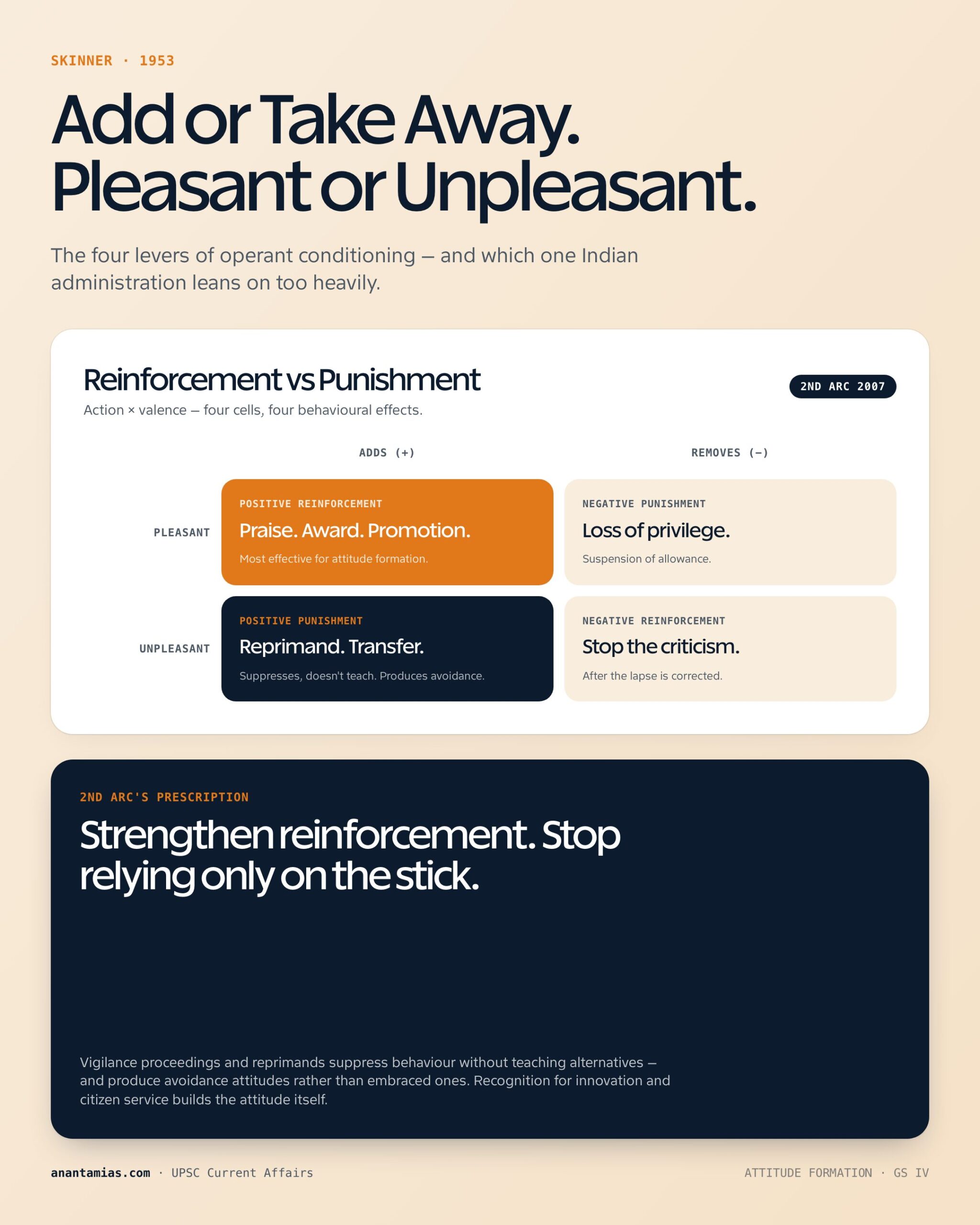
- Positive reinforcement — adding a reward (praise, recognition, promotion).
- Negative reinforcement — removing an unpleasant condition (no further criticism after correction).
- Positive punishment — adding an unpleasant consequence (reprimand, transfer).
- Negative punishment — removing a pleasant condition (loss of privilege).
For attitude formation in administration, positive reinforcement is generally most effective, followed by negative reinforcement. Punishment is widely overestimated — it suppresses behaviour without teaching the alternative, and produces avoidance attitudes rather than embracing attitudes.
"Behaviour that is rewarded is repeated." — B.F. Skinner, Science and Human Behavior (1953)
The Civil-Service Implication
Performance management systems, codes of conduct, vigilance proceedings, and recognition schemes all leverage operant conditioning at scale.
- Annual Performance Appraisal Reports (APAR) — reinforce or punish over a career.
- Code of conduct violations — operant punishment for unethical attitude expressions.
- Awards and recognition — operant reinforcement for desired attitudes (innovation, citizen service, integrity).
The 2nd ARC's 4th Report on Ethics in Governance (2007) explicitly recommended strengthening positive reinforcement structures for ethical conduct alongside the existing punishment infrastructure.
Procedure 3 — Direct Instruction
The Mechanism
The third procedure is explicit teaching. The agent is told what attitude to hold, with reasons. The compass example — the rule of awakening at 5 a.m. — captures this: a parent or guru transmits the desired attitude (toward early rising) directly, with rationale.
Direct instruction works best when:
- The instructor is a trusted source.
- The recipient is cognitively mature enough to evaluate reasons.
- The instruction is consistent with other channels (modelling, conditioning).
- The instruction is practised, not merely heard.
Forms of Direct Instruction
- Family teaching — "In our family, we never lie."
- Religious instruction — "The Gita teaches that…"
- School curriculum — civics, moral science, value education modules.
- Civil-service training — LBSNAA induction, ethics modules at SVPNPA, mid-career courses.
- Public-information campaigns — "Do not litter; do not drink and drive; pay your taxes."
The challenge with direct instruction is that stated attitudes may not transfer to behaviour without operant reinforcement and classical-conditioning support. A child told honesty is the best policy who watches her parent lie about her age to a ticket clerk receives mixed signals. The instruction is overridden by the modelling.
The Civil-Service Implication
The bulk of formal value education in civil-service training is direct instruction. Its effectiveness depends on integration with other procedures:
- Modelling by senior officers (classical conditioning of values to admired figures).
- Reinforcement through evaluation systems (operant conditioning of ethical conduct).
- Lived practice — reflection, journaling, peer dialogue — that internalises instruction.
Direct instruction without these supports produces stated attitudes that disappear under situational pressure.
Procedure 4 — Satisfaction of Wants
The Mechanism
The compass states it precisely: an individual develops favourable attitudes towards those people and objects which satisfy his wants and unfavourable attitudes towards those that do not satisfy them.
This is closely related to operant conditioning but emphasises the internal need rather than the external reward. An attitude is functional — in Katz's sense — because it points the agent toward what satisfies her needs.
A young officer who needs mentorship develops a positive attitude toward the senior who provides it. A citizen who needs the certificate develops a positive attitude toward the office that provides it. A community whose need for security is met by the local police develops a positive attitude toward the police; a community whose security needs are unmet develops the opposite attitude.
Maslow's Hierarchy as a Frame
Different needs operate at different levels of Maslow's hierarchy — physiological, safety, belonging, esteem, self-actualisation. Attitudes form around the objects that satisfy needs at the currently active level.
| Need Level | Objects That Satisfy | Attitude Direction |
|---|---|---|
| Physiological | Food, water, shelter | Positive toward providers |
| Safety | Police, courts, neighbours | Positive toward reliable safety-providers |
| Belonging | Family, community, cadre | Positive toward affirming groups |
| Esteem | Recognition, honour, awards | Positive toward sources of recognition |
| Self-actualisation | Meaningful work, growth | Positive toward growth-enabling environments |
A civil servant whose esteem needs are unmet may develop attitudes oriented toward seeking recognition through means that compromise her ethical anchoring. The corrective is healthier sources of esteem (peer respect, citizen feedback, professional excellence) rather than denial of the need.
Bandura — The Fifth Procedure (Bonus)
Beyond the compass list, Albert Bandura's social learning theory adds a fifth and powerful procedure: observational learning / modelling. Attitudes form through watching others — without direct conditioning, instruction, or want-satisfaction. A child who observes her father respect his mother forms a positive attitude toward elderly women. A junior officer who observes her senior treat citizens with dignity forms a positive attitude toward citizen-respectful conduct.
"Most of the behaviour we exhibit is learned through modelling — observing others." — Albert Bandura, Social Learning Theory (1977)
For civil-service training, modelling is decisive. The conduct of senior officers is the most powerful attitude-formation channel for juniors — far more than any formal module. This is why the leadership factor in the 2nd ARC's framework matters disproportionately.
Two Indian Case Studies
Case 1 — Swachh Bharat as a Multi-Procedure Intervention
Swachh Bharat Abhiyan combined all four procedures.
- Classical conditioning — pairing of clean public spaces with national pride and respected leaders' visible participation.
- Operant conditioning — recognition for ODF villages, awards for swachhagrahis, public ranking of cities.
- Direct instruction — mass media campaigns explicitly teaching the value of sanitation.
- Satisfaction of wants — building toilets that satisfied the genuine need for dignified, safe sanitation.
The campaign's measurable success — lakhs of toilets built, behaviour shifts in target districts — illustrates what coordinated multi-procedure attitude formation can achieve at scale.
Case 2 — The Cadre Officer and the Procedural Inheritance
A 2018-batch IAS officer joins her cadre. Within the first year, she acquires a complex set of attitudes — toward particular departments, particular districts, particular citizens — that she did not hold at recruitment. Investigation shows: classical conditioning through cadre-stories about districts, operant conditioning through senior approval and disapproval, direct instruction in cadre-mentorship sessions, and want satisfaction in her need for cadre belonging. The case shows how all four procedures operate simultaneously to shape the new entrant's attitudinal landscape — making the auditability of inherited attitudes one of the key disciplines of the early career.
UPSC Syllabus Relevance
GS-IV explicitly names attitude — content, structure, function; its influence and relation with thought and behaviour. How attitudes form is at the head of this syllabus block.
Past-Year Prompts
- "What is meant by 'crisis of conscience'? Narrate one incident in your life when you were faced with such a crisis." — 2017 (involves attitude formation reflection).
- "Discuss how attitudes are formed in a public servant." — 2018, 2020 (multiple variants).
- "What are the various procedures of attitude formation? Discuss with examples." — 2022 paraphrased.
Mains Answer-Writing Tips
- Open with the four-procedure compass list as the structuring frame.
- Cite Pavlov, Skinner, Bandura for theoretical anchor.
- Use Swachh Bharat as the multi-procedure case.
- Include modelling as a fifth procedure to demonstrate broader reading.
- Close with the civil-service implication — formation procedures are also reform levers.
Prelims Pointers
- Ivan Pavlov (1897) — classical / respondent conditioning.
- John Watson — Little Albert experiment (1920) — first demonstration of conditioned attitude in humans.
- B.F. Skinner (1938) — operant conditioning; Skinner box.
- Albert Bandura (1961) — Bobo doll experiment; observational learning.
- Henry Murray — needs and motivational psychology.
- Abraham Maslow (1943) — hierarchy of needs.
FAQ
Which procedure is most powerful?
Combination is most powerful. No single procedure dominates. Sustained attitude formation typically uses two or more — modelling plus direct instruction, classical plus operant, want-satisfaction plus modelling. Single-procedure interventions are usually weak.
Do these procedures stop in adulthood?
No. All four continue throughout life. The adult mind is less plastic than the child's, but new exposures, new rewards, new instruction, and new need-satisfactions continue to form and reform attitudes well into senior years.
Can adults un-form attitudes?
Yes — through the same procedures, applied in reverse or to alternatives. Implicit-bias training, exposure programmes, cadre-rotation, and structured peer reflection all leverage these mechanisms for adult attitude reformation.
What’s the difference between attitude formation and attitude change?
Formation is the original acquisition of an attitude where none existed. Change is the modification of an existing attitude. The procedures are the same; the change usually requires more sustained intervention because the existing attitude is anchored.
How can a parent / officer / teacher use this consciously?
Be the model (classical and observational), reinforce desired attitudes consistently (operant), explain why (direct instruction), and make sure the desired attitude actually serves the agent's needs (want satisfaction). Coordinated effort across the four channels produces durable attitude formation.
The four procedures of attitude formation are not abstract psychology. They are the levers through which families raise children, schools educate citizens, organisations socialise new entrants, and the state shapes public ethos. A civil servant who understands the procedures has a working theory of how the public she serves became who they are — and how, slowly and respectfully, they can be supported in becoming who the Constitution invites them to be.
The four procedures of attitude formation are not abstract psychology. They are the levers through which families raise children, schools educate citizens, organisations socialise new entrants, and the state shapes public ethos. A civil servant who understands the procedures has a working theory of how the public she serves became who they are — and how, slowly and respectfully, they can be supported in becoming who the Constitution invites them to be.
Tell Google you want more of this.
Add Anantam IAS as a preferred sourceOne tap, and this site shows up more often in your own Top Stories, AI Overviews and AI Mode. Remove it any time.