
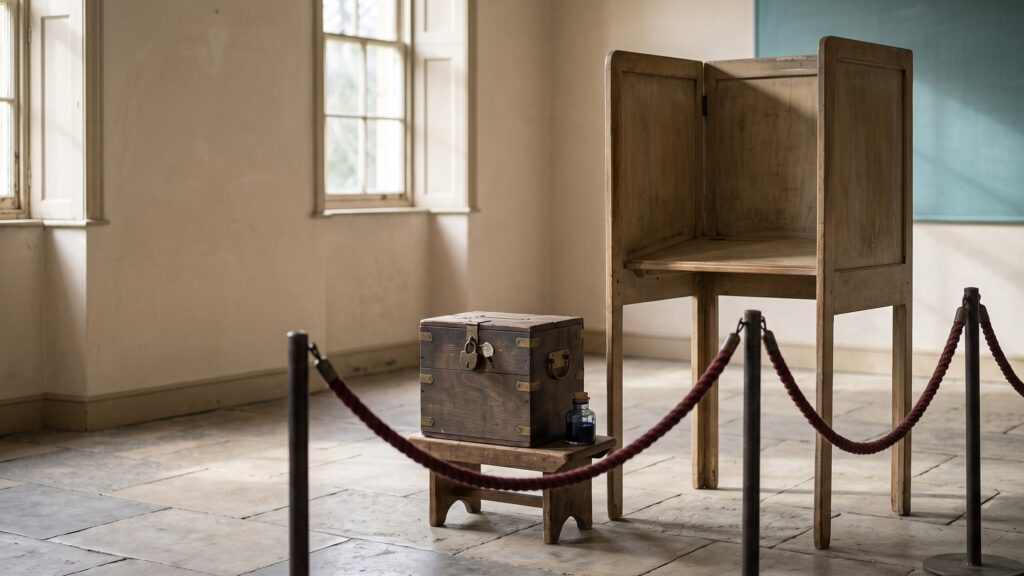
The Election Commission solved the problem it was designed for, conducting free polls at enormous scale, and has limited purchase on the problems that have replaced it: money, criminality and the terms on which the referee is appointed.
This is chapter 34 of the PSIR Optional Notes, from the part on Indian Government and Politics in the Paper I syllabus. The complete book is a free download.
UPSC syllabus
Electoral politics: Election Commission, electoral reforms, voting behaviour. (Voting behaviour is treated in Chapter 31; this chapter covers the machinery and its reform.)
In one page
- The Election Commission under Article 324 has superintendence, direction and control of elections to Parliament, state legislatures, and the offices of President and Vice-President. Local body elections belong to State Election Commissions under Articles 243K and 243ZA.
- It became a multi-member body permanently in 1993. The Chief Election Commissioner can be removed only like a Supreme Court judge; the other Commissioners only on the CEC’s recommendation, which is a weaker protection.
- Anoop Baranwal (2023) directed appointment by a committee of the Prime Minister, the Leader of the Opposition and the Chief Justice until Parliament legislated. The 2023 Act replaced the Chief Justice with a Union minister, which is the substance of the 2025 question.
- Delimitation has been frozen since the 42nd Amendment and extended by the 84th (2001) and 87th (2002) to the first census after 2026, which makes the census of 2027 the trigger.
- The delimitation problem is federal: constituencies redrawn on current population would transfer seats from southern and western states, which reduced fertility fastest, to the north.
- Money is the deepest problem: expenditure limits apply to candidates and not to parties, and the electoral bond scheme removed donor disclosure until it was struck down in ADR (2024).
- Criminality has risen across successive Lok Sabhas. The Court has required disclosure (2002, 2003) and disqualified convicted legislators (Lily Thomas, 2013) but has held that disqualification on framing of charges is for Parliament.
- Reform proposals cluster around state funding, decriminalisation, internal party democracy, simultaneous elections, and a broader-based appointment process for the Commission.
The Election Commission
Constitution and powers
Article 324 vests superintendence, direction and control of the preparation of electoral rolls and the conduct of all elections to Parliament and state legislatures, and to the offices of President and Vice-President, in the Election Commission. The provision is deliberately broad, and Mohinder Singh Gill (1978) held that Article 324 is a reservoir of power for situations the law does not cover, so the Commission may act where statute is silent, subject to the rules of natural justice.
Its statutory framework is the Representation of the People Acts of 1950 and 1951. Its principal instruments: the Model Code of Conduct, which has no statutory force and operates by consensus and publicity; the power to countermand or postpone polls; recognition and symbol allotment under the 1968 Order; and registration of parties under Section 29A.
The Commission became multi-member in 1989, reverted, and was made permanently multi-member in 1993. The T.N. Seshan period from 1990 is the standard reference for the assertion of its powers: enforcement of the Model Code, expenditure monitoring, photo identity cards, and the routine deployment of observers.
Appointment and independence
The 2025 paper asked about the appointment procedure, which is the live controversy.
Until 2023, appointment was by the President on the advice of the council of ministers, meaning by the government of the day, with no statutory process. In Anoop Baranwal v. Union of India (March 2023) a Constitution Bench held that this left the Commission vulnerable and directed that, until Parliament made a law, appointments be made on the advice of a committee comprising the Prime Minister, the Leader of the Opposition in the Lok Sabha, and the Chief Justice of India.
Parliament then enacted the Chief Election Commissioner and other Election Commissioners (Appointment, Conditions of Service and Term of Office) Act 2023, which constituted the selection committee as the Prime Minister, a Union Cabinet Minister nominated by the Prime Minister, and the Leader of the Opposition, with a search committee headed by the Law Minister proposing names.
The arguments to weigh:
- For the Act. Appointment is an executive function; the Court’s interim arrangement was expressly to hold until Parliament legislated; involving the judiciary in appointing an authority whose decisions it may later review raises its own conflict; and the executive remains answerable to Parliament.
- Against. A three-member committee with two government members guarantees a government majority, which reproduces exactly the defect Anoop Baranwal identified. The Commission adjudicates disputes in which the ruling party is an interested party, so the appearance of independence is part of the function.
- The asymmetry that remains. The CEC may be removed only in the manner of a Supreme Court judge; the other Commissioners only on the CEC’s recommendation. The Goswami Committee (1990) and the Law Commission’s 255th Report (2015) both recommended equal protection for all Commissioners, and neither has been implemented.
Delimitation
Delimitation is the redrawing of constituency boundaries and the reallocation of seats among states, carried out under Article 82 by a Delimitation Commission after each census. Commissions were constituted in 1952, 1963, 1973 and 2002.
The freeze is the key fact. The 42nd Amendment (1976) froze the allocation of Lok Sabha seats among states on the 1971 census until after the 2001 census, to reassure states that succeeded in reducing fertility that they would not lose representation. The 84th Amendment (2001) extended the freeze to the first census after 2026, and the 87th (2002) allowed the 2002 Commission to redraw boundaries within states on 2001 population without altering the number of seats per state.
The 2025 question links delimitation to the decision to conduct the census in 2027, and the answer must set out the federal problem precisely.
- The arithmetic. States that reduced fertility fastest, Kerala, Tamil Nadu, Andhra Pradesh, Telangana and Karnataka, have grown more slowly than Uttar Pradesh, Bihar, Madhya Pradesh and Rajasthan. Redistribution strictly by current population would move seats from the former to the latter.
- The grievance. States are asked to be penalised for complying with national policy. The same argument runs through fiscal devolution, where the Fifteenth Finance Commission’s use of 2011 population data raised the identical objection.
- The counter. Equal weight for each vote is a democratic principle, and constituency populations now differ by very large margins, which is itself a violation of political equality. One person, one vote, one value was Ambedkar’s phrase.
- The options canvassed. Freezing state shares while increasing total seats so that no state loses in absolute terms; weighting by both population and performance; strengthening the Rajya Sabha as a states’ chamber to compensate; or extending the freeze again.
- The linked question. The 106th Amendment (2023) reserving one-third of seats for women takes effect only after a census and delimitation, so all three questions are now tied to the same exercise.
Money in elections
Candidate expenditure ceilings are prescribed under the Conduct of Elections Rules and revised periodically, and every candidate must file an account. The ceilings do not apply to expenditure by the party or by supporters, which Kanwar Lal Gupta (1975) had held should be included until Explanation 1 to Section 77 of the RPA was amended to exclude it. That exclusion is the central weakness of the whole regime.
Disclosure is required of contributions above twenty thousand rupees under Section 29C of the RPA. Electoral bonds, introduced in 2018, allowed anonymous donation through instruments purchased from a designated bank, with amendments to the Companies Act removing the profit-linked cap on corporate donations and the requirement to disclose the recipient. In Association for Democratic Reforms v. Union of India (February 2024) the Supreme Court struck the scheme down as violating the right to information under Article 19(1)(a) and the Companies Act amendments as manifestly arbitrary, and directed disclosure of past purchases.
The remaining problems: the twenty-thousand-rupee threshold permits unlimited undisclosed small-donation aggregation; parties are outside the Right to Information Act despite a Central Information Commission ruling in 2013 that six national parties are public authorities; and electoral trusts, though more transparent than bonds, still intermediate corporate funding.
Criminalisation, and other reforms
Criminalisation
Disqualification under Section 8 of the RPA follows conviction, not accusation. The Court has moved in stages: Union of India v. ADR (2002) and PUCL (2003) required candidates to disclose criminal cases, assets and educational qualifications on affidavit; Lily Thomas (2013) struck down Section 8(4), which had allowed convicted legislators to remain in office pending appeal; Public Interest Foundation (2018) declined to disqualify on the framing of charges, holding that a matter for Parliament, but required candidates and parties to publicise pending cases; and directions since 2020 require parties to publish reasons for selecting a candidate with pending cases.
Special courts for cases against legislators have been directed and constituted, with mixed throughput. The Law Commission’s 244th Report (2014) recommended disqualification on framing of charges for offences carrying five years or more, at least a year before the election, which Parliament has not enacted.
The reform agenda
| Proposal | Source | Principal objection |
|---|---|---|
| State funding of elections | Indrajit Gupta Committee 1998; Law Commission 170th Report 1999 | Does not displace private money unless private funding is simultaneously capped and enforced |
| Disqualification on framing of charges | Law Commission 244th Report 2014 | Risks misuse of prosecution against opponents; presumption of innocence |
| Ceiling on party expenditure | Repeatedly recommended | Enforcement capacity; definition of party-versus-candidate spending |
| Internal party democracy and audited accounts | Law Commission 255th Report 2015 | Parties resist; no regulator with power to enforce |
| Simultaneous elections | High Level Committee 2024 | Requires constitutional amendment; what happens when a house falls early; federal objection that national issues would crowd out state ones |
| Right to recall and totally negative voting | Periodically canvassed | NOTA exists but has no consequence; recall is administratively impracticable at scale |
| Equal removal protection for all Commissioners | Goswami 1990; Law Commission 255th Report 2015 | Not implemented; the asymmetry remains |
NOTA was introduced following PUCL (2013) and appears on every ballot, but a constituency where NOTA leads still elects the highest-polling candidate, so it registers dissatisfaction without consequence. VVPAT was introduced from 2013 and universalised, with the Court declining in 2024 to order full count-verification while directing retention of slips and a verification facility on candidate request.
Where answers lose marks
- Saying the Election Commission conducts all elections. Local body elections belong to State Election Commissions under Articles 243K and 243ZA.
- Treating the Model Code of Conduct as law. It has no statutory force; its power is consensus and publicity, which is both its strength and its limit.
- Saying the 2023 Act implemented Anoop Baranwal. It replaced the Chief Justice with a Union minister, which reverses the judgment’s purpose while acting on its invitation to legislate.
- Presenting delimitation as a technical exercise. It is a federal redistribution question, and the fertility-decline grievance is the substance of it.
- Saying electoral bonds are anonymous still. The scheme was struck down in February 2024 and past purchase data was ordered disclosed.
- Claiming candidates with criminal cases are disqualified. Disqualification follows conviction; Public Interest Foundation (2018) expressly left charge-framing to Parliament.
Asked before
- There is a debate on the procedure for appointment of the Chief Election Commissioner and Election Commissioners to the Election Commission of India. Analyse its various aspects. (2025, Paper I, 15 marks)
- The decision to conduct Population Census-2027 has reopened the debate on delimitation in India. Discuss its various aspects. (2025, Paper I, 20 marks)
Answer skeleton
The decision to conduct Population Census-2027 has reopened the debate on delimitation in India. Discuss its various aspects. (20 marks, 350 words)
Frame. Delimitation is not a technical exercise but a redistribution of political power between states, and the census is its statutory trigger under Article 82.
The legal position. Article 82 and the Delimitation Commission; Commissions of 1952, 1963, 1973 and 2002; the 42nd Amendment’s freeze on 1971 population; the 84th Amendment extending it to the first census after 2026; the 87th allowing internal redrawing on 2001 data. The 2027 census is therefore the first that can end the freeze.
The federal problem. States that reduced fertility fastest have grown more slowly. Strict population-based reallocation transfers seats from the south and west to the north. The grievance is that compliance with national population policy is being penalised, and the same argument arises in Finance Commission devolution on 2011 data.
The democratic counter. Political equality requires roughly equal constituency populations, and current disparities are very large. Ambedkar’s one person, one vote, one value cuts the other way.
Options. Increase total seats so no state loses in absolute terms; retain state shares while redrawing internally; compensate through a strengthened Rajya Sabha; or extend the freeze again, which postpones rather than resolves.
The linked questions. The 106th Amendment’s women’s reservation takes effect only after a census and delimitation; and any expansion raises the practical question of chamber capacity in the new Parliament building.
Conclude. The debate is a conflict between two constitutional principles, equal representation of citizens and fair treatment of states, and no purely arithmetic solution satisfies both. Any settlement will have to be political and negotiated, which argues for consultation through the Inter-State Council before, not after, the Commission is constituted.
Last-mile revision
- Article 324; Mohinder Singh Gill (1978) reservoir of power; RPA 1950 and 1951; Model Code of Conduct non-statutory; multi-member permanently from 1993; Seshan from 1990.
- Anoop Baranwal (2023): PM, LoP, CJI committee until legislation. CEC and Other ECs Act 2023: PM, a Union minister, LoP. Removal asymmetry between CEC and ECs; Goswami 1990 and Law Commission 255th Report 2015 recommended parity.
- Delimitation: Article 82; Commissions 1952, 1963, 1973, 2002; 42nd Amendment freeze on 1971; 84th Amendment to the first census after 2026; 87th Amendment for internal redrawing on 2001.
- Money: Section 77 Explanation 1 excluding party expenditure; Section 29C disclosure above twenty thousand; electoral bonds 2018 struck down in ADR (February 2024); parties outside RTI despite the CIC ruling of 2013.
- Criminalisation: ADR (2002), PUCL (2003), Lily Thomas (2013), Public Interest Foundation (2018); Law Commission 244th Report 2014.
- Reform sources: Indrajit Gupta 1998, Law Commission 170th 1999, 244th 2014, 255th 2015; NOTA after PUCL (2013); VVPAT from 2013 and the 2024 judgment.
Read the rest. This chapter is one of 58 in the complete PSIR Optional Notes, covering Paper I and Paper II in full — free to download.
Tell Google you want more of this.
Add Anantam IAS as a preferred sourceOne tap, and this site shows up more often in your own Top Stories, AI Overviews and AI Mode. Remove it any time.