
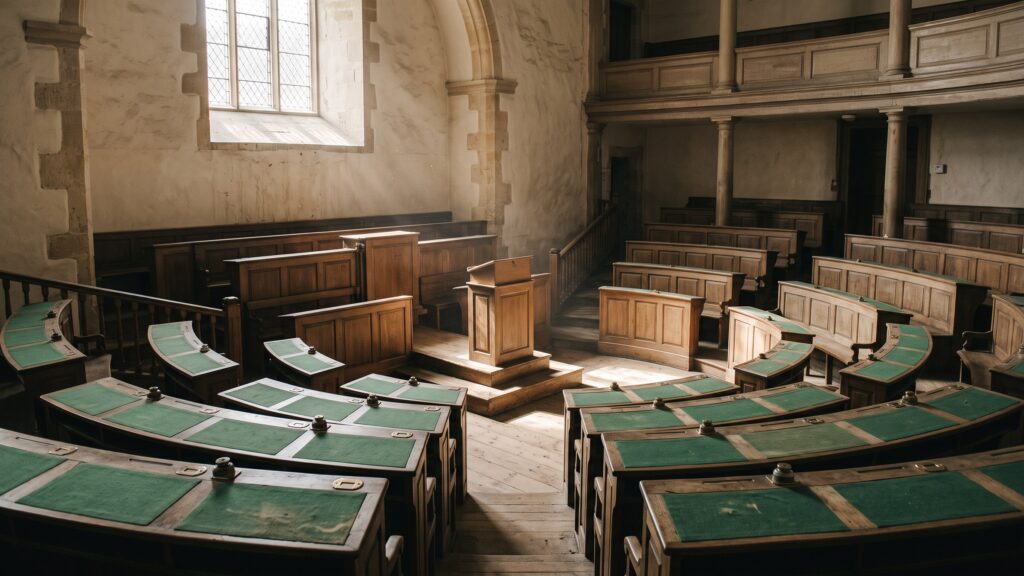
The Constituent Assembly was not a blank page. It inherited a century of colonial administrative law, wrote under partition, and had to reconcile a liberal rights framework with a society that could not deliver those rights without state intervention.
This is chapter 21 of the PSIR Optional Notes, from the part on Indian Government and Politics in the Paper I syllabus. The complete book is a free download.
UPSC syllabus
Making of the Indian Constitution: Legacies of the British rule; different social and political perspectives.
In one page
- The Constitution’s borrowings are extensive and deliberate. The largest single source is the Government of India Act 1935, from which roughly two-thirds of the text derives.
- The British legacy is the parliamentary system, cabinet responsibility, the rule of law, single citizenship, the speaker’s office, and the doctrine of parliamentary privilege.
- The Constituent Assembly was elected indirectly by the provincial assemblies under the Cabinet Mission Plan of 1946, on a restricted franchise, and first met on 9 December 1946.
- Nehru‘s Objectives Resolution, moved on 13 December 1946 and adopted 22 January 1947, declared India an independent sovereign republic and became the basis of the Preamble.
- After partition the Assembly’s Muslim League members largely withdrew, leaving a body dominated by the Congress, which raises the representativeness question every critic presses.
- The Assembly worked through committees. The Drafting Committee under Ambedkar, with B.N. Rau as Constitutional Adviser and S.N. Mukherjee as chief draftsman, did the technical work.
- Granville Austin‘s reading is the standard one: the Constitution is a social document, and its core is the seamless web of national unity, democracy and a social revolution pursued together.
- The perspectives divide sharply. Liberal and Gandhian critics attack it from opposite directions, and the Marxist charge is that it entrenched property while promising equality.
The colonial legacy
The 2023 paper asked for the imprint of the British Constitution on the Indian one, which requires distinguishing three different kinds of inheritance.
Statutory inheritance
A chain of Acts built the administrative and representative apparatus the Assembly inherited.
- Regulating Act 1773 and Pitt’s India Act 1784 begin parliamentary control over the Company and create the Governor-General.
- Charter Act 1833 makes the Governor-General of India, centralises legislative power and, in a clause much cited later, declares that no Indian shall be disqualified from office by religion, birth, descent or colour.
- Indian Councils Acts 1861, 1892, 1909 introduce Indians into legislative councils, then the elective principle, then separate electorates under Morley-Minto.
- Government of India Act 1919 (Montagu-Chelmsford) creates dyarchy in the provinces, splitting subjects into transferred and reserved, and bicameralism at the centre.
- Government of India Act 1935 is the decisive source: provincial autonomy replacing dyarchy, a federal scheme with a threefold legislative list, a Federal Court, a public service commission, emergency provisions, and the Governor’s discretionary powers.
The 1935 Act’s contribution is structural rather than incidental. The federal division of powers, the Union, State and Concurrent Lists, the office of Governor, President’s Rule in the form of Section 93, the administrative relations between centre and provinces, and much of the text’s drafting conventions come from it. Ambedkar’s own defence of this borrowing in the Assembly was that there is nothing to be ashamed of in borrowing, since the essentials of a constitutional structure are broadly similar everywhere, and what matters is the accommodation to a country’s particular conditions.
The Westminster inheritance proper
Distinct from the statutes is what was taken from British constitutional practice, most of which is unwritten in Britain and had to be written down in India.
| Feature | Taken from Britain | Indian departure |
|---|---|---|
| Executive | Parliamentary system; collective responsibility; a nominal head of state | Republic with an elected President, not a hereditary Crown |
| Legislature | Bicameralism; Speaker and Deputy Speaker; parliamentary privilege; legislative procedure | Rajya Sabha represents states and is not a hereditary chamber |
| Rule of law | Equality before the law and the ordinary law administered by ordinary courts | Written and justiciable, not conventional |
| Citizenship | Single citizenship for the whole union | Retained despite federalism |
| Sovereignty | Parliamentary supremacy | Rejected: written constitution, judicial review, basic structure |
| Rights | Common-law liberties, unwritten | Codified in Part III and enforceable under Article 32 |
The rejections matter as much as the borrowings. India took the parliamentary executive and refused parliamentary sovereignty, which is why judicial review and, later, the basic structure doctrine were possible here and are not in Britain.
Other sources, briefly
Fundamental Rights and the office of an impeachable President from the United States; Directive Principles and the method of electing the President from Ireland; the Concurrent List, trade and commerce provisions and a joint sitting from Australia; emergency provisions and the suspension of rights from the Weimar Constitution; the Fundamental Duties and a five-year plan from the Soviet Union; the amendment procedure and elected Rajya Sabha members from South Africa; the procedure established by law formulation from Japan; and cabinet responsibility with the residuary power to the centre from Canada.
Note the distinction worth making: procedure established by law in Article 21 was taken from Japan in preference to the American due process, on B.N. Rau’s advice after his conversation with Justice Frankfurter, and Maneka Gandhi (1978) effectively restored the substance of the rejected formula by judicial route.
The Constituent Assembly
Composition and process
The Assembly was constituted under the Cabinet Mission Plan of 1946: members elected by the provincial legislative assemblies through proportional representation by single transferable vote, with seats allotted between General, Muslim and Sikh categories, plus nominees of the princely states. The provincial assemblies had themselves been elected in 1946 on a franchise covering roughly a seventh of the adult population.
Its first sitting was on 9 December 1946, with Sachchidananda Sinha as temporary chairman and Rajendra Prasad elected President on 11 December. After partition its strength fell to about 299. It sat for 165 days across eleven sessions over two years, eleven months and eighteen days, and adopted the Constitution on 26 November 1949, with commencement on 26 January 1950, a date chosen because it was the anniversary of the 1930 Independence Day pledge.
The work was done in committees, and naming a few precisely is worth marks: the Union Powers Committee and Union Constitution Committee under Nehru, the Provincial Constitution Committee under Patel, the Advisory Committee on Fundamental Rights and Minorities under Patel with its sub-committees under J.B. Kripalani and H.C. Mookherjee, the Drafting Committee under Ambedkar, and the Steering Committee under Rajendra Prasad. B.N. Rau as Constitutional Adviser prepared the initial draft and toured foreign jurisdictions; S.N. Mukherjee was chief draftsman.
The Objectives Resolution
Moved by Nehru on 13 December 1946 and adopted on 22 January 1947, the Objectives Resolution is the Assembly’s statement of purpose and the direct ancestor of the Preamble. Its content:
- India to be an independent sovereign republic with a constitution framed by the Assembly itself.
- The territories to be a Union of the present British Indian territories, the princely states and other willing territories, with residuary powers in the units except as vested in the Union.
- All power and authority derived from the people.
- Guarantees of justice, social, economic and political; equality of status and opportunity before the law; and freedom of thought, expression, belief, faith, worship, vocation, association and action, subject to law and public morality.
- Adequate safeguards for minorities, backward and tribal areas, and depressed and other backward classes.
- Maintenance of the integrity of the territory and its sovereign rights on land, sea and air according to justice and the law of civilised nations.
- A willing contribution to world peace and the welfare of mankind.
Two points beyond the content. Rhetorically, Nehru presented it as a pledge rather than a legal draft, and it functioned to hold the Assembly together across deep divisions on federal structure. Legally, the Supreme Court has used it as an aid to interpretation, and Kesavananda Bharati (1973) drew on it in identifying the Constitution’s fundamental features.
The representativeness question
The standard criticisms must be stated and answered rather than avoided.
The Assembly was indirectly elected on a franchise of about fourteen per cent of adults; it was Congress-dominated, overwhelmingly so after the League’s withdrawal, holding roughly eighty-two per cent of seats; and it was socially unrepresentative, dominated by upper-caste, urban, English-educated lawyers. Winston Churchill‘s jibe that it represented only one major community has been echoed by later critics from very different positions.
The defences are equally substantial. The Congress deliberately included those outside it, Ambedkar prominent among them, and Ambedkar had been defeated in his original seat and was returned from Bombay with Congress support after partition removed his Bengal constituency; independent-minded members such as H.V. Kamath, K.T. Shah, Naziruddin Ahmad and Somnath Lahiri dissented frequently and are all over the debates; the Congress itself contained the full ideological range from Hindu traditionalists to socialists; and the Assembly’s proceedings were public, published and lengthy, which is a form of accountability universal suffrage alone does not supply. Granville Austin‘s judgement is that the Assembly was a one-party body in an essentially one-party country, and that the party was itself an umbrella.
Perspectives on the Constitution
Thinker
Granville Austin (1927–2014)
Key works. The Indian Constitution: Cornerstone of a Nation (1966), Working a Democratic Constitution (1999)
Core claim. The Constitution is above all a social document: the majority of its provisions are directly aimed at furthering the goals of social revolution, or at establishing the conditions for it. Its core commitments form a seamless web of three strands, national unity and integrity, democratic institutions, and social revolution, which cannot be pursued separately without damaging all three.
Standard critique. The seamless-web image can smooth over genuine contradictions the Assembly left unresolved, particularly between property rights and redistribution; and his access to Congress sources gives a sympathetic reading of the leadership’s choices.
Exam hook. The 2023 question quoted his “cornerstone of a nation” phrase directly. Any answer on the Constitution’s character should engage his framework.
The perspectives, in brief
Liberal. The Constitution’s achievement is a justiciable bill of rights, an independent judiciary, universal adult suffrage from the outset, and constitutional government in a poor and plural society. Its liberal criticism is the extent of emergency powers, the ease of amendment under Article 368 as originally drafted, and preventive detention written into Article 22, which Ambedkar himself defended with visible discomfort.
Gandhian. The critique from the movement’s own tradition, pressed in the Assembly by K. Santhanam and outside by others: the Constitution is centralised, city-facing and Western-modelled, and the village finds a place only in the non-justiciable Article 40. Gandhi’s oceanic circles, the polity built upward from village republics, was not adopted, and the 73rd Amendment came four decades later.
Marxist. Somnath Lahiri’s remark in the Assembly, that many of the fundamental rights had been framed from the point of view of a police constable, is the sharpest internal version. The broader charge is that the Constitution guarantees formal equality while protecting property, that the socio-economic commitments were placed in the non-justiciable Part IV, and that this reflects the class composition of both the movement and the Assembly.
Ambedkarite. Ambedkar’s own position is not straightforwardly celebratory. He defended the document as the best available and warned on 25 November 1949 that a constitution is only as good as those who work it, that political democracy on an unequal social base is a life of contradictions, and that the people must abandon the grammar of anarchy and hero-worship. His later disillusionment, expressed in his 1953 remark in the Rajya Sabha that he would be the first to burn it, is usually quoted without its context, which was his frustration at the Hindu Code Bill’s failure and at the treatment of minorities.
Conservative and Hindu traditionalist. The objection that the Constitution ignored indigenous political traditions and drew nothing from Indian sources, made in the Assembly and after, and answered by the observation that Article 40, the fundamental duties, and the constitutional protection of personal law all draw on Indian material.
Debate: Was the Constituent Assembly representative enough to make a constitution?
No. Indirect election on a fourteen per cent franchise, a single dominant party holding over four-fifths of seats, and a membership drawn from a narrow social stratum. The people whose lives the Constitution most transformed, agricultural labourers, women, Dalits outside the reserved seats, were almost absent from the room. The League’s withdrawal removed the main opposition, so the document was made without the country’s principal political disagreement being represented. Yes, sufficiently. No constituent assembly anywhere has been elected on universal suffrage before a constitution existed to define the franchise; the objection generalises into an impossibility. The Congress operated as an umbrella containing socialists, traditionalists and liberals, and it deliberately co-opted outside talent, most consequentially Ambedkar. The debates were public and prolonged, dissent was recorded and frequently accepted, and the Assembly gave itself universal adult suffrage, the strongest possible evidence that it did not legislate for its own class. The examiner’s line. The formal deficiency is real and the substantive record is stronger than the formal composition predicts. Judge it by outputs as well as inputs: an assembly of the propertied gave the vote to everyone, abolished untouchability, and provided for reservation. Austin’s verdict, a one-party body in a one-party country where the party was itself a coalition, is the fair summary; and Ambedkar’s own warning, that the document would be as good as those working it, is the more useful question to carry forward.
The Indian Constitution is first and foremost a social document
Granville Austin, The Indian Constitution: Cornerstone of a Nation, 1966
However good a Constitution may be, it is sure to turn out bad because those who are called to work it, happen to be a bad lot
B. R. Ambedkar, Constituent Assembly, 25 November 1949
Where answers lose marks
- Listing borrowed features country by country without the departures. India took the parliamentary executive and rejected parliamentary sovereignty; that contrast is the answer.
- Saying the Constitution copied the Government of India Act 1935 without saying what it changed: an elected head of state, justiciable rights, universal suffrage, and no Governor’s discretionary override of a responsible ministry.
- Treating the Objectives Resolution as a preamble draft only. It settled the republic question and the source of authority, and it has been used interpretively by the courts.
- Quoting Ambedkar’s 1953 burn-it remark without context. It expressed frustration over the Hindu Code Bill and minority treatment, not repudiation of the document he defended in 1949.
- Presenting Austin as merely a source of quotations. The seamless web and the social-document thesis are analytical claims that can be applied and tested.
- Omitting the perspectives the question asks for. The syllabus line says social and political perspectives; a purely institutional answer misses half the marks.
Asked before
- The Constitution of India is the “cornerstone of a nation”. (Granville Austin). Analyze. (2023, Paper I, 15 marks)
- Imprint of the British Constitution on the Indian Constitution. (2023, Paper I, 10 marks)
- Objective Resolution of the Constituent Assembly. (2024, Paper I, 10 marks)
Answer skeleton
The Constitution of India is the “cornerstone of a nation”. (Granville Austin). Analyze. (15 marks, 250 words)
Frame. Austin’s phrase is a claim, not a compliment: the Constitution was to be the foundation on which a nation would be built, because in 1950 the nation was not yet made.
Unpack the thesis. The Constitution as a social document: most provisions aim at social revolution or at creating its conditions. The seamless web of national unity, democratic institutions and social revolution, which stand or fall together.
Evidence for it. Universal adult suffrage at once, without phased extension; abolition of untouchability in Article 17; reservation; Part IV’s social and economic goals; linguistic reorganisation later accommodated within the same frame; and single citizenship with a strong centre to hold a partitioned polity together.
Test the metaphor. A cornerstone bears weight it does not itself create. The Constitution supplied instruments, not the social change; Article 17 did not end untouchability, and Part IV was made non-justiciable precisely so that the promise would not bind.
The critiques, briefly. Gandhian, that the village was omitted; Marxist, that property was protected while equality was promised; Ambedkarite, that a constitution is only as good as those who work it.
Evaluate. The web has held under strain: emergency, coalition governments, insurgency and seventeen general elections. Where it has frayed, it has done so along exactly the line Austin identified, when unity was pursued at the cost of the other two strands.
Conclude. Cornerstone rather than edifice is the right image, and the accurate verdict is that the foundation proved sound while the building remains unfinished.
Last-mile revision
- Statutes: 1773, 1784, 1833, 1861, 1892, 1909, 1919 dyarchy, 1935 provincial autonomy and the federal scheme; about two-thirds of the text derives from 1935.
- British imprint: parliamentary executive, collective responsibility, rule of law, single citizenship, Speaker, privileges, bicameralism. Rejected: parliamentary sovereignty.
- Other sources: US rights and impeachment; Irish DPSP and presidential election; Australian Concurrent List and joint sitting; Weimar emergency; Soviet duties and planning; South African amendment; Japanese procedure established by law; Canadian strong centre and residuary power.
- Assembly: Cabinet Mission Plan 1946, indirect election, first sitting 9 December 1946, Rajendra Prasad President 11 December, 165 days over 2 years 11 months 18 days, adopted 26 November 1949, commenced 26 January 1950.
- Objectives Resolution: moved 13 December 1946, adopted 22 January 1947; sovereign republic, power from the people, justice social economic political, minority safeguards, world peace.
- Committees: Nehru on Union Powers and Union Constitution; Patel on Provincial Constitution and on Fundamental Rights and Minorities; Ambedkar on Drafting; B.N. Rau adviser; S.N. Mukherjee chief draftsman.
- Austin: social document; seamless web of unity, democracy, social revolution.
- Perspectives: liberal (emergency powers, preventive detention), Gandhian (village omitted), Marxist (Lahiri’s police-constable remark), Ambedkarite (as good as those who work it).
Read the rest. This chapter is one of 58 in the complete PSIR Optional Notes, covering Paper I and Paper II in full — free to download.
Tell Google you want more of this.
Add Anantam IAS as a preferred sourceOne tap, and this site shows up more often in your own Top Stories, AI Overviews and AI Mode. Remove it any time.