
An ideology is not a bad theory; it is a theory doing a different job. It connects a picture of human nature to a programme of action, and it is judged as much by what it makes people do as by whether it is true.
This is chapter 8 of the PSIR Optional Notes, from the part on Political Theory in the Paper I syllabus. The complete book is a free download.
UPSC syllabus
Political Ideologies: Liberalism, Socialism, Marxism.
In one page
- Ideology has a pejorative sense (Marx: distorted consciousness serving class interest) and a neutral, social-scientific sense (a set of ideas providing a basis for organised political action). Both are examinable and they must not be run together.
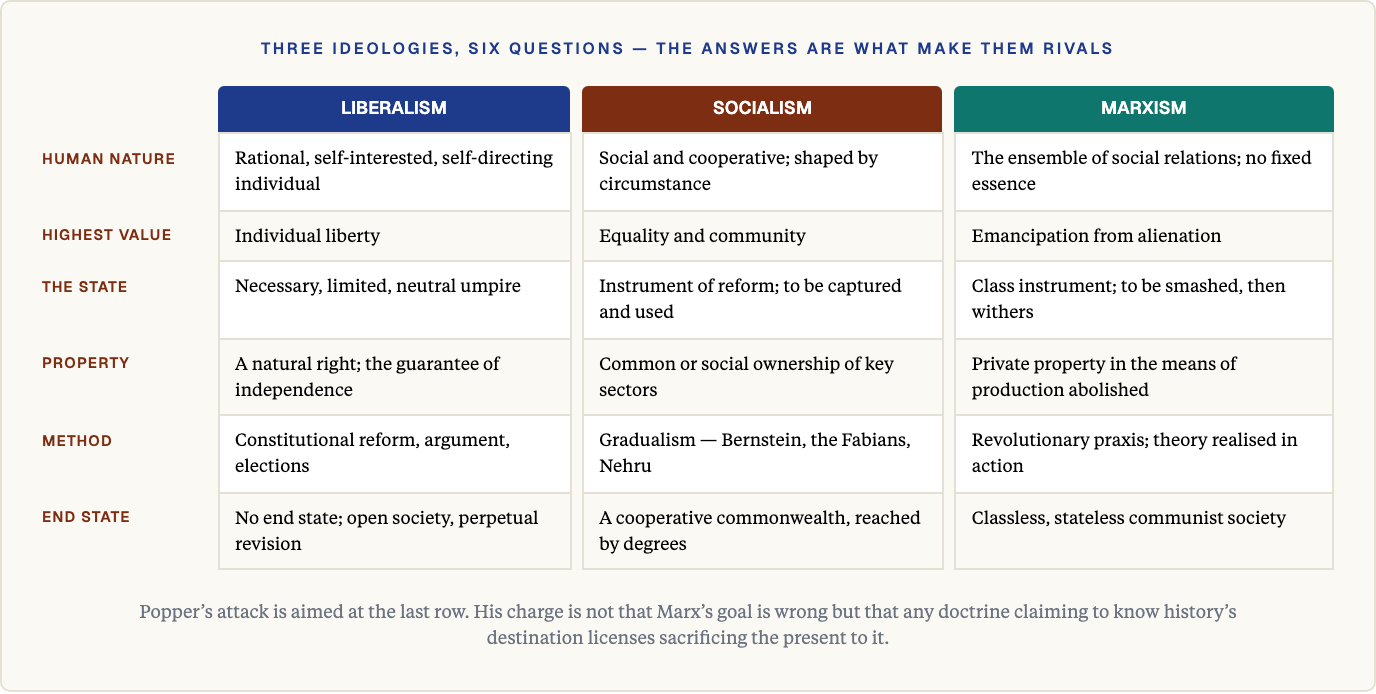
- Liberalism‘s core is the primacy of the individual, together with freedom, reason, justice and toleration. It splits into classical (negative liberty, minimal state) and modern (positive liberty, enabling state).
- The decline of liberalism thesis has four strands: the communitarian critique of its account of the self, the post-modern critique of its universalism, neoliberalism hollowing out its social commitments, and the contemporary retreat of liberal democracy itself.
- Socialism‘s core is community, cooperation, equality, need and common ownership. Its great internal division is revolutionary against evolutionary: Marx against Bernstein and the Fabians.
- Marxism is distinguished by historical materialism, the labour theory of value and surplus value, alienation, class struggle as the motor of history, and praxis: theory is completed in action, which is what makes it a theory of action.
- Neo-Marxism loosens economic determinism: Gramsci through hegemony, the Frankfurt School through the critique of instrumental reason, Althusser through structural causation.
- Popper‘s attack in The Open Society and Its Enemies (1945) is on historicism, the claim to know history’s laws and destination, which he argues licenses the sacrifice of the present to the future.
- The Indian variants matter: Nehruvian democratic socialism, Lohia’s socialism with caste at its centre, and M.N. Roy’s radical humanism, which broke with Marxism over exactly Popper’s objection.
Ideology: the concept
The pejorative tradition
The word was coined by Destutt de Tracy in the 1790s for a proposed science of ideas, and acquired its negative charge when Napoleon used it to dismiss impractical theorists.
Marx and Engels, in The German Ideology (written 1845–46), gave it its enduring critical sense: the ruling ideas of any age are the ideas of its ruling class, and ideology inverts reality as in a camera obscura, presenting the interests of a particular class as the universal interest. Ideology in this sense is not lying but systematic misrepresentation of which its bearers are largely unaware. The later concept of false consciousness, the term is Engels’s, from an 1893 letter to Mehring, names the condition of those who hold it.
Karl Mannheim, in Ideology and Utopia (1929), generalised the analysis into the sociology of knowledge and turned it against Marxism too: all thought is situationally determined, including the critic’s. He distinguished ideology, thought that defends the existing order, from utopia, thought that seeks to transform it, and looked to a relatively unattached intelligentsia to achieve a synthesis. The obvious objection, which he never fully answered, is that if all thought is situated then so is his.
Gramsci converts ideology from illusion into a material force organised through civil society, and Althusser into the mechanism by which subjects are constituted. Both are covered in Chapter 7.
The neutral tradition
Twentieth-century political science needed a term for organised political belief systems without the implication that they are false. In Heywood’s standard formulation an ideology is a more or less coherent set of ideas that provides the basis for organised political action, offering an account of the existing order, a model of a desired future, and an explanation of how change is to be achieved.
This is the sense in which liberalism, socialism, conservatism, fascism and feminism are ideologies, and in which the end of ideology thesis, Bell and Lipset in the 1950s, and its successor, Fukuyama’s end of history in 1989, could be advanced and then refuted by events.
Liberalism
Core commitments
Five elements recur across all its variants: the individual as the basic unit of moral and political concern; freedom as the highest political value, though not the only one; reason as the means of settling disagreement and the ground for confidence in progress; justice understood as formal equality and equality of opportunity; and toleration, extended from religion outward, which underwrites pluralism.
Classical and modern
Classical liberalism takes freedom negatively, treats the state as a necessary evil, defends laissez-faire, and derives from Locke, Smith, Bentham and the early Mill. Its nineteenth-century extension into social Darwinism, in Spencer and Sumner, is the point at which it became least defensible.
Modern or social liberalism, from T.H. Green through Hobhouse, Hobson, Keynes, Beveridge and Rawls, holds that freedom requires capacity, that unregulated markets produce unfreedom, and that the state must enable. The welfare state and demand management are its programme.
Neoliberalism is the classical position revived, treated in Chapter 2.
The decline of liberalism
UPSC set this as a short note in 2024, and the answer needs four distinct strands rather than a general lament.
- Philosophical. The communitarian critique of the unencumbered self, from Chapter 3. If persons are partly constituted by attachments they did not choose, the liberal account of autonomous choice is not merely incomplete but wrong about what a person is.
- Epistemological. The post-modern and post-colonial critique of liberal universalism: its allegedly neutral categories carry a particular history, and its claim to speak for humanity was made while excluding most of it.
- Economic. Neoliberalism’s ascendancy hollowed out the social liberalism of the mid-century, so that liberalism came to be identified with market discipline rather than with the enabling state. The inequality this produced eroded liberalism’s political base.
- Political. The contemporary retreat of liberal democracy: constitutional constraints, judicial independence and press freedom weakening in states that continue to hold elections. This is the phenomenon Fukuyama’s 1989 thesis did not anticipate.
The counter-argument worth making is that liberalism has repeatedly survived its own obituaries by absorbing its critics, which is what happened when it absorbed the socialist critique to become social liberalism, and what Rawls attempted with Political Liberalism (1993) in response to pluralism.
Socialism
Core commitments
Community against the atomised individual; cooperation against competition, on the ground that human beings are naturally social and that competition is a learned behaviour; social equality, treated as the guarantee of both stability and freedom; distribution according to need; and common ownership, in some form, of the means of production.
Its account of human nature is the deepest point of difference with liberalism: for the socialist, the acquisitive individual liberalism describes is a product of capitalism, not a discovery about humanity.
Varieties
Utopian socialism, in Owen, Fourier and Saint-Simon, proceeded by model communities and moral appeal; Marx and Engels named it utopian precisely to distinguish their own claim to scientific status.
Revolutionary socialism holds that the capitalist state cannot be reformed into socialism because it is structurally tied to capital, so power must be seized and the state transformed.
Evolutionary socialism or revisionism is Eduard Bernstein‘s position in Evolutionary Socialism (1899). Observing that capitalism had not polarised into two classes, that immiseration had not occurred and that the middle class was growing, he concluded that socialism would be reached by parliamentary means and trade union action. His formula, that the movement is everything and the final goal nothing, defines social democracy.
Fabianism, from the Webbs and Shaw, is the British version, resting on permeation of existing institutions and the inevitability of gradualness. It supplied much of the intellectual apparatus of the British welfare state and, through Nehru, a good deal of Indian planning.
Guild socialism, in G.D.H. Cole, sought worker control through industrial guilds rather than state ownership, and is the ancestor of arguments for economic democracy.
Socialism in India
Three variants are examinable. Nehru‘s democratic socialism combined parliamentary democracy, a mixed economy with a commanding-heights public sector, and planning; the Avadi session of 1955 adopted the socialistic pattern of society as the objective. Lohia‘s socialism insisted that a socialism which addressed class while ignoring caste would fail in India, and produced the programme of preferential opportunity for backward castes that shaped north Indian politics after 1967. Jayaprakash Narayan moved from Marxism to Gandhian sarvodaya and finally to total revolution, arguing that party politics itself was the obstacle. All three are developed in Chapter 13.
Marxism
Historical materialism
The foundational claim, stated in the 1859 Preface to A Contribution to the Critique of Political Economy (1859), is that in the social production of their existence people enter into definite relations independent of their will, that the totality of these relations of production constitutes the economic structure of society, and that it is not the consciousness of people that determines their being but their social being that determines their consciousness.
The base comprises the forces of production, meaning labour, tools and technique, and the relations of production, meaning property relations. The superstructure comprises law, politics, religion, philosophy and art. When the forces of production outgrow the existing relations, an epoch of social revolution begins.
Engels’s letter to Bloch of 1890 is the necessary qualification and worth citing, because it concedes that the economic element is determining only in the last instance, and that neither he nor Marx ever asserted more; the superstructure reacts back upon the base.
Class, value and alienation
History is the history of class struggles. Under capitalism the decisive relation is between the bourgeoisie, which owns the means of production, and the proletariat, which owns only its labour power. Surplus value is the source of profit: the worker is paid the value of their labour power, which is what it costs to reproduce it, but produces more value than that in the working day, and the difference is appropriated.
Alienation, developed in the Economic and Philosophic Manuscripts (1844), has four dimensions: from the product of labour, which confronts the worker as an alien thing; from the activity of labour, which becomes forced rather than expressive; from species-being, the human capacity for free conscious creation; and from other human beings, who become competitors. This is the humanist Marx recovered in the twentieth century, and it is the register in which M.N. Roy and the Frankfurt School work.
Praxis, and Marxism as a theory of action
UPSC asked in 2024 whether Marxism is a political theory of action demanding strict compliance with its core principles, which requires separating two claims.
Marxism is undeniably a theory of action. The eleventh of the Theses on Feuerbach (1845) states the programme: philosophers have only interpreted the world in various ways, the point is to change it. Praxis is the unity of theory and practice, in which theory is validated by its capacity to guide transformative action rather than by contemplation alone. Unlike liberalism, Marxism specifies an agent, the proletariat, a method, revolution, and an outcome.
Whether it demands strict compliance is the contested half. The historical record of orthodoxy and excommunication, from the Second International splits to Stalinist enforcement of doctrine, supports the charge. But the tradition itself is plural to the point of contradiction: Bernstein revised the economics, Lenin the theory of the party, Gramsci the theory of the state, the Frankfurt School the theory of culture, Althusser the theory of causation, and Cohen the theory of justice. A doctrine that generated Trotsky, Mao, Gramsci, Marcuse and Amartya Sen’s interlocutors is not well described as demanding uniformity; what demanded uniformity was the party-state, which is a political fact rather than a feature of the theory.
Neo-Marxism
The twentieth century’s revisions all loosen economic determinism. Gramsci adds hegemony and the war of position. The Frankfurt School, in Horkheimer, Adorno and Marcuse, shifts from political economy to the critique of culture and of instrumental reason; Dialectic of Enlightenment (1944) argues that enlightenment reason turned into domination, and Marcuse’s One-Dimensional Man (1964) argues that advanced industrial society integrates opposition by satisfying false needs, producing a society without an agent of change. Althusser replaces the base-superstructure metaphor with structural causation and overdetermination.
Popper against historicism
Thinker
Karl Popper (1902–1994)
Key works. The Open Society and Its Enemies (1945), The Poverty of Historicism (1957)
Core claim. Historicism, the doctrine that history has discoverable laws and an inevitable destination, is intellectually unfounded and politically dangerous. It is unfounded because the course of history depends on the growth of knowledge, which cannot be predicted in advance; it is dangerous because certainty about the end justifies any means toward it. Against utopian social engineering he sets piecemeal social engineering: identify a concrete evil, act to reduce it, and remain able to detect and correct the error.
Standard critique. His readings of Plato, Hegel and Marx are widely regarded by specialists as tendentious; and piecemeal reform may be inadequate where the injustice is systemic rather than local.
Exam hook. UPSC set the open society as a fifteen-marker in 2025. The answer must connect the epistemology, falsifiability and fallibilism, to the politics, since for Popper they are the same argument.
The open society is one in which individuals confront personal decisions, institutions are subject to criticism, and rulers can be removed without violence. Popper’s reformulation of the central political question is the most quotable thing in him: the classical question, who should rule, invites the answer that the best should rule and hence unaccountable power; the right question is how we can arrange institutions so that bad rulers can be removed without bloodshed. This makes democracy a fallibilist device for error correction rather than an expression of the popular will, and it is the deepest available defence of it.
The paradox of tolerance belongs here: unlimited tolerance leads to the disappearance of tolerance, so a tolerant society must retain the right to suppress the intolerant when they refuse argument and answer with force.
Debate: Is Marxism a science or an ideology?
Science. It claims a testable account of social change: forces of production develop, relations of production become fetters, crisis follows, and its predictions about the concentration of capital, globalisation of markets and recurrent crises have held up better than its critics allow. Marx himself framed the argument as an explanatory theory, not a moral appeal. Ideology. Popper’s charge is that it immunises itself: every failed prediction is absorbed by an auxiliary hypothesis, false consciousness explains away the workers who do not revolt, and relative autonomy explains away the states that do not serve capital. A theory compatible with every outcome forecasts none. Its function, on this view, is to organise and legitimise a movement, which is what an ideology does. The examiner’s line. The dichotomy is too clean. Marxism contains testable historical propositions, some borne out and some not, and a normative commitment to emancipation that no evidence could settle. Say which part is being assessed. Note also that Popper’s falsifiability criterion has been substantially qualified within the philosophy of science since Kuhn and Lakatos, so “unfalsifiable, therefore unscientific” is no longer the clean verdict it was in 1957.
The philosophers have only interpreted the world, in various ways; the point, however, is to change it
Karl Marx, Theses on Feuerbach, 1845
It is not the consciousness of men that determines their being, but, on the contrary, their social being that determines their consciousness
Karl Marx, Preface to A Contribution to the Critique of Political Economy, 1859
The movement is everything, the final goal nothing
Eduard Bernstein, Evolutionary Socialism, 1899
Where answers lose marks
- Using “ideology” in the Marxist and the neutral sense in the same answer without saying so. Fix the sense in the first sentence.
- Presenting liberalism as one doctrine. The classical and modern versions disagree about the state, about liberty and about what equality requires.
- Writing the decline of liberalism as a mood. Four distinct strands, philosophical, epistemological, economic and political, with different remedies.
- Reducing socialism to Marxism. Bernstein, the Fabians, Cole and Nehru are socialists who rejected revolution, and the internal argument between them is the substance of the topic.
- Stating base and superstructure without Engels’s 1890 qualification. Uncorrected economic determinism is a caricature that no serious Marxist has defended since.
- Treating Popper as refuting Marx’s conclusions. His target is the form of the claim, historical inevitability, not the desirability of equality.
Asked before
- Karl Popper presents a defence of the open society against its enemies. Elaborate. (2025, Paper I, 15 marks)
- Marxism is a political theory of action demanding strict compliance with its core principles. Comment. (2024, Paper I, 15 marks)
- Decline of Liberalism. (2024, Paper I, 10 marks)
Answer skeleton
Karl Popper presents a defence of the open society against its enemies. Elaborate. (15 marks, 250 words)
Frame. Name the enemies and the charge. Plato, Hegel and Marx are indicted not for their values but for historicism: the claim to know history’s laws and destination.
Why historicism fails. The course of history depends on the growth of knowledge; no one can predict today what will be known tomorrow; so historical prophecy is impossible in principle, not merely difficult.
Why it is dangerous. Certainty about the destination licenses any means to reach it, and suppresses the criticism by which error would be detected. Utopian social engineering makes correction impossible because it changes everything at once.
The positive proposal. The open society: personal decision, criticisable institutions, and above all rulers removable without violence. Piecemeal social engineering: attack a specific evil and stay able to see that you were wrong.
Connect epistemology to politics. Falsifiability and fallibilism are the same argument in two registers. Democracy is valuable as an error-correcting mechanism, which is why Popper reframes the question from who should rule to how bad rulers can be removed.
Evaluate. Note the standard objections: his readings of Plato, Hegel and Marx are tendentious; piecemeal reform may be inadequate against systemic injustice, which is the standing socialist reply. Add the paradox of tolerance as the internal limit he himself acknowledged.
Last-mile revision
- Ideology: Destutt de Tracy’s coinage; Marx’s camera obscura in The German Ideology (1845–46); Engels on false consciousness, 1893; Mannheim’s ideology and utopia, 1929; the neutral social-scientific sense.
- Liberal core: individual, freedom, reason, justice, toleration. Classical (Locke, Smith, Bentham, early Mill) against modern (Green, Hobhouse, Hobson, Keynes, Beveridge, Rawls).
- Decline of liberalism: communitarian, post-modern and post-colonial, neoliberal hollowing, democratic backsliding.
- Socialist core: community, cooperation, equality, need, common ownership. Utopian (Owen, Fourier, Saint-Simon), revolutionary, revisionist (Bernstein 1899), Fabian (Webbs, inevitability of gradualness), guild (Cole).
- India: Nehru’s democratic socialism and Avadi 1955; Lohia on caste and class; JP’s total revolution.
- Historical materialism: 1859 Preface, base and superstructure, social being determines consciousness; Engels to Bloch 1890 for determination in the last instance.
- Surplus value; four dimensions of alienation from the 1844 Manuscripts; praxis and the eleventh thesis on Feuerbach, 1845.
- Neo-Marxism: Gramsci’s hegemony, Frankfurt School with Dialectic of Enlightenment (1944) and Marcuse’s One-Dimensional Man (1964); Althusser’s structural causation.
- Popper: historicism, utopian versus piecemeal social engineering, the open society, how to remove bad rulers without bloodshed, the paradox of tolerance.
Read the rest. This chapter is one of 58 in the complete PSIR Optional Notes, covering Paper I and Paper II in full — free to download.
Watch on YouTube
Related video from the Anantam IAS YouTube channel.
Karl Marx Simplified for PSIR Optional

Tell Google you want more of this.
Add Anantam IAS as a preferred sourceOne tap, and this site shows up more often in your own Top Stories, AI Overviews and AI Mode. Remove it any time.