
These three share nothing except that each rejects the liberal settlement at its root. Fascism rejects reason, Gandhism rejects the modern state, and feminism rejects the boundary liberalism draws between the political and the private.
This is chapter 9 of the PSIR Optional Notes, from the part on Political Theory in the Paper I syllabus. The complete book is a free download.
UPSC syllabus
Political Ideologies: Fascism, Gandhism, Feminism.
In one page
- Fascism‘s core is anti-rationalism, struggle, the leader principle, elitism and ultranationalism, with the individual wholly subordinated to the collective. It defines itself negatively, against liberalism, democracy and Marxism together.
- The Italian and German variants differ on what is supreme. For Mussolini and Gentile it is the state; for Hitler the state is a means and the race is the end.
- Fascism’s stance toward parliamentary democracy is genuinely ambivalent: both movements used constitutional means to take power and then abolished the constitution, while claiming to deliver a truer democracy through the identity of leader and people.
- Gandhism rests on the unity of means and ends, from which everything else follows: ahimsa, satyagraha, swaraj as self-rule before self-government, swadeshi, sarvodaya and trusteeship.
- Hind Swaraj (1909) is a critique of modern civilisation, not of British rule alone. Its target is machinery, railways, lawyers and doctors as instruments of dependence.
- Feminism moves through waves: suffrage and legal personhood; the second wave’s analysis of patriarchy in the private sphere; the third wave’s intersectionality and critique of the category “woman”.
- The personal is political is the second wave’s central claim: the boundary protecting the private from politics is itself a political arrangement, and it shields the site where subordination is produced.
- The strands differ on the mechanism: liberal feminism blames law and custom, socialist feminism blames capitalism’s need for unpaid reproductive labour, radical feminism blames patriarchy as an independent system.
Fascism
The core
Fascism is the hardest ideology to define because it was anti-theoretical by conviction, and because both regimes changed their doctrine to suit circumstance. Six elements recur.
- Anti-rationalism. Reason is displaced by will, instinct, myth and the emotional bond of the crowd. Sorel’s myth of the general strike and Nietzsche’s will to power are the intellectual antecedents, both used selectively and against their authors’ intentions.
- Struggle. Social Darwinism applied to nations and races. War is not a failure of politics but its highest expression, and peace is decadence.
- Leadership and elitism. The Führerprinzip: the leader possesses a unique insight into the destiny of the people, so authority flows downward and obedience upward. Democracy in any deliberative sense is incoherent on this view.
- Ultranationalism. The nation, defined organically or racially, is the unit of moral value; the individual has significance only as part of it.
- Totalitarian ambition. All spheres are politicised. There is no private domain the movement does not claim.
- Anti-liberalism, anti-democracy, anti-Marxism. It opposes liberalism for individualism, democracy for weakness and division, Marxism for internationalism and class war, while borrowing the mass mobilisation techniques of the last.
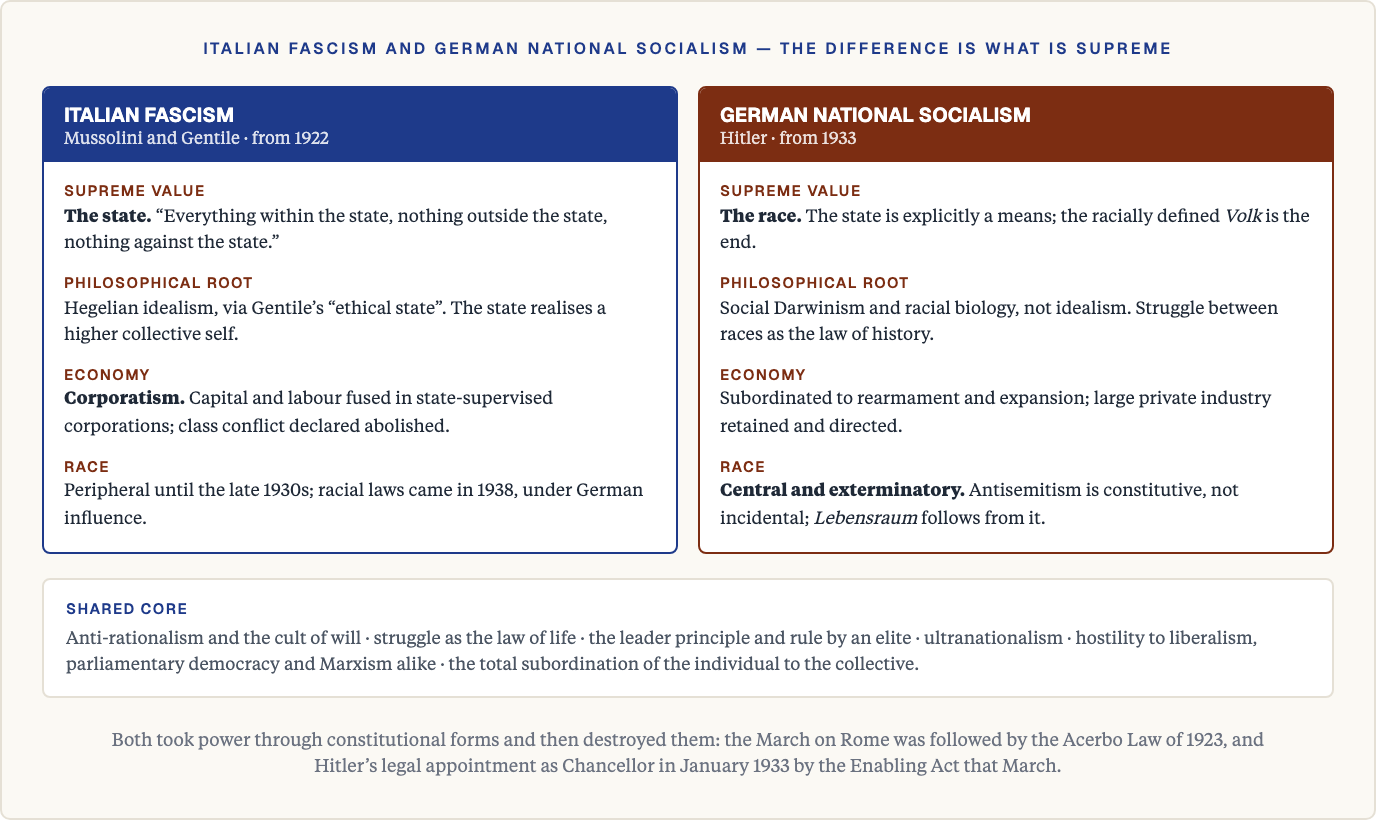
Italian and German fascism compared
UPSC set this directly in 2025. The single organising difference is what occupies the supreme place.
For Mussolini and Giovanni Gentile, whose The Doctrine of Fascism (1932) supplied the philosophical section, the state is supreme. The formula is total: everything within the state, nothing outside the state, nothing against the state. The state is an ethical reality that realises a higher collective self, an inheritance from Hegelian idealism. Race was peripheral to Italian Fascism for most of its life; the racial laws of 1938 came late and under German influence.
For Hitler, the state is explicitly a means. The Volk, the racially defined people, is the end, and a state that fails to serve racial preservation has no claim on loyalty. The intellectual root is not idealism but racial biology and social Darwinism. Antisemitism is constitutive rather than incidental, and Lebensraum, living space in the east, follows from the doctrine of racial struggle rather than from ordinary strategic ambition.
Two further differences are worth a line each. Italian Fascism developed corporatism as a distinctive economic doctrine, fusing capital and labour in state-supervised corporations and declaring class conflict abolished; National Socialism had no comparable doctrine and subordinated the economy to rearmament. And Italian Fascism never achieved the total penetration of society that the German regime did, since the monarchy, the army and the Church retained independent standing throughout.
Fascism and parliamentary democracy
The 2023 question, on fascism’s ambivalent stance toward parliamentary democracy, needs the ambivalence stated as a structure rather than as a contradiction.
In doctrine, hostile. Parliament is condemned as a talking shop that dissolves national will into faction, and as the instrument by which liberal elites and Marxist parties frustrate the nation. Gentile’s ethical state has no room for organised opposition, and the leader principle is incompatible with representation.
In practice, instrumental. Both movements entered through constitutional doors. The March on Rome in October 1922 was followed by Mussolini’s appointment as Prime Minister by the King, a governing coalition, and the Acerbo Law of 1923 which awarded two-thirds of seats to the largest list; only after the 1924 election and the Matteotti crisis was the parliamentary system dismantled. Hitler was appointed Chancellor legally in January 1933 and secured the Enabling Act that March through a Reichstag vote taken under conditions of intimidation.
In rhetoric, a rival claim to democracy. Both regimes claimed to be more democratic than liberal states, on the argument that the leader embodies the people’s will directly rather than refracting it through parties, and both used plebiscites to manufacture the appearance of ratification. This is why fascism is better described as anti-liberal democracy than as frankly anti-popular.
The lesson usually drawn, and worth drawing, is that constitutional forms are not self-protecting. Both cases show a democracy dismantled through its own procedures, which is why post-war constitutions, including India’s, contain entrenchment devices and why the basic structure doctrine matters.
Gandhism
Thinker
Mohandas Karamchand Gandhi (1869–1948)
Key works. Hind Swaraj (1909), An Autobiography, or The Story of My Experiments with Truth (1927–29), the collected writings in Young India and Harijan
Core claim. Means and ends are inseparable: the means are the end in process, so a just order cannot be built by unjust methods. From this follow ahimsa as the only permissible method, satyagraha as its political form, swaraj as self-rule beginning with rule over oneself, and a decentralised order of village republics.
Standard critique. Ambedkar’s charge that the village is a den of localism and the natural home of caste oppression; the socialist charge that trusteeship depends on a change of heart with no sanction if it does not come; and the criticism that satyagraha presupposes an opponent capable of shame.
Exam hook. Gandhi appears in three separate syllabus places: as ideology here, as Indian political thought in Chapter 12, and as the strategy of the national movement in Chapter 14. Do not repeat the same material in all three.
The unity of means and ends
This is the axis of the whole system and the point most often missed. For Gandhi the common metaphor of the seed and the tree governs: the means are the seed and the end the tree, and there is the same inviolable connection between them as between the two. There is therefore no calculation in which a violent means can be justified by a peaceful end, which distinguishes him from every consequentialist and from the revolutionary tradition entirely.
The working concepts
Ahimsa is not merely abstention from violence but active love, including toward the opponent, whose humanity the method is designed to reach.
Satyagraha, literally holding firmly to truth, is the political technique that follows. It is not passive resistance, a description Gandhi rejected, because it is active, requires courage rather than weakness, and aims at converting the opponent rather than defeating them. Its forms include non-cooperation, civil disobedience, the fast and the constructive programme; its discipline requires openness about intentions, the acceptance of suffering, and a readiness to compromise on everything except principle.
Swaraj carries two senses simultaneously, and an answer that gives only the political sense has missed the argument. Outwardly it is self-government, the end of foreign rule. Inwardly it is rule over oneself, the mastery of one’s own mind and passions, without which political independence merely substitutes Indian rulers for English ones. Hind Swaraj (1909) makes this explicit: English rule without the Englishman would be not Hindustan but Englistan.
Swadeshi is the discipline of using and serving what is near, of which the charkha is both the instrument and the symbol: economic self-reliance, dignity of manual labour, and a link between the educated nationalist and the village.
Sarvodaya, the welfare of all, is Gandhi’s alternative to utilitarianism, taken from his reading of Ruskin’s Unto This Last. The greatest good of the greatest number is insufficient because it permits the sacrifice of a minority; the rise of all is the only acceptable standard. Vinoba Bhave’s Bhoodan movement was the attempt to institutionalise it.
Trusteeship applies the same logic to property. The wealthy are to regard their wealth as held in trust for society, taking only what they need. It avoids the violence of expropriation and depends entirely on voluntary conversion, which is precisely the objection to it.
The critique of modern civilisation
Hind Swaraj (1909) is directed less at the British than at the civilisation the Indian elite wished to inherit. Machinery is condemned as displacing labour and creating dependence; railways as spreading famine and plague and enabling centralised extraction; lawyers as thriving on quarrels; doctors as enabling people to persist in the habits that made them ill. The underlying charge is that modern civilisation multiplies wants and calls the multiplication progress, while true civilisation is the deliberate limitation of wants.
The state, as Chapter 2 sets out, is rejected as violence in concentrated form, and the alternative is the oceanic circle: authority flowing outward from self-governing individuals to villages and upward only by consent, so that the centre serves the periphery rather than commanding it.
Assessment
Gandhism’s achievements are not in dispute: it made mass politics possible in a colonial society without an armed struggle, it supplied a method that has been used from Montgomery to Manila, and it placed the moral quality of political action permanently on the agenda.
The criticisms an answer must record are Ambedkar’s, that the village Gandhi idealised was the principal instrument of caste oppression and that varnashrama could not be reformed into equality however sincerely reinterpreted; the Marxist charge that trusteeship left the structure of property untouched while diverting mass energy into moral self-improvement; and the practical observation that satyagraha works against an opponent with a conscience and a free press, which is why it has no answer to a genuinely totalitarian regime.
Feminism
The waves
| Wave | Period and site | Claim, and key texts |
|---|---|---|
| First | 19th century to 1920s; law and the state | Legal personhood, property, education, suffrage. Wollstonecraft’s A Vindication of the Rights of Woman (1792); Mill’s The Subjection of Women (1869); Seneca Falls, 1848 |
| Second | 1960s to 1980s; the family, work, the body | Formal rights are insufficient because subordination is produced privately. Friedan’s The Feminine Mystique (1963); Millett’s Sexual Politics (1970); de Beauvoir’s The Second Sex (1949) as the precursor |
| Third | 1990s onward; the category “woman” itself | There is no single female experience; race, class, caste and sexuality intersect. Crenshaw on intersectionality, 1989; Butler’s Gender Trouble (1990); Mohanty’s “Under Western Eyes”, 1986 |
Simone de Beauvoir‘s claim that one is not born but rather becomes a woman is the hinge between the first and second waves, because it separates sex, the biological fact, from gender, the social construction built upon it, and thereby makes subordination a political question rather than a natural one. Judith Butler pushes further, arguing that gender is performative, constituted by the repeated acts said to express it, and that the sex–gender distinction itself presupposes a pre-social body that is already culturally read.
The personal is political
The slogan, from the title of Carol Hanisch’s 1969 paper circulated in 1970, is the second wave’s central theoretical claim and the subject of UPSC’s 2025 question. Its argument has four steps.
- Liberal political theory treats the family as private, and therefore as beyond the reach of justice and outside politics.
- But that boundary is not natural. It is drawn by law, upheld by the state, and it has been drawn differently at different times, which shows it to be a political decision.
- The private sphere so protected is precisely where women’s subordination is organised: in the division of domestic labour, in control over reproduction, in violence within marriage, and in the transmission of gender roles to children.
- Therefore what women experience as individual, personal difficulty, unhappiness in marriage, exhaustion, the assumption of caring duties, is a systematic and political phenomenon, and consciousness-raising is the method by which it is recognised as such.
The practical consequences are large and concrete: domestic violence becomes a public wrong rather than a family matter, marital rape becomes intelligible as rape, unpaid care work becomes visible as labour, and reproductive autonomy becomes a political right. In India the legislative trail runs from the Dowry Prohibition Act 1961 through the Protection of Women from Domestic Violence Act 2005 to the sexual harassment legislation of 2013, and the marital rape exception in the criminal law remains the sharpest unresolved instance.
The standing objection, from Jean Bethke Elshtain among others, is that collapsing the distinction entirely leaves no protected private sphere at all, which is a loss for women as much as for anyone, since the same logic can license state intrusion into intimate life. The reply is that the claim is about the justification of the boundary, not its abolition: a private sphere is defensible, but only one whose limits can be publicly argued for.
The strands
- Liberal feminism. Subordination arises from unequal legal rights and irrational custom; the remedy is equal access to education, employment and office. Wollstonecraft, Mill, Friedan. Criticised for accepting the public–private division and for speaking for professional women.
- Socialist and Marxist feminism. Women’s oppression is bound to capitalism, which relies on unpaid reproductive labour to produce and maintain the workforce at no cost. Engels’s The Origin of the Family, Private Property and the State (1884), Zetkin, Mitchell; Hartmann’s dual-systems account treats patriarchy and capitalism as distinct but interlocking. Criticised for subordinating gender to class.
- Radical feminism. Patriarchy is an independent and primary system of domination, not a by-product of anything else. Millett, Firestone, MacKinnon. Its strength is the analysis of sexuality and violence; its weakness is a tendency to universalise the experience of particular women.
- Post-modern feminism. The category “woman” is itself produced by the discourse that claims to describe it. Butler. Its strength is analytical; its difficulty is that dissolving the subject makes collective political claims harder to ground.
- Post-colonial and Indian feminism. Chandra Talpade Mohanty’s “Under Western Eyes” (1986) attacks the construction of a singular “third world woman” as victim in western feminist writing. In India, Dalit feminist scholarship, notably Sharmila Rege’s argument for a Dalit standpoint, holds that mainstream Indian feminism universalised the experience of upper-caste women and that caste and gender must be analysed together.
Mill on the subjection of women
UPSC quoted Mill’s opening claim in 2023: that the legal subordination of one sex to another is wrong in itself and now one of the chief hindrances to human improvement. The Subjection of Women (1869) argues that the existing relation between the sexes is a survival of the law of the strongest into an age that has abolished it everywhere else; that no one can know women’s nature because it has only ever been observed under conditions of subjection, which he calls an eminently artificial thing; that marriage law makes the wife the nearest analogue to a slave the law still recognises; and that the loss is not only to women but to society, which forfeits half its talent and corrupts men by giving them unearned authority. It is a liberal argument in form, resting on liberty, utility and the removal of artificial restraint, and its limitation is correspondingly liberal: it addresses law and opinion rather than the division of domestic labour, which is what the second wave added.
Debate: Was Gandhi’s rejection of the modern state a coherent politics or a moral posture?
Coherent politics. It follows rigorously from the means-and-ends premise: if compulsion cannot produce moral action, an order resting on compulsion cannot produce a moral society. The positive content is specific rather than vague, village republics, oceanic circles, trusteeship, the constructive programme, and parts of it were institutionalised, in Panchayati Raj, in Bhoodan, and in the constitutional preference for decentralisation. Moral posture. Ambedkar’s objection is decisive on its own ground: transferring power to village republics in a caste society transfers it to dominant castes, so decentralisation without prior social reform is not emancipation but its opposite. Trusteeship has no mechanism, and a stateless order has no answer to external aggression, which is why the Constituent Assembly built a strong centre and Nehru a developmental state. The examiner’s line. Separate the diagnosis from the prescription. Gandhi’s diagnosis, that centralised power and unlimited want are corrosive, has aged extremely well and is echoed in contemporary work on sustainability and on democratic deficit. His prescription assumed a moral transformation for which he offered no institutional guarantee, and Ambedkar identified precisely where that assumption fails hardest.
They say means are, after all, means. I would say means are, after all, everything. As the means so the end
M.K. Gandhi, Young India, 17 July 1924
One is not born, but rather becomes, a woman
Simone de Beauvoir, The Second Sex, 1949
The principle which regulates the existing social relations between the two sexes, the legal subordination of one sex to the other, is wrong in itself
John Stuart Mill, The Subjection of Women, 1869
Where answers lose marks
- Treating fascism and Nazism as interchangeable. The supreme value differs, state against race, and everything else follows from that.
- Saying fascism simply opposed democracy. It used constitutional means to take power and claimed a superior democracy of leader and people; that is what makes the stance ambivalent.
- Reducing satyagraha to non-violent protest. It aims at converting the opponent, requires self-suffering, and is defined against passive resistance.
- Giving swaraj only its political sense. The inner sense, rule over oneself, is what makes Hind Swaraj (1909) a critique of modern civilisation rather than of British rule.
- Presenting feminism as one position. Liberal, socialist, radical, post-modern and post-colonial strands disagree about the mechanism of subordination, which is the substance of the topic.
- Writing on Indian feminism without caste. Rege’s argument, that mainstream Indian feminism universalised upper-caste women’s experience, is the necessary correction.
Asked before
- Mention the difference between Italian and German brands of facism. (2025, Paper I, 10 marks)
- Explain how the slogan “the personal is political” addresses the issue of women’s oppression and discrimination? (2025, Paper I, 15 marks)
- Fascism displays an ambivalent stance towards parliamentary democracy. Explain. (2023, Paper I, 20 marks)
- “The legal subordination of one sex to another is wrong in itself, and now one of the chief hindrances to human development.” (J.S. Mill). Comment. (2023, Paper I, 15 marks)
Answer skeleton
Explain how the slogan “the personal is political” addresses the issue of women’s oppression and discrimination. (15 marks, 250 words)
Frame. Locate it: Carol Hanisch, 1969, and the organising claim of second-wave feminism. It is a thesis about the boundary of politics, not a slogan about attitudes.
Step one, the target. Liberal theory places the family in a private sphere beyond justice. Okin’s charge, from Chapter 3, is that this exempts the institution that most shapes women’s life chances.
Step two, the boundary is political. It is drawn by law, enforced by the state, and has moved historically. What can be redrawn by political decision is political.
Step three, what the boundary shields. The division of domestic labour, control over reproduction, violence within marriage, and the transmission of gender roles.
Step four, the method. Consciousness-raising converts what is experienced as private difficulty into a recognised structural pattern, which makes collective action possible.
Consequences, with Indian anchors. Domestic violence as a public wrong (Act of 2005), sexual harassment at work (2013), unpaid care work as labour, and the unresolved marital rape exception as the clearest surviving instance of the private-sphere shield.
Evaluate. Elshtain’s objection that collapsing the distinction leaves no protected private life, and the reply: the claim concerns the justification of the boundary, not its abolition. Close by noting the strands differ on the mechanism, so the slogan states the problem rather than settling the explanation.
Last-mile revision
- Fascist core: anti-rationalism, struggle, leader principle, elitism, ultranationalism, totalitarian ambition; against liberalism, democracy and Marxism together.
- Italy: state supreme, Gentile’s The Doctrine of Fascism (1932), corporatism, race peripheral until 1938. Germany: race supreme, state a means, social Darwinism, Lebensraum, constitutive antisemitism.
- Ambivalence toward parliament: doctrinally hostile, instrumentally used (March on Rome 1922, Acerbo Law 1923; Chancellorship January 1933, Enabling Act March 1933), rhetorically claiming a truer democracy.
- Gandhi: unity of means and ends; ahimsa; satyagraha as active, converting, self-suffering, not passive resistance; swaraj inner and outer; swadeshi; sarvodaya from Ruskin; trusteeship; Hind Swaraj (1909) against modern civilisation.
- Critiques of Gandhi: Ambedkar on the village and caste, the Marxist charge against trusteeship, the limits of satyagraha against a regime without conscience.
- Feminist waves: first (Wollstonecraft 1792, Seneca Falls 1848, Mill 1869), second (de Beauvoir 1949, Friedan 1963, Millett 1970), third (Crenshaw 1989, Butler 1990, Mohanty 1986).
- Sex and gender; de Beauvoir’s becoming; Butler’s performativity.
- The personal is political: Hanisch 1969; four steps from the private sphere to consciousness-raising; Elshtain’s objection.
- Strands and their mechanisms: liberal (law and custom), socialist (unpaid reproductive labour, Engels 1884, Hartmann’s dual systems), radical (patriarchy as primary), post-modern (discourse), post-colonial and Dalit (Mohanty 1986, Rege).
Read the rest. This chapter is one of 58 in the complete PSIR Optional Notes, covering Paper I and Paper II in full — free to download.
Tell Google you want more of this.
Add Anantam IAS as a preferred sourceOne tap, and this site shows up more often in your own Top Stories, AI Overviews and AI Mode. Remove it any time.