
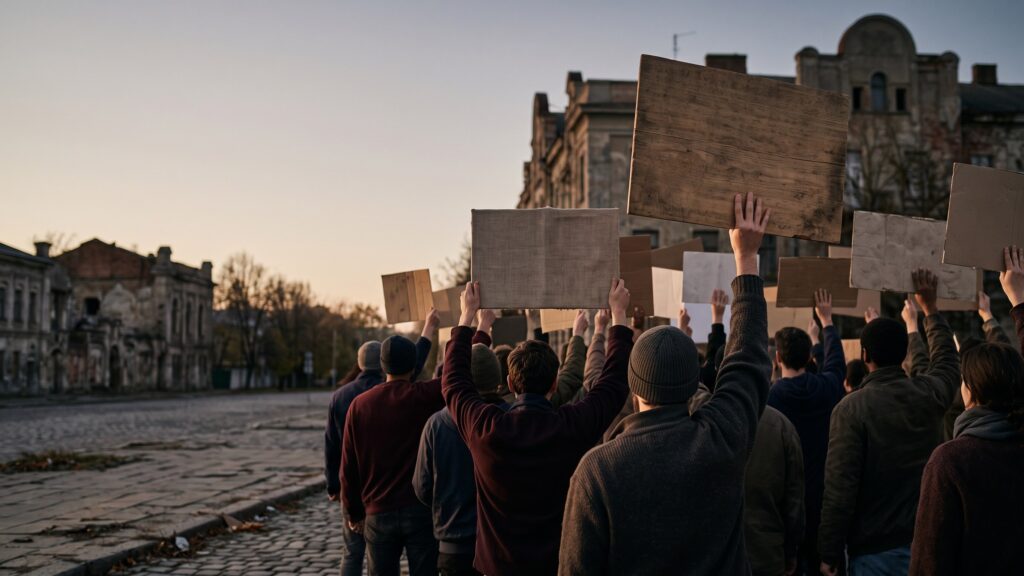
Movements are the part of Indian democracy that operates between elections. Their measure is not whether they won their immediate demand but whether they changed what the state is obliged to do, and by that measure several of them have legislated.
This is chapter 32 of the PSIR Optional Notes, from the part on Indian Government and Politics in the Paper I syllabus. The complete book is a free download.
UPSC syllabus
Social Movements: Civil liberties and human rights movements; women’s movements; environmentalist movements.
In one page
- A social movement is sustained collective action outside routine institutional channels, with a shared identity and a challenge to existing authority or distribution.
- The old movements were class-based and redistributive; new social movements from the 1970s are identity-, rights- and issue-based, decentralised, and often suspicious of state-led development.
- Civil liberties organisations, PUCL (1976) and PUDR (1977), were born of the Emergency, and their staple work is custodial death, encounter killings, preventive detention and the operation of security laws.
- The women’s movement runs from nineteenth-century social reform through the nationalist phase to the autonomous movement of the late 1970s, which was triggered by the Mathura rape judgment and won the Criminal Law (Amendment) Act 1983.
- The anti-arrack movement in Nellore, Andhra Pradesh (1991–92), is the standard case of a women’s movement arising from literacy classes and producing state-level prohibition.
- Environmental movements in India are predominantly movements of livelihood, which is Guha and Martinez-Alier’s environmentalism of the poor: the resource is not scenery but subsistence.
- Chipko (1973), Silent Valley (1978–83), Narmada Bachao Andolan (1985) and the anti-POSCO and Niyamgiri struggles are the reference cases, and each produced institutional change.
- The right to information campaign is the clearest instance of a movement legislating: from MKSS wage-record demands in Rajasthan to the RTI Act 2005.
Framing the field
Old and new
Old movements were organised around class and made redistributive demands on the state: the peasant and workers’ movements of Chapter 19 are the type. New social movements, theorised by Touraine, Melucci and Offe and applied to India by Rajni Kothari, D.L. Sheth and Gail Omvedt, differ in four ways: their base is identity or issue rather than class; their organisation is decentralised and often anti-hierarchical; their demands concern autonomy, dignity, recognition and control over resources rather than a larger share of output; and they are frequently sceptical of the developmental state itself.
Kothari’s non-party political process is the standard Indian formulation: from the late 1970s, groups outside party politics took up issues parties would not, and became a parallel channel of representation. His own later worry, that this space could be depoliticised into project-based NGO work dependent on funding, is the standing internal criticism.
Civil liberties and human rights
PUCL, founded by Jayaprakash Narayan in 1976 as the People’s Union for Civil Liberties and Democratic Rights, and PUDR, which separated in 1977, are the movement’s core. The Emergency is the formative experience: preventive detention under MISA, press censorship, and the Supreme Court’s capitulation in ADM Jabalpur (1976) demonstrated that constitutional guarantees could fail exactly when needed.
The movement’s characteristic work: documentation of custodial deaths and encounter killings; fact finding after communal violence; litigation on preventive detention and on the operation of TADA, POTA, UAPA and the Armed Forces (Special Powers) Act; and campaigns on the death penalty. Its jurisprudential yield is substantial, and the cases are worth naming: Hussainara Khatoon (1979) on undertrials and speedy trial, Sunil Batra on prisoners’ rights, D.K. Basu (1997) on arrest guidelines, PUCL (1997) on telephone tapping and privacy, and Nandini Sundar (2011) on state-supported vigilantism in Chhattisgarh.
The movement’s own difficulties: dependence on courts whose enforcement is weak; the charge of selectivity, which is made against it from several directions; the shrinking of the space for foreign-funded organisations under FCRA amendments; and the persistent gap between judicial guidelines and police practice.
The women’s movement
Phases
- Social reform, nineteenth century. Led largely by men, Rammohun Roy, Vidyasagar, Phule, and directed at sati, widow remarriage, child marriage and women’s education. Its framing was reform of the community rather than rights of the woman.
- Nationalist phase. Women’s organisations, the Women’s Indian Association (1917), the National Council of Women in India (1925) and the All India Women’s Conference (1927), and mass participation in the civil disobedience movement. The demand for the vote was largely conceded with independence, which meant the movement did not need a suffrage struggle and did not build the organisation such a struggle produces.
- Autonomous movement, late 1970s onward. Triggered by the Supreme Court’s judgment in Tuka Ram v. State of Maharashtra (1979), the Mathura custodial rape case, in which four law teachers wrote an open letter that became the movement’s founding document. The campaign produced the Criminal Law (Amendment) Act 1983, which created the offence of custodial rape, shifted the burden of proof on consent in such cases, and provided for in-camera trial.
- After 1990. Diversification: Dalit feminist critique from Chapter 9, campaigns on dowry and domestic violence producing the Protection of Women from Domestic Violence Act 2005, the Vishaka guidelines (1997) and the sexual harassment Act of 2013, and the post-2012 mobilisation producing the Criminal Law (Amendment) Act 2013 on the Justice Verma Committee’s recommendations.
The anti-arrack movement
The 2024 paper asked about women’s role in the anti-arrack movement, which is a specific and answerable case.
It began in Dubagunta village in Nellore district of Andhra Pradesh in 1991–92. Its origin was a literacy programme: a lesson in the adult literacy primer described a woman whose household was destroyed by her husband’s drinking, and the women in the class recognised their own situation. They organised to stop arrack sales, picketed auctions and shops, and the movement spread across the district and then the state.
Its significance is fourfold. It was led by poor rural women, not by urban organisations, which is unusual. It connected an apparently private grievance, household violence and the diversion of wages, to a public and fiscal question, since state excise revenue depended on arrack sales. It succeeded: Andhra Pradesh prohibited arrack in 1993 and briefly imposed total prohibition in 1995. And it demonstrated the political consequences of literacy programmes, which is why it recurs in the adult-education literature as well as the movement literature. Prohibition was later rolled back under fiscal pressure, which is itself part of the lesson.
Environmental movements
Environmentalism of the poor
The concept, developed by Ramachandra Guha and Juan Martinez-Alier, distinguishes the environmentalism of affluent societies, concerned with amenity, wilderness and post-material values, from that of poor societies, where environmental conflict is a conflict over the material basis of livelihood. The 2023 question asked for exactly this term.
Its features: the protagonists are peasants, forest dwellers, fishers and Adivasis, not middle-class conservationists; the object is access to and control over forests, water, pasture and coastline; the language is often of customary right rather than of ecology; and the opponent is typically the state or a state-backed project. Guha and Madhav Gadgil’s omnivores and ecosystem people distinction is the accompanying analytical frame: those who draw resources from the whole country against those who depend on their immediate environment.
The cases
- Chipko (1973, Mandal village in Chamoli). Villagers, women prominently, embraced trees to prevent felling by contractors. Leadership from Chandi Prasad Bhatt and Sunderlal Bahuguna represented two strands, one emphasising local forest use for village industry, the other conservation. Outcome: a fifteen-year ban on green felling above 1000 metres in the Uttarakhand Himalaya in 1980.
- Silent Valley (1978–83, Kerala). A scientific and literary campaign, led by the Kerala Sasthra Sahithya Parishad, against a hydroelectric project in an undisturbed rainforest. Outcome: the project was abandoned and the area declared a national park in 1984. This is the one major case closer to classical conservation than to livelihood.
- Narmada Bachao Andolan (from 1985, Medha Patkar). Against the Sardar Sarovar and associated dams, on displacement and inadequate rehabilitation. Outcomes: the first World Bank independent review, the Morse Commission (1992), and Bank withdrawal in 1993; the Supreme Court’s judgment in 2000 permitting construction with rehabilitation conditions; and, most durably, the establishment of resettlement and rehabilitation as a policy question, leading eventually to the Right to Fair Compensation and Transparency in Land Acquisition, Rehabilitation and Resettlement Act 2013.
- Appiko (1983, Karnataka), the southern counterpart of Chipko; the Chilika fishers’ movement against commercial prawn culture; anti-POSCO in Odisha; and Niyamgiri, where the Supreme Court in 2013 directed that the Dongria Kondh Gram Sabhas decide on bauxite mining, and all twelve rejected it. Niyamgiri is the strongest demonstration of the Forest Rights Act’s consent provision working.
Effect on environmental governance
The 2024 question asked how environmental movements shaped governance, and the causal links are specific: the Water Act 1974, Air Act 1981 and the Environment (Protection) Act 1986 following Stockholm and Bhopal; the creation of a separate Department and then Ministry of Environment; the Forest Conservation Act 1980 requiring central clearance for diversion of forest land; environmental impact assessment notified in 1994 and revised in 2006, with public hearing requirements that movements had demanded; the Forest Rights Act 2006, which recognised individual and community forest rights and required Gram Sabha consent for diversion; the National Green Tribunal Act 2010, creating a specialised forum; and the 2013 land acquisition Act’s consent and social impact assessment provisions.
The counter-current should also be stated: successive relaxations of clearance procedures, the draft EIA notification of 2020, and amendments to the Forest Conservation Act in 2023 have moved in the opposite direction, which is why movements remain active.
Other movements worth naming
The right to information campaign is the clearest case of movement-to-statute. It began with the Mazdoor Kisan Shakti Sangathan in Rajasthan in the early 1990s demanding access to muster rolls and bills to verify whether wages recorded had been paid, expanded through the National Campaign for People’s Right to Information, produced state legislation, and culminated in the Right to Information Act 2005. The right to food campaign, from a PUCL petition in 2001, produced the Supreme Court’s interim orders on midday meals and eventually the National Food Security Act 2013. The right to work campaign contributed to MGNREGA in 2005. Together these are the strongest evidence for the claim that movements in India legislate.
Where answers lose marks
- Treating Chipko as a conservation movement. It was about villagers’ rights to forest produce against contractors, which is why it belongs to the environmentalism of the poor.
- Presenting the women’s movement as beginning in the 1970s. The reform and nationalist phases matter, and the absence of a suffrage struggle explains a real organisational weakness.
- Giving the anti-arrack movement without its origin in the literacy programme. That link is the point of the case.
- Listing movements without outcomes. Chipko’s 1980 felling ban, Silent Valley’s 1984 national park, Narmada’s Morse Commission and the 2013 Act, and Niyamgiri’s Gram Sabha verdict are what make the answer analytical.
- Omitting the counter-current in environmental governance. Clearance relaxation and the 2023 forest amendments are part of an honest assessment.
- Ignoring the movement-to-legislation cases. RTI 2005, MGNREGA 2005 and the food security Act 2013 are the strongest evidence available for movement effectiveness.
Asked before
- Discuss the role of environmental movements in shaping the environmental governance in India. (2024, Paper I, 20 marks)
- Environmentalism of the poor. (2023, Paper I, 10 marks)
- Women’s role in anti-arrack movement. (2024, Paper I, 10 marks)
Answer skeleton
Environmentalism of the poor. (10 marks, 150 words)
Define. Guha and Martinez-Alier’s term for environmental conflict in poor societies, where the stake is the material basis of livelihood rather than amenity or wilderness. Contrast with the post-material environmentalism of affluent societies.
Features. Protagonists are peasants, Adivasis, fishers and forest dwellers; the object is access to and control over forest, water, pasture and coast; the idiom is customary right as much as ecology; and the antagonist is usually the state or a state-backed project.
The accompanying frame. Gadgil and Guha’s omnivores and ecosystem people: those who draw on the resources of the whole country against those who depend on their immediate surroundings, with ecological refugees as the product of that asymmetry.
Indian cases. Chipko (1973) over forest produce against contractors; Narmada Bachao Andolan (1985) over displacement; Chilika fishers against commercial prawn culture; Niyamgiri, where twelve Dongria Kondh Gram Sabhas rejected mining in 2013.
Why the distinction matters. It refutes the claim that environmentalism is a luxury of the rich, and it changes the policy question from conservation versus development to whose resources are being converted into whose growth.
Close. Its institutional trace is visible in the Forest Rights Act 2006 and in the consent and social impact provisions of the 2013 land acquisition Act.
Last-mile revision
- Old versus new social movements; Kothari’s non-party political process and his worry about NGO-isation; Omvedt and Sheth.
- PUCL 1976, PUDR 1977; ADM Jabalpur (1976) as the formative failure; Hussainara Khatoon (1979), D.K. Basu (1997), PUCL (1997) on tapping, Nandini Sundar (2011).
- Women: reform phase; WIA 1917, NCWI 1925, AIWC 1927; Mathura judgment 1979 and the open letter; Criminal Law (Amendment) Act 1983; Vishaka 1997 and the 2013 Act; Domestic Violence Act 2005; Justice Verma Committee and the 2013 amendment.
- Anti-arrack: Dubagunta, Nellore, 1991–92, from a literacy primer; arrack banned in Andhra Pradesh 1993, prohibition 1995, later rolled back.
- Environment: Chipko 1973 and the 1980 felling ban; Silent Valley 1978–83 and the 1984 national park; NBA from 1985, Morse Commission 1992, World Bank withdrawal 1993, Supreme Court 2000; Appiko 1983; Niyamgiri Gram Sabhas 2013.
- Governance: Water Act 1974, Air Act 1981, EPA 1986, Forest Conservation Act 1980, EIA 1994 and 2006, Forest Rights Act 2006, NGT Act 2010, land acquisition Act 2013; counter-current in the 2020 draft EIA and the 2023 forest amendments.
- Movement to statute: MKSS to RTI 2005; PUCL petition 2001 to the food security Act 2013; right-to-work campaign to MGNREGA 2005.
Read the rest. This chapter is one of 58 in the complete PSIR Optional Notes, covering Paper I and Paper II in full — free to download.
Tell Google you want more of this.
Add Anantam IAS as a preferred sourceOne tap, and this site shows up more often in your own Top Stories, AI Overviews and AI Mode. Remove it any time.