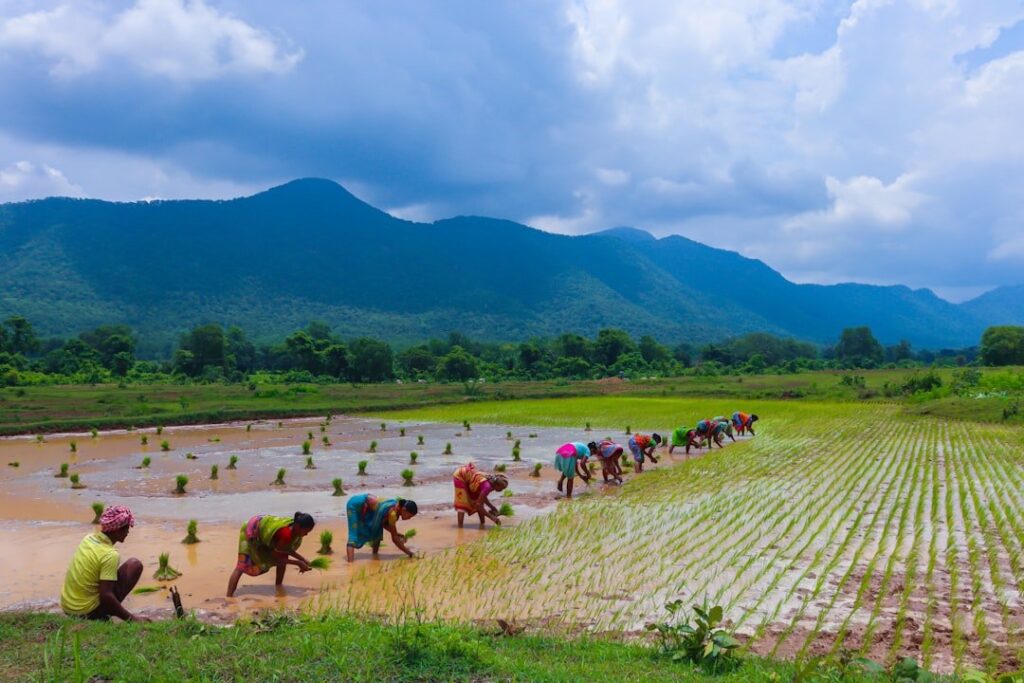
Rainfed Area Development under NMSA is one of the four core components of the National Mission for Sustainable Agriculture, the Indian climate-smart agriculture mission that sits inside the National Action Plan on Climate Change. Rainfed Area Development (RAD) is explicitly designed for the 51 per cent of India’s net sown area that depends on the monsoon rather than on assured irrigation — a tract that includes most of the central, peninsular and western dry regions. The core idea is not to push more rice or wheat into these districts, and not to encourage monoculture; instead, RAD promotes Integrated Farming System (IFS) models that combine crops with livestock, horticulture, fisheries, agroforestry and apiculture so that a household has multiple income streams resilient to drought, pest outbreaks and price shocks.
For UPSC, Rainfed Area Development NMSA is examined in agriculture, environment and economy; in governance (centrally sponsored schemes); and in current affairs. A prelims item typically tests whether the candidate recognises that RAD is built around Integrated Farming Systems, not monoculture, and that it is targeted at rainfed regions, not irrigated paddy belts.
What NMSA Is
The National Mission for Sustainable Agriculture is one of the eight national missions under the National Action Plan on Climate Change (NAPCC) announced in 2008. It was operationalised in the 12th Five Year Plan period and continues today. NMSA aims to make Indian agriculture more productive, sustainable, remunerative and climate-resilient. It has four main components:
- Rainfed Area Development (RAD).
- Soil Health Management (SHM).
- Sub-Mission on Agroforestry (SMAF).
- Paramparagat Krishi Vikas Yojana (PKVY) — promoting organic farming.
A national fund — the National Adaptation Fund on Climate Change — supports adaptation activities including those under NMSA.
What Rainfed Area Development Does
Rainfed Area Development is the sub-mission within NMSA targeted at districts where less than half the cropped area is irrigated. Its core strategy is the Integrated Farming System approach.
Integrated Farming System (IFS)
An IFS is a farming model in which two or more enterprises are combined on a single holding so that the by-product of one enterprise becomes the input of another. Typical pairings include:
- crop + dairy (crop residue feeds animals, manure goes back to the field),
- crop + poultry,
- crop + horticulture + apiculture,
- crop + fish + duck,
- crop + agroforestry (shade trees, fruit trees, nitrogen-fixing trees),
- crop + small ruminants.
IFS is the opposite of monoculture. A rainfed farmer is most vulnerable to a single shock — a delayed monsoon, a hailstorm, a pest outbreak — when the entire household income depends on one crop. Diversification across enterprises spreads risk and creates year-round cash flow.
Why not monoculture?
Monoculture maximises yield per hectare in good years but is fragile against a single shock. In rainfed districts, where the rainfall coefficient of variation often exceeds 25 per cent, a single bad year wipes out an entire household’s income. RAD therefore explicitly avoids monoculture and promotes IFS.
Any statement that says RAD “promotes monoculture of high-yielding cereals in rainfed districts” is therefore wrong.
Why not paddy in irrigated tracts?
A second confusion is about where RAD operates. RAD is for rainfed areas — by definition, low-irrigation districts. It is not intended to promote paddy in already irrigated tracts. Paddy cultivation in over-irrigated belts is, if anything, what other schemes (crop diversification programmes, ground-water restoration efforts) try to shift away from.
Any statement that says RAD “encourages paddy cultivation in irrigated rice tracts” is therefore wrong.
How RAD Is Implemented
The scheme is a centrally sponsored scheme implemented by state agriculture departments under guidelines issued by the Department of Agriculture and Farmers Welfare.
Cluster approach
Implementation is in clusters — typically 100 hectares of rainfed land in a single contiguous block, with farmers grouped together. Cluster organisation allows pooled procurement of inputs, joint marketing, shared infrastructure for storage and value addition, and easier convergence with other schemes such as MGNREGS (for land development), PMKSY (for water structures) and NRLM (for self-help group formation).
Funding pattern
Funding is shared between Centre and States at a ratio of 60:40 for general states and 90:10 for hill, northeastern and special-category states. Per-hectare assistance covers land treatment, water management, IFS adoption, livestock support, fodder, horticulture and beneficiary training.
Outcome metrics
RAD tracks indicators such as area covered under IFS, additional household income, water productivity, and adoption of climate-resilient practices.
Relationship with Other Components of NMSA
- Soil Health Management (SHM) provides soil health cards, balanced fertilisation guidance, and support for soil-test laboratories.
- Sub-Mission on Agroforestry (SMAF) promotes tree-based farming systems and links to the National Agroforestry Policy 2014.
- PKVY subsidises organic farming clusters, particularly in NE and rainfed states.
RAD complements these by providing the IFS framework around which soil, agroforestry and organic components can converge on the ground.
Climate-Smart Agriculture: The Wider Frame
NMSA, including RAD, is part of India’s nationally appropriate response to climate change in agriculture. The IPCC’s Sixth Assessment Report and the FAO’s climate-smart agriculture framework both stress three pillars: productivity, adaptation and mitigation. Indian rainfed farming systems — already adapted to high-variability environments — are natural laboratories for the climate-smart approach. RAD’s IFS focus matches this framework.
Why IFS Works Economically
Studies by ICAR institutes, including IIFSR (Indian Institute of Farming Systems Research), have repeatedly shown that integrated farming systems on small holdings can generate higher and more stable household income than monoculture cropping. Crop residues feed animals; animal dung returns nutrients to fields; fish or duck-rearing in farm ponds adds protein and income; bees pollinate horticultural crops. The system mimics natural ecological cycles and reduces input costs.
In rainfed districts where the costs of irrigation and fertiliser are punitive, this kind of low-input integrated approach is often the only economically viable model.
Common Tests on RAD-NMSA
Three multi-statement formats recur in prelims:
- RAD-NMSA promotes IFS that combines crops with livestock, horticulture, fisheries, agroforestry and apiculture — correct.
- RAD-NMSA promotes monoculture of high-yielding cereals in rainfed districts — incorrect.
- RAD-NMSA encourages paddy cultivation in irrigated rice tracts — incorrect.
If only one statement is correct in a three-statement question, it will almost always be the IFS one.
For deeper context, see also our explainers on the National Action Plan on Climate Change and Pradhan Mantri Krishi Sinchayee Yojana.
Frequently Asked Questions
What is Rainfed Area Development under NMSA?
Rainfed Area Development (RAD) is the sub-mission of the National Mission for Sustainable Agriculture that targets non-irrigated districts and promotes Integrated Farming Systems combining crops, livestock, horticulture, fisheries and agroforestry to build climate resilience.
What is an Integrated Farming System?
An Integrated Farming System combines two or more enterprises on a single holding so that the output of one is the input of another, diversifying income and reducing risk for the farm household.
Does RAD promote monoculture?
No. RAD is built around Integrated Farming Systems, which are the opposite of monoculture. Monoculture is fragile against drought, pest and price shocks, and RAD deliberately avoids it.
Does RAD support paddy in irrigated tracts?
No. RAD is targeted at rainfed districts with limited irrigation. It is not intended to promote paddy in already-irrigated rice belts; other schemes work on crop diversification in over-irrigated tracts.
Which ministry implements NMSA?
The Department of Agriculture and Farmers Welfare under the Ministry of Agriculture and Farmers Welfare, in partnership with state agriculture departments.
What is the funding pattern for RAD?
Sixty-forty between Centre and States for general states, and ninety-ten for hill, northeastern and special-category states.
How big is India’s rainfed area?
About 51 per cent of the net sown area is rainfed — roughly 86 million hectares — and these districts produce a significant share of pulses, coarse cereals, oilseeds, cotton and livestock products.
How does RAD link with MGNREGS and PMKSY?
Implementation in clusters is designed to allow convergence — MGNREGS supports land and water development works, PMKSY provides micro-irrigation and water-saving infrastructure, and RAD provides the IFS framework on top.
Tell Google you want more of this.
Add Anantam IAS as a preferred sourceOne tap, and this site shows up more often in your own Top Stories, AI Overviews and AI Mode. Remove it any time.