The Rashtrakuta dynasty was one of the most powerful ruling houses of medieval India, dominating the Deccan and beyond from the mid-8th to the late 10th century CE (c. 753–982 CE). Known for their military prowess, administrative efficiency, and extraordinary patronage of art and architecture — most notably the Kailasa temple at Ellora — the Rashtrakutas are a significant topic in UPSC Ancient and Medieval Indian History. Arab traveller Sulaiman described the Rashtrakuta king as one of the four great kings of the world.
Origin and Rise
The origins of the Rashtrakutas are debated among historians:
- Some scholars trace them to the Rashtikas mentioned in Ashokan inscriptions.
- They initially served as feudatories (subordinates) of the Chalukyas of Badami.
- Dantidurga (c. 735–756 CE) overthrew the last Badami Chalukya ruler, Kirtivarman II, and established the independent Rashtrakuta kingdom with its capital at Manyakheta (Malkhed) in present-day Karnataka.
The dynasty's power was centred in the northern Deccan but extended from the Vindhyas to the Tungabhadra, and at their peak, Rashtrakuta armies campaigned as far as Kannauj in the north and Tanjore in the south.
Major Rulers
| Ruler | Reign (approx.) | Key Achievements |
|---|---|---|
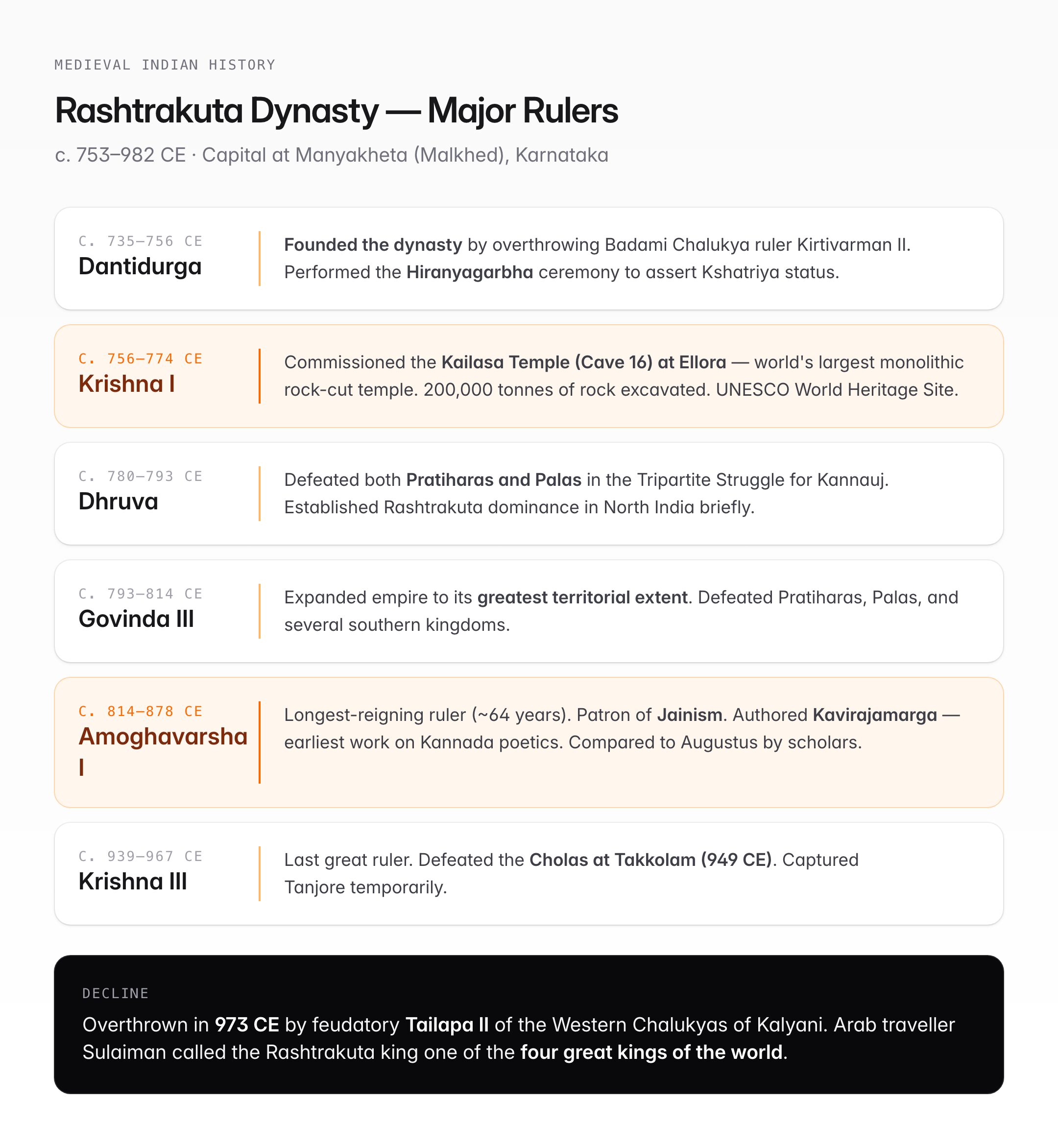
| Dantidurga | c. 735–756 CE | Founded the dynasty by overthrowing the Badami Chalukyas; performed the Hiranyagarbha ceremony to assert Kshatriya status |
| Krishna I | c. 756–774 CE | Commissioned the Kailasa temple at Ellora (Cave 16) — the greatest monolithic rock-cut temple in the world |
| Dhruva | c. 780–793 CE | Defeated both the Pratiharas and Palas in the Tripartite Struggle for Kannauj; established Rashtrakuta dominance in North India briefly |
| Govinda III | c. 793–814 CE | Expanded the empire to its greatest territorial extent; defeated the Pratiharas, Palas, and several southern kingdoms |
| Amoghavarsha I | c. 814–878 CE | Longest-reigning Rashtrakuta king (~64 years); patron of Jainism; authored Kavirajamarga (earliest work on Kannada poetics); compared to Augustus by scholars; shifted focus from military expansion to culture and religion |
| Krishna III | c. 939–967 CE | Last great Rashtrakuta ruler; defeated the Cholas at the Battle of Takkolam (949 CE); captured Tanjore temporarily |
The Tripartite Struggle for Kannauj
One of the defining geopolitical contests of early medieval India was the three-way struggle for control of Kannauj — the symbolic and strategic centre of North Indian political power:
- Rashtrakutas (Deccan) vs. Pratiharas (western/central India) vs. Palas (Bengal and Bihar).
- This struggle lasted roughly from the late 8th to the early 10th century.
- The Rashtrakutas, particularly Dhruva and Govinda III, defeated both rivals but could not hold Kannauj permanently due to the distance from their Deccan base.
- The Pratiharas eventually gained the most sustained control over Kannauj.
Ellora Caves and the Kailasa Temple
The Kailasa temple (Cave 16) at Ellora (near Aurangabad, Maharashtra) is the crowning achievement of Rashtrakuta art:
- Commissioned by Krishna I in the 8th century CE.
- It is a monolithic structure — carved top-down from a single rock, an estimated 200,000 tonnes of rock were excavated.
- Dedicated to Lord Shiva, it represents Mount Kailasa, the abode of Shiva.
- The temple complex includes a Nandi pavilion, a main shrine, and elaborate sculptural panels depicting scenes from the Ramayana and Mahabharata, and the demon-king Ravana shaking Mount Kailasa.
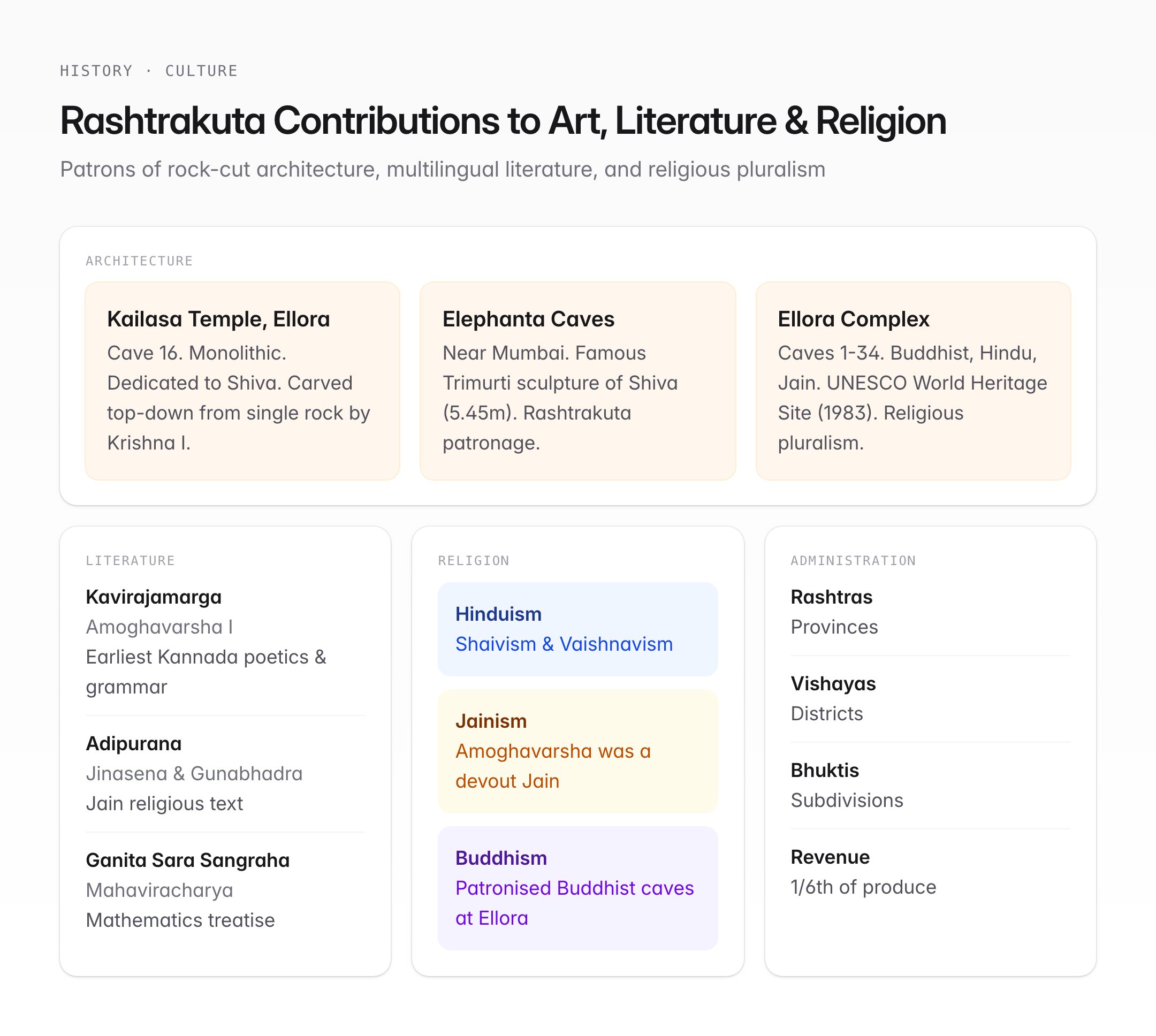
- It is part of the Ellora Caves complex (Caves 1-34), which is a UNESCO World Heritage Site (designated 1983) and includes Buddhist, Hindu, and Jain cave temples — reflecting the religious pluralism of the Deccan.
Administration
The Rashtrakutas developed an efficient administrative system:
- The empire was divided into rashtras (provinces), vishayas (districts), and bhuktis (subdivisions).
- Village administration was largely autonomous, with elected village assemblies managing local affairs.
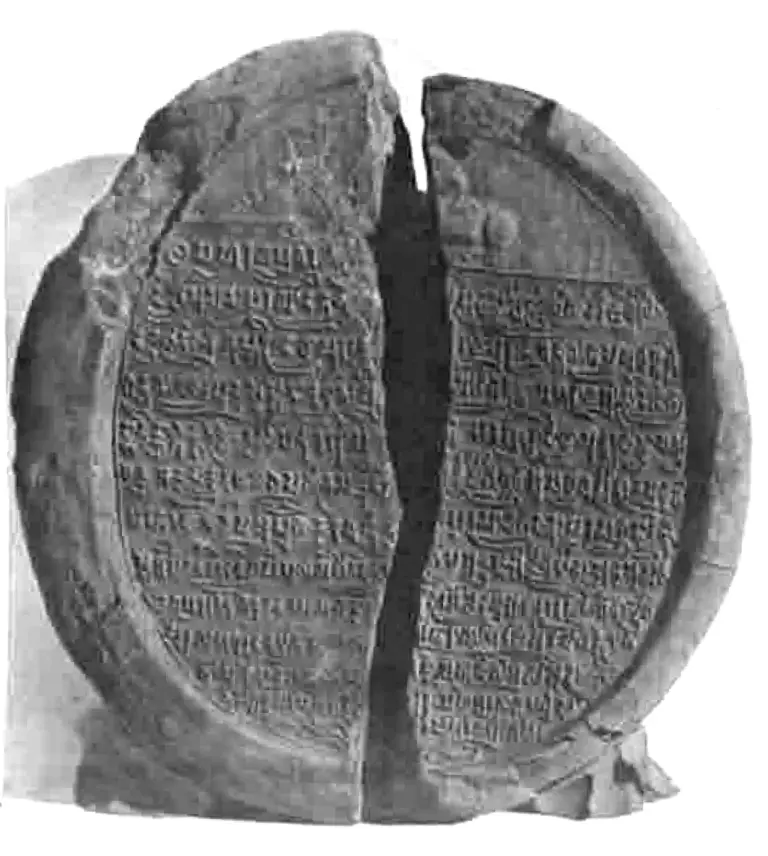
- Land grants to Brahmanas and temples (recorded in copper-plate inscriptions) were common.
- The dynasty maintained a powerful standing army and a navy for coastal defence.
- Revenue was primarily from land tax (typically one-sixth of the produce), trade levies, and tribute from feudatories.
- Officials included the yuvaraja (crown prince), mahasamantadhipati (chief feudatory), and sandhi-vigrahika (minister for peace and war).
Contributions to Art, Literature & Architecture
Art and Architecture
- Beyond Ellora, Rashtrakutas patronised the Elephanta Caves (near Mumbai) with the famous Trimurti sculpture of Shiva.
- Rock-cut architecture reached its zenith under their patronage.
- The Jain Narayana temple at Pattadakal (also a UNESCO site) reflects Rashtrakuta influence.
Literature
- Amoghavarsha I authored the Kavirajamarga, the earliest extant work on Kannada poetics and grammar.
- The court supported scholars in Sanskrit, Kannada, Prakrit, and Apabhramsha.
- Jinasena and Gunabhadra composed the Adipurana, a Jain religious text.
- Mahaviracharya, a renowned mathematician, flourished under Amoghavarsha and authored Ganita Sara Sangraha (a treatise on mathematics).
Religion
- The Rashtrakutas practised religious tolerance, patronising Hinduism (Shaivism and Vaishnavism), Jainism, and Buddhism.
- Amoghavarsha I was a devout Jain and is said to have cut off his own finger as an offering to the Jain goddess Mahalakshmi during a famine.
- This pluralism is reflected in the Ellora caves, where Buddhist, Hindu, and Jain monuments coexist.
Decline
The Rashtrakuta dynasty declined due to several factors:
- Internal feudatory revolts — Subordinate rulers, particularly the Western Chalukyas of Kalyani, grew increasingly powerful and rebellious.
- Succession disputes weakened the central authority.
- In 973 CE, the feudatory Tailapa II of the Western Chalukya dynasty overthrew the last Rashtrakuta king, Karka II (Kakka), and established the Chalukya dynasty of Kalyani.
- The empire's extensive military campaigns had also strained its resources.
UPSC Relevance
GS Paper I — History: Art and architecture; cultural developments; major dynasties.
GS Paper I — Culture: Indian architecture; literature and literary contributions.
Prelims key facts:
- The Rashtrakuta dynasty ruled from c. 753 to 982 CE with their capital at Manyakheta (Malkhed).
- Dantidurga founded the dynasty by overthrowing the Badami Chalukyas.
- Krishna I commissioned the Kailasa temple (Cave 16) at Ellora — the world's largest monolithic rock-cut temple.
- Amoghavarsha I ruled for ~64 years and authored the Kavirajamarga (Kannada poetics).
- The Tripartite Struggle was between the Rashtrakutas, Pratiharas, and Palas for control of Kannauj.
- Arab traveller Sulaiman called the Rashtrakuta king one of the four great kings of the world.
- Ellora Caves are a UNESCO World Heritage Site (1983) with Buddhist, Hindu, and Jain caves.
- The dynasty was overthrown by Tailapa II of the Western Chalukyas in 973 CE.
- Mahaviracharya wrote Ganita Sara Sangraha (mathematics) under Rashtrakuta patronage.
Tell Google you want more of this.
Add Anantam IAS as a preferred sourceOne tap, and this site shows up more often in your own Top Stories, AI Overviews and AI Mode. Remove it any time.