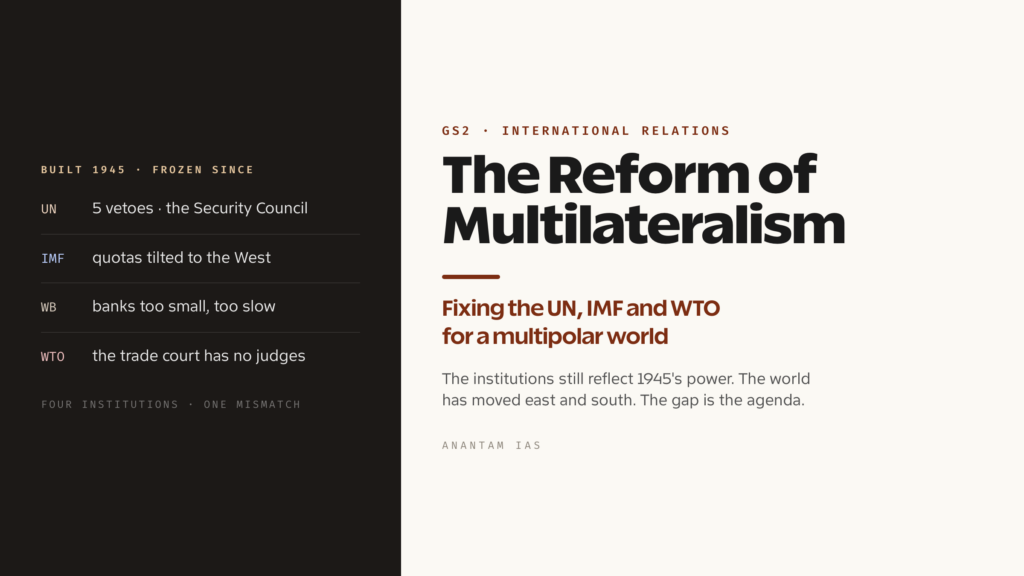
The IMF is the International Monetary Fund — one of the Bretton Woods institutions created in 1945, alongside the United Nations, the World Bank and (later) the World Trade Organization. These are the pillars of the post-war multilateral order, and the reform of multilateralism is the project of rebuilding them — their seats, votes and vetoes — to fit a multipolar world.
Almost every global crisis of the last few years has ended at the same dead end. A war breaks out and the body built to keep the peace is paralysed by a single veto. A wave of debt swamps the developing world and the institutions meant to lend a hand are too small and too slow. A trade dispute lands and the court that was supposed to settle it has no judges left to hear the case. The pattern has a name now, used by diplomats and aspirants alike: the reform of multilateralism — the long-overdue project of rebuilding the global institutions designed in 1945 so they can actually govern the world of the 2020s.
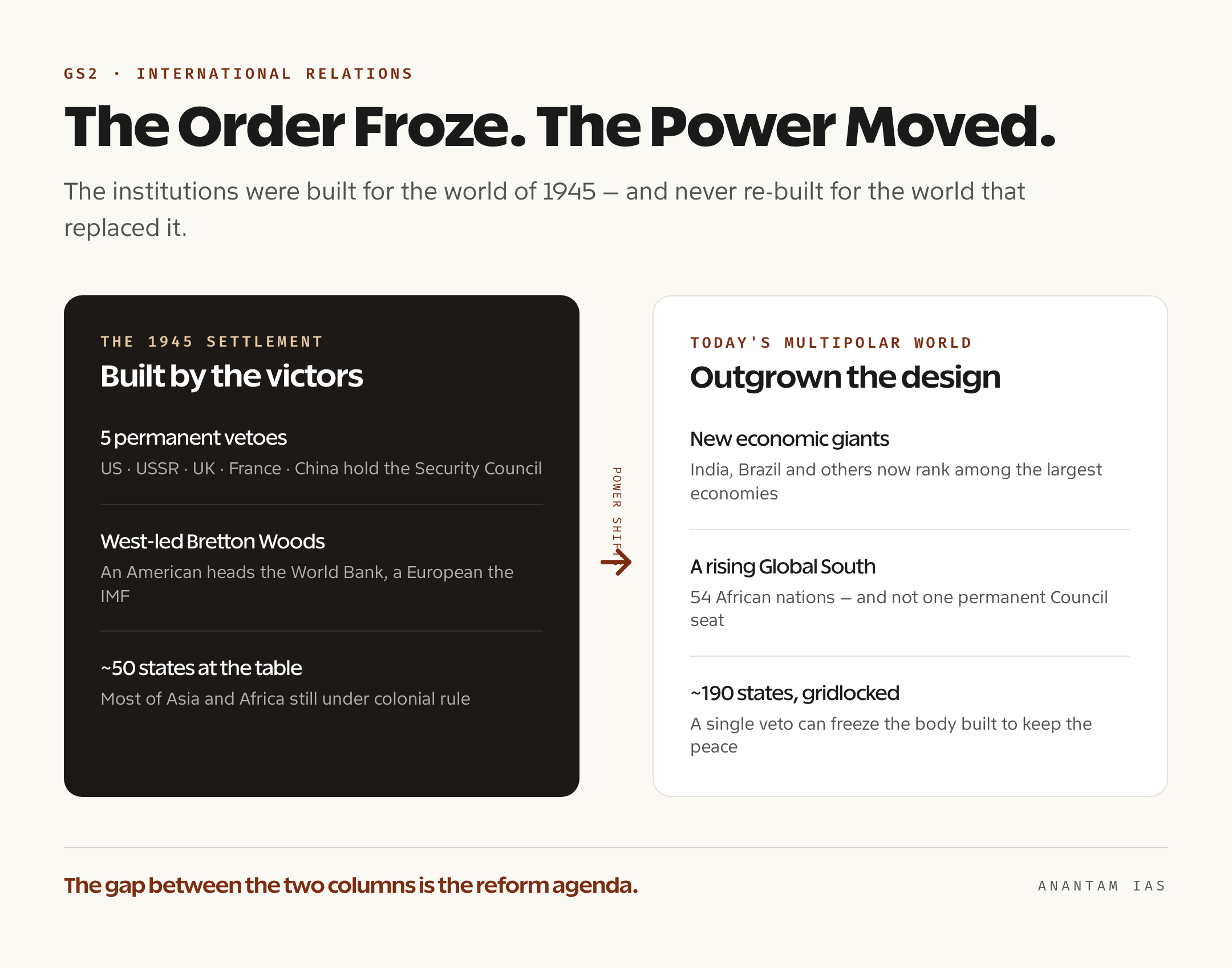
And the reason the project matters is uncomfortable but simple. The United Nations, the International Monetary Fund, the World Bank and the World Trade Organization were all shaped by the winners of the Second World War, for a world of about fifty states, most of Asia and Africa still under colonial rule. Eighty years on, there are nearly two hundred states, the centre of economic gravity has shifted east and south, and yet the seats, the votes and the vetoes still mostly reflect 1945. That mismatch is what produces both a legitimacy crisis (the institutions no longer look representative) and an effectiveness crisis (they no longer get things done). For an aspirant, this is one of the richest GS2 themes going, because India has placed itself at the very centre of it with a single insistent phrase: not less multilateralism, but reformed multilateralism.
Why the 1945 Order No Longer Fits the World
Start with why reform is even necessary, because the diagnosis is half the answer. The post-war institutions were a genuine achievement — they replaced the failed League of Nations and gave the world rules, forums and referees it had never had. But they froze a particular distribution of power into their very design. The UN Security Council handed permanent seats and the veto to five victors — the United States, the Soviet Union (now Russia), the United Kingdom, France and China. The Bretton Woods twins, the IMF and the World Bank, tied voting power to “quotas” weighted toward the Western economies, with an unwritten convention that an American always heads the Bank and a European the Fund. The whole architecture assumed the West would lead and the rest would follow.
That assumption has quietly collapsed. The Global South — the broad family of developing countries across Asia, Africa and Latin America — is now the bulk of humanity and a fast-rising share of world output, yet it remains structurally underrepresented in every one of these bodies. Africa, with fifty-four nations and over a billion people, holds not a single permanent Security Council seat. This is the “democratic deficit” critics point to: the governed have outgrown the governors. And when the unrepresented lose faith that the rules are fair, they start building their own clubs alongside — the BRICS grouping, the Shanghai Cooperation Organisation, regional development banks — which is exactly the fragmentation reform is meant to prevent.
Layered on top of the legitimacy problem is an effectiveness problem, and the two feed each other. The Security Council’s veto has repeatedly frozen it on the conflicts that matter most, from Syria to Ukraine to Gaza, because a permanent member can block any action touching its interests. The institutions are slow, consensus-bound and starved of the resources today’s shocks demand — pandemics, climate finance, debt waves. So you get gridlock at the top and improvisation everywhere else. The reform of multilateralism is the attempt to close this gap before the system loses its authority altogether — to make the institutions both more representative (so they are seen as fair) and more capable (so they can deliver).
Fixing the United Nations Security Council
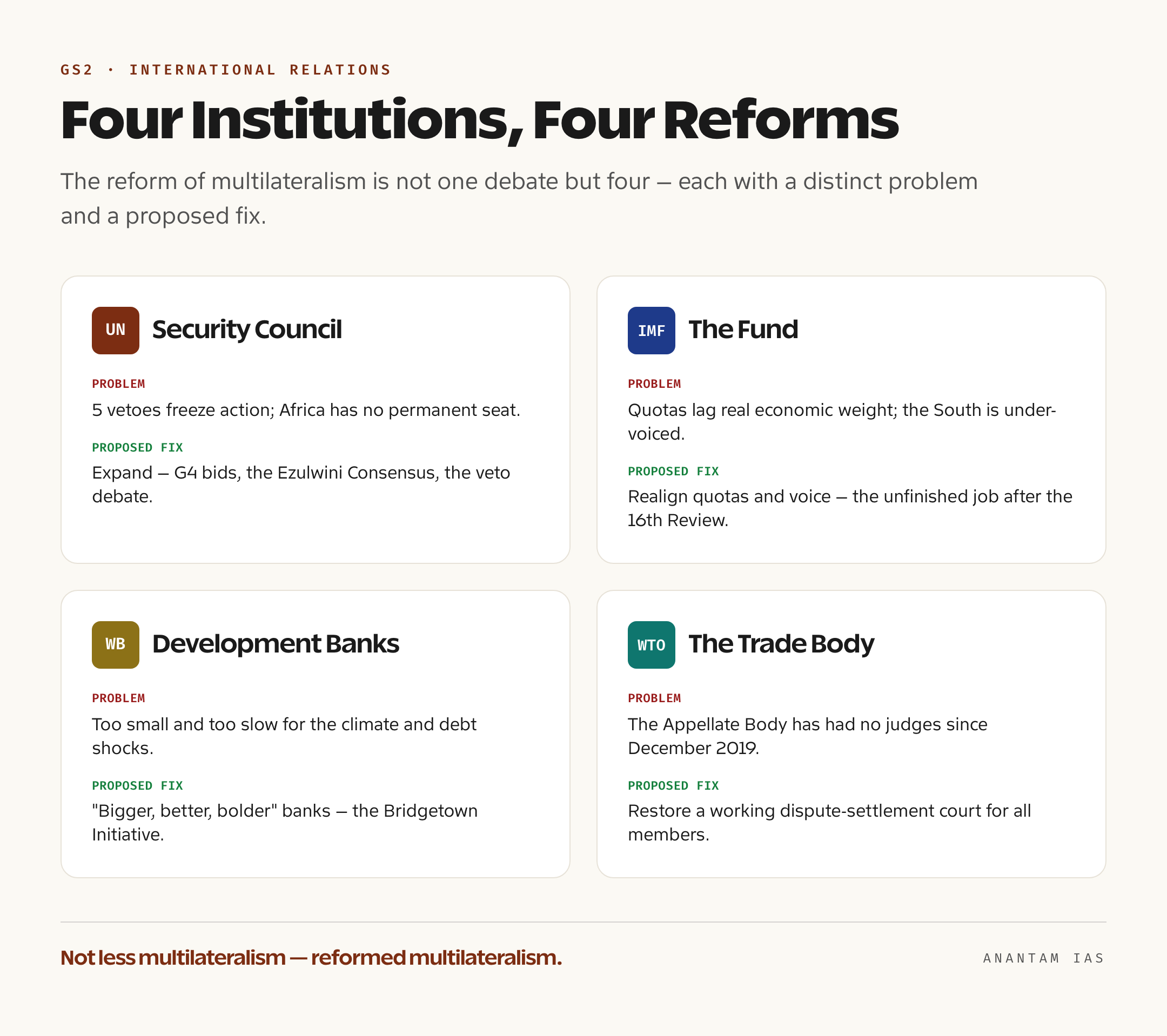
Reform is not one debate but four, each with its own sticking point, and a strong answer keeps them distinct. The headline fight is over the UN Security Council. The core demand is expansion — adding permanent and non-permanent members so the Council mirrors today’s world, especially the underrepresented Global South. Here the camps are well drawn. The G4 — India, Brazil, Germany and Japan — back each other’s bids for permanent seats; in 2025 they tabled a model to grow the Council from fifteen to around twenty-five or twenty-six members, with new permanent members forgoing the veto for an initial review period. Africa speaks through the Ezulwini Consensus and the Sirte Declaration, demanding two permanent seats with full veto rights and additional non-permanent seats, on the principle that a continent so long excluded must enter on equal terms. Ranged against expansion of the permanent category is the Uniting for Consensus group — led by Italy and including Pakistan, South Korea, Argentina and others — which argues that more permanent vetoes would worsen the gridlock, and proposes adding only longer-term elected seats instead. Then there is the veto debate itself, where proposals run from outright abolition to the French-Mexican idea of voluntary restraint in cases of mass atrocity. The deadlock is why, after three decades, the Council has not changed at all.
Reforming the IMF, World Bank and WTO
Beyond the Council, the money and the trade institutions face their own reckonings, and a complete answer treats all three. Next come the Bretton Woods institutions. At the IMF, the fight is over “quotas” — the shareholdings that determine both a country’s voting weight and its access to funds. The problem is that the quotas lag far behind real economic weight, so dynamic emerging economies are under-weighted and the West is over-weighted. The Fund’s 16th General Review of Quotas, agreed in December 2023, raised total quotas by 50 per cent but pointedly did not realign the shares — it left the voice question to a 17th Review, a delay the Global South reads as foot-dragging on legitimacy. On the development side, the push is to make the multilateral development banks (the World Bank and its regional cousins) “bigger, better and bolder,” in the words of the G20’s Independent Expert Group, whose Triple Agenda report urged tripling their lending. The political energy here comes from Barbados: Prime Minister Mia Mottley’s Bridgetown Initiative, launched in 2022, has become the rallying cry for reforming the whole international financial architecture so it can deliver climate and development finance at the scale the moment needs.
The fourth front is the World Trade Organization, where the crisis is sharpest and least noticed. The WTO’s crown jewel was its dispute-settlement system, a two-tier court that could enforce trade rules against even the most powerful members. Its top tier, the Appellate Body, has been paralysed since December 2019, because the United States has blocked the appointment of new judges over long-standing grievances, leaving appeals to fall into a “void.” Restoring a functioning, accessible dispute-settlement system — the members set themselves a target year of 2024 at the Thirteenth Ministerial Conference, and India has pushed a plan to prioritise the Appellate Body’s revival — is the central WTO reform. Without an umpire, the rules-based trading order slowly erodes into power-based bargaining, which hurts smaller economies most.
The Summit of the Future and “Reformed Multilateralism”
For years reform was all diagnosis and no movement, so the UN tried to force a moment of decision. In September 2024 it convened the Summit of the Future in New York, billed as a once-in-a-generation chance to “reimagine the multilateral system,” and world leaders adopted the Pact for the Future — the most wide-ranging UN agreement in years, bundled with a Global Digital Compact and a Declaration on Future Generations. The Pact runs across peace and security, sustainable development, climate, digital cooperation and the reform of global governance itself. Its language on the Security Council was the strongest in decades: a commitment to redress the historic underrepresentation of Africa “as a priority,” and to make the Council more representative. The UN Secretary-General called the agreements a “step-change” toward a more effective, inclusive and networked multilateralism.
But it is worth being honest about what the Pact is and is not, because examiners reward that judgement. It is a political declaration, not a binding amendment — it commits members to negotiate, not to a final new Council. It sets direction and raises the floor of ambition, yet the hard arithmetic of who gets a seat, and whether the veto survives, was left for later. So the Summit of the Future is best read as a milestone, not a destination: proof that reform is now firmly on the agenda, and an admission that it still has not happened. The gap between the soaring promise of the Pact and the unchanged composition of the Council is, in miniature, the whole story of multilateral reform.
The phrase that has come to frame the entire project, and the one to carry into an answer, is “reformed multilateralism.” It captures a deliberately constructive stance: the answer to failing institutions is not to abandon them (the path of narrow nationalism) nor to walk away into rival blocs (the path of fragmentation), but to repair and modernise them so they regain both legitimacy and effectiveness. It is a defence of the cooperative system coupled with an insistence that the system must change. That framing matters because it positions reformers as the responsible custodians of global order rather than its wreckers — which is precisely the space India has chosen to occupy.
India’s Case: The Voice of Reformed Multilateralism
India has made the reform of multilateralism a signature of its foreign policy, and the framing is consistent enough to quote. New Delhi argues that institutions which exclude a sixth of humanity cannot credibly claim to govern the world, and that India — a founding UN member, a top troop contributor to peacekeeping, the world’s most populous nation and a major economy — has an unanswerable claim to a permanent Security Council seat. It pursues that claim through the G4, trading mutual support with Brazil, Germany and Japan, and it presses the broader case in nearly every major speech, with External Affairs Minister S. Jaishankar repeatedly calling for “reformed multilateralism” and a “more democratic” international order.
What lifts India’s position above mere self-interest is that it has paired its own seat-claim with a broader push for the Global South, which is what gives the argument its moral force. During its 2023 G20 presidency, India convened the first Voice of Global South Summit in January 2023, gathering over a hundred developing countries — a clear act of South-South cooperation — to channel their concerns into the G20 agenda — and then delivered a concrete win: it secured permanent membership for the African Union in the G20, bringing a fifty-four-nation continent inside the world’s premier economic forum for the first time. That single move is the cleanest example of reformed multilateralism in practice — not a speech about representation, but representation actually delivered. The New Delhi Leaders’ Declaration, adopted unanimously, further pushed the case for stronger, reformed multilateral institutions and development banks.
So India’s strategy works on two levels at once, and naming both is what makes an answer complete. On one level it advances its own ambition — the permanent UNSC seat, a bigger IMF quota share, a louder voice in trade. On another it presents itself as the bridge between the wealthy North and the developing South, the country best placed to translate the Global South’s grievances into reforms the established powers can accept. The risk India must manage is the charge that it wants to join the high table rather than dismantle it — that a permanent seat for New Delhi does nothing for the dozens of states still locked out. India’s answer is that incremental, achievable reform beats unattainable perfection, and that getting the African Union into the G20 shows it can deliver real gains for others, not just for itself. Whether that argument holds is exactly the kind of open question a good Mains answer is built to weigh.
For Your Mains Answer
This is a flagship GS Paper 2 topic, sitting squarely under “important international institutions, agencies and fora — their structure, mandate,” and under “bilateral, regional and global groupings involving India.” It also reaches into GS Paper 3 through the IMF, the World Bank and the global financial architecture, and it makes a strong Essay on a fairer world order or the crisis of global governance. The instinct examiners reward is balance: show that reform is genuinely necessary, that concrete movement is finally happening, and that the deepest obstacles remain unresolved — because that gap is where the marks live.
How to Build the Answer
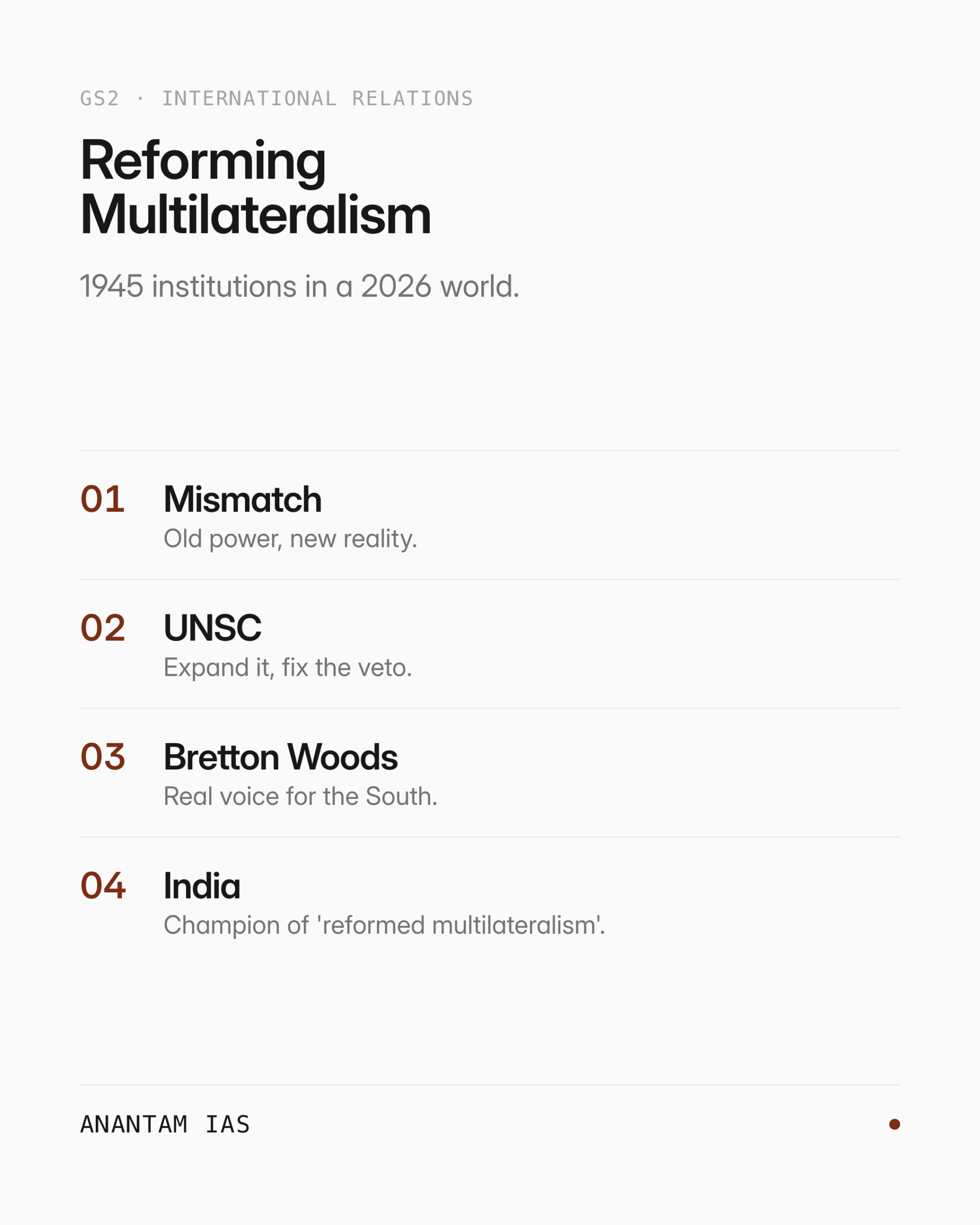
Move in a clean chain. Open with the core problem — institutions built in 1945 no longer reflect today’s distribution of power, producing twin crises of legitimacy and effectiveness. Then take the agenda institution by institution: the Security Council (expansion, the G4 versus Uniting for Consensus, the Ezulwini Consensus, the veto debate); the IMF (quota and voice reform); the development banks (the Bridgetown Initiative, “bigger, better, bolder”); and the WTO (the paralysed Appellate Body). Next, mark the milestone — the 2024 Summit of the Future and the Pact for the Future — while noting it is a declaration, not a done deal. Close with India’s role and a balanced verdict. That arc — diagnose, itemise, locate the milestone, place India, judge — fits almost any phrasing of the question.
Common Mistakes to Avoid
Don’t treat “multilateralism” and the “Security Council” as the same thing — the reform agenda spans the UN, the IMF, the World Bank and the WTO, and the broader answer scores higher. Don’t forget the opposition: an answer that only lists India’s demands, without the Uniting for Consensus counter-argument or the veto stalemate, reads as one-sided. Don’t oversell the Pact for the Future as having “achieved” reform — it is a political commitment, not an amended Charter. And don’t frame India as anti-institution; its stance is reformed multilateralism — fix the system, not abandon it.
A Compact Answer Spine
1945 institutions frozen into 1945 power → twin crises: legitimacy (Global South underrepresented, “democratic deficit”) + effectiveness (veto gridlock, under-resourced, slow) → reform agenda: UNSC (G4 expansion vs Uniting for Consensus; Ezulwini Consensus; veto debate) · IMF (quota/voice, 16th Review raised size not shares) · MDBs (Bridgetown Initiative, “bigger, better, bolder” Triple Agenda) · WTO (Appellate Body paralysed since 2019) → milestone: 2024 Summit of the Future → Pact for the Future (direction set, not delivered) → India: “reformed multilateralism,” G4 seat-claim, Voice of Global South Summit, African Union into the G20 → verdict: reform is necessary and finally moving, but the hardest changes are still blocked.
Diagram or Flowchart Idea
Draw a simple two-state diagram: a “1945” box (5 vetoes, West-led IMF/World Bank, most of the South colonised) with an arrow labelled “power shifts east and south” pointing to a “today” box (multipolar, rising Global South, gridlocked institutions). The visible gap between the two boxes is the reform agenda — a clean way to show the whole argument in one frame.
A Balanced-Conclusion Line
A line that lands the marks: “The reform of multilateralism is less about replacing the post-war order than about renewing it — and India’s contribution has been to show, by getting the African Union into the G20, that reformed multilateralism can be delivered in practice and not merely demanded in speeches.”
How to Use Data Without Cramming
You need a handful of anchors, not a table: five permanent veto-holders versus fifty-four African nations with no permanent seat; the G4 (India, Brazil, Germany, Japan) versus the Uniting for Consensus bloc; the IMF’s 16th Review (2023) that raised quotas by 50 per cent without realigning shares; the WTO Appellate Body paralysed since December 2019; and the Summit of the Future and Pact for the Future of September 2024. Attribute them plainly — “as the Pact for the Future committed,” “under the G20’s Triple Agenda” — rather than scattering figures loose.
Frequently Asked Questions
What is meant by the reform of multilateralism?
It is the project of restructuring the major post-1945 global institutions — the UN (especially its Security Council), the International Monetary Fund, the World Bank and the World Trade Organization — so they reflect today’s distribution of power rather than 1945’s. The institutions were shaped by the victors of the Second World War and have not kept pace with the rise of the Global South, producing a crisis of both legitimacy (they look unrepresentative) and effectiveness (they struggle to act). Reform aims to make them more representative and more capable.
What is “reformed multilateralism” and why does India use the phrase?
“Reformed multilateralism” is the idea that failing global institutions should be repaired and modernised rather than abandoned or replaced by rival blocs. India uses it to signal a constructive stance: it backs the cooperative international system but insists the system must change to include the underrepresented. The phrase frames India as a responsible reformer of global order, pressing for its own permanent Security Council seat while also championing the wider Global South.
Why has UN Security Council reform stalled for so long?
Because the camps cannot agree and any change is hard to pass. The G4 (India, Brazil, Germany, Japan) want new permanent seats; the Uniting for Consensus group opposes more permanent members and prefers additional elected seats; Africa, through the Ezulwini Consensus, demands two permanent seats with veto rights. On top of this, the veto itself is disputed, and amending the UN Charter needs the agreement of the existing permanent five — none of whom is keen to dilute its own power. The result is three decades of deadlock.
What did the 2024 Summit of the Future achieve?
World leaders adopted the Pact for the Future, the most wide-ranging UN agreement in years, covering peace and security, development, climate, digital cooperation and the reform of global governance. Its language on Security Council reform was the strongest in decades, prioritising the historic underrepresentation of Africa. But it is a political declaration committing members to negotiate, not a binding amendment — so it set the direction for reform without actually delivering a new Council.
Practice Questions
Prelims MCQs
- The “G4” nations, who support each other’s bid for permanent seats on the UN Security Council, comprise which of the following?
(a) India, China, Russia and Brazil
(b) India, Brazil, Germany and Japan
(c) India, South Africa, Nigeria and Egypt
(d) India, France, Germany and Japan
Answer: (b) The G4 — India, Brazil, Germany and Japan — coordinate their claims for permanent UNSC membership; China and Russia are existing permanent members, not G4. - The “Ezulwini Consensus” is associated with which of the following?
(a) The African Union’s common position on UN Security Council reform
(b) A WTO agreement on agricultural subsidies
(c) The IMF’s formula for calculating member quotas
(d) A BRICS proposal for a common currency
Answer: (a) The Ezulwini Consensus is the African Union’s common position, demanding at least two permanent seats with full rights, including the veto, plus additional non-permanent seats. - The “Uniting for Consensus” group, in the context of UN reform, is best described as:
(a) A bloc supporting the immediate abolition of the veto
(b) A group opposing the creation of new permanent Security Council seats
(c) The G20’s expert panel on development-bank reform
(d) A coalition demanding India’s permanent membership
Answer: (b) Led by Italy and including Pakistan and others, Uniting for Consensus opposes new permanent seats and instead favours expanding the elected, non-permanent category. - The “Bridgetown Initiative,” frequently cited in discussions on reforming the global financial architecture, was launched by which country’s leadership?
(a) India
(b) Barbados
(c) Brazil
(d) South Africa
Answer: (b) The Bridgetown Initiative was launched in 2022 under the leadership of Barbados Prime Minister Mia Mottley to reform the international financial architecture for climate and development finance. - The paralysis of the World Trade Organization’s Appellate Body since December 2019 has been caused primarily by:
(a) A shortage of funds at the WTO
(b) The United States blocking the appointment of new judges
(c) A formal decision to abolish the body at MC13
(d) India’s withdrawal from the dispute-settlement system
Answer: (b) The Appellate Body has been unable to function because the United States has blocked new appointments over long-standing concerns, leaving appeals in a “void.”
Mains Practice Questions
- “The institutions of global governance were designed in 1945 and have not kept pace with the redistribution of power since.” Examine this statement with reference to the reform of multilateralism. (15 marks, 250 words)
- Discuss the main proposals and obstacles in the reform of the UN Security Council, with reference to the G4, the Uniting for Consensus group and the Ezulwini Consensus. (15 marks, 250 words)
- The reform of multilateralism extends well beyond the UN Security Council. Analyse the reform agenda for the Bretton Woods institutions and the World Trade Organization. (15 marks, 250 words)
- “The Pact for the Future set the direction for reform without delivering it.” Critically evaluate the outcome of the 2024 Summit of the Future. (10 marks, 150 words)
- Critically analyse India’s pursuit of “reformed multilateralism,” distinguishing its own permanent-seat ambition from its leadership of the Global South. (15 marks, 250 words)
Tell Google you want more of this.
Add Anantam IAS as a preferred sourceOne tap, and this site shows up more often in your own Top Stories, AI Overviews and AI Mode. Remove it any time.