Sound pollution — more formally called noise pollution — is the presence of unwanted, harmful or disturbing sound in the environment that interferes with normal human and animal life. Unlike air or water pollution, noise leaves no visible residue, but its impact on health, wildlife and cognition is substantial. Indian law recognises noise as an "air pollutant" under the Air (Prevention and Control of Pollution) Act, 1981, and the Noise Pollution (Regulation and Control) Rules, 2000 fix limits for different area categories.
For UPSC, sound pollution features in GS3 (Environment) and increasingly in GS2 (health, welfare of vulnerable groups) and Essay papers.
What Is Sound Pollution?
Sound becomes pollution when it crosses the threshold at which it causes discomfort, damage or ecological disturbance. It is measured in decibels (dB) on a logarithmic scale.
| Concept | Detail |
|---|---|
| Sound pressure level | Measured in decibels (dB) |
| A-weighted decibel (dB(A)) | Adjusted to match human hearing sensitivity |
| Safe exposure limit (WHO) | 53 dB (day) / 45 dB (night) for road traffic |
| Pain threshold | ~120 dB |
| Hearing damage risk | Prolonged exposure >85 dB |
Sources of Sound Pollution
| Category | Examples |
|---|---|
| Transportation | Road traffic (especially horns), railways, aircraft, shipping |
| Industrial | Factories, power plants, construction equipment, mining, stone crushers |
| Commercial | Markets, loudspeakers, public address systems |
| Residential | Generators, air conditioners, pets, loud gatherings |
| Social/religious | Festivals, processions, fireworks, places of worship |
| Agricultural | Tractors, pumps, threshers |
| Defence and aviation | Military exercises, sonic booms |
In Indian cities, road traffic is the single largest contributor.
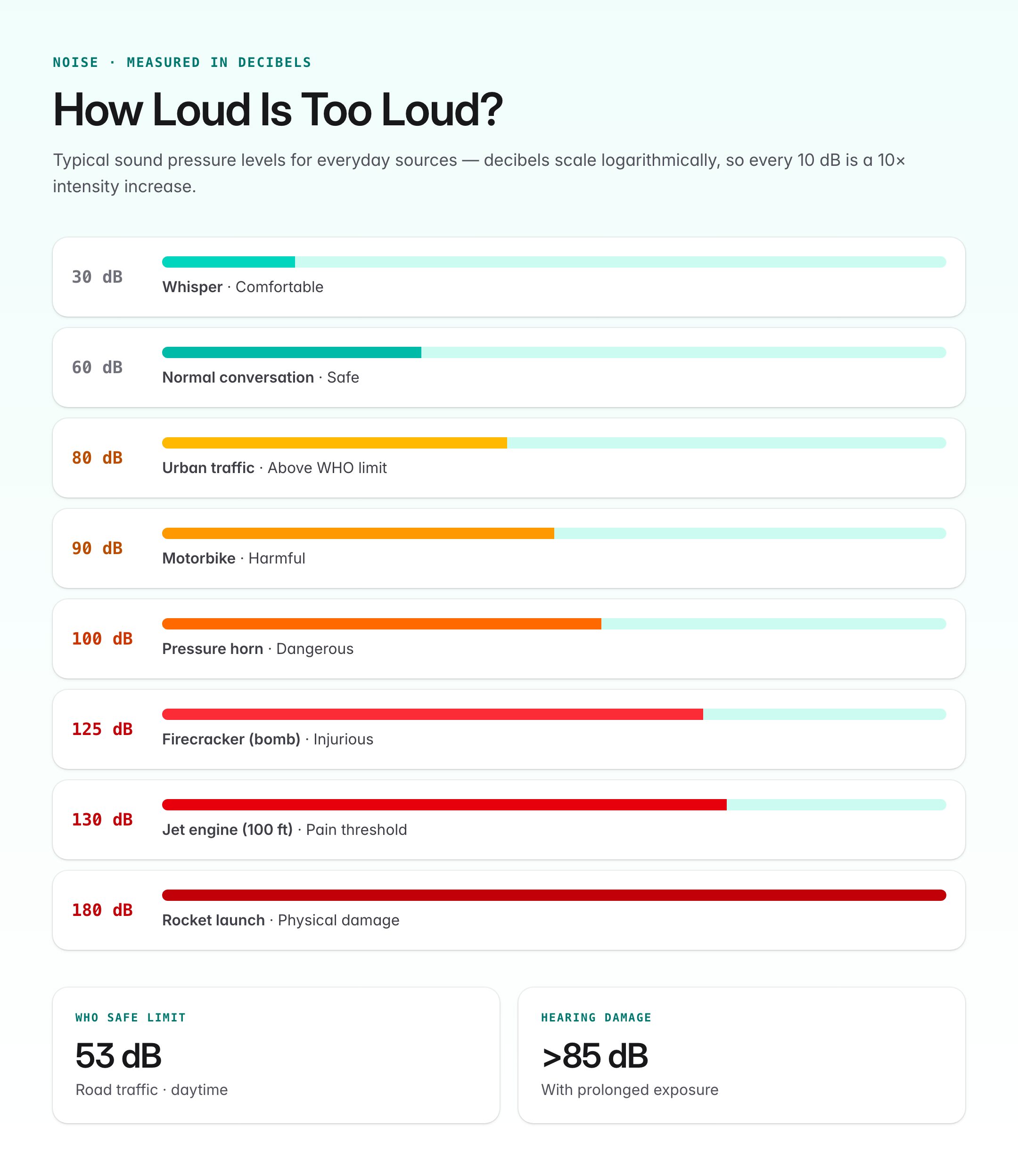
Typical Decibel Levels
| Source | Approximate Level (dB) | Comment |
|---|---|---|
| Whisper | 30 | Comfortable |
| Normal conversation | 60 | Safe |
| Urban traffic | 70–85 | Above WHO safe limit |
| Subway | 85–95 | Risk with prolonged exposure |
| Motorbike | 90 | Harmful |
| Pressure horn | 100–110 | Dangerous |
| Firecracker (bomb type) | 110–140 | Injurious |
| Jet engine (100 ft) | 130 | Pain threshold |
| Rocket launch | 180 | Physical damage |
Health Effects on Humans
| System | Effect |
|---|---|
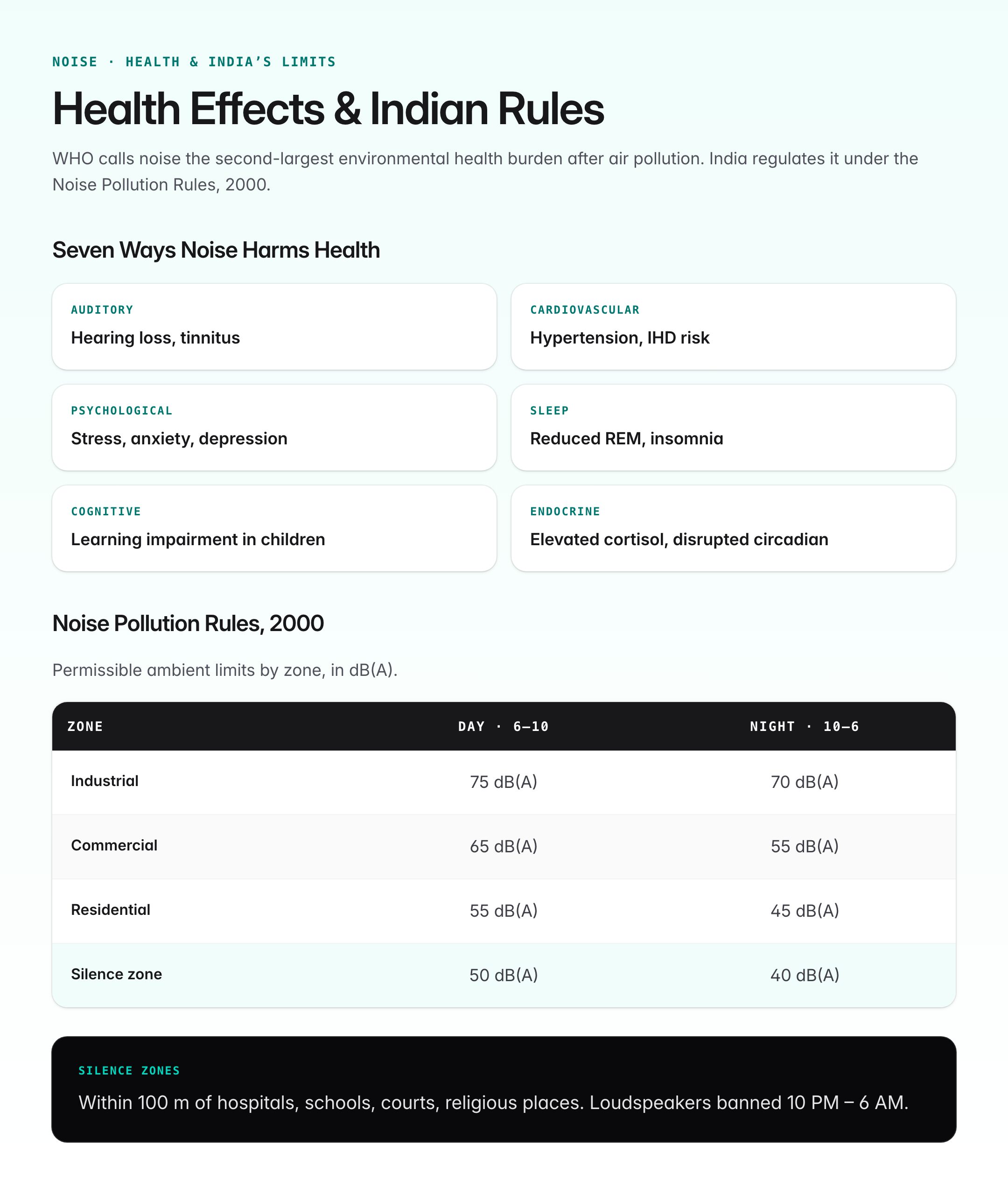
| Auditory | Noise-Induced Hearing Loss (NIHL); tinnitus; temporary threshold shift |
| Cardiovascular | Hypertension, increased heart rate, risk of ischaemic heart disease |
| Psychological | Stress, anxiety, irritability, depression, aggression |
| Sleep | Disturbed sleep architecture; reduced REM sleep; insomnia |
| Cognitive | Reduced concentration; learning impairment in children |
| Endocrine | Elevated cortisol; disrupted circadian rhythm |
| Maternal | Low birth weight associated with chronic maternal noise exposure |
The WHO estimates that environmental noise causes the loss of over 1 million healthy life-years every year in Western Europe alone — the second-largest environmental burden of disease after air pollution.
Effects on Wildlife and Ecosystems
Noise pollution is not a purely human problem.
| Ecosystem | Impact |
|---|---|
| Marine | Ship engine and sonar noise disrupts whale and dolphin communication and navigation |
| Birds | Alters call frequency; reduces breeding success near busy roads |
| Terrestrial mammals | Increased stress hormones; altered migration; reduced predator-prey detection |
| Insects | Interferes with mating calls of crickets, frogs |
| Forest ecosystems | Reduced biodiversity near highways and rail lines |
Indian Legal Framework
Air (Prevention and Control of Pollution) Act, 1981
The 1987 amendment included noise within the definition of an “air pollutant”. This made noise subject to regulation by the Central Pollution Control Board (CPCB) and State Pollution Control Boards.
Environment (Protection) Act, 1986
An umbrella law under which the Noise Pollution Rules, 2000 were framed.
Noise Pollution (Regulation and Control) Rules, 2000
These are the primary noise rules in India and classify areas into four categories with day and night limits.
| Area Category | Day (6 AM – 10 PM) | Night (10 PM – 6 AM) |
|---|---|---|
| Industrial | 75 dB(A) | 70 dB(A) |
| Commercial | 65 dB(A) | 55 dB(A) |
| Residential | 55 dB(A) | 45 dB(A) |
| Silence zone | 50 dB(A) | 40 dB(A) |
Silence zones are areas within 100 m of hospitals, educational institutions, courts and religious places, declared by the appropriate authority.
Additional provisions:
- Loudspeakers banned between 10 PM and 6 AM (except in closed halls and auditoriums)
- State government may permit loudspeaker use on cultural/religious occasions, but not beyond 12 midnight and only for a limited number of days a year
Motor Vehicles Act, 1988 / CMVR
Regulates vehicle horn noise and bus/truck exhaust noise. Pressure horns are banned; vehicles must conform to prescribed noise emission limits.
Factories Act, 1948
Regulates workplace noise exposure; employers must provide hearing protection above 90 dB.
Explosives Act, 1884 / Firecracker Rules
The Supreme Court (Arjun Gopal v. Union of India, 2018) capped firecracker noise at 125 dB(AI) at a 4-metre distance and restricted manufacture and sale.
Landmark Judicial Pronouncements
| Case | Year | Principle |
|---|---|---|
| Moulana Mufti v. State of West Bengal | 1999 | Noise from religious places must comply with limits |
| Church of God v. KKR Majestic Colony | 2000 | No religion mandates the use of loudspeakers |
| Noise Pollution (In Re) | 2005 | SC directions on loudspeakers, horns, fireworks; nighttime bans upheld |
| Arjun Gopal v. Union of India | 2018 | Restrictions on fireworks; mandate for "green crackers" |
| NGT orders | Various | Uphold silence zones; direct action against violators |
WHO Environmental Noise Guidelines (2018)
| Source | WHO Recommended Limit |
|---|---|
| Road traffic | 53 dB(Lden) day; 45 dB(Lnight) |
| Rail | 54 dB day; 44 dB night |
| Aircraft | 45 dB day; 40 dB night |
| Wind turbines | 45 dB day |
These are health-protection thresholds, stricter than many national regulations including India's.
Noise Pollution in Indian Cities
CPCB's National Ambient Noise Monitoring Network data consistently shows that Indian metros exceed prescribed limits, particularly at night.
| City | Typical Day Level | Typical Night Level |
|---|---|---|
| Mumbai | 75–85 dB | 70–80 dB |
| Delhi | 70–82 dB | 65–78 dB |
| Kolkata | 70–85 dB | 65–80 dB |
| Chennai | 65–80 dB | 60–75 dB |
| Bengaluru | 70–82 dB | 65–78 dB |
Most Indian cities have a zero compliance record for silence zone night limits.
Firecrackers and Festivals
Firecrackers are a major episodic source of noise pollution, particularly around Diwali.
- Supreme Court has permitted only "green crackers" with reduced noise and emissions
- Timings restricted (usually 8 PM to 10 PM) in many States
- Ban on barium salts reduces both noise and particulate emission
- Regional festivals (Ganesh Visarjan, Muharram, Navratri) also trigger violations
Solutions and Mitigation
| Level | Measures |
|---|---|
| Policy | Strict enforcement of 2000 Rules; update decibel limits to align with WHO |
| Urban planning | Buffer zones; green belts; low-noise road surfaces; noise barriers on highways |
| Vehicles | Phase out pressure horns; promote EVs (quieter); BS-VI noise norms |
| Construction | Quiet equipment; restrict night-time construction |
| Industry | Noise-reducing enclosures; mandatory PPE; periodic audits |
| Individual | Avoid unnecessary honking; use earplugs in loud settings; limit loud devices |
| Technology | Active noise cancellation; acoustic glazing; road-surface design |
| Awareness | Campaigns on World Hearing Day (3 March); school programmes |
Global Best Practices
| Country | Feature |
|---|---|
| Germany | National noise action plans under EU Noise Directive |
| Japan | Strict vehicle noise norms; quiet rail corridors |
| Singapore | Residential noise limits 55 dB day / 45 dB night, strictly enforced |
| Netherlands | Low-noise asphalt on highways |
| UK | "Noise maps" of cities under EU directive |
Sound Pollution vs Other Pollutants
| Feature | Air Pollution | Water Pollution | Sound Pollution |
|---|---|---|---|
| Visible | Often yes | Often yes | No |
| Residue | Yes | Yes | None |
| Spatial spread | Regional | Watershed-bound | Localised |
| Duration | Persistent | Persistent | Transient (stops with source) |
| Regulatory history | Strong | Strong | Relatively weak |
The transient nature of noise often leads to weaker enforcement — a key challenge.
UPSC Relevance
GS3 (Environment): Pollution, environmental laws, enforcement challenges, linkages with public health.
Key Prelims facts:
- Noise is an "air pollutant" under the Air Act, 1981 (1987 amendment)
- Noise Pollution (Regulation and Control) Rules, 2000 set decibel limits
- Four area categories: Industrial, Commercial, Residential, Silence Zone
- Residential limit: 55 dB (day) / 45 dB (night)
- Silence zone: within 100 m of hospitals, schools, courts, religious places
- Loudspeakers banned between 10 PM and 6 AM
- Firecracker limit: 125 dB(AI) at 4 m (SC 2018 order)
- WHO safe limit (road traffic): 53 dB day / 45 dB night
- CPCB monitors ambient noise nationally
- Unit of measurement: decibel (dB / dB(A))
- World Hearing Day: 3 March
Tell Google you want more of this.
Add Anantam IAS as a preferred sourceOne tap, and this site shows up more often in your own Top Stories, AI Overviews and AI Mode. Remove it any time.