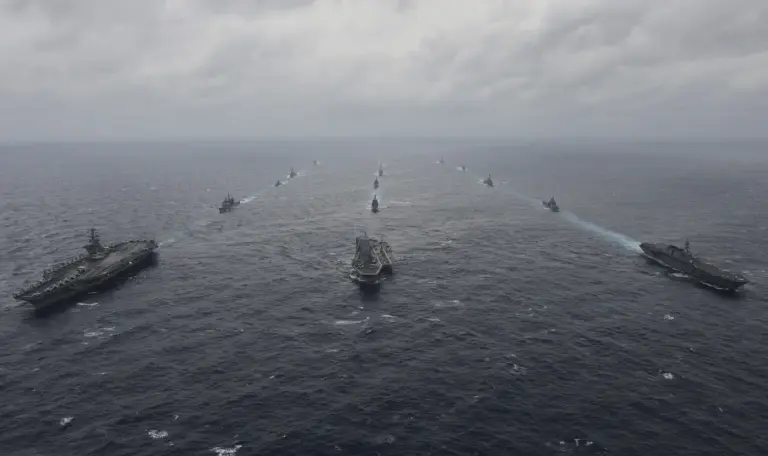
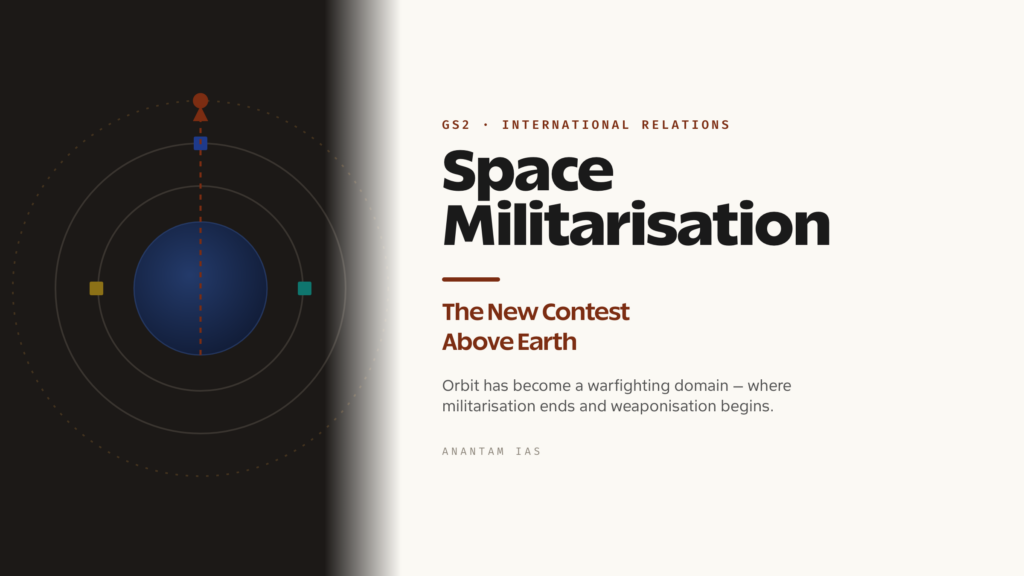
In April 2025 the head of US Space Command, General Stephen Whiting, said out loud what military planners had been circling for years — that the United States now needs weapons in orbit to hold an adversary’s satellites at risk. A few months earlier the US Space Force had published a “Space Warfighting Framework” declaring that “space superiority” was no longer a useful advantage but the very foundation of modern military power. Read those two statements together and you can feel the ground shift. The orbital belt that carries your phone signal, your maps, your weather forecast and your bank’s timestamp has been formally reclassified as a place where wars will be fought.
For an aspirant this is one of the richest international-relations stories going, because it sits at the meeting point of technology, law and great-power rivalry. Every modern economy and every modern military now runs on satellites — and anything a society depends on that completely becomes a target. The contest above Earth is no longer science fiction; it is a live security problem with a weak rulebook, a handful of nuclear-armed players testing the limits, and India squarely in the middle of it. The first thing to get right, before any of the strategy makes sense, is a distinction that examiners love and most candidates blur.
Militarisation Versus Weaponisation: The Distinction That Decides the Debate
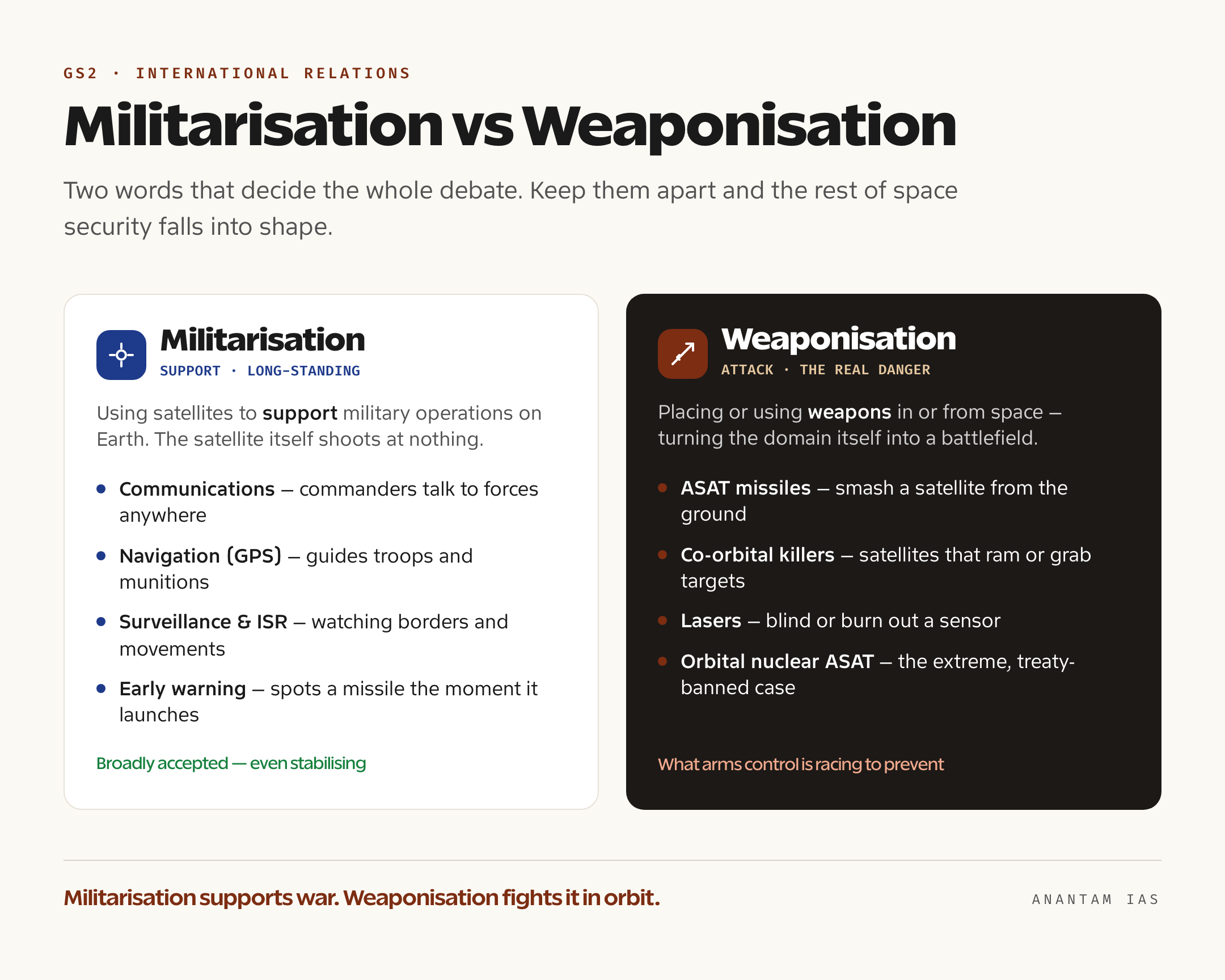
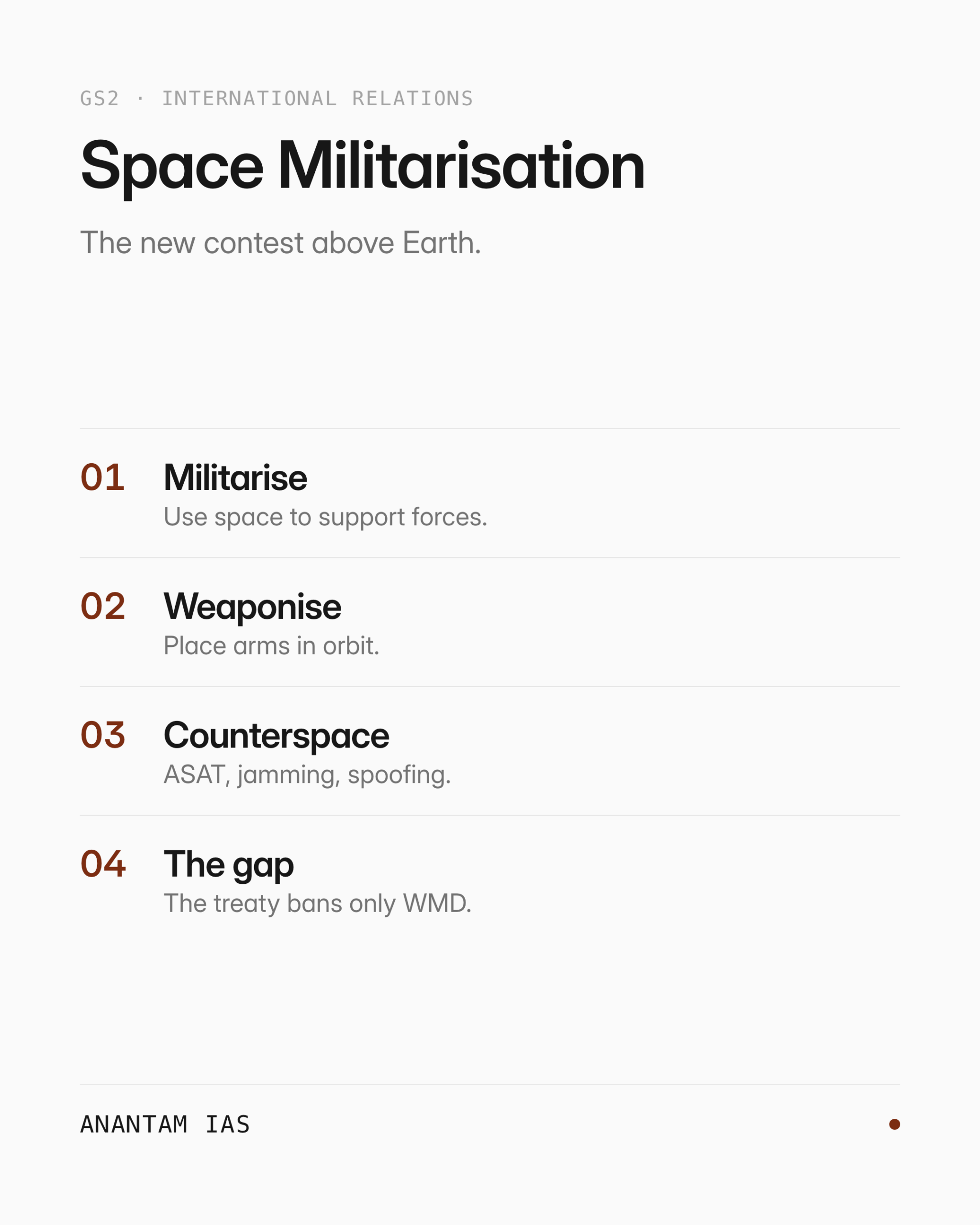
The single most important idea in this whole topic is that “militarisation” and “weaponisation” are not the same thing, and confusing them wrecks an answer. Militarisation of space means using space-based assets to support military operations on Earth — and it has been happening quietly since the Cold War began. Communications satellites that let commanders talk to forces anywhere, navigation satellites like GPS that guide both troops and precision munitions, imaging and signals satellites that watch borders and troop movements, and early-warning satellites that spot a missile launch the moment its engine lights — all of these are military uses of space. They are passive, in the sense that the satellite itself shoots at nothing. India’s own armed forces lean on exactly this kind of support, and the new Space-Based Surveillance constellation discussed later is militarisation in its purest form.
Weaponisation is the harder line. It means actually placing weapons in orbit, or building weapons on the ground designed to strike targets in space — turning the domain itself into a battlefield rather than a support service. A satellite that can ram or grab another satellite, a missile fired from Earth to shatter one, a ground-based laser that blinds an orbiting sensor, or, at the extreme, a nuclear device parked in orbit to fry every satellite nearby with its electromagnetic pulse — that is weaponisation. The reason the distinction matters so much is legal and political: the world has broadly accepted militarisation as normal and even stabilising, because reconnaissance satellites that let each side verify the other’s behaviour can reduce the risk of miscalculation. Weaponisation is what the arms-control community is desperate to prevent, and it is precisely the part the existing law fails to ban.
So when a news report says space is being “militarised,” ask which sense it means. The militarisation of space is old, deep and largely settled. The fight that is actually unfolding now — the one driving Space Forces and ASAT tests and stalled UN negotiations — is over whether the domain gets weaponised, and how far that has already gone. Hold those two words apart and the rest of this story falls into a clean shape.

The Counterspace Toolkit: How You Actually Attack a Satellite
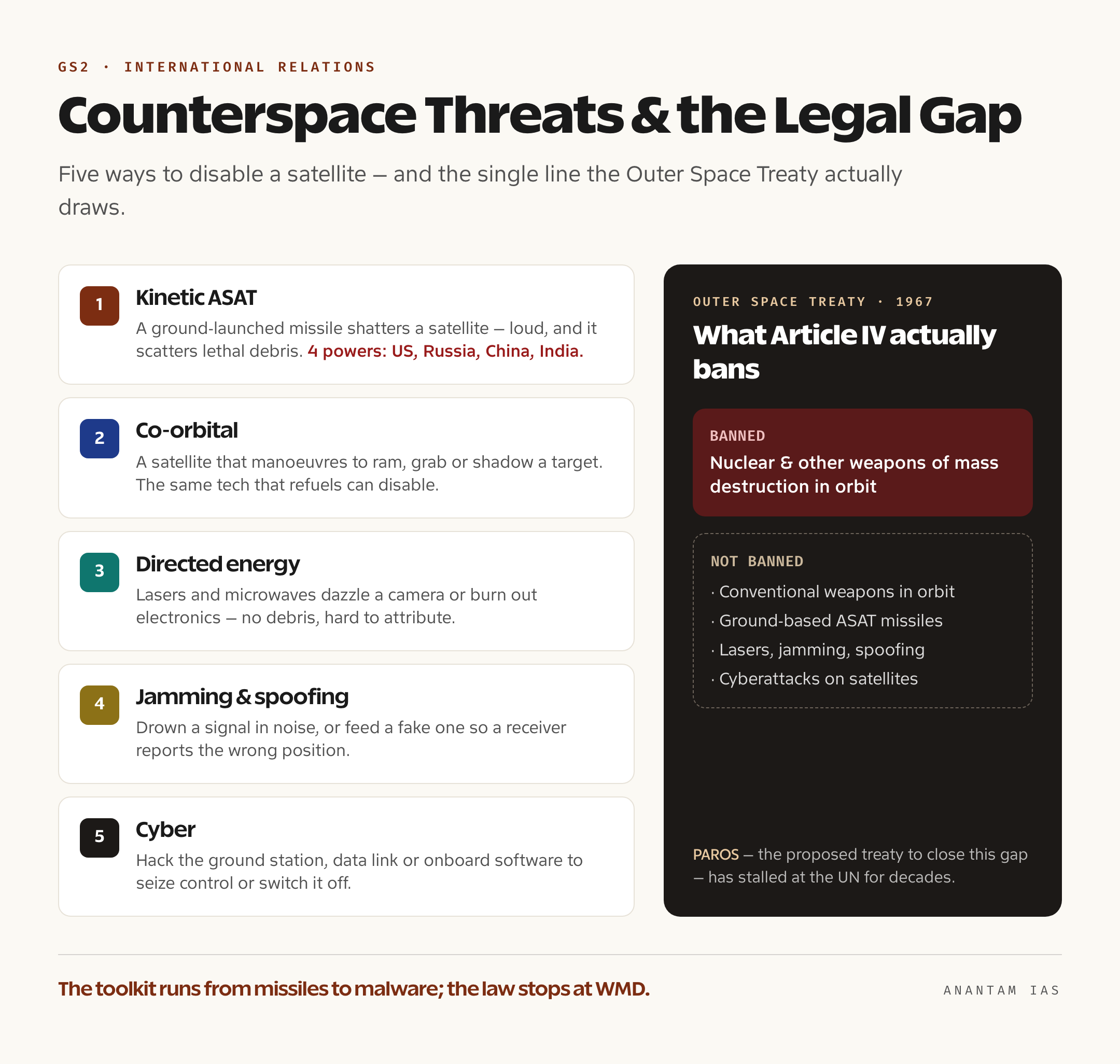
Once you accept that satellites are targets, the next question is how an adversary would hit one — and here the strategic community has settled on a tidy five-part menu, laid out each year in the Secure World Foundation’s Global Counterspace Capabilities Report. The first and most notorious is the kinetic, or direct-ascent, anti-satellite weapon — an ASAT. This is a missile fired from the ground that smashes into a satellite at enormous speed, destroying it by sheer impact. Four nations have proven they can do it: the United States, Russia, China and India. The problem is that kinetic kills are catastrophically dirty. When Russia destroyed one of its own defunct satellites in a 2021 test, the collision scattered more than 1,500 trackable fragments of debris across low Earth orbit, each a bullet travelling at thousands of kilometres an hour, threatening every other satellite and the International Space Station for years. Debris is the reason ASATs are as feared for their mess as for their menace.
The second category is co-orbital — a satellite that is itself the weapon. Instead of being launched from the ground, it is parked in orbit and can manoeuvre up to a target to ram it, grab it with a robotic arm, or shadow it for spying. The same rendezvous-and-proximity technology that lets a friendly spacecraft refuel or repair another can, with a change of intent, disable it; the capability is dual-use, which is exactly what makes it so hard to regulate. The third and fourth are the quiet, reversible attacks. Directed-energy weapons — lasers and microwaves fired from the ground or from orbit — can dazzle a satellite’s camera or burn out its electronics without leaving a single piece of debris. Electronic warfare is subtler still: jamming drowns a satellite’s signal in noise so a GPS receiver goes dark, while spoofing feeds it a convincing fake signal so it confidently reports the wrong position. The fifth is cyber — hacking the ground stations, the data links or the satellite’s own software to seize control, corrupt its data, or simply switch it off.
What makes this menu so destabilising is that most of it is invisible and deniable. A kinetic ASAT announces itself with a flash and a debris cloud, but a jammed signal or a cyber intrusion can look like an ordinary malfunction, and the victim may never be sure it was attacked at all. US officials have warned more recently that Russia is developing a space-based nuclear anti-satellite weapon — a device that would use a nuclear blast in orbit to indiscriminately knock out hundreds of satellites at once, friend and foe alike. That prospect is what turned a slow-burning policy debate into an urgent one, because it would cross the one bright line the existing law actually draws, and it would do so in the most reckless way imaginable.
Why Space Became a Warfighting Domain
None of this counterspace effort would matter if satellites were a luxury. The reason it matters — the reason countries are standing up dedicated military space organisations — is that modern life and modern war have become utterly dependent on a thin layer of hardware in orbit. The timing signal from GPS-style navigation satellites does far more than guide cars; it synchronises power grids, stock exchanges, mobile networks and the timestamps on financial transactions. Communications satellites carry the data that armies, ships and drones rely on. Imaging satellites are the eyes of any modern military. Knock those out and you do not just blind an army — you can freeze parts of a civilian economy. That deep dependence is precisely what makes satellites such tempting targets, and what makes their defence a first-order security concern.
The institutional response has been to treat space the way air power was treated a century ago — as a distinct domain of warfare that needs its own command, doctrine and force. The United States created the Space Force in 2019 as a separate armed service and has paired it with a Space Command, and its framework now talks openly about “control of space.” China and Russia have built up parallel structures and aggressive counterspace programmes, and a string of other states have stood up their own space commands. The logic is the same everywhere: if your forces depend on space and your rival can deny you space, then protecting your satellites and being able to threaten your rival’s becomes as basic as defending an airfield. This is the strategic shift in one line — space has moved from a benign support service to a contested domain that militaries expect to fight over.
And the contest has a built-in cruelty. The very interdependence that makes everyone vulnerable also makes restraint fragile, because a country that fears losing its satellites first has an incentive to strike pre-emptively in a crisis. Add the fact that an attack can be silent and deniable, and you have a recipe for misreading and escalation. This is why so much energy now goes into the legal and diplomatic side — into trying to build rules and norms before the technology races past any chance of controlling it.
The Law and Its Gaps: From the Outer Space Treaty to PAROS
The cornerstone of space law is the Outer Space Treaty of 1967 — the document that declares space the “province of all mankind,” forbids any nation from claiming sovereignty over the Moon or other bodies, and, crucially, contains the one hard military prohibition that still holds. Under Article IV, states undertake not to place in orbit, install on the Moon, or otherwise station in space any nuclear weapons or any other weapons of mass destruction, and to use the Moon and other celestial bodies exclusively for peaceful purposes. That is a real and valuable ban — it is why a space-based nuclear ASAT would be a flagrant treaty violation, and why Russia’s reported pursuit of one is so alarming.
But look at what the treaty does not say. It bans weapons of mass destruction in orbit, and nothing more. It does not prohibit conventional weapons in space — a kinetic interceptor, a co-orbital killer, a laser. It does not ban ground-based ASATs at all. It does not stop the militarisation of space in the ordinary sense, and it never anticipated jamming, spoofing or cyberattacks. The whole counterspace toolkit described earlier, with the single exception of a nuclear device, sits comfortably outside the 1967 prohibition. For more than four decades the international community has tried to close that gap through the Conference on Disarmament under the banner of PAROS — the Prevention of an Arms Race in Outer Space — which aims at a new, legally binding treaty covering conventional weapons in orbit. PAROS has been discussed at the UN year after year and has gone almost nowhere, deadlocked by the same great-power distrust it is meant to cure; the major spacefaring powers cannot agree on definitions, on verification, or on whether a binding ban serves their interests at all.
With a comprehensive treaty stuck, attention has shifted to softer norms — voluntary pledges and confidence-building measures meant to slow the slide. The most concrete is the moratorium on destructive direct-ascent ASAT tests. After Russia’s debris-spewing 2021 test, the United States in 2022 pledged unilaterally never to conduct such tests again and urged others to follow; that December the UN General Assembly backed a resolution encouraging the same restraint, carried by 155 states, with several Western nations and others making their own commitments. The aim is narrow but real — not to ban ASAT weapons, which no one has managed, but to stop the specific tests that fill orbit with debris. Russia and China voted against, and India, which had tested its own ASAT only three years earlier, abstained. That abstention is the perfect bridge to the part of the story that matters most for an Indian answer.
Where India Stands: Mission Shakti, the Defence Space Agency and Strategic Autonomy
India announced itself as a counterspace power on 27 March 2019, when it conducted Mission Shakti — a direct-ascent ASAT test in which a Defence Research and Development Organisation interceptor, based on the Prithvi missile, destroyed one of India’s own satellites at about 283 kilometres altitude in low Earth orbit. With that single strike India became only the fourth country, after the United States, Russia and China, with a proven ability to physically destroy a satellite. New Delhi was careful to frame it as a deterrent and a demonstration of capability rather than a hostile act, and deliberately chose a low altitude so that the debris would decay and burn up quickly rather than linger — a pointed contrast with the messier tests of others. The message was that India would not be left out of the orbital balance of power.
Mission Shakti was paired with new institutions. In 2019 the government created the Defence Space Agency, a tri-services body to plan and coordinate the military use of space, and approved a Defence Space Research Organisation to develop space-warfare technologies. ISRO, for its part, runs Project NETRA — Network for Space Objects Tracking and Analysis — India’s growing space-situational-awareness system that tracks debris and foreign satellites to protect Indian assets. The most striking recent step is the Space-Based Surveillance Phase-III programme, cleared by the Cabinet Committee on Security in 2023 at roughly twenty-seven thousand crore rupees, which will put a constellation of fifty-two military surveillance satellites in orbit by the end of the decade — about twenty-one built by ISRO and the rest by private Indian firms, fusing radar, optical and electronic-intelligence sensors over India’s borders and the Indian Ocean. By mid-2026 the programme was being actively fast-tracked, its urgency sharpened by the lessons of the 2025 military exchanges with Pakistan and by China’s rapid build-up in space.
India’s diplomatic stance threads a careful needle, and it is worth quoting in spirit in an answer. New Delhi consistently calls for the peaceful use of outer space, supports PAROS and the development of norms, and stresses that space should not become an arena of conflict — while simultaneously building the counterspace and surveillance capability it judges necessary for its own security. That is not hypocrisy; it is the standard logic of strategic autonomy. India argues that meaningful restraint must be negotiated multilaterally and apply to all, and that until a credible binding regime exists, it cannot unilaterally disarm in a domain where its rivals are arming. Its abstention on the ASAT-test moratorium fits the same pattern — sympathy for the goal, caution about tying its own hands. For India, the contest above Earth is a test of whether a rising power can hold the line on its security and its principles at the same time.
For Your Mains Answer
This is a high-value topic that straddles two papers. It is squarely a GS Paper 2 international-relations question — global governance, international treaties, India’s bilateral and multilateral diplomacy, and the role of forums like the UN Conference on Disarmament. It is equally a GS Paper 3 security-and-technology question — the militarisation of new domains, the security challenges of emerging technologies, and the defence of critical infrastructure. It also feeds the Essay paper on themes of technology and ethics, the commons, and security. The skill examiners reward is precision: open with the militarisation-versus-weaponisation distinction, name the legal instrument and its gap, and always land India’s position.
How to Build the Answer
Lead with the distinction — militarisation (using satellites to support war, long-standing and accepted) versus weaponisation (placing or using weapons to fight in or from space, the real danger). Then explain why space became a warfighting domain: total dependence of economies and militaries on satellites makes them targets, prompting Space Forces and space commands. Lay out the counterspace threats in their five families — kinetic ASAT and debris, co-orbital, directed-energy, electronic jamming and spoofing, and cyber. Turn to the law: the Outer Space Treaty bans only weapons of mass destruction in orbit, leaving conventional ASATs and the rest unregulated, and PAROS has stalled while the 2022 ASAT-test moratorium offers a softer norm. Close on India — Mission Shakti, the Defence Space Agency, NETRA and SBS-III — and on its balanced call for peaceful use alongside building deterrence.
Common Mistakes to Avoid
Don’t use “militarisation” and “weaponisation” interchangeably — keeping them apart is half the marks. Don’t claim the Outer Space Treaty bans all weapons in space; it bans only weapons of mass destruction, which is the entire point of the legal-gap argument. Don’t say India “violated” any treaty with Mission Shakti — no treaty bans ASAT tests, and India minimised debris by testing at low altitude. Don’t forget the debris problem, which is what makes kinetic ASATs a shared danger rather than a purely military issue. And don’t present India as either a pure dove or a pure hawk; the nuance — building capability while advocating norms — is what earns a top answer.
A Compact Answer Spine
Militarisation (satellite support: comms, GPS, ISR, early warning — old and accepted) ≠ weaponisation (weapons in/from space — the real threat) → space now a warfighting domain because economies and militaries depend on satellites → US Space Force, China, Russia, others build counterspace forces → five threat families: kinetic ASAT (debris) + co-orbital + directed-energy + jamming/spoofing + cyber → law: Outer Space Treaty 1967 bans only WMD in orbit, conventional ASATs unregulated → PAROS stalled at the CD; 2022 ASAT-test moratorium a softer norm → India: Mission Shakti 2019 (4th ASAT power), Defence Space Agency + DSRO, NETRA, SBS-III 52 satellites → posture: peaceful-use advocacy + strategic-autonomy deterrence → verdict: rules must catch up before the technology does.
Diagram or Flowchart Idea
Draw a two-box split at the top — “Militarisation: support” beside “Weaponisation: attack” — then below it a simple ladder of the five counterspace threats from kinetic at the top to cyber at the bottom, with a side note showing the Outer Space Treaty line drawn only around “WMD in orbit.” This single visual carries the distinction and the legal gap together, which are the two ideas the whole answer turns on.
A Balanced-Conclusion Line
A line that lands the marks: “The militarisation of space is already a fact of modern security; the unfinished task is to stop its weaponisation — and for India that means deterring threats to its satellites while pushing, through PAROS and norms like the ASAT-test moratorium, for a rulebook that keeps the orbital commons open to all.”
How to Use Data Without Cramming
You need only a few anchors: four ASAT powers (US, Russia, China, India), Mission Shakti on 27 March 2019 at about 283 km, the Outer Space Treaty of 1967, the 2022 ASAT-test moratorium backed by 155 states, and India’s 52-satellite SBS-III programme. Attribute them plainly — “as the Secure World Foundation’s counterspace report sets out” or “under Article IV of the Outer Space Treaty” — rather than scattering figures without a source.
Frequently Asked Questions
What is the difference between militarisation and weaponisation of space?
Militarisation means using space assets to support military operations on Earth — communications, navigation like GPS, surveillance and reconnaissance, and early warning of missile launches. It has gone on since the Cold War and is broadly accepted as normal, even stabilising. Weaponisation means placing weapons in orbit or building weapons to attack targets in space or on the ground — turning the domain itself into a battlefield. Militarisation is settled; weaponisation is what arms-control efforts are trying to prevent and what the current contest is really about.
Does the Outer Space Treaty ban all weapons in space?
No, and this is the key legal gap. The 1967 Outer Space Treaty, under Article IV, only bans placing nuclear weapons or other weapons of mass destruction in orbit, and reserves the Moon and other bodies for peaceful purposes. It does not prohibit conventional weapons in orbit, ground-based anti-satellite missiles, lasers, jamming or cyberattacks. Efforts to close that gap through a new treaty — PAROS, the Prevention of an Arms Race in Outer Space — have been deadlocked at the UN Conference on Disarmament for decades.
What are counterspace capabilities and ASAT weapons?
Counterspace capabilities are the means of attacking or disabling satellites. They fall into five groups: kinetic or direct-ascent anti-satellite (ASAT) weapons — missiles that physically smash a satellite, creating dangerous debris; co-orbital weapons — satellites that manoeuvre to ram, grab or shadow a target; directed-energy weapons such as lasers and microwaves; electronic warfare like jamming and spoofing; and cyberattacks on ground stations or satellite software. Four nations — the US, Russia, China and India — have demonstrated kinetic ASAT capability.
What is India’s position on the militarisation of space?
India advocates the peaceful use of outer space and supports PAROS and the development of international norms, while building the capability it judges necessary for its security. It demonstrated an ASAT weapon in Mission Shakti in March 2019, becoming the fourth nation able to destroy a satellite, and set up the Defence Space Agency and Defence Space Research Organisation. It runs Project NETRA for space situational awareness and is building the 52-satellite SBS-III military surveillance constellation. This twin-track of deterrence plus norm-advocacy reflects India’s strategic autonomy.
Practice Questions
Prelims MCQs
- With reference to the militarisation and weaponisation of space, which statement is correct?
(a) Both terms mean the same thing and refer to placing weapons in orbit
(b) Militarisation refers to using satellites for military support such as communications and surveillance, while weaponisation refers to placing or using weapons to attack targets
(c) Weaponisation is permitted under international law but militarisation is banned
(d) Militarisation began only after the creation of the US Space Force
Answer: (b) Militarisation is the long-standing use of satellites to support military operations; weaponisation means turning space into a battlefield with actual weapons. - Under Article IV of the Outer Space Treaty of 1967, which of the following is prohibited?
(a) All military use of satellites
(b) Ground-based anti-satellite missiles
(c) Placing nuclear weapons or other weapons of mass destruction in orbit
(d) The creation of national space forces
Answer: (c) The treaty bans only weapons of mass destruction in orbit; conventional weapons, ground-based ASATs and military support uses are not prohibited. - India conducted its anti-satellite (ASAT) weapon test, Mission Shakti, in which year, becoming the fourth nation with such capability?
(a) 2007
(b) 2014
(c) 2019
(d) 2022
Answer: (c) Mission Shakti was carried out on 27 March 2019, destroying an Indian satellite at about 283 km altitude in low Earth orbit. - Which of the following is NOT one of the five recognised categories of counterspace capability?
(a) Kinetic direct-ascent ASAT weapons
(b) Co-orbital systems
(c) Directed-energy weapons
(d) Hypersonic glide vehicles
Answer: (d) The five categories are kinetic ASAT, co-orbital, directed-energy, electronic warfare (jamming and spoofing) and cyber; hypersonic glide vehicles are a separate, terrestrial-strike technology. - PAROS, frequently discussed in the context of space security, refers to which of the following?
(a) A constellation of Indian surveillance satellites
(b) The Prevention of an Arms Race in Outer Space, a proposed treaty at the UN Conference on Disarmament
(c) A US programme to deploy weapons in orbit
(d) An agency that tracks space debris
Answer: (b) PAROS aims at a new legally binding treaty to cover conventional weapons in space, addressing gaps left by the Outer Space Treaty, but has remained deadlocked for decades.
Mains Practice Questions
- Distinguish between the militarisation and the weaponisation of outer space. Why is this distinction central to understanding contemporary space-security debates? (15 marks, 250 words)
- “The Outer Space Treaty of 1967 has aged into an inadequate instrument for an era of counterspace weapons.” Critically examine, with reference to its provisions and the failure of PAROS. (15 marks, 250 words)
- Discuss the principal counterspace threats faced by space-faring nations today. Why does the kinetic anti-satellite weapon pose a danger that extends beyond the immediate target? (15 marks, 250 words)
- Examine the rationale and implications of treating outer space as a distinct warfighting domain, with reference to the dependence of modern economies and militaries on satellites. (10 marks, 150 words)
- “India seeks to deter threats in space while advocating its peaceful use.” In light of Mission Shakti, the Defence Space Agency and India’s stance at the UN, critically evaluate India’s approach to space security. (15 marks, 250 words)
Tell Google you want more of this.
Add Anantam IAS as a preferred sourceOne tap, and this site shows up more often in your own Top Stories, AI Overviews and AI Mode. Remove it any time.