
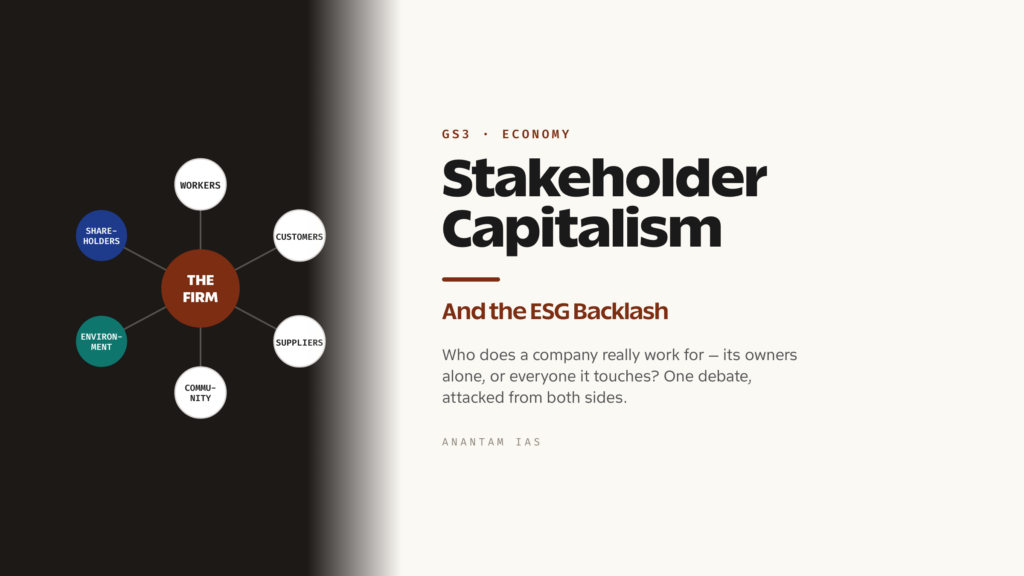
Ask a simple question and you split the entire history of modern capitalism in two: who does a company actually work for? For most of the last fifty years the answer that ruled boardrooms and business schools was clean and narrow — a company works for its shareholders, the people who own it, and its one job is to make them richer. Then, in August 2019, the Business Roundtable, the club of chief executives running America’s biggest firms, signed a statement that quietly tore up that creed. A corporation, they declared, exists to serve all its stakeholders — its customers, its workers, its suppliers, the communities it operates in, and only then its shareholders. Around the same time the World Economic Forum at Davos was preaching the same gospel, and a wave of money labelled “ESG” was pouring into funds that promised to invest in good corporate behaviour. For a few years it looked like the rules of capitalism were being rewritten.
And then came the backlash — fierce, fast and from both directions at once. Critics on the left said it was all a marketing trick, a coat of green paint over business as usual. Critics on the right said it was “woke capitalism,” a political agenda smuggled into people’s pension funds, and US states began passing laws to ban it. ESG funds started bleeding money. The phrase itself became almost unsayable in some boardrooms. For a UPSC aspirant, this is one of the richest debates in the economy and governance syllabus, because it forces you to think clearly about the purpose of the firm, the limits of markets, and how a country like India is trying to make companies disclose their impact without choking growth. It is a near-perfect GS3 and Essay theme — a live argument with sharp data on every side.
Shareholder Primacy and the Stakeholder Alternative
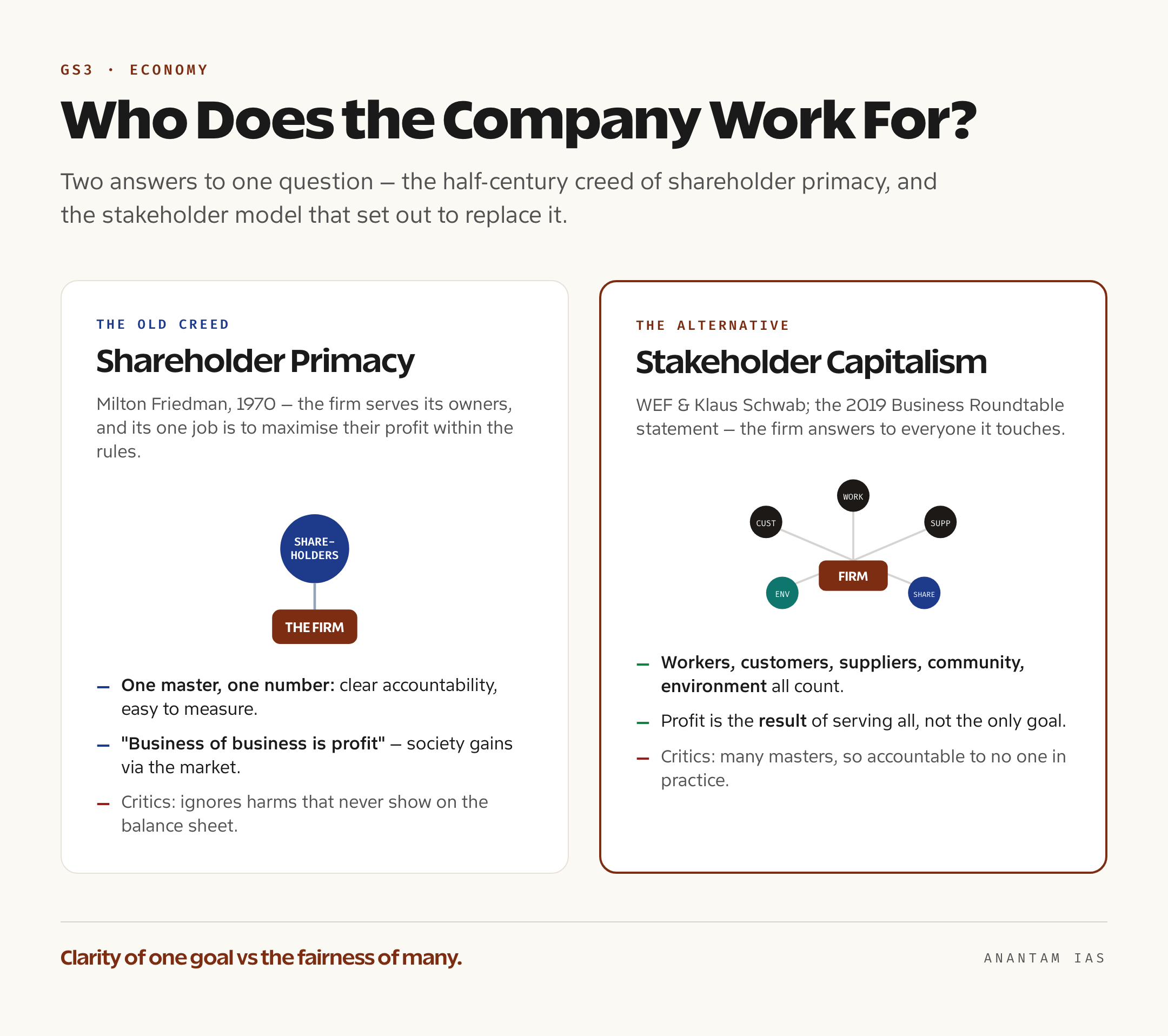
Start with the idea that ruled for half a century, because you cannot judge the rebellion without first understanding the king. In 1970 the economist Milton Friedman wrote a famous essay arguing that the social responsibility of business is to increase its profits — that the business of business is business, and nothing more. His logic was tight. A company’s managers are hired agents of its owners, the shareholders; spending company money on social causes the owners never approved is, in effect, spending other people’s money on the manager’s own pet projects, a kind of taxation without consent. If a person wants to do good, let them earn their dividend and give it to charity themselves. Society is served best, in this view, when each firm maximises profit within the rules of the game, and the invisible hand of the market does the rest. This is shareholder primacy, and for decades it was simply how serious people thought a company should be run.
Stakeholder capitalism is the direct answer to that. It says a firm is not just a money-making machine for its owners but a social institution embedded in a web of relationships — and that it owes something to everyone whose life it touches. Klaus Schwab, the founder of the World Economic Forum, has pushed this idea hardest, arguing that a company should serve its employees with fair wages and safe work, its customers with honest products, its suppliers with fair dealing, the communities around it with good citizenship, and the environment with restraint — and that delivering profit to shareholders is the result of getting all of that right, not the sole goal. The idea is not new; the post-war social democracies of Northern Europe built whole economies around it, with workers sitting on company boards. What was new in 2019 was watching America’s most powerful executives, the very high priests of shareholder value, publicly switch sides.
But here is the catch that every good answer must name. A manager who serves shareholders has one master and one number to maximise. A manager who serves everyone has many masters whose interests collide — higher wages please workers but shrink profits, cheaper prices please customers but squeeze suppliers, cleaner factories please communities but raise costs. When you are accountable to everyone, critics ask, are you not in practice accountable to no one, free to justify almost any decision by pointing to whichever stakeholder is convenient? That tension — between the clarity of one goal and the fairness of many — sits at the heart of the whole debate, and it is what ESG tried, and largely failed, to resolve.
ESG Investing: The Rise and the Reckoning
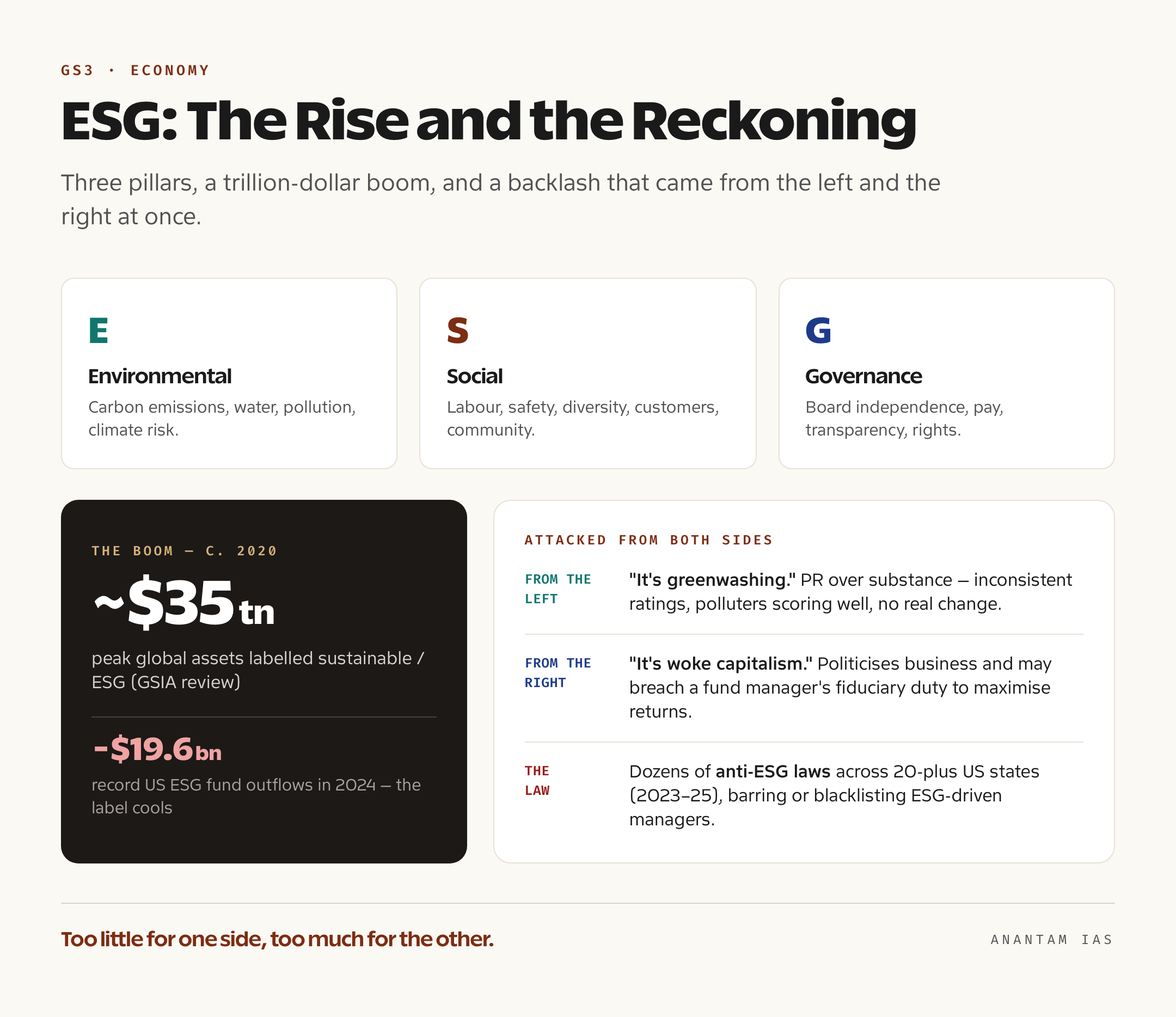
If stakeholder capitalism is the philosophy, ESG was the machinery built to measure it. ESG stands for Environmental, Social and Governance — three baskets of non-financial factors that investors began using to score how responsibly a company behaves. The Environmental pillar asks about carbon emissions, water use, pollution and climate risk; the Social pillar about labour practices, safety, diversity and how a firm treats its customers and communities; the Governance pillar about board independence, executive pay, transparency and the rights of minority shareholders. The promise was elegant: turn good corporate citizenship into a number, and money would flow toward the firms that scored well and away from those that scored badly, nudging the whole economy toward better behaviour without a single new law.
For a while the money came in a flood. By the start of this decade, assets sitting in funds that called themselves sustainable or ESG were estimated at tens of trillions of dollars — a Global Sustainable Investment Alliance review put the figure around $35 trillion in 2020, the high-water mark of the movement. Asset-management giants rebranded around it, ratings agencies sprang up to sell ESG scores, and “purpose” became the favourite word in every annual report. Then the tide turned. Under tighter, more honest definitions, that same global tally was recounted at about $30 trillion for 2022 — a 14 per cent drop driven less by investors fleeing than by the industry admitting that much of what it had labelled “sustainable” did not really qualify. That recount was an early confession that the emperor’s wardrobe was thinner than advertised.
The reckoning that followed has been brutal. In the United States, sustainable funds suffered net outflows of roughly $13 billion in 2023 and a record of around $19.6 billion in 2024, with the number of ESG funds on offer shrinking back toward where it stood years earlier as managers quietly dropped the label. Higher interest rates made plain old bonds look attractive again; the underperformance of some green funds soured the mood; and a steady drip of greenwashing scandals — firms caught overstating how clean or ethical they really were — drained the trust the whole edifice depended on. ESG had promised to align doing well with doing good. By the mid-2020s, a lot of investors had concluded it reliably did neither.
The Backlash from Both Sides
What makes this story unusual is that ESG and stakeholder capitalism are being attacked from the left and the right at the same time, for opposite reasons — and a strong answer holds both critiques in view. Take the critique from the left first, because it is the older one. To progressive critics, ESG is mostly public relations — a way for corporations to look responsible without changing anything that matters. They point to greenwashing, where a company trumpets a small green initiative while its core business keeps polluting; to the inconsistency of ESG ratings, where the same firm earns a high score from one agency and a low one from another, proving the scores measure spin as much as substance; and to the awkward fact that some of the world’s biggest fossil-fuel and arms companies have carried perfectly respectable ESG ratings. In this telling, stakeholder capitalism lets executives pose as moral leaders while quietly defending the status quo — a feel-good story that buys off pressure for real regulation and real redistribution.
The critique from the right is newer, louder, and now backed by the force of law. To conservative critics, especially in the United States, ESG is “woke capitalism” — an attempt by activists, regulators and big asset managers to impose a political agenda on business through the back door of finance. Their sharpest argument is about fiduciary duty: when a pension fund manager invests on ESG grounds, the claim goes, they may be putting their own political values ahead of their legal obligation to earn the best possible return for the retirees whose money it is. That is not just controversial, the argument runs, it may be a breach of duty. This has moved well beyond rhetoric. Across 2023 to 2025 a wave of US states passed anti-ESG laws — blacklisting asset managers seen as hostile to oil and gas, barring state pension funds from weighing ESG factors, and restricting how firms may collaborate on climate goals. Texas alone passed measures aimed at curbing shareholder activism on contentious issues. By 2025 dozens of such laws sat on the books across twenty-odd states, and the federal regulatory mood had cooled sharply too.
So the movement is caught in a pincer. One side says it does too little — empty promises dressed up as change. The other says it does too much — politics masquerading as investing. The honest middle is that ESG was always trying to do something genuinely hard: compress messy, contested questions about a company’s effect on the world into a single tidy score. When you attempt that, you will inevitably please neither the people who want deep change nor the people who want none. The label may be fading, but the underlying question it tried to answer — how do we hold companies accountable for harms that do not show up on a profit-and-loss statement — has not gone anywhere.
The India Angle: BRSR, CSR and ESG at Home
India has taken a quieter, more regulatory path through all this, and it is the part of the topic an Indian examiner cares about most. Two distinct tools matter, and you should never confuse them. The first is mandatory corporate social responsibility, which India pioneered. Under Section 135 of the Companies Act 2013 and the CSR rules, large companies — broadly those with a net worth of at least ₹500 crore, or turnover of at least ₹1,000 crore, or net profit of at least ₹5 crore in a financial year — must spend at least 2 per cent of their average net profit of the preceding three years on approved social causes, and explain themselves if they fall short. India was among the first countries in the world to make CSR a statutory obligation rather than a voluntary gesture, channelling thousands of crores a year into education, health, sanitation and rural development.
The second, and newer, tool is disclosure rather than spending — and this is where India’s version of ESG lives. The market regulator SEBI has built a framework called Business Responsibility and Sustainability Reporting, or BRSR. Since the financial year 2022-23, the top 1,000 listed companies by market value have had to publish a detailed BRSR report each year, laying out their environmental footprint, their treatment of workers and communities, and their governance — turning the soft language of sustainability into hard, comparable data filed with the regulator. To stop this becoming another box-ticking exercise, SEBI added a tougher core within it. The BRSR Core is a focused set of roughly nine key parameters — including greenhouse-gas emissions, energy and water use, waste, and gender diversity — that must be independently checked, with mandatory third-party assurance rolling out in phases: the very largest companies first, then steadily down the list until, by around 2026-27, all of the top 1,000 must have their core sustainability claims verified by an outsider rather than merely asserted. India, in other words, is trying to answer the greenwashing critique with audit.
ESG investing exists in India too, though on a modest scale next to the West. A clutch of ESG-themed mutual funds have grown from a few hundred crore at the start of the decade to several thousand crore by the mid-2020s — real, but a rounding error in a market this size. That smallness is partly why India has been spared the worst of the Western backlash: ESG here is driven more by the regulator demanding disclosure than by a tidal wave of investor money chasing a label. As the latest Economic Survey discussions on sustainable finance suggest, the Indian state sees responsible-business reporting less as an ideological project and more as plumbing for a future where green capital, carbon markets and climate risk will all need reliable corporate data to function. The lesson India seems to have drawn from the global mess is shrewd: skip the hype, mandate the numbers, and make companies prove their claims.
For Your Mains Answer
This is a high-value topic for GS Paper 3, which covers the Indian economy, mobilisation of resources, and the role of regulators and the corporate sector — and it touches GS Paper 2 wherever corporate governance and regulatory bodies like SEBI come up. It is also a gift for the Essay paper on themes of capitalism, ethics in business, growth versus responsibility, and the purpose of the corporation. The skill examiners reward here is balance: you must present a genuine two-sided debate, refuse to caricature either camp, and then land the India-specific framework — CSR plus BRSR — as the concrete, examinable core.
How to Build the Answer
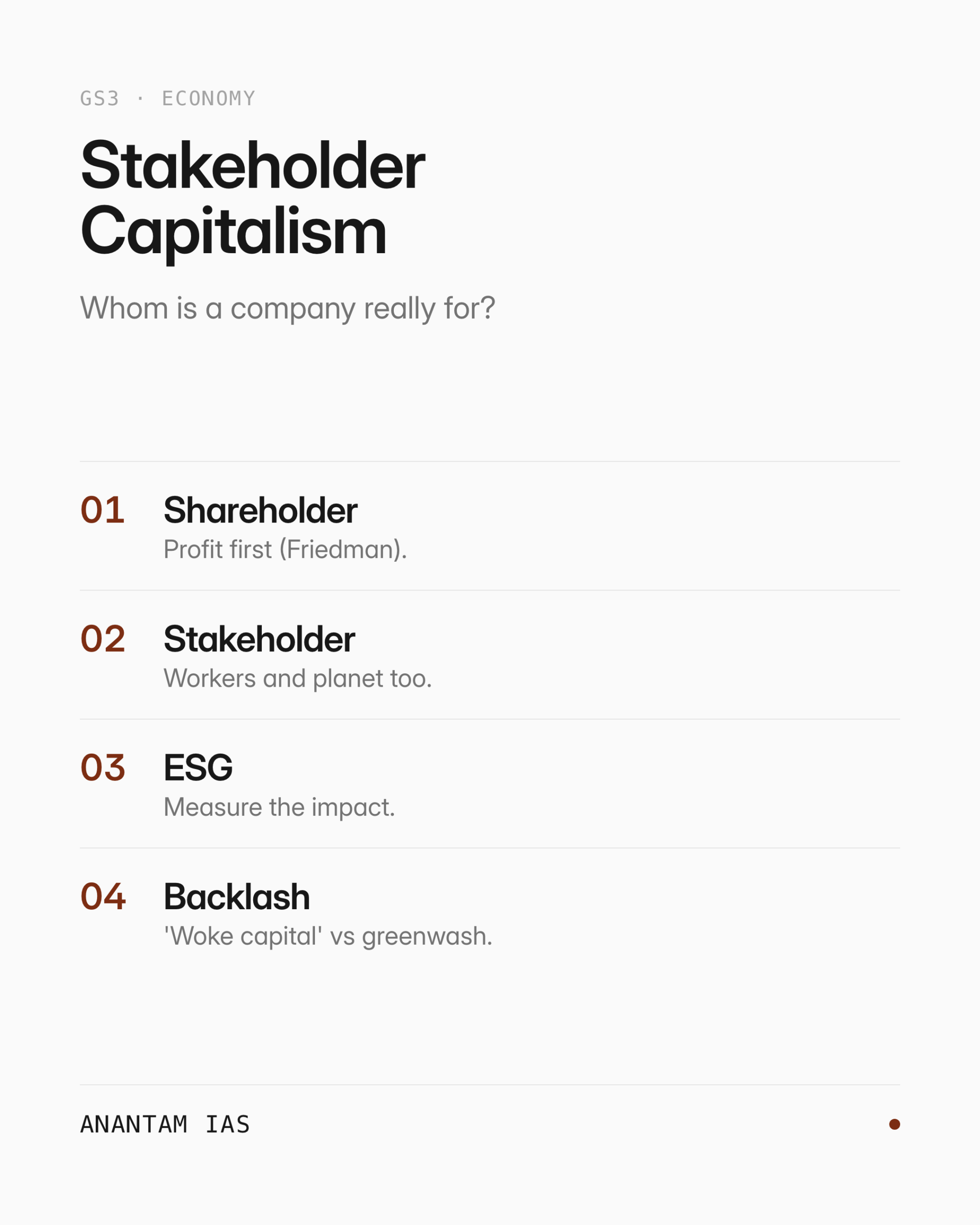
Open with the question, not the jargon — who does a company serve? Then move in a clean arc: shareholder primacy (Friedman’s profit-maximising firm) versus stakeholder capitalism (the firm that serves all who depend on it, championed by the WEF and signalled by the 2019 Business Roundtable statement) → ESG as the measurement machinery, with its three pillars and its rise to tens of trillions → the twin backlash, left and right → India’s regulatory answer in CSR and BRSR → a balanced verdict. That structure works for almost any question on corporate responsibility, ESG, or the purpose of business.
Common Mistakes to Avoid
Don’t conflate CSR with ESG — CSR is a spending mandate under the Companies Act, BRSR is a disclosure mandate under SEBI; muddling them is a tell-tale error. Don’t present the backlash as coming only from the right; the left’s greenwashing critique is older and equally examinable. Don’t claim ESG has “failed” outright — say the label is cooling while the underlying accountability question endures. And don’t forget the fiduciary-duty argument; naming it shows you understand why the right’s objection has legal teeth.
A Compact Answer Spine
Question: who does the firm serve? → Friedman’s shareholder primacy (business of business is profit) vs stakeholder capitalism (workers + customers + suppliers + communities + environment; WEF/Schwab; 2019 Business Roundtable) → ESG = Environmental + Social + Governance, the measurement tool, peaked near $35 tn (2020) → backlash: left says greenwashing + inconsistent ratings; right says “woke capitalism” + breach of fiduciary duty + US state anti-ESG laws; record fund outflows 2023-24 → India: CSR (Sec 135, 2% spend) + BRSR / BRSR Core with phased third-party assurance under SEBI → verdict: label fading, accountability question permanent.
Diagram or Flowchart Idea
Sketch the firm at the centre with arrows out to five stakeholders — workers, customers, suppliers, community, environment — and shareholders shown as just one of them, captioned “stakeholder model.” Beside it, a small three-box stack labelled E, S, G feeding into a single “ESG score.” This one visual captures both the philosophy and the machinery in seconds.
A Balanced-Conclusion Line
A line that lands the marks: “Stakeholder capitalism asked the right question — what does a company owe the world beyond its owners — even if ESG proved a clumsy way to answer it; India’s quieter bet on mandatory disclosure over investor hype may yet hold the more durable lesson.”
How to Use Data Without Cramming
You need only a handful of anchors: the 2019 Business Roundtable statement, the roughly $35-trillion ESG peak around 2020, record US outflows of about $19.6 billion in 2024, the dozens of US state anti-ESG laws, and India’s 2 per cent CSR rule plus the top-1,000 BRSR mandate. Attribute them plainly — “as a Global Sustainable Investment Alliance review found,” “under SEBI’s BRSR framework” — rather than scattering figures loose.
Frequently Asked Questions
What is the difference between shareholder and stakeholder capitalism?
Shareholder capitalism, or shareholder primacy, holds that a company’s sole purpose is to maximise returns for its owners, the shareholders — the view Milton Friedman made famous in 1970. Stakeholder capitalism holds that a firm must also serve its workers, customers, suppliers, communities and the environment, treating profit as the result of looking after all of them rather than the only goal. The US Business Roundtable endorsed the stakeholder view in 2019, and the World Economic Forum has championed it.
What does ESG stand for, and why is there a backlash against it?
ESG stands for Environmental, Social and Governance — three sets of non-financial factors investors use to judge how responsibly a company behaves. The backlash comes from two sides: the left says ESG is greenwashing, with inconsistent ratings and little real change, while the right calls it “woke capitalism” that politicises business and may breach a fund manager’s fiduciary duty to maximise returns. Several US states have passed anti-ESG laws, and ESG funds saw record outflows in 2023-24.
What is BRSR and how does it apply in India?
BRSR is SEBI’s Business Responsibility and Sustainability Reporting framework. Since 2022-23, India’s top 1,000 listed companies must publish an annual BRSR report disclosing their environmental, social and governance performance. A tougher subset, the BRSR Core, covers key metrics like emissions and water use and requires independent third-party assurance, phased in from the largest companies down to all top 1,000 by around 2026-27 — India’s regulatory answer to the greenwashing problem.
Is CSR the same as ESG?
No. CSR (corporate social responsibility) under Section 135 of the Companies Act 2013 is a spending mandate — eligible large companies must spend at least 2 per cent of their average net profit on approved social causes. ESG, expressed in India mainly through SEBI’s BRSR, is a disclosure and investment framework about measuring and reporting a company’s wider impact. CSR is about giving money; ESG is about measuring behaviour.
Practice Questions
Prelims MCQs
- The concept of “shareholder primacy,” associated with Milton Friedman, holds that:
(a) a company must serve its employees and communities before its owners
(b) the primary social responsibility of a business is to maximise profits for its shareholders
(c) the government should own a controlling stake in large firms
(d) shareholders must be drawn only from the local community
Answer: (b) Friedman argued in 1970 that the social responsibility of business is to increase its profits within the rules, serving owners above all. - In 2019, which body issued a statement redefining the purpose of a corporation to serve all stakeholders rather than shareholders alone?
(a) The International Monetary Fund
(b) The US Securities and Exchange Commission
(c) The Business Roundtable
(d) The Organisation for Economic Co-operation and Development
Answer: (c) The Business Roundtable, a group of major US chief executives, signed the statement in August 2019. - The “G” in ESG investing refers to which of the following?
(a) Growth
(b) Globalisation
(c) Governance
(d) Green technology
Answer: (c) ESG stands for Environmental, Social and Governance; the governance pillar covers board independence, executive pay, transparency and shareholder rights. - With reference to SEBI’s BRSR framework, which statement is correct?
(a) It requires the top 1,000 listed companies to publish a sustainability report each year
(b) It mandates that every company spend 2 per cent of profit on social causes
(c) It applies only to public sector undertakings
(d) It bans ESG-themed mutual funds in India
Answer: (a) Business Responsibility and Sustainability Reporting applies to the top 1,000 listed companies by market value from FY 2022-23, with the BRSR Core requiring third-party assurance. - Under Section 135 of the Companies Act 2013, eligible companies must spend at least how much on corporate social responsibility?
(a) 1 per cent of turnover
(b) 2 per cent of average net profit of the preceding three years
(c) 5 per cent of net worth
(d) 10 per cent of dividends paid
Answer: (b) Eligible companies must spend at least 2 per cent of their average net profit of the immediately preceding three financial years on approved CSR activities.
Mains Practice Questions
- Distinguish between shareholder primacy and stakeholder capitalism. In light of the 2019 Business Roundtable statement, examine whether the purpose of the corporation is genuinely shifting. (15 marks, 250 words)
- “ESG investing was attacked from the left and the right at the same time, for opposite reasons.” Critically analyse the twin backlash against ESG and stakeholder capitalism. (15 marks, 250 words)
- Discuss the role of disclosure-based regulation in promoting responsible business conduct, with reference to SEBI’s BRSR and BRSR Core framework. (15 marks, 250 words)
- Differentiate between India’s mandatory CSR regime and the ESG disclosure framework. How do the two together shape corporate responsibility in India? (10 marks, 150 words)
- “Stakeholder capitalism asks the right question even if ESG offered a flawed answer.” Evaluate this statement in the context of the global debate on the purpose of business and India’s regulatory approach. (15 marks, 250 words)
Tell Google you want more of this.
Add Anantam IAS as a preferred sourceOne tap, and this site shows up more often in your own Top Stories, AI Overviews and AI Mode. Remove it any time.