Disclosure: this guide contains Amazon affiliate links. As an Amazon Associate, Anantam IAS earns from qualifying purchases — at no extra cost to you.
An internal security book for UPSC should help you explain a threat, connect it to institutions and write a workable response. A long collection of incidents can leave you with dates but no answer structure. Buying several overlapping books makes that problem harder to see.
I recommend one main textbook, a small set of official updates and regular answer practice. Courseware on Challenges to Internal Security of India by Ashok Kumar and Vipul Anekant is a defensible main-book choice because its published contents cover the central security themes. Keep your current source if it already does that job; add another only for a specific gap.
Choose One Main Book
Start by checking the exact edition and language. McGraw Hill’s English and Hindi products use different edition numbers.
| Version | Verified Book Details | Buying Decision |
|---|---|---|
| English | Courseware on Challenges to Internal Security of India; Ashok Kumar and Vipul Anekant; McGraw Hill; 8th edition; ISBN 9789378528149 | Choose if you want a structured English source and its explanations suit you |
| Hindi | Bharat ki Aantrik Suraksha ki Mukhya Chunautiyan – A Courseware; the same authors; McGraw Hill; 7th edition; ISBN 9789364446563 | Choose by language comfort, after checking its contents and current coverage |
The English eighth-edition listing matches the publisher’s ISBN. The publisher’s Hindi listing identifies the separate seventh edition. Don’t assume the Hindi book includes every addition made to the English edition.
A publisher’s contents list establishes coverage, not that every explanation is equally strong. Read a sample before buying if possible. If digital access matters to you, confirm its conditions for the copy you’re purchasing rather than assuming a used copy includes an unused code.
You can place this source within your broader plan using our Mains booklist. For definitions and the subject framework, use the internal security explainer. Your book work should produce applications beyond those basic definitions.
Give Each Source A Job
Use a textbook for the durable framework and official materials for the changing details. Keep a source only if you can explain what it contributes to an answer.
| Source | Use It For | Reading Boundary |
|---|---|---|
| Main textbook | Concepts, connections and institutions | Check its cutoff before using a recent statistic or policy claim |
| Ministry of Home Affairs annual reports | Government programs, institutional activity and dated figures | Reporting year and definitions matter; a reported activity isn’t proof of effectiveness |
| Parliamentary answers and official releases | A specific current fact or policy clarification | Record the question date and the period described |
| CERT-In advisories | Concrete cybersecurity risks and protective guidance | Technical advisories aren’t a complete account of policing or national security |
| Official previous question papers | Understanding the demand and scope of questions | Attempt the question before reading a model answer |
Begin with the MHA annual-report index and CERT-In. For a particular fact, keep the exact report or advisory link in your notes. Don’t cite a homepage as proof of a numerical claim.
Treat your sources like a map and a dated road update. The textbook gives the layout; official material helps you check a change. The analogy stops there: a government report can present its own account of performance, so examine what its evidence actually measures.
Turn The Contents Into Tasks
The English eighth edition’s contents identify terrorism, regional insurgencies, extremism, organized crime, cybersecurity, border management and security forces. Convert those themes into tasks rather than copying chapter summaries.
| Theme | Study Task | Output |
|---|---|---|
| Terrorism and external actors | Separate actor, objective, support network and response | Threat-mechanism map |
| Insurgency and extremism | Separate grievances, recruitment, violence and the State’s response | Cause-response comparison |
| Development and extremism | Explain a possible connection without treating poverty as a complete explanation | A qualified causal argument |
| Organized crime and money laundering | Distinguish the underlying crime from handling its proceeds | Process note with verified institutional roles |
| Cybersecurity and social media | Separate technical vulnerability, fraud and public-order consequences | Risk-response matrix |
| Borders and security forces | Link a problem to the relevant mandate and coordination need | Role-and-coordination card |
Avoid a single “deploy more forces” conclusion for every topic. The response to a financial-fraud complaint, recruitment into violence and a border vulnerability will have different actors and safeguards.
Work Through A Rumor Scenario
This is an original hypothetical practice exercise, not a UPSC question. A falsely captioned video circulates in a district. Crowds begin gathering near a religious site, and residents report threats. Explain how the administration should respond while protecting safety and avoiding unsupported blame. Assume no additional facts about who posted the video or why.
First separate the information layers:
- Known in the scenario: a false caption, circulating content, gatherings and reported threats.
- Needs verification: origin of the content, identities of those making threats, scale of risk and whether coordinated organization exists.
- Cannot be assumed: every sharer belongs to a terrorist network, or an entire community is responsible.
Now connect each risk to an action and a limit.
| Risk | Reasoned Response | Safeguard |
|---|---|---|
| Immediate physical harm | Protect vulnerable people and locations; assess threats through lawful policing | Use proportionate measures based on the assessed risk |
| False information spreading | Issue a clear correction through trusted local channels and seek appropriate platform action | Preserve necessary evidence; avoid repeating inflammatory content needlessly |
| Investigation losing evidence | Record complaints and preserve relevant digital evidence through competent personnel | Follow applicable legal procedure and privacy protections |
| Community mistrust | Engage credible local representatives and provide regular factual communication | Don’t assign collective guilt or promise an unverified outcome |
The reasoning chain is content exposure → belief or fear → mobilization → possible harm. Different steps need different responses. Removing a post alone doesn’t protect people already facing threats; policing alone doesn’t correct the false information.
A concise practice answer could say:
“The administration should treat the scenario as an information-driven public-safety risk. It should protect threatened people and sensitive locations, verify complaints and preserve relevant digital evidence. A prompt factual correction through trusted local channels can reduce uncertainty, while competent authorities pursue lawful investigation and appropriate platform engagement. Action should target evidence of individual wrongdoing, avoid collective blame and retain proportionality and review. Prevention should include reliable reporting channels, local trust and digital-literacy measures.”
The answer doesn’t name an invented offender, claim a particular statute automatically applies or promise that one action ends the risk. If a question asks for the law, verify the relevant provision before adding it.
Build An Evidence Card
Record a statistic or policy with enough detail to prevent accidental distortion. A figure without its period and definition is easy to misuse.
Use these fields:
- Claim: exactly what the source reports.
- Source and date: report title, page or table, publication date and URL.
- Measurement: incidents, cases, arrests, convictions, complaints or funds; these aren’t interchangeable.
- Period and geography: the years and places covered.
- Application: the argument the fact can reasonably support.
- Limit: what it does not establish.
For example, a hypothetical rise in registered cybercrime cases could reflect more offending, more reporting or changes in recording. The number alone won’t identify the cause. Label that as a reasoning exercise; don’t turn it into a current statistic.
Use A Flexible Study Cycle
Use a four-week cycle if your timetable allows. You can stretch it by giving each theme more sessions, while retaining the same outputs.
- Week 1: foundations, terrorism and regional insurgencies; make mechanism maps.
- Week 2: extremism, development and organized crime; write cause-response comparisons.
- Week 3: cybersecurity, borders and institutional roles; make risk-response cards and verify mandates.
- Week 4: consolidate official updates, attempt questions and rewrite weak answers.
A 60-minute session can use 25 minutes for the textbook, 10 for one relevant official update, 15 for a written application and 10 for review. With 30 minutes available, use a smaller reading segment and alternate update work with answer practice.
Before closing a topic, explain its mechanism without the book, identify the responsible institutions and write one response with a safeguard. If you can’t do those three things, reread the gap. A second complete book should wait.
Frequently Asked Questions
Which internal security book should I start with?
Courseware on Challenges to Internal Security of India by Ashok Kumar and Vipul Anekant is a defensible main source based on its published coverage. Inspect a sample and keep a current source if it already meets your needs.
Are the English and Hindi editions the same?
Their edition numbers differ. McGraw Hill identifies the English eighth edition with ISBN 9789378528149 and the Hindi seventh edition with ISBN 9789364446563. Do not assume identical updates.
Is one book enough for current developments?
Use one book for the framework and dated official sources for updates. Check the reporting period and definition of any statistic before using it.
Should I read an entire MHA annual report?
Read the relevant sections for a defined study question. Record the exact report, table, period and limit of the evidence rather than collecting unrelated numbers.
How do I turn a chapter into a Mains answer?
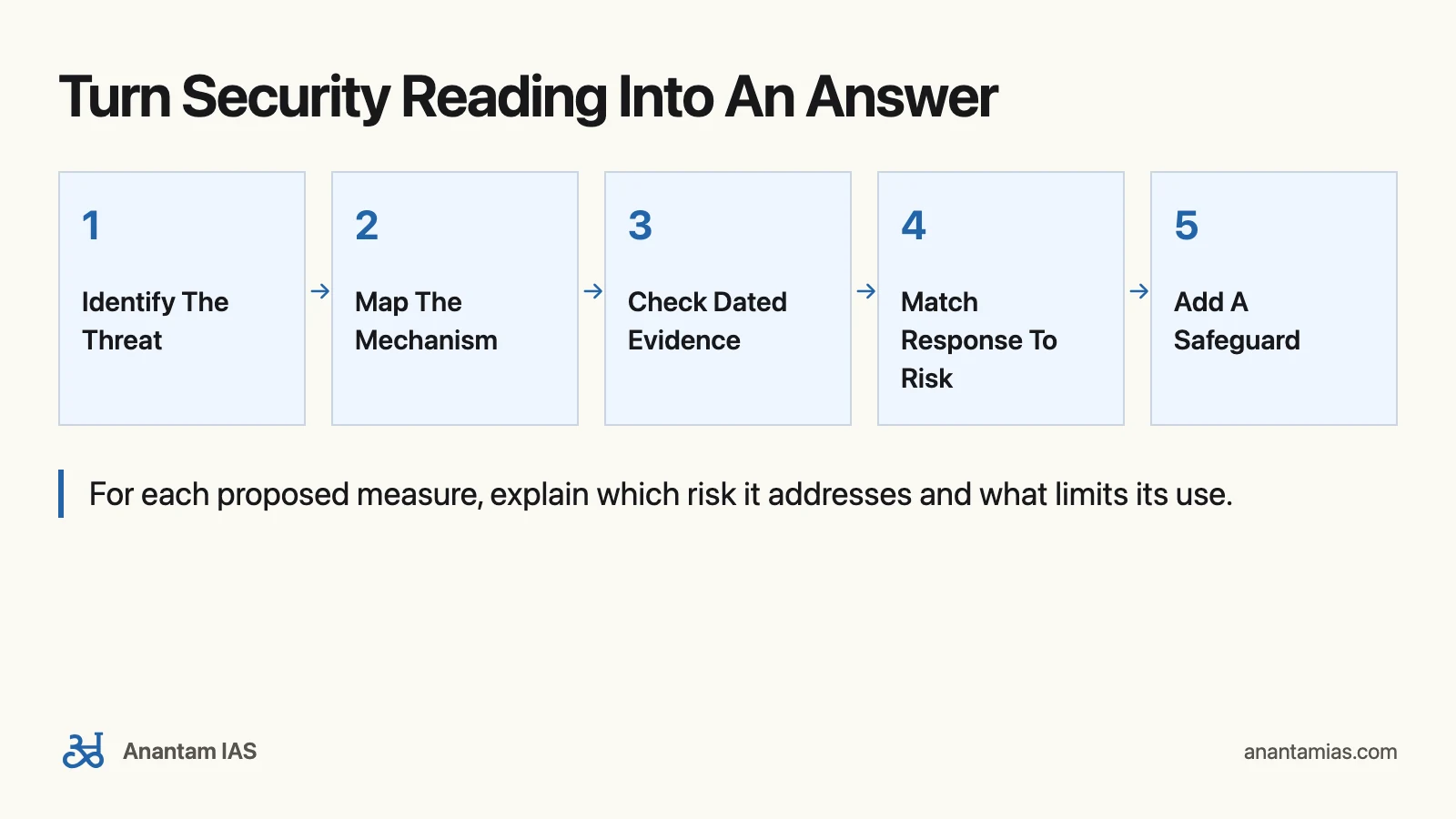
Explain the threat mechanism, identify responsible institutions, connect each response to a risk and add safeguards. Write the answer yourself before looking at a model.
Tell Google you want more of this.
Add Anantam IAS as a preferred sourceOne tap, and this site shows up more often in your own Top Stories, AI Overviews and AI Mode. Remove it any time.