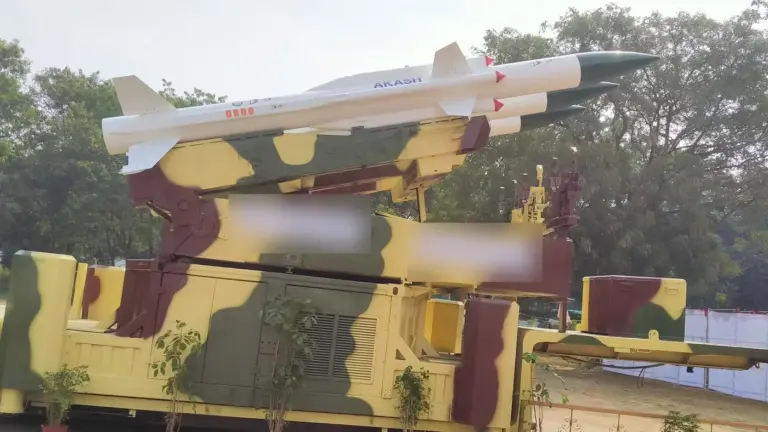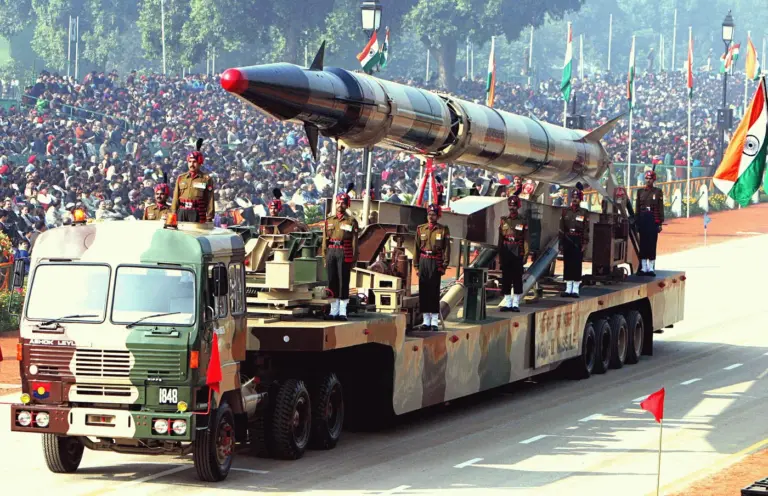
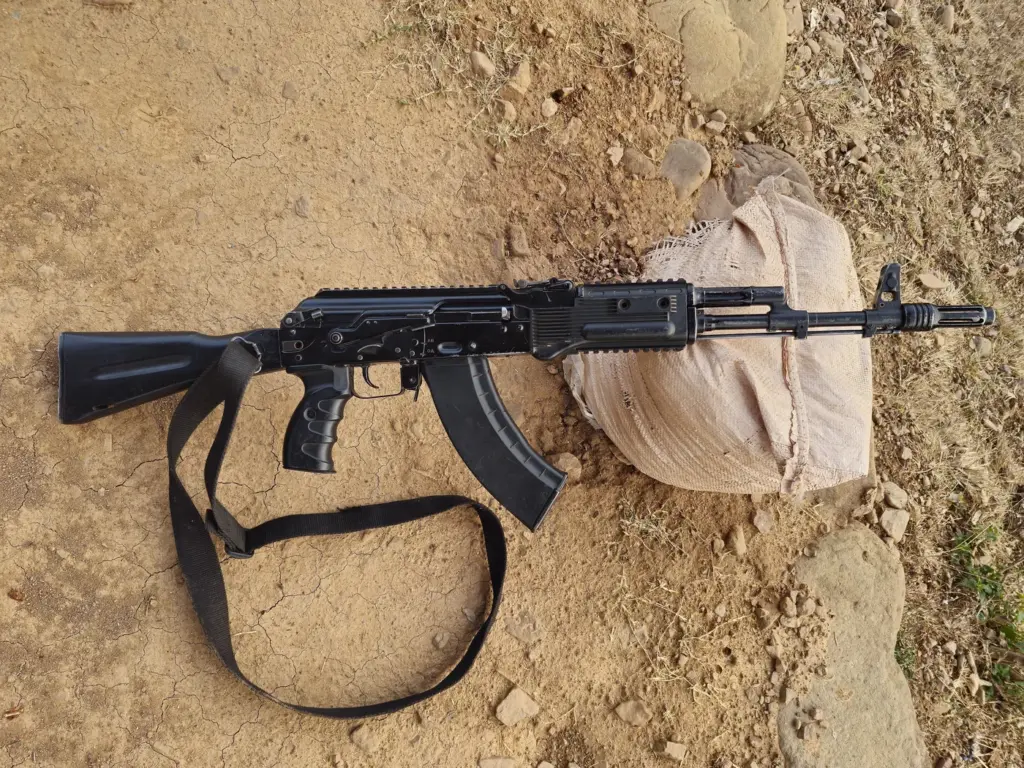
The AK-203 (searched just as often as AK 203) is a Kalashnikov-family assault rifle that India is producing at Korwa in Amethi, Uttar Pradesh, through a joint venture with Russia called Indo-Russian Rifles Private Limited. On 6 December 2021 the Ministry of Defence signed a contract with that company for 6,01,427 rifles, meant to replace the INSAS rifle that infantry soldiers have carried since 1994. It matters because it is a test of whether a licensed foreign design can become a fully Indian product.
The common confusion is that India simply bought Russian rifles. It didn’t. The AK 203 contract is with an Indian-registered company in which Indian defence PSUs hold the majority, and the agreement aims at full localisation of production. A second confusion is that the AK-203 replaced INSAS on its own; in practice the Army now uses a mix of rifles, and this note shows where each one fits.
What is the AK-203?
The AK-203 is a 7.62 x 39 mm assault rifle from the newest 200 series of Kalashnikov designs, built in India by a company where India holds 50.5 percent and Russia 49.5 percent. Reports on the programme use the name Sher for the Indian-made version.
| Fact | Detail |
|---|---|
| Type | Assault rifle, Kalashnikov 200 series |
| Cartridge | 7.62 x 39 mm |
| Producer | Indo-Russian Rifles Private Limited (IRRPL) |
| Factory | Korwa, Amethi district, Uttar Pradesh |
| Indian partners | Advanced Weapons and Equipment India Limited (AWEIL) and Munitions India Limited (MIL) |
| Russian partners | Rosoboronexport and Concern Kalashnikov |
| Shareholding | India 50.5 percent, Russia 49.5 percent |
| Contract | 6,01,427 rifles, signed 6 December 2021 |
| Rifle it replaces | 5.56 mm INSAS, inducted in 1994 |
One figure is missing from the table on purpose: the contract value. The Rajya Sabha reply that announced the deal gave the quantity but not the price, so the widely quoted rupee amounts are press estimates rather than official figures.
How does an assault rifle like the AK-203 work?
An assault rifle is a rifle that can fire one shot per trigger pull or keep firing while the trigger is held, using a cartridge smaller than a full-power battle rifle round. Kalashnikov designs have a long reputation for simplicity and for working in dust and mud, which suits an army deployed from deserts to glaciers.
What the numbers in a calibre mean
The calibre is the part aspirants most often garble. A cartridge written as 7.62 x 39 mm has a bullet about 7.62 mm wide and a case 39 mm long. The case holds the propellant, so a longer case usually means more powder, more energy and more recoil.
Put the three rifle rounds in the Indian Army side by side and the logic appears:
- 5.56 x 45 mm is the INSAS round: small, light and easy to carry in quantity.
- 7.62 x 39 mm is the AK-203 round: a wider bullet with a shorter case, a middle path.
- 7.62 x 51 mm is the SIG 716 round: the same width as the AK round but a much longer case, so it carries more energy over longer range.
A useful way to hold it in memory is a ladder of punch. INSAS sits on the bottom rung, the AK-203 in the middle and the SIG 716 at the top. The ladder simplifies one thing, because real performance also depends on barrel length and the bullet itself, but for comparing the three rifles it holds well.
Why is India replacing the INSAS rifle?
INSAS, short for Indian Small Arms System, was inducted in 1994 as a 5.56 mm rifle. The decision to replace it came slowly and changed direction more than once, and the sequence explains why the AK-203 arrived when it did.
The PIB record gives the steps in order:
- November 2011: a Request for Proposal for a new generation assault rifle was issued under the ‘Buy and Make with Transfer of Technology’ route.
- June 2015: the RFP was retracted because trials produced no clearly compliant model.
- August 2016: the Army changed the calibre it wanted from 5.56 x 45 mm to 7.62 x 51 mm.
- 2018: the Defence Acquisition Council approved a fast-track ‘Buy-Global’ rifle purchase and, separately, an inter-governmental agreement with Russia to produce assault rifles in India through a joint venture.
The Acceptance of Necessity is the first formal step in any Indian defence purchase: the Defence Acquisition Council agrees that the forces genuinely need an item before any tender or agreement follows. In 2018 the Council gave that approval to both rifle tracks at once, which is why the import and the joint venture ran in parallel rather than one after the other.
The 2016 calibre change had a cost that is easy to miss. The Rifle Factory Ishapore had developed an improved INSAS 1C in 2015-16, and a 2017 Lok Sabha reply admitted that because of the change of calibre, this indigenous rifle could not be inducted in the Army. An Indian design lost its customer just as it matured.
So the replacement took two tracks. The fast-track import brought the 7.62 x 51 mm SIG 716 for frontline troops, and the Russian joint venture was set up to produce rifles at scale inside India. The AK-203 is the second track.
The Indo-Russian Rifles joint venture
IRRPL is a joint venture company formed after the India-Russia Inter-governmental Agreement of February 2019. Prime Minister Narendra Modi dedicated it to the nation at Kauhar, Amethi on 3 March 2019. In a message read out at the event, Russian President Vladimir Putin said the venture would make the newest 200 series Kalashnikov rifles and would eventually reach full localisation of production.
The Indian shareholder changed name during the project, which confuses many notes. In 2019 the Indian side was the Ordnance Factory Board (OFB), holding 50.5 percent. From 1 October 2021 the OFB’s factories were converted into seven defence public sector undertakings. Two of them now hold India’s stake: AWEIL, which makes weapons, and MIL, which makes ammunition. When the contract was signed in December 2021, the PIB release therefore named AWEIL and MIL, not the OFB.
The Raksha Mantri’s July 2019 review set out two goals beyond supplying the Army:
- 100 percent indigenisation of the rifle, as per the project understanding.
- Exports of the rifle to friendly countries.
That same review linked Korwa to the Uttar Pradesh Defence Industrial Corridor, expecting the plant to buy components and services from local small firms once it was fully running. The UP defence corridor is the wider policy this sits inside.
How has production progressed?
Production started later than the 2019 announcement suggested, and that delay is part of the story. A February 2023 Rajya Sabha reply said IRRPL had set up all the facilities at Korwa and that rifles were then at the manufacturing and testing stage. PIB’s December 2025 factsheet on India-Russia relations lists AK-203 production at Korwa as one of the two countries’ defence collaborations.
Indigenisation is where the programme will be judged. Reports in September 2026 said the first AK-203 built entirely from Indian-sourced components had been test-fired at Korwa and was being offered to the Army for trials, with deliveries of the fully indigenous version expected from April 2027. The same reports said Adani Defence and Aerospace had signed a five-year agreement to supply 7.62 x 39 mm ammunition for the programme. Treat these as reported milestones until the Ministry of Defence confirms them in Parliament or a PIB release.
Why does the ammunition deal matter as much as the rifle? Because a rifle that depends on imported cartridges is only half localised. An Indian rifle firing Indian rounds is the version that survives a supply disruption.
Significance and criticisms
The AK-203 programme is a reasonable answer to a real gap, with honest weak points that a good answer should name.
On the positive side:
- Scale at home: over six lakh rifles built in Uttar Pradesh rather than imported, which is the core idea of Make in India in defence.
- Majority Indian control: Indian PSUs hold 50.5 percent of the producer, unlike a straight import.
- Technology absorption: the stated aim is full localisation, with an export option once Indian needs are met.
The weak points are just as specific:
- Delay: the venture was dedicated in March 2019, but the contract came in December 2021 and production was still being tested in early 2023.
- Dependence on Russia: the design and early components came from Russia, so the programme was exposed to the effects of Western sanctions on Russia after 2022. Russia has been India’s largest arms supplier for decades, a pattern visible in SIPRI arms-transfer data, and the AK-203 deepens that link in small arms.
- A lost indigenous option: the calibre change of 2016 shut out the INSAS 1C, and critics argue that sustained investment in an Indian design could have produced a rifle without licensing.
- Logistics: with INSAS, the AK-203 and the SIG 716 all in service, the Army handles three rifle cartridges, which complicates supply chains.
The balanced view is that the joint venture bought time and production capacity India did not have in 2019, while the real test, a rifle and round made entirely in India, is only now arriving.
The AK-203 today
As of October 2026, the AK-203 is in production at Korwa against the 2021 order for 6,01,427 rifles, and the programme is moving from Russian-assisted assembly toward a fully localised rifle. The policy environment around it has also shifted toward domestic sourcing: the government’s positive indigenisation lists bar imports of a growing set of items, and in December 2025 the Ministry signed a contract for over 4.25 lakh close-quarter battle carbines with two Indian private firms, Bharat Forge and PLR Systems. On 15 October 2025 it signed a Rs 659.47 crore contract for night sights for the SIG 716, which shows that rifle remains a frontline weapon alongside the AK-203.
How to study the AK-203 for exams
The AK-203 belongs to GS Paper III under defence technology, indigenisation and security forces, and to GS Paper II under India-Russia relations. Read it alongside the broader story of defence manufacturing in India, where it is the best small-arms example.
Questions rarely ask about one rifle; they ask about the policy it illustrates. Mains 2014 GS Paper III asked about the expected influence of liberalised FDI in the defence sector on Indian defence and the economy, and a joint venture with a foreign partner holding 49.5 percent is a concrete case to cite. Science and Technology accounts for 192 of the 1,403 questions in the Prelims question bank, and defence equipment questions often hinge on exactly the kind of detail below.
Revision facts:
- Contract for 6,01,427 AK-203 rifles signed on 6 December 2021.
- Producer: Indo-Russian Rifles Private Limited, Korwa, Amethi, Uttar Pradesh.
- Shareholding: AWEIL and MIL 50.5 percent; Rosoboronexport and Concern Kalashnikov 49.5 percent.
- Joint venture dedicated on 3 March 2019, after the February 2019 Inter-governmental Agreement.
- Cartridge: 7.62 x 39 mm; INSAS is 5.56 x 45 mm; SIG 716 is 7.62 x 51 mm.
- INSAS inducted in 1994; Army changed its preferred calibre in August 2016.
- OFB became seven DPSUs from 1 October 2021.
Three confusions cost marks. First, the AK-203 is not an import; it is made in India by a majority Indian-owned company. Second, the AK-203 and SIG 716 are not the same calibre, even though both start with 7.62. Third, the OFB no longer exists as a body, so its stake now sits with AWEIL and MIL.
| Weapon | Cartridge | Origin and producer | Status |
|---|---|---|---|
| INSAS | 5.56 x 45 mm | Indian design, ordnance factories | In service since 1994, being replaced |
| AK-203 | 7.62 x 39 mm | Russian design, made at Korwa by IRRPL | 6,01,427 ordered in 2021 |
| SIG 716 | 7.62 x 51 mm | Imported under fast-track procurement | Frontline rifle; night sights ordered in 2025 |
| Ghaatak | 7.62 x 39 mm | OFB design | Supplied to police forces |
| CQB carbine | Not given in the contract release | Bharat Forge and PLR Systems | Over 4.25 lakh ordered in December 2025 |
The AK-203 is worth your time because it compresses a whole debate into one object. If you can explain why India chose a joint venture over an import or a purely Indian design, and what full indigenisation would prove, you have a ready example for any question on defence self-reliance or the India-Russia partnership.
Frequently Asked Questions
What is the AK-203 rifle?
The AK-203 is a 7.62 x 39 mm assault rifle from the Kalashnikov 200 series. In India it is made at Korwa in Amethi, Uttar Pradesh, by Indo-Russian Rifles Private Limited to replace the INSAS rifle.
Where is the AK-203 made in India?
It is made at the Indo-Russian Rifles Private Limited factory at Korwa in Amethi district, Uttar Pradesh. Prime Minister Narendra Modi dedicated the joint venture to the nation in March 2019.
How many AK-203 rifles has India ordered?
The Ministry of Defence signed a contract for 6,01,427 AK-203 rifles on 6 December 2021. The official reply in Parliament gave the quantity but did not state the contract value.
Who owns Indo-Russian Rifles Private Limited?
India holds 50.5 percent through the defence PSUs Advanced Weapons and Equipment India Limited and Munitions India Limited. Russia holds 49.5 percent through Rosoboronexport and Concern Kalashnikov.
What is the calibre of the AK-203?
The AK-203 fires a 7.62 x 39 mm cartridge. The INSAS fires a smaller 5.56 x 45 mm round, while the SIG 716 fires a longer and more powerful 7.62 x 51 mm round.
Why is the INSAS rifle being replaced?
INSAS has been in service since 1994, and attempts to find a successor began with a 2011 tender that was withdrawn in 2015. In 2016 the Army changed its preferred calibre, which led to a fast-track import of the SIG 716 and the joint venture to make the AK-203 in India.
Is the AK-203 fully made in India?
Not yet fully. The agreement aims at full localisation, and reports in September 2026 said the first rifle made entirely from Indian-sourced components had been test-fired, with deliveries of the fully indigenous version expected from April 2027.
What is the AK-203 called in India?
The Indian-made AK-203 is referred to as ‘Sher’ in reports about the programme. The official contract and parliamentary replies use the name AK-203.
Practice Questions
Prelims
1. Consider the following statements about the AK-203 programme: 1. The rifles are produced by a joint venture in which Indian entities hold a majority stake. 2. The production facility is located at Korwa in Uttar Pradesh. Which of the statements given above is/are correct?
- (a) 1 only
- (b) 2 only
- (c) Both 1 and 2
- (d) Neither 1 nor 2
Answer: (c) Indian PSUs hold 50.5 percent of IRRPL, and the plant is at Korwa in Amethi, Uttar Pradesh.
2. Consider the following statements: 1. The AK-203 and the SIG 716 use the same cartridge. 2. The INSAS rifle was inducted into service in 1994. Which of the statements given above is/are correct?
- (a) 1 only
- (b) 2 only
- (c) Both 1 and 2
- (d) Neither 1 nor 2
Answer: (b) The AK-203 uses 7.62 x 39 mm and the SIG 716 uses 7.62 x 51 mm; INSAS was inducted in 1994.
3. Which of the following are the Russian partners in Indo-Russian Rifles Private Limited?
- (a) Rostec and Almaz-Antey
- (b) Rosoboronexport and Concern Kalashnikov
- (c) Rosatom and Roscosmos
- (d) Uralvagonzavod and Sukhoi
Answer: (b) Rosoboronexport and Concern Kalashnikov together hold 49.5 percent.
4. The Indian shareholders of Indo-Russian Rifles Private Limited at the time of the December 2021 contract were:
- (a) Bharat Electronics Limited and Hindustan Aeronautics Limited
- (b) Ordnance Factory Board and DRDO
- (c) Advanced Weapons and Equipment India Limited and Munitions India Limited
- (d) Bharat Forge and PLR Systems
Answer: (c) The OFB had been converted into seven DPSUs from 1 October 2021, and AWEIL and MIL held India’s stake.
5. In a cartridge described as ‘7.62 x 39 mm’, the number 39 refers to:
- (a) The length of the rifle barrel in centimetres
- (b) The length of the cartridge case in millimetres
- (c) The effective range of the rifle in tens of metres
- (d) The number of rounds in a standard magazine
Answer: (b) 7.62 is the approximate bullet diameter and 39 is the case length, both in millimetres.
Mains
- The AK-203 joint venture at Korwa has been presented as a model for defence indigenisation. Examine its achievements and limitations. (15 marks, 250 words)
- What is the significance of Indo-US defence deals over Indo-Russian defence deals? Discuss with reference to stability in the Indo-Pacific region. (15 marks, 250 words) Previous year: Mains 2020, GS Paper II.
- Why did India’s search for a successor to the INSAS rifle take so long? What lessons does it hold for defence procurement? (10 marks, 150 words)
- Discuss the role of defence industrial corridors in building a domestic supply chain for defence manufacturing, with suitable examples. (10 marks, 150 words)
- Joint ventures with foreign partners can speed up defence production but may prolong technological dependence. Critically analyse in the Indian context. (15 marks, 250 words)
Tell Google you want more of this.
Add Anantam IAS as a preferred sourceOne tap, and this site shows up more often in your own Top Stories, AI Overviews and AI Mode. Remove it any time.