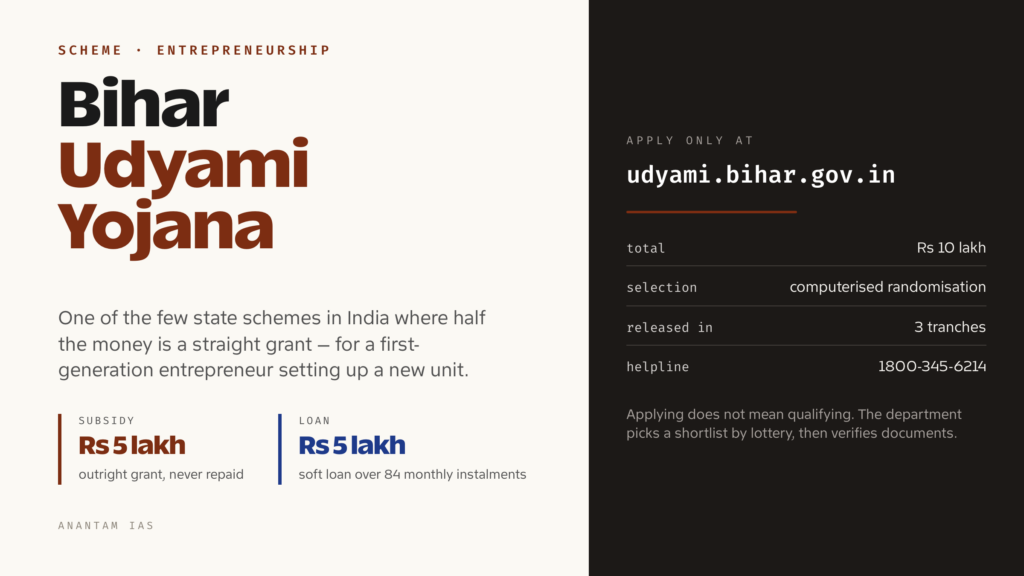
Bihar’s Udyami Yojana is one of the few state schemes in India where half the money is a straight grant. A selected applicant gets up to Rs 10 lakh to set up a new manufacturing or service unit — Rs 5 lakh as a subsidy that is never repaid, and Rs 5 lakh as a soft loan repayable in 84 monthly instalments. The Industries Department of the Government of Bihar runs it, and applications are filed on the department’s own portal at udyami.bihar.gov.in.
Two things confuse first-time applicants. The first is the name: “Udyami Yojana” is an umbrella, not a single scheme, and the department runs separate category-wise components plus a smaller Rs 2 lakh grant scheme for the poorest households. The second is selection — applying does not mean qualifying. Every year the number of applications runs far ahead of the sanctioned target, so the department picks the shortlist by computerised randomisation, then verifies documents. Getting the paperwork right is what decides whether a randomised name survives scrutiny.
What Bihar’s Udyami Yojana Actually Is
The umbrella runs under the Bihar Industries Department, and it exists for a specific reason: Bihar has one of the lowest rates of registered enterprise per lakh population in the country, and very little of that enterprise is first-generation. The scheme tries to fix the capital gap at the smallest end of the pyramid — the person with a viable plan for a flour mill, a garment unit, a dairy processing shed or a small workshop, but no collateral and no family business to borrow against.
The programme sits in two distinct pieces.
Mukhyamantri Udyami Yojana (MMUY) is the Rs 10 lakh scheme. It is delivered through category-wise components — the SC/ST component, the Extremely Backward Class component, the Mukhyamantri Mahila Udyami Yojana for women of any category, the Mukhyamantri Yuva Udyami Yojana for general and Backward Class men, and the Mukhyamantri Alpsankhyak Udyami Yojana for minority applicants. The financial structure is the same across components; the eligibility gate and the interest treatment differ slightly.
Bihar Laghu Udyami Yojana (BLUY) is the smaller, poverty-targeted scheme. It gives Rs 2 lakh as a pure grant, with no loan component at all, to families identified as extremely poor. It was designed after the Bihar caste-based survey, which found roughly 94 lakh families in the state living on a monthly income below Rs 6,000.
Both are administered on the same portal, and both use the same randomisation-then-verification model. If you are searching for “Udyami Yojana” because you saw a Rs 10 lakh figure, you want MMUY. If your household income is very low and you want a small grant with no repayment obligation at all, BLUY is the door.
What the Scheme Offers
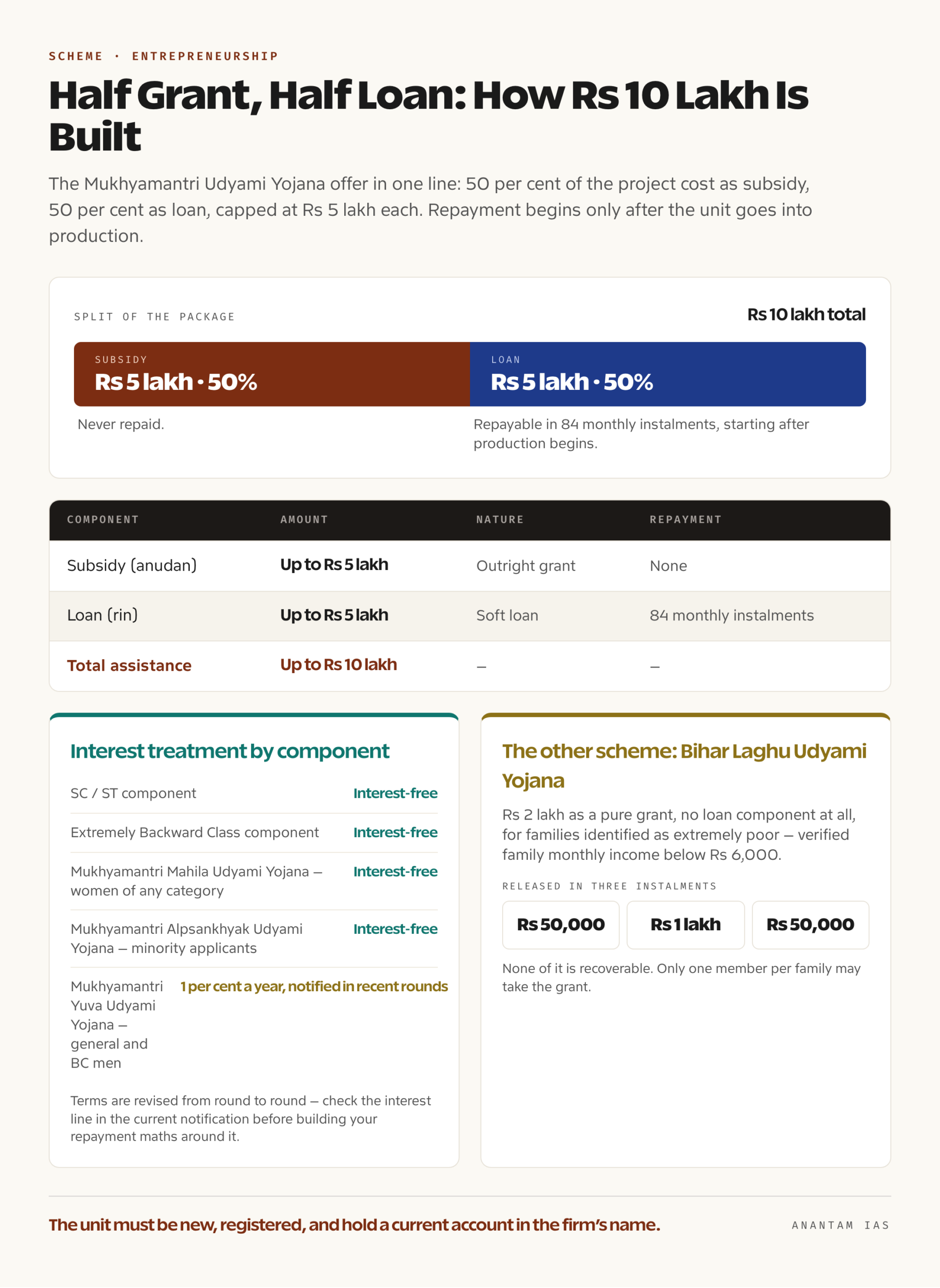
The core MMUY offer is straightforward and worth memorising in one line: 50 per cent of the project cost as subsidy, 50 per cent as loan, capped at Rs 5 lakh each.
| Component | Amount | Nature | Repayment |
|---|---|---|---|
| Subsidy (anudan) | Up to Rs 5 lakh | Outright grant | None |
| Loan (rin) | Up to Rs 5 lakh | Soft loan | 84 monthly instalments |
| Total assistance | Up to Rs 10 lakh | — | — |
Interest treatment varies by component. The SC/ST, Extremely Backward Class, women and minority components carry an interest-free loan. The youth component for general and Backward Class men carries a nominal charge — the Industries Department has notified it at 1 per cent per annum in recent rounds. Because the department revises component terms from round to round, check the interest line in the current year’s notification on the portal before you build your repayment maths around it.
Repayment does not begin the day the money lands. Instalments start after the unit actually goes into production, which gives a new enterprise breathing room in its first months.
The money also does not arrive in one lump. MMUY releases assistance in three tranches tied to progress. The first tranche comes after the selected applicant completes the department’s short entrepreneurship training and produces a current account in the firm’s name; it is meant for site preparation, machinery advance and the electricity connection. The second and third tranches follow verification that the earlier money was spent on what the project report said it would be spent on. Applicants who treat the detailed project report as a formality tend to get stuck at exactly this checkpoint.
There is a further condition people miss: the unit has to be new. An existing business being expanded does not qualify. The enterprise also has to be a registered entity — a proprietorship firm, partnership, LLP or private limited company — with its own current account, because the money is credited to the firm, not to a personal savings account.
Bihar Laghu Udyami Yojana runs on a different logic. Its Rs 2 lakh is released in three instalments — Rs 50,000, then Rs 1 lakh, then Rs 50,000 — and none of it is recoverable. It is a grant meant to put tools, stock and a working premises in the hands of a household that has none.
Who Is Eligible
Eligibility for MMUY sits on four gates: residence, age, education and enterprise status.
| Criterion | Requirement |
|---|---|
| Residence | Permanent resident of Bihar, with a valid residential certificate |
| Age | 18 years and above; the upper limit has been notified at 50 years in recent rounds |
| Education | Class 12 pass, or ITI certificate, or polytechnic diploma, or higher |
| Category | Applies through the relevant component — SC/ST, EBC, women, minority, or general and BC youth — with a competent-authority caste certificate where the component requires one |
| Enterprise | A new unit only; proprietorship, partnership, LLP or private limited company |
| Banking | A current account in the firm’s name, in a bank branch within Bihar |
| Documents | Aadhaar, PAN, matriculation certificate for date of birth, educational certificates, residential certificate, caste certificate where applicable, recent photograph and signature |
Who is kept out matters as much. Serving government employees are excluded. Anyone who has already taken benefit under this or a comparable subsidy scheme is excluded. An applicant running an existing business is excluded from setting up a “new” unit on paper while the old one runs. And an application with a mismatch between the Aadhaar name, the bank account name and the certificate name is very likely to fail at verification even after being randomly picked.
The upper age limit is the single most-disputed number in every application season, because it has moved between rounds and different components have historically used different ceilings. Read the current year’s notification rather than a forwarded WhatsApp table.
For Bihar Laghu Udyami Yojana, the gates are different: the applicant’s family must fall within the extremely poor bracket identified by the caste-based survey — verified family monthly income below Rs 6,000 — the applicant must be a permanent resident of Bihar aged between 18 and 50, and only one member per family may take the grant.
How to Apply, Step by Step
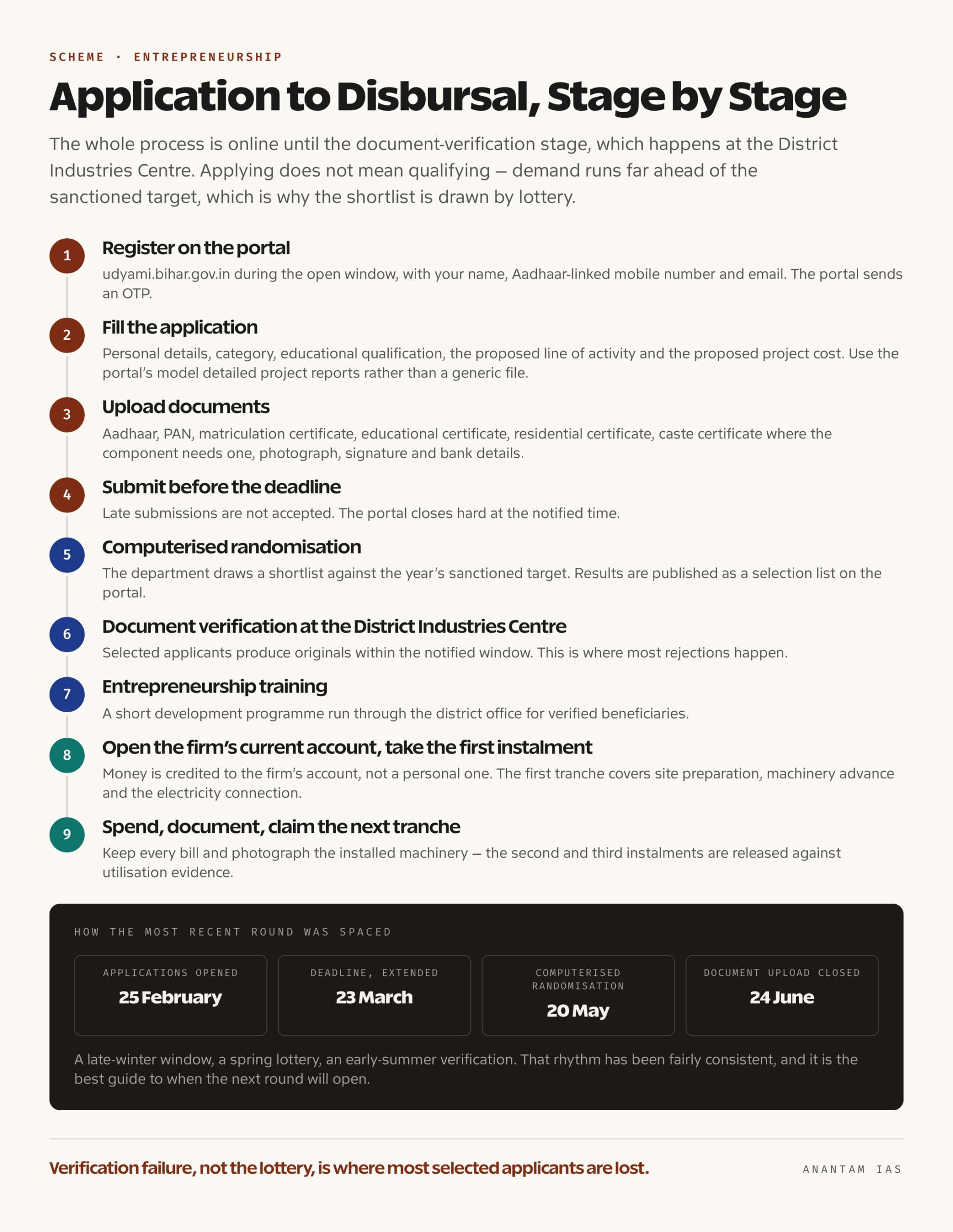
The whole process is online until the document-verification stage, which happens at the District Industries Centre.
- Register on the portal. Go to udyami.bihar.gov.in during the open window and register with your name, Aadhaar-linked mobile number and email. The portal sends an OTP; the mobile number you use becomes the number for every later notification, so use one you will keep.
- Fill the application. Personal details, category, educational qualification, the proposed line of activity and the proposed project cost. The portal offers model detailed project reports for common trades — use them as a template rather than uploading a generic file.
- Upload documents. Aadhaar, PAN, matriculation certificate, educational certificate, residential certificate, caste certificate where the component needs one, photograph, signature and bank details.
- Submit before the deadline. Late submissions are not accepted, and the portal closes hard at the notified time.
- Wait for randomisation. The department runs a computerised randomisation to draw a shortlist against the year’s sanctioned target. Results are published as a selection list on the portal.
- Complete document verification. Selected applicants upload or produce originals within the notified window, and the District Industries Centre verifies them. This is where most rejections happen.
- Attend training. Verified beneficiaries go through a short entrepreneurship development programme run through the district office.
- Open the firm’s current account and receive the first instalment. Money is credited to the firm’s account, not a personal one.
- Spend, document, claim the next tranche. Keep every bill and photograph the installed machinery — the second and third instalments are released against utilisation evidence.
To check status, log back into the portal with the same credentials; application status, selection list and instalment status all sit inside the dashboard. The department also runs a toll-free helpline on 1800-345-6214 during working hours.
For the FY 2025-26 round, the department opened applications on 25 February 2026, extended the deadline to 23 March 2026, ran the computerised randomisation on 20 May 2026, and kept the document upload window open until 24 June 2026. That rhythm — a late-winter window, a spring lottery, an early-summer verification — has been fairly consistent, and it is the best guide to when the next round will open.
How It Works on the Ground
The scheme has done something genuinely unusual for a state industrial programme: it has pulled applications in the hundreds of thousands from districts that have almost no formal industry. Demand runs several times ahead of the sanctioned target every year, which is why randomisation exists at all. That gap is the scheme’s most honest performance indicator — it tells you the appetite for self-employment in Bihar is not the constraint.
What happens after selection is more mixed. Verification knocks out a meaningful share of randomised applicants, usually for document mismatches, ineligible category claims or an existing business surfacing during scrutiny. A second group drops out at the firm-registration and current-account stage, because setting up a proprietorship with a business bank account is harder than filling an online form.
The three-tranche design does real work here. Tying money to utilisation evidence makes diversion harder than a single lump-sum transfer would. It also slows things down, and a unit waiting on its second tranche while machinery sits half-installed is a familiar complaint at district offices.
Bihar Laghu Udyami Yojana operates at a very different scale — the state has said it intends to cover the roughly 94 lakh families identified as extremely poor over several years, in annual batches. That is one of the largest untied-grant commitments any Indian state has made to household enterprise, and its success will be judged less on disbursal numbers than on whether the tiny units it seeds are still running in year three.
For context on how state-level enterprise support fits into the national picture, the central government’s own credit route for micro units runs through the Mudra Yojana, while artisan-specific support runs through PM Vishwakarma. Bihar’s scheme is distinctive because of the grant component — most central instruments offer credit, not capital.
Challenges and What to Watch
Randomisation is fair but blunt. A lottery removes discretion and the rent-seeking that comes with it. It also means a strong, bankable project can lose to a weak one. Some analysts want a viability score before the draw; the department’s answer is that scoring reintroduces discretion.
Verification failure is the real bottleneck. The common causes are avoidable: a name spelled differently across Aadhaar, bank and certificates; a caste certificate from the wrong authority; an expired residential certificate. Fix these before you apply, not after you are selected.
Recovery discipline on the loan half. Rs 5 lakh of the package is recoverable over 84 months from micro units with thin margins, so repayment performance is the scheme’s long-term fiscal question.
Survival, not sanction, is the outcome that matters. Disbursal figures are easy to publish. Tracking of how many assisted units still operate after three years, and how many jobs they hold, is much thinner — and that is the evidence worth demanding.
Watch for round-to-round changes. Age ceilings, component names, interest treatment and the qualification floor have all shifted between rounds. Treat any table you find online as a guide to the structure, and the portal notification as the authority on the current numbers.
FAQ
What is the total assistance under Bihar’s Mukhyamantri Udyami Yojana? Up to Rs 10 lakh per selected applicant — Rs 5 lakh as a subsidy that does not have to be repaid, and Rs 5 lakh as a loan repayable in 84 monthly instalments after the unit starts production.
Is the Rs 5 lakh loan really interest-free? For the SC/ST, Extremely Backward Class, women and minority components, yes. The component for general and Backward Class male youth carries a nominal charge notified at 1 per cent per annum in recent rounds. Confirm the figure in the current year’s notification.
How are applicants selected? By computerised randomisation against the year’s sanctioned target, followed by document verification at the District Industries Centre. Applying does not guarantee selection, and being randomly selected does not guarantee sanction if documents fail scrutiny.
What is the difference between Mukhyamantri Udyami Yojana and Bihar Laghu Udyami Yojana? MMUY gives up to Rs 10 lakh (half grant, half loan) to set up a new enterprise, with an education floor of Class 12 or an ITI or diploma. BLUY gives Rs 2 lakh as a pure grant in three instalments to families identified as extremely poor, with verified family monthly income below Rs 6,000.
Can I apply if I already run a shop or small business? No. The assistance is for setting up a new unit. Applicants with an existing enterprise, serving government employees, and anyone who has already drawn benefit under a similar subsidy scheme are excluded.
Practice Questions
Prelims MCQs
- Under Bihar’s Mukhyamantri Udyami Yojana, the maximum assistance available to a selected applicant is: (a) Rs 2 lakh (b) Rs 5 lakh (c) Rs 10 lakh (d) Rs 25 lakh Answer: (c) The package is up to Rs 10 lakh, made up of a Rs 5 lakh subsidy and a Rs 5 lakh loan.
- The loan component of the Mukhyamantri Udyami Yojana package is repayable in: (a) 36 monthly instalments (b) 60 monthly instalments (c) 84 monthly instalments (d) 120 monthly instalments Answer: (c) Repayment runs over 84 monthly instalments and begins after the unit goes into production.
- Which department of the Government of Bihar implements the Udyami Yojana schemes? (a) Rural Development Department (b) Industries Department (c) Social Welfare Department (d) Labour Resources Department Answer: (b) The Industries Department runs the schemes through District Industries Centres and the udyami.bihar.gov.in portal.
- Bihar Laghu Udyami Yojana provides assistance of: (a) Rs 1 lakh as a loan (b) Rs 2 lakh as a full grant (c) Rs 2 lakh as an interest-free loan (d) Rs 5 lakh as half grant and half loan Answer: (b) BLUY gives Rs 2 lakh as an outright grant, released in three instalments, with no repayment obligation.
- The shortlist of applicants under the Mukhyamantri Udyami Yojana is drawn by: (a) an interview before a district committee (b) a merit list based on marks (c) computerised randomisation (d) first-come, first-served order of application Answer: (c) A computerised randomisation draws the shortlist, which is then subjected to document verification.
Mains Practice Questions
- Bihar’s Udyami Yojana combines an outright capital grant with an interest-free loan. Assess the case for capital subsidies, rather than credit alone, in states with weak private enterprise bases. (15 marks, 250 words)
- Selection by computerised randomisation removes discretion but ignores project viability. Discuss the trade-off between fairness and effectiveness in the design of entitlement-style enterprise schemes. (15 marks, 250 words)
- “Disbursal is a poor proxy for outcome.” Examine what indicators should be used to evaluate state entrepreneurship schemes, using the Bihar experience. (10 marks, 150 words)
- Compare a state-level capital-grant scheme for first-generation entrepreneurs with central credit-guarantee instruments for micro enterprise. Which model better addresses the collateral problem, and why? (15 marks, 250 words)
- Untied household grants of the kind offered under Bihar’s Laghu Udyami Yojana are increasingly used as an anti-poverty instrument. Critically evaluate their advantages and risks compared with wage-employment guarantees. (15 marks, 250 words)
Tell Google you want more of this.
Add Anantam IAS as a preferred sourceOne tap, and this site shows up more often in your own Top Stories, AI Overviews and AI Mode. Remove it any time.