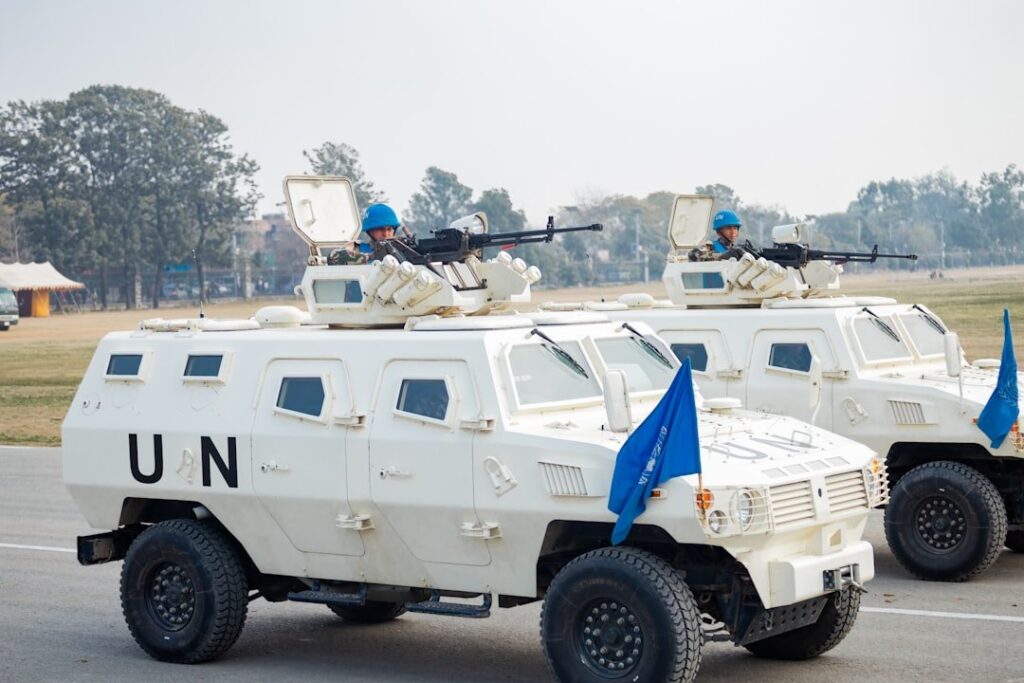
UN peacekeeping operations names follow a logic that is easy to miss on first reading. The acronyms are not random. They typically combine an abbreviation for “United Nations” (UN) or “Mission” (MIN) with the country or region, often in the local language. Once the pattern is clear, the long list of historical and current missions becomes much easier to navigate.
This reference covers four of the most frequently cited recent missions: UNMIL in Liberia, MINURCAT in Chad and the Central African Republic, MINUSTAH in Haiti, and UNMISET in Timor-Leste. Each had a defined mandate, a defined start and end date, and a place in the broader history of UN peace operations since the late 1990s.
UNMIL: United Nations Mission in Liberia (2003–2018)
The United Nations Mission in Liberia (UNMIL) was established by Security Council Resolution 1509 on 19 September 2003. Liberia had emerged from over a decade of civil war that had killed roughly a quarter of a million people and displaced more than half the population. The peace agreement signed in Accra in August 2003 created the political space for a UN deployment.
UNMIL was authorised under Chapter VII of the UN Charter with a strong mandate that included supporting implementation of the ceasefire, protection of civilians, security sector reform, and assistance for elections and humanitarian relief. At its peak the mission deployed over 15,000 uniformed personnel.
The mission was extended in successive resolutions through the 2005 and 2011 elections and the 2014 Ebola outbreak. UNMIL formally completed its mandate on 30 March 2018, with security responsibilities fully transferred to Liberian forces.
MINURCAT: UN Mission in the Central African Republic and Chad (2007–2010)
The United Nations Mission in the Central African Republic and Chad (MINURCAT) was established by Security Council Resolution 1778 on 25 September 2007. The mission was authorised to address the spillover of the Darfur conflict into eastern Chad and the north-eastern part of the Central African Republic, where Sudanese refugees and internally displaced persons faced severe insecurity.
MINURCAT had an unusual deployment history. The EU European Force EUFOR Tchad/RCA operated alongside the UN mission in its early phase before responsibilities were transferred. After internal political disagreement with the Chadian government, the Security Council, at the request of Chad, decided in May 2010 to draw down the mission.
MINURCAT completed its mandate on 31 December 2010. The acronym stands for Mission des Nations Unies en République Centrafricaine et au Tchad, reflecting the French operating language of the region.
MINUSTAH: UN Stabilization Mission in Haiti (2004–2017)
The United Nations Stabilization Mission in Haiti (MINUSTAH) was established by Security Council Resolution 1542 on 30 April 2004, following the political crisis that had displaced President Jean-Bertrand Aristide. The acronym derives from the French Mission des Nations Unies pour la Stabilisation en Haïti.
MINUSTAH operated for more than thirteen years, the longest of the four missions discussed here. The mandate evolved repeatedly. After the catastrophic earthquake of January 2010 that killed more than 200,000 people including the head of mission Hédi Annabi and 101 UN personnel, MINUSTAH took on a major humanitarian recovery role alongside its political and security mandate.
The mission concluded on 15 October 2017. A successor mission, MINUJUSTH (the United Nations Mission for Justice Support in Haiti), focused on rule of law, took over until October 2019. MINUSTAH itself remains controversial in Haiti for, among other things, the cholera outbreak in 2010 traced to mission personnel.
UNMISET: UN Mission of Support in East Timor (2002–2005)
The United Nations Mission of Support in East Timor (UNMISET) was established by Security Council Resolution 1410 on 17 May 2002, three days before Timor-Leste’s formal independence on 20 May 2002.
UNMISET took over from the United Nations Transitional Administration in East Timor (UNTAET), which had administered the territory from 1999 to 2002 following the 1999 referendum on independence. UNMISET’s mandate was to assist Timor-Leste’s new institutions during the post-independence transition, particularly in the areas of public administration, law enforcement, internal security and external border control.
UNMISET successfully completed its mandate on 20 May 2005, the third anniversary of Timorese independence. It was followed by a smaller political office, UNOTIL, and later by UNMIT after the 2006 crisis.
Reference Table
| Mission | Country | Start | End |
|---|---|---|---|
| UNMIL | Liberia | 19 September 2003 | 30 March 2018 |
| MINURCAT | Chad and CAR | 25 September 2007 | 31 December 2010 |
| MINUSTAH | Haiti | 30 April 2004 | 15 October 2017 |
| UNMISET | Timor-Leste | 17 May 2002 | 20 May 2005 |
How UN Peacekeeping Mission Acronyms Work
The naming pattern follows a few recurring forms.
- UN + Mission + Country: UNMIL (Liberia), UNMIS (Sudan), UNMIT (Timor-Leste)
- MIN (Mission) in French + UN + Country: MINUSCA (Central African Republic), MINURSO (Western Sahara), MINUSTAH (Haiti), MINURCAT (Chad/CAR), MINUSMA (Mali)
- ON (Operación in Spanish) or MONUSCO (DR Congo, French Mission)
Recognising the pattern helps decode unfamiliar acronyms. MIN at the start almost always means a French-named mission in a French-speaking or partly Francophone country.
How These Missions Fit Together
All four missions came from the same generation of post-Cold War peace operations: large, multidimensional, Chapter VII deployments that combined troops, police and civilian components. UNMISET was relatively modest by comparison; UNMIL, MINUSTAH and MINURCAT were larger and more complex.
The UN currently runs a smaller number of active peacekeeping operations than at the peak in the 2000s, with new mission authorisations becoming rare in the post-2015 period. Many of the missions discussed here are now historical reference points for the study of peacekeeping practice, exit strategies and the difficulties of post-conflict statebuilding.
FAQs
When did UNMIL operate in Liberia?
The United Nations Mission in Liberia (UNMIL) operated from 19 September 2003, when it was established by Security Council Resolution 1509, until 30 March 2018, when it formally completed its mandate.
What does MINURCAT stand for?
MINURCAT stands for the Mission des Nations Unies en République Centrafricaine et au Tchad, the United Nations Mission in the Central African Republic and Chad. It operated from 25 September 2007 to 31 December 2010.
When did MINUSTAH operate in Haiti?
MINUSTAH operated from 30 April 2004 to 15 October 2017, more than thirteen years, making it one of the longest UN peacekeeping missions in the western hemisphere.
What was UNMISET?
UNMISET was the United Nations Mission of Support in East Timor, operating from 17 May 2002 to 20 May 2005. It succeeded UNTAET after Timor-Leste’s independence.
Which UN mission preceded UNMISET?
UNTAET, the United Nations Transitional Administration in East Timor, administered the territory from 1999 to 2002, preceding UNMISET in the transition to independent statehood.
Are any of these missions still active?
No. UNMIL, MINURCAT, MINUSTAH and UNMISET have all completed their mandates. Their reference value lies in case-study analysis of multidimensional peace operations.
Which country had the longest UN peacekeeping mission of the four?
Haiti, with MINUSTAH from 2004 to 2017, just over thirteen years. UNMIL in Liberia was close behind at fourteen and a half years.
What does the MIN prefix in UN mission names indicate?
The MIN prefix indicates a French-language mission name beginning with “Mission”. It is used for missions in Francophone or partly Francophone countries such as the Central African Republic, Haiti and Mali.
Tell Google you want more of this.
Add Anantam IAS as a preferred sourceOne tap, and this site shows up more often in your own Top Stories, AI Overviews and AI Mode. Remove it any time.