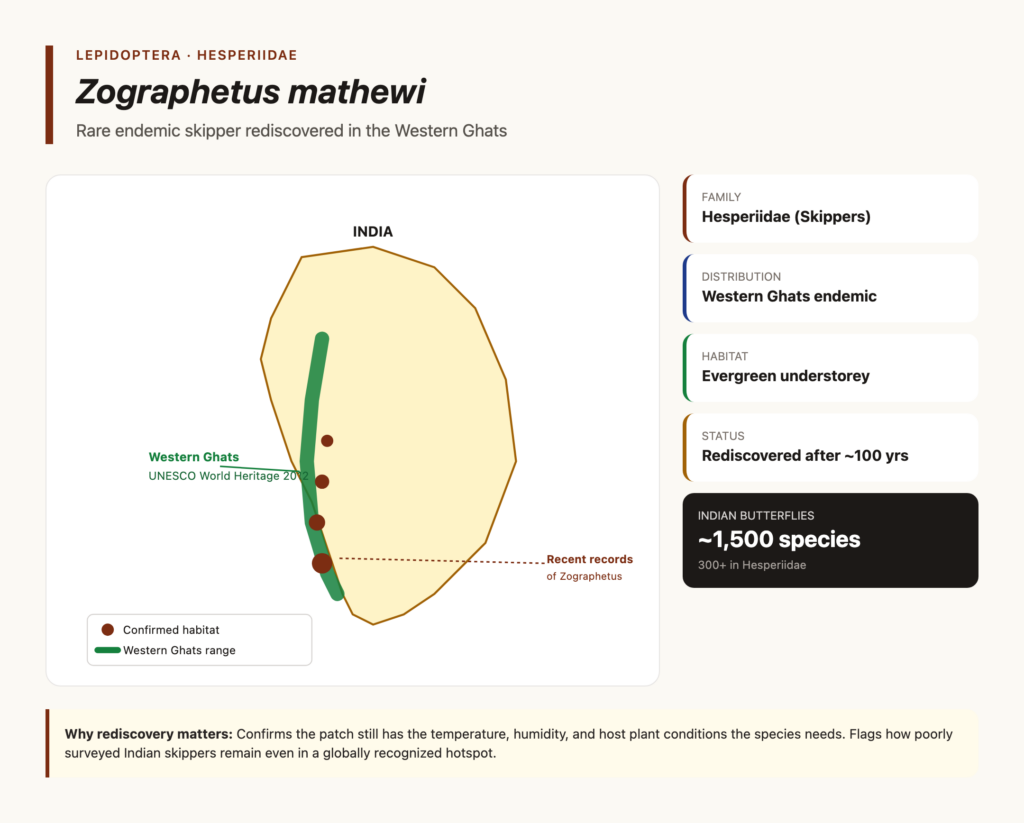
Zographetus mathewi is a small, fast-flying skipper butterfly that almost no one had seen for a century. When entomologists rediscovered it in the Western Ghats in recent surveys, the news traveled well beyond taxonomy circles. A rediscovery like this is more than a checklist update. It is a reminder that India’s most studied biodiversity hotspot still hides species that science had practically given up on, and that small, cryptic insects can carry as much conservation weight as the tigers and elephants that dominate the headlines.
For UPSC aspirants, the species is a useful peg to hang a much larger story. The Western Ghats are one of the four global biodiversity hotspots that touch India, alongside the Himalayas, Indo-Burma, and Sundaland. Endemism is staggeringly high, especially among amphibians, reptiles, freshwater fish, and insects. The Hesperiidae family, to which Zographetus belongs, is one of the least-surveyed butterfly groups, and recent expeditions have produced a steady stream of fresh records and rediscoveries.
This guide places Zographetus mathewi in its scientific, ecological, and policy context, then turns to the broader landscape of Indian butterfly diversity and the conservation lessons that flow from it.
Quick Facts: Zographetus mathewi
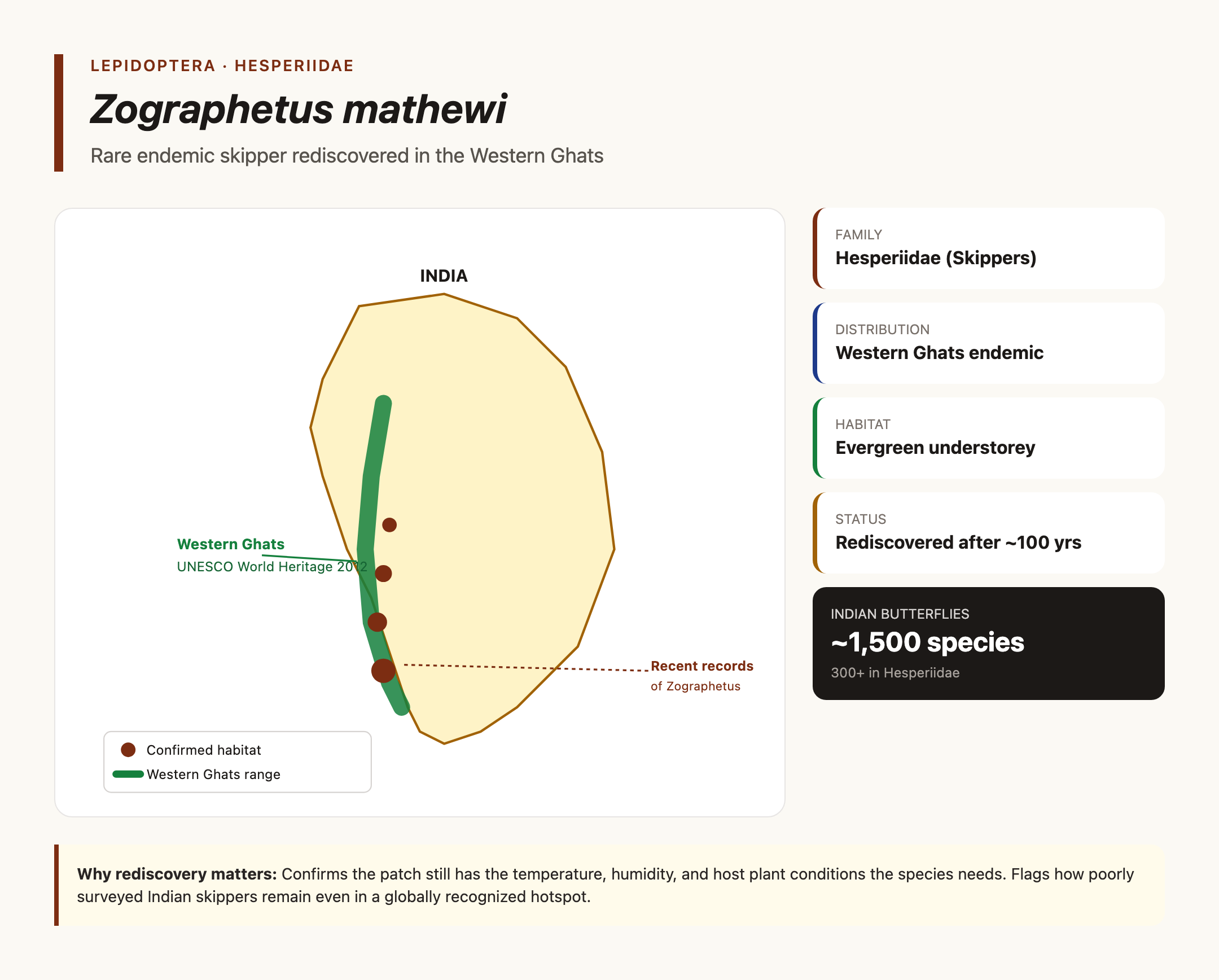
- Common reference: a rare and endemic skipper butterfly of India
- Family: Hesperiidae, the skipper family within order Lepidoptera
- Genus: Zographetus, a small genus of Asian skippers
- Range: Western Ghats, primarily in evergreen and semi-evergreen forest patches
- Status: Rediscovered in the Western Ghats after roughly a century of being known only from museum specimens
- Significance: Highlights insect endemism of the Western Ghats and the under-surveyed nature of Indian skippers
- Closest published reference: Recent paper in the journal Entomon documenting the rediscovery
- Western Ghats designation: UNESCO World Heritage Site declared in 2012, also a global biodiversity hotspot
- Related committees: Gadgil Committee Report 2011 and Kasturirangan Committee Report 2013 on Western Ghats protection
What Zographetus mathewi Is
Zographetus mathewi is one of the rarer members of the skipper family. Skippers are small, stout-bodied butterflies named for their darting, jerky flight, with antennae tipped in a distinctive hooked club that separates them from the rest of the butterflies. Their larvae are typically leaf-folders that feed on grasses, palms, and other monocots, although several Asian skippers feed on dicot trees and shrubs.
The species was described by entomologists in the late nineteenth century from material collected in the southern Western Ghats. After that, very few sightings made it into the scientific record. The reasons are partly behavioural and partly habitat-driven. Skippers are easy to overlook because of their small size, fast flight, and tendency to perch with wings half-open. They also depend on shaded forest understorey microhabitats that have been steadily fragmented by plantations, roads, and settlements.
The recent rediscovery, documented in peer-reviewed entomological journals, came from focused field surveys in evergreen forest patches of the Western Ghats. Researchers used standard butterfly transect methods combined with bait-trapping and photographic documentation, and verified identification against historic type specimens.
Background and Historical Context
The Western Ghats run for roughly 1,600 kilometres along peninsular India’s western edge, from the Tapi river in the north to the southern tip of Kerala. Their orographic role drives the south-west monsoon onto the Indian landmass, and their evergreen forests host an astonishing concentration of endemic species. The hotspot status was formalized by Norman Myers and colleagues in the late 1990s and reaffirmed in subsequent global biodiversity assessments.
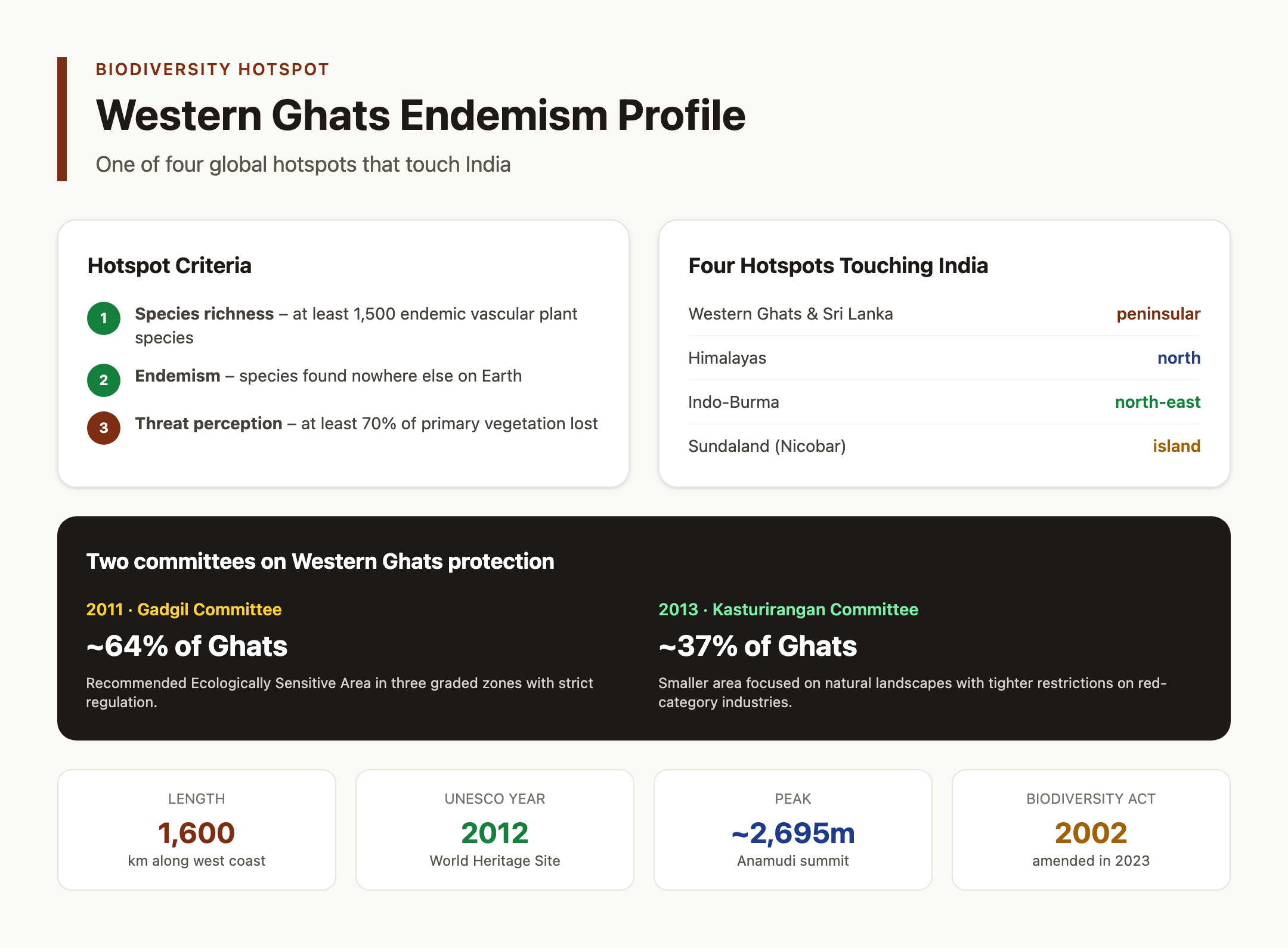
Recognition of the Western Ghats as a UNESCO World Heritage Site in 2012 followed a long policy debate. The Western Ghats Ecology Expert Panel, chaired by Madhav Gadgil, submitted its report in 2011 and recommended designating roughly 64 per cent of the Ghats as Ecologically Sensitive Area in three graded categories. The Kasturirangan Committee, formally the High Level Working Group on Western Ghats, reviewed the Gadgil report in 2013 and recommended a smaller and more graded ecologically sensitive area covering roughly 37 per cent of the landscape. Subsequent draft notifications have been issued and revised by the Ministry of Environment, Forest and Climate Change.
Within this larger debate sits the question of insect conservation. India has a National Wildlife Action Plan and a Wildlife Protection Act, but most invertebrates remain under-listed, under-surveyed, and under-represented in protected area design. Recent decadal updates of the IUCN Red List have begun to add Indian butterflies, but coverage remains thin compared to mammals and birds.
Key Facts on Indian Butterflies and State Butterflies
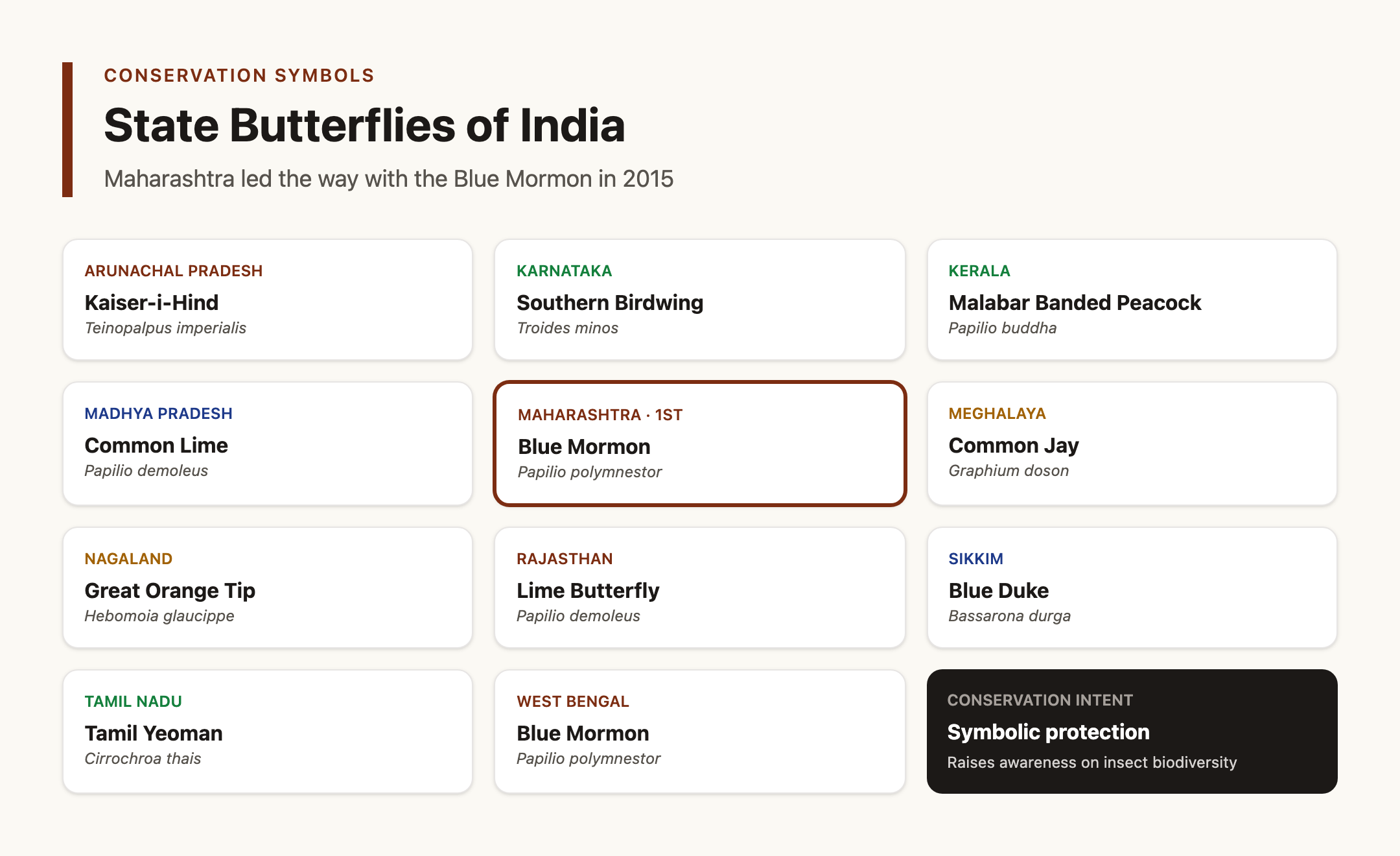
India hosts roughly 1,500 species of butterflies, with the highest diversity in the North-East and the Western Ghats. The Hesperiidae family alone contributes more than 300 species. Several states have declared a state butterfly to raise conservation awareness, mirroring the longer-standing tradition of state birds and state animals.
| State or Union Territory | State Butterfly |
|---|---|
| Arunachal Pradesh | Kaiser-i-Hind |
| Karnataka | Southern Birdwing |
| Kerala | Malabar Banded Peacock |
| Madhya Pradesh | Common Lime |
| Maharashtra | Blue Mormon |
| Meghalaya | Common Jay |
| Nagaland | Great Orange Tip |
| Rajasthan | Lime Butterfly |
| Sikkim | Blue Duke |
| Tamil Nadu | Tamil Yeoman |
| West Bengal | Blue Mormon |
The Maharashtra declaration of the Blue Mormon in 2015 was India’s first state butterfly notification and triggered a wave of similar declarations across other states.
Why Zographetus mathewi and Insect Endemism Matter
Insects are the silent majority of biodiversity. They pollinate, decompose, control pests, and feed everything from frogs to forest birds. Butterflies in particular are sensitive indicators of habitat quality, microclimate, and management regime. A rediscovery like Zographetus mathewi tells researchers that the patch where it survives still has the temperature, humidity, and host plant conditions that the species needs, which in turn flags the patch as worth protecting.
For UPSC, the takeaway is broader. Conservation policy in India remains heavily skewed toward charismatic vertebrates. Tiger reserves, elephant corridors, and bustard recovery plans crowd out insect, freshwater, and fungal conservation. The Convention on Biological Diversity targets and the Kunming-Montreal Global Biodiversity Framework explicitly call for protecting biodiversity at the species, ecosystem, and genetic levels, which means insect conservation cannot stay an afterthought. The Biological Diversity Act, 2002, and the Biological Diversity (Amendment) Act, 2023, provide the domestic statutory frame.
Detailed Analysis: Why Western Ghats Endemism Is So High
Several converging factors explain the Western Ghats’ exceptionally high endemism. First, the landscape is old and stable. Geological evidence places the Ghats in their current form for tens of millions of years, which has given evolution long stretches of time to diversify lineages. Second, the topography is rugged and creates strong climatic gradients over short distances. Cold, wet shola grasslands sit only kilometres away from dry deciduous slopes, generating hundreds of distinct microhabitats. Third, the monsoon cycle layers seasonal rhythms over those microhabitats, producing different breeding windows for different taxa.
For insects, the consequence is that closely related species can specialize on slightly different host plants, light regimes, or seasonal niches. This ecological partitioning is what produces the long lists of endemic Hesperiidae, lycaenids, and nymphalids that fresh surveys keep adding to. Skippers specifically benefit from a rich understorey palm and grass flora that the wet evergreen forests of the southern Ghats still preserve in places.
The threats are equally specific. Conversion of forest to monoculture plantations of tea, coffee, cardamom, and rubber removes the structural complexity that insects depend on. Hydropower dams and tunnels alter humidity patterns kilometres downstream. Pesticide drift from adjacent farmlands hits non-target invertebrates first. Climate change is starting to push narrow-range species uphill, where there is sometimes no further ridge to climb.
Comparative Perspective: Recent Butterfly Discoveries in India
| Butterfly Species | Region in India | Conservation or Scientific Note |
|---|---|---|
| Zographetus mathewi | Western Ghats | Rediscovered after nearly a century; flags insect endemism |
| Spindasis abnormis | Western Himalayas | Rare hairstreak butterfly with limited records |
| Rapala damodar | Eastern Himalayas | Indicates under-surveyed Himalayan biodiversity |
| Delias sanaca sanaca | North-East India | Range expansion possibly linked to climate change |
| Arhopala species | North-East India | Complex genus with multiple recent records |
| New skipper species | Western Ghats and North-East India | Skippers remain among the least-surveyed butterflies |
The pattern across these records is consistent. India still adds and rediscovers Lepidoptera species at a steady pace, especially in the two biodiversity hotspots that fall on its territory.
Challenges in Insect Conservation in India
The first challenge is taxonomic. India does not yet have a complete catalogue of its insect fauna, and museum collections from the colonial era remain partly undigitized. Without baseline data, it is hard to know what is being lost. The second is habitat. Outside protected areas, insect-rich habitats like wet meadows, secondary scrub, ponds, and forest edges receive little attention. The third is regulatory. The Wildlife Protection Act lists very few insects in its schedules, and those that are listed are mostly large butterflies. The fourth is climate. Range-restricted species in narrow elevational bands have nowhere to go when temperatures rise. The fifth is funding. Insect surveys are cheap by ecology standards but routinely lose grant competitions to mammal projects.
Prelims Pointers on Zographetus mathewi and Western Ghats
- Zographetus mathewi is a rare endemic skipper butterfly of the Western Ghats, recently rediscovered.
- It belongs to the family Hesperiidae, the skippers.
- The Western Ghats is a UNESCO World Heritage Site, declared in 2012.
- Western Ghats and Sri Lanka together form one of the global biodiversity hotspots.
- Hotspot recognition is based on species richness, endemism, and threat perception.
- The Gadgil Committee Report and the Kasturirangan Committee Report relate to protection of the Western Ghats.
- Maharashtra was the first Indian state to declare a state butterfly, the Blue Mormon, in 2015.
- The Hesperiidae family has more than 300 species in India.
- The Biological Diversity Act, 2002, with its 2023 amendment, is the apex domestic biodiversity statute.
Mains Practice Questions
- (GS-III) Discuss the significance of recent butterfly rediscoveries in the Western Ghats. What do they reveal about the state of insect conservation in India?
- (GS-III) Compare the recommendations of the Gadgil Committee and Kasturirangan Committee on the protection of the Western Ghats. Examine the policy outcomes that have followed.
- (GS-III) Insects play a critical role in ecosystem function but receive limited attention in Indian conservation policy. Examine the gaps and suggest a framework for insect conservation.
- (GS-III) Explain why the Western Ghats has exceptionally high endemism. What threats do its endemic invertebrates face today?
Way Forward
Insect conservation in India needs a deliberate scaling up. A national butterfly atlas, building on the Indian Foundation for Butterflies database and state-level checklists, would close the baseline gap. Including additional invertebrates in Schedule I of the Wildlife Protection Act after rigorous IUCN-style assessment can provide statutory backing where habitat threats are demonstrable. Mainstreaming pollinator-friendly farming under the Paramparagat Krishi Vikas Yojana and similar schemes will benefit both insect populations and crop yields. State butterfly campaigns, citizen science platforms like iNaturalist, and partnership programmes with educational institutions can expand the survey workforce dramatically. For the Western Ghats specifically, finalizing a science-backed Ecologically Sensitive Area notification that draws on both the Gadgil and Kasturirangan recommendations remains the single most important policy step. Climate adaptation plans for high-elevation endemic species, including assisted habitat connectivity, should move from research papers into actual protected area management plans.
Frequently Asked Questions
What is Zographetus mathewi?
Zographetus mathewi is a rare endemic skipper butterfly of India, belonging to the family Hesperiidae. It is associated with evergreen and semi-evergreen forest patches of the Western Ghats and was rediscovered in recent surveys after nearly a century without confirmed sightings.
Why is the rediscovery of Zographetus mathewi significant?
The rediscovery confirms that the species still survives in the Western Ghats and that habitat patches with the right microclimatic conditions remain. It also highlights the broader problem of how poorly surveyed Indian skippers are, and how much insect diversity remains undocumented even in well-studied landscapes.
Where is Zographetus mathewi found?
Current confirmed records come from forested locations in the Western Ghats. The species is associated with shaded forest understorey habitats. Precise locality details are usually withheld in scientific publications to protect the species from collection pressure.
What is the family Hesperiidae?
Hesperiidae is the skipper family within the butterfly group of order Lepidoptera. Skippers are characterized by stout bodies, fast erratic flight, and antennae tipped with a hooked club. India hosts more than 300 species of skippers.
What is a biodiversity hotspot?
A biodiversity hotspot, as defined by Conservation International, is a region with at least 1,500 endemic vascular plant species and that has lost at least 70 per cent of its primary vegetation. The Western Ghats and Sri Lanka, the Himalayas, the Indo-Burma region, and Sundaland are the four hotspots that touch Indian territory.
What did the Gadgil and Kasturirangan committees recommend?
The Gadgil Committee Report of 2011 recommended designating about 64 per cent of the Western Ghats as an Ecologically Sensitive Area in three graded zones with strict regulation. The Kasturirangan Committee in 2013 recommended a smaller area, about 37 per cent, with a graded approach focused on natural landscapes and tighter restrictions on red-category industries.
Which Indian states have declared a state butterfly?
States including Maharashtra, Karnataka, Kerala, Tamil Nadu, Madhya Pradesh, Arunachal Pradesh, Meghalaya, Nagaland, Sikkim, West Bengal, and Rajasthan have declared state butterflies. Maharashtra was the first to do so, with the Blue Mormon, in 2015.
Are butterflies protected under Indian law?
A small number of butterflies are listed in the schedules of the Wildlife (Protection) Act, 1972, mostly large or threatened species like swallowtails. Most Indian butterflies are not specifically scheduled, although habitat protection through national parks, sanctuaries, and tiger reserves provides indirect protection.
What is the current threat to Zographetus mathewi?
The principal threats are habitat loss from conversion of native forest to plantations, fragmentation by linear infrastructure, microclimate change driven by climate variability, and pesticide drift from adjacent agricultural land. The narrow range of the species amplifies all of these pressures.
Why is the Western Ghats so rich in endemic species?
The Western Ghats combine geological antiquity, complex topography, strong monsoon-driven climatic gradients, and a long history of stable forest cover. These factors together have produced an exceptional diversity of microhabitats and a high rate of speciation, particularly in amphibians, reptiles, freshwater fish, and insects.
Tell Google you want more of this.
Add Anantam IAS as a preferred sourceOne tap, and this site shows up more often in your own Top Stories, AI Overviews and AI Mode. Remove it any time.