

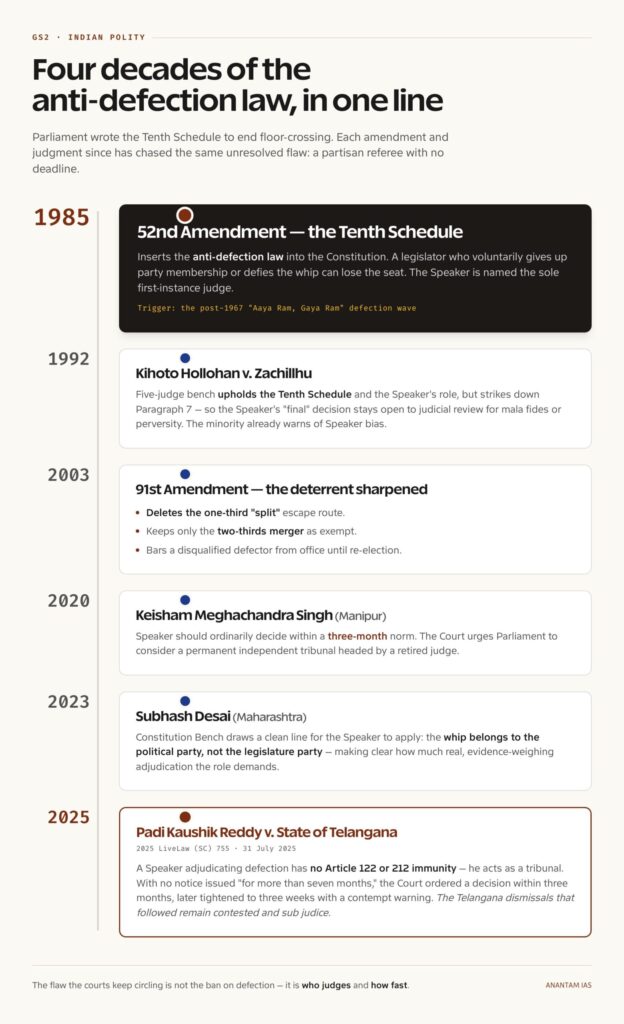
A law works best when nobody has to think about it. The anti-defection law is the opposite. Four decades after Parliament wrote it to stop legislators from selling their loyalty mid-term, it lands back in front of the Supreme Court almost every time a government wobbles. On 31 July 2025, in Padi Kaushik Reddy v. State of Telangana, a bench led by Chief Justice B.R. Gavai had to tell a Speaker, in plain words, that he holds no special immunity to sit on defection cases forever. That a court had to say this at all tells you the design has a hole in it.
The hole isn’t the idea. Banning floor-crossing is a sensible thing for a democracy to do. The hole is in two choices made when the law was drafted: who gets to judge a defection, and how long they can take. So this isn’t a story about one party or one state. It’s a story about an institutional referee who happens to wear one team’s jersey, and a clock nobody set.
The Issue, Framed
The argument here isn’t whether defection should be punished. Almost everyone agrees it should. The argument is about who decides a member has defected, and whether that person can quietly run out the clock instead.
Let’s fix the vocabulary first, because most of the confusion around this topic comes from people using the words loosely. The Tenth Schedule is the part of the Constitution that contains the anti-defection law. It was inserted by the Constitution (Fifty-Second Amendment) Act, 1985, and it lays down when a legislator loses their seat for switching sides. Defection here has a precise meaning. Under Paragraph 2, a member is disqualified on two grounds: if they voluntarily give up membership of the party they were elected on, or if they vote or abstain against the party whip without permission, and the party doesn’t pardon it within fifteen days.
That phrase, “voluntarily gives up membership,” does more work than it looks. As PRS Legislative Research notes, courts have read it broadly, beyond a formal resignation letter, to cover conduct like publicly attacking your own party or openly campaigning for a rival. So you can defect without ever saying the word.
Two more terms you can’t write this answer without. A whip is the party’s official instruction on how its legislators must vote. Defy it on a covered motion and you’ve handed the Speaker a disqualification ground. And the Speaker is the presiding officer of the House, who, under Paragraph 6, is the sole first-instance judge of every defection petition. Hold those two ideas together, because the friction lives exactly where they meet.
Here’s why that matters. The Speaker isn’t a neutral judge parachuted in for the case. In most Houses the Speaker is an elected member of the ruling party, who won a seat on a party ticket and may want another term. So the law took its most politically charged question, “did this person betray the mandate they were elected on?”, and handed it to the one official with the clearest stake in the answer. That single design choice is what the past four decades of litigation keep circling back to.
What the Data Says
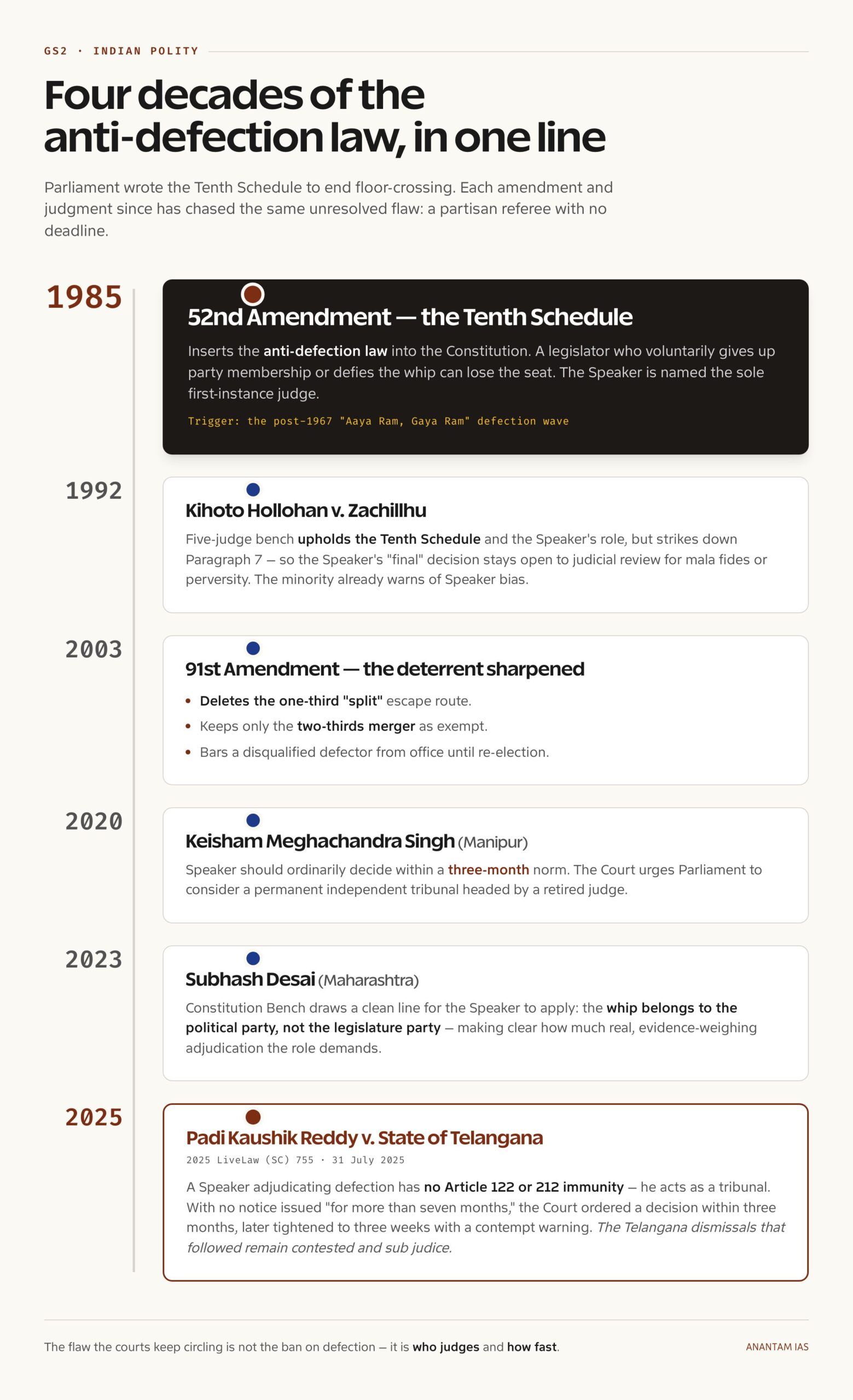
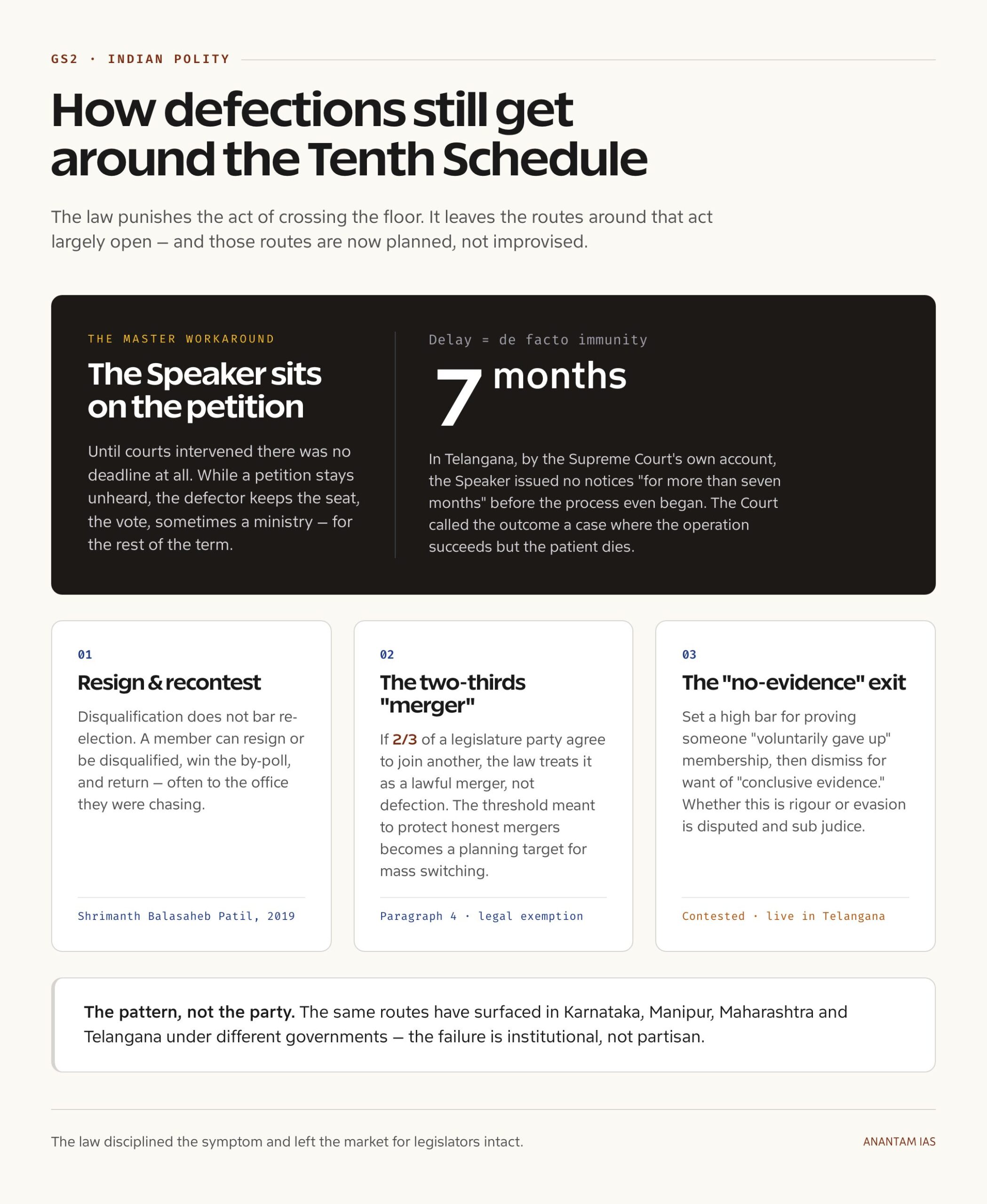
The numbers don’t measure votes here. They measure delay, and delay is the whole game. When a Speaker can sit on a petition for as long as he likes, a defector enjoys office, voting power, sometimes a ministry, for the entire stretch the case stays unheard. By the time a ruling comes, the term may be over and the point is moot. The Supreme Court has a grim phrase for it: the operation was successful, but the patient died.
Start with the case that put it on the front page. In Telangana, several MLAs elected on Bharat Rashtra Samithi (BRS) tickets in the 2023 Assembly election later moved to the ruling Congress in 2024. Disqualification petitions were filed before the Telangana Speaker, who, by the Supreme Court’s own account, didn’t even issue notices “for more than seven months”. Seven months of inaction before the process so much as started.
When the matter reached the top court, the ruling was blunt. On 31 July 2025, in Padi Kaushik Reddy v. State of Telangana, the bench held that a Speaker acting under the Tenth Schedule “does not enjoy constitutional immunity under Articles 122 or 212”. Those Articles normally shield what happens inside the House from court scrutiny. The Court said they don’t cover a Speaker sitting on defection cases, because there he acts as a tribunal, not as the House. It directed him to decide within three months. The citation, for your answer, is 2025 LiveLaw (SC) 755.
Then watch what happened next, because this is the part that proves the thesis. The deadline passed without decisions. The Court issued contempt notices in November 2025, and in February 2026 cut the leash to a final three weeks with a contempt warning. Between December 2025 and March 2026, the Speaker finally dismissed the petitions, clearing MLAs including Danam Nagender and Kadiyam Srihari, citing “no conclusive documentary or legally sustainable evidence” of defection. The verdicts on those two came on 11 March 2026, nearly two weeks past even the three-week deadline.
Now attribute carefully, because this is where answers go wrong. The merits of those dismissals are contested. BRS and the petitioners call the “no conclusive evidence” reasoning evasive; the Speaker’s office frames it as a finding on the evidentiary bar for “voluntarily giving up membership,” and the matter was headed to the Telangana High Court. So treat the dismissals as sub judice and disputed, never as proven facts either way. What isn’t in dispute is the timeline: a unanimous Supreme Court rebuke, two deadlines, a contempt warning, and the petitions still resolved late.
And this is not a Telangana problem. The same pattern, an interested Speaker plus an open-ended clock, has surfaced in Karnataka, Manipur, and Maharashtra under different parties. So when you reach for an example, reach for the structure, not the scoreboard. The failure is institutional, and it travels across the political spectrum.
The Case For
The case for the law is genuinely strong, and a Mains answer that skips it reads like a complaint, not an analysis. So let’s state it at full strength.
It ended an era of open horse-trading. Before 1985, governments fell mid-term because legislators switched sides for cash or a ministry. The cartoon shorthand was “Aaya Ram, Gaya Ram,” after the Haryana MLA Gaya Lal, who reportedly crossed the floor three times in a single fortnight in 1967. The Tenth Schedule made that naked individual defection costly. So the law solved a real and ugly problem, not an imaginary one.
It buys government stability. A majority that can be bought is no majority at all. By raising the price of switching, the law underpins full-term governance, which is exactly why Parliament passed it near-unanimously in 1985. Voters elect a party and its programme; the whip is meant to stop a legislator from quietly abandoning the platform they were sent to deliver.
The 91st Amendment sharpened the deterrent. The Constitution (Ninety-First Amendment) Act, 2003 did two things that matter here. It deleted the old “split” escape route, the loophole that let one-third of a party walk out and call it a legal split rather than defection. And it barred a disqualified defector from becoming a minister or holding any paid political post until they win re-election or the term ends. So after 2003, defection costs you your seat and your shot at office. That’s a real price.
And the law isn’t an unreviewable gag. In Kihoto Hollohan v. Zachillhu (1992), a five-judge Constitution Bench upheld the Tenth Schedule and the Speaker’s role, while striking down the clause that had tried to bar courts entirely. So the Speaker’s decision is “final” in the statute, but courts can still review it for bad faith, perversity, or a breach of natural justice. The deterrent operates inside the Constitution’s checks, not outside them. That combination, a strong rule with a judicial backstop, is the best version of the case for the law.
The Case Against
Here’s what the case for the law walks past. A rule is only as good as the referee who applies it, and on the two design choices that matter most, who judges and how fast, the Tenth Schedule is wired to fail under pressure.
The judge is an interested party. The Speaker usually belongs to the ruling party and contests on its ticket, yet the law makes him the sole first-instance judge of whether a defection helped or hurt his own side. The minority in Kihoto Hollohan flagged this exact risk back in 1992, and the Supreme Court returned to it in Keisham Meghachandra Singh (2020), openly questioning whether a partisan presiding officer is the right person for the job. This isn’t a hypothetical worry. It’s the structural fault the cases keep naming.
Delay is the weapon. Until the Court intervened, there was no deadline at all, so a Speaker could simply pocket a petition, leave it unheard, and let the defector serve out the term. Telangana’s seven months of silence before any notice is the textbook example. In Keisham, the Court said petitions should ordinarily be decided in a “reasonable period,” indicatively three months. But a judicial suggestion isn’t a statute, which is why Speakers can still stall and why the Court keeps having to chase individual cases one at a time.
The disqualified can simply come back. Because losing your seat doesn’t bar you from contesting again, a defector can resign or be disqualified, win the by-election, and return, often to be handed the office they were chasing all along. The Supreme Court confirmed this in Shrimanth Balasaheb Patil v. Speaker, Karnataka (2019): it upheld the disqualification of 17 coalition MLAs but set aside the part stopping them from fighting by-polls. So the “resign-and-recontest” route turns a disqualification into a short detour.
The merger route legalises mass defection. The law exempts a merger, which it defines as at least two-thirds of a legislature party agreeing to join another. The logic was that a genuine merger isn’t betrayal. But in practice, if you can flip two-thirds, wholesale defection becomes perfectly legal, and the disputes over which faction is the “real party”, fought out in Maharashtra in 2023, let large-scale switching masquerade as an internal split. So the very threshold meant to protect honest mergers has become a planning target.
The whip muzzles conscience. Because the whip can bind a legislator on every vote, not just on whether the government survives, the law suppresses honest dissent and constituency-based judgement. PRS puts it sharply: the law “restricts a legislator from voting in line with his conscience… and the interests of his electorate”. A Parliament where members can’t break ranks on an ordinary bill without losing their seats is a weaker deliberative body, which is a cost the stability argument tends to ignore.
The Deeper Structural Read
Step back from any single state and the real fault line shows up. The Tenth Schedule sits on a contradiction it never resolved: it asks a political office to do a judicial job, and then trusts political restraint to keep it honest. That was never going to hold.
Start with what the Speaker actually is in this role. In Subhash Desai v. Principal Secretary, Governor of Maharashtra (2023), a Constitution Bench made a clean distinction that belongs in your answer: the whip belongs to the political party, not the legislature party. So when a faction breaks away and appoints its own whip, the Speaker can’t just bless it; he has to ask which body is the real party. That ruling matters because it shows how much genuine adjudication the role demands, careful, evidence-weighing, quasi-judicial work, and how badly it fits an officer chosen for political reasons.
This is the basic structural problem in plain terms. Separation of powers is the idea that the legislature, executive, and judiciary should check each other rather than collapse into one. The Tenth Schedule blurs that line by asking a legislative officer to perform a judicial function on a question with direct political stakes for his own party. Then it leaves the timing entirely to his discretion. So even a scrupulously fair Speaker operates under a cloud of suspicion, and a partisan one has every tool to game the outcome. The design doesn’t just permit the failure. It invites it.
And notice how the courts have been forced to govern by remote control. The 2025 Telangana sequence, a three-month order, then contempt notices, then a three-week deadline, then a contempt warning, is the judiciary doing manual labour the law should have automated. Strip Article 122 and 212 immunity, set a clock, threaten contempt: that’s a court compensating, case by case, for a statute that never set a deadline. It can’t scale. There are too many Houses and too many petitions for the Supreme Court to babysit each one.
There’s a federalism layer underneath, too. The Tenth Schedule is one uniform code that runs across both Parliament and every State legislature, so the same flaw plays out from Manipur to Maharashtra to Telangana, under whichever party happens to hold the chair. That’s the strongest argument for treating this as a constitutional design problem rather than a partisan grievance. A flaw that surfaces everywhere, regardless of who’s in power, isn’t about the players. It’s about the rules.
And here’s the part that should bother a future administrator most. The law penalises the form of defection, the individual who crosses the floor, while leaving the underlying market for legislators largely intact. Engineer the switch at scale, route it through a merger, time it around a by-poll, and the horse-trading the law was born to kill carries on in a more organised form. So the deeper read isn’t that the law failed. It’s that it disciplined the symptom and left the disease.
What Should Be Done
So what would actually fix this? Not a vague call for “political will,” but changes you could draft into the statute. Six of them, and none weakens the core ban on defection.
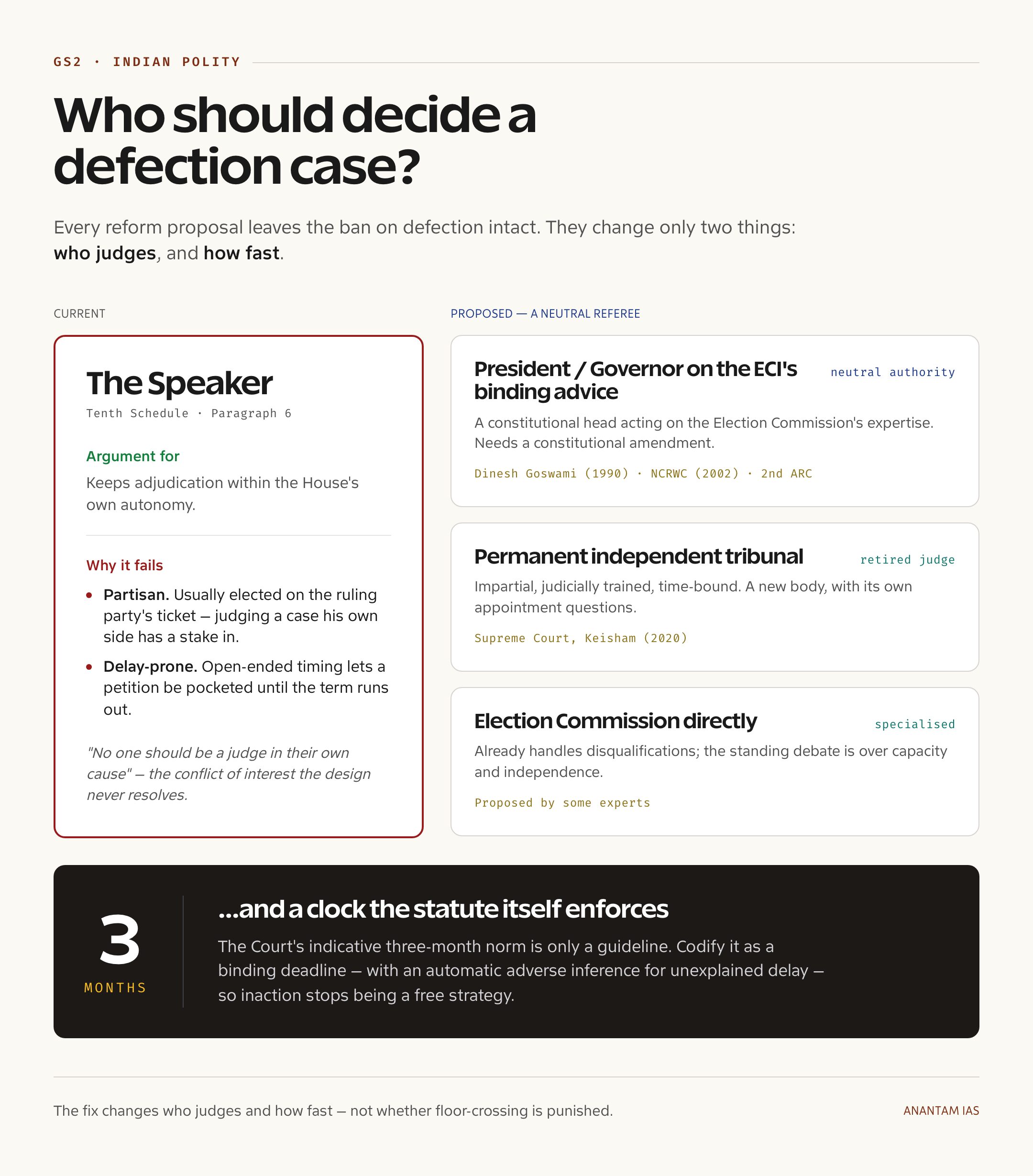
- Take the decision out of the Speaker’s hands. This is the central reform, and the expert consensus is striking. The Dinesh Goswami Committee (1990), the National Commission to Review the Working of the Constitution (2002), and the Second Administrative Reforms Commission all favour shifting the call to the President or Governor acting on the binding advice of the Election Commission. The Supreme Court in Keisham floated a different route, a permanent independent tribunal headed by a retired judge. Either way, the principle is the same: the referee can’t wear a team jersey. For the institution at the centre of this, see the Election Commission of India.
- Put a hard clock in the statute. Codify the Supreme Court’s indicative three-month limit as a binding deadline, with an automatic adverse inference, or even deemed disqualification, for unexplained delay. The whole point is that inaction must stop being a free strategy. A deadline the court has to enforce case by case isn’t a deadline. It’s a suggestion.
- Narrow the whip to votes that actually matter. Confine the disqualification trigger to defiance of the whip on confidence and no-confidence motions and money or budget bills, the votes that decide whether a government lives. On ordinary legislation, free the legislator to vote on conscience and constituency interest. This restores Parliament as a deliberative body without reopening the door to government-toppling. Dinesh Goswami, the NCRWC, and PRS all back this narrowing.
- Close the resign-and-rejoin reward loop. Building on the logic of the 91st Amendment, bar a disqualified defector from holding ministerial or office-of-profit posts for the rest of the term even if re-elected. That neutralises the incentive to defect, lose the seat, win it back, and collect the ministry anyway.
- Tighten the merger route and treat pre-poll fronts as parties. The Law Commission’s 170th Report urged exactly this, so that coalitions and en-masse switches can’t be relabelled to slip past the law. The two-thirds threshold shouldn’t double as a blueprint for legal mass defection.
- Make the whole process transparent. Time-stamped public listing of every petition, reasoned speaking orders, and published hearing timelines. Quiet “pocketing” thrives in the dark. Sunlight on the docket is the cheapest discipline available, and it costs no constitutional amendment to start. For how the chair’s powers stretch into other contested terrain, the parallel debate sits in the Governor’s office and Article 200.
Every one of these keeps the ban on defection fully intact. They change who judges and how fast, not whether floor-crossing is punished. That’s the entire fix: a neutral referee and a clock the law itself enforces.
For Your Mains Answer
This is a GS2 staple, and it rewards structure. The topic touches Parliament and State legislatures, the role of the Speaker, separation of powers, judicial review, and the functioning of constitutional bodies, all in one frame.
GS paper mapping: GS2: Parliament and State legislatures (structure, functioning, conduct of business, powers); separation of powers and checks and balances; the role of the Speaker; judicial review; functioning of constitutional bodies (the Election Commission as a possible adjudicator).
Likely question frames:
- “The anti-defection law has secured stability at the cost of legislative deliberation.” Critically examine in light of recent Supreme Court rulings.
- “The flaw in the Tenth Schedule is not the ban on defection but the choice of adjudicator.” Discuss with reference to the Speaker’s role and the 2025 Telangana case.
- Examine whether the decision on disqualification should be shifted from the Speaker to an independent authority. Support your answer with case law and committee recommendations.
Quotable data and cases:
- Tenth Schedule added by the 52nd Amendment, 1985, after the post-1967 “Aaya Ram, Gaya Ram” defection wave.
- Kihoto Hollohan (1992): upheld the Tenth Schedule, struck down the court-bar in Paragraph 7, made the Speaker’s “final” decision reviewable for mala fides and perversity; the minority foresaw Speaker bias.
- 91st Amendment (2003): deleted the one-third “split” exemption, kept only the two-thirds merger exemption, and barred defectors from office till re-election.
- Shrimanth Balasaheb Patil (2019): a disqualified defector may still contest by-elections.
- Keisham Meghachandra Singh (2020): an indicative three-month norm, plus a call for a permanent independent tribunal.
- Subhash Desai (2023): the whip belongs to the political party, not the legislature party.
- Padi Kaushik Reddy v. State of Telangana (31 July 2025): the Speaker has no Article 122 or 212 immunity while adjudicating defection; three-month deadline; later tightened to three weeks with a contempt warning (2025 LiveLaw (SC) 755).
Keywords to use: Tenth Schedule, Paragraph 2, voluntarily giving up membership, the whip, Paragraph 6, Speaker as tribunal, merger exception, judicial review, separation of powers, independent tribunal.
Syllabus linkages: salient features of the Constitution, Parliament and State legislatures, separation of powers, judicial review and basic structure, electoral reforms, and the functioning of constitutional bodies.
Balanced conclusion line: The anti-defection law was right to make betrayal expensive; it went wrong by trusting a partisan officer with an open-ended clock to police it, and the fix is a neutral adjudicator bound by a deadline, not the abandonment of the ban itself.
How to Build the Answer
Open with the conflict, not a definition. The tension here is that stability and deliberation are both democratic goods, and a badly designed adjudicator forces a false choice between them. That first sentence signals you’ve grasped the value clash. A one-line definition of the Tenth Schedule can follow in the second sentence, never the first.
Bring a case in early, but make it work. The 2025 Telangana ruling is your strongest anchor because it captures the whole thesis: a court had to strip a Speaker of immunity just to make him decide. State the fact, then say what it proves, that the Speaker-as-judge model is failing in real time. UPSC rewards the move from fact to inference.
The second body paragraph should steelman the law. If your stance favours reform, first admit why the law exists and works: it killed “Aaya Ram, Gaya Ram,” it buys stability, the 91st Amendment closed the split loophole. That’s how an answer reads balanced instead of one-sided.
Group the way forward; don’t scatter it. Cluster the reforms under two heads, who decides (independent tribunal or ECI-advised Governor) and how fast (a statutory deadline), then add the whip and transparency fixes. Use the topic’s own vocabulary, Paragraph 6, merger exception, judicial review, so the answer sounds like constitutional analysis, not a news recap.
Close on judgment, not summary. The last line should not echo the introduction; it should resolve the tension. The reliable pattern is “the goal is not X alone, but X with Y”, here, not stability alone, but stability with a neutral and timely referee.
Common Mistakes to Avoid
- Don’t make it partisan. Defection and Speaker delay have happened under multiple parties in Karnataka, Manipur, Maharashtra, and Telangana. Frame the failure as institutional, or you’ll lose marks for balance.
- Don’t state the three-month limit as statutory law. It’s a judicial guideline from Keisham, not a codified rule, which is precisely why reform is needed.
- Don’t treat the Telangana dismissals as proven facts. The merits are contested and were headed to the High Court. Write “alleged” and “disputed,” never “established.”
- Don’t forget the 91st Amendment. Many answers stop at 1985. The 2003 change, deleting the split and barring defectors from office, is half the story.
- Don’t end on a slogan. Close with an implementable principle, a neutral adjudicator on a deadline, not a flourish.
A Compact Answer Spine
- Introduction: Open with the stability-versus-deliberation tension in one sentence; define the Tenth Schedule and the grounds for defection in the next.
- Evidence: Use two or three attributed cases, Kihoto, Keisham, Telangana 2025, and tie each to a structural point.
- Arguments: The case for the law (stability, the 91st Amendment), then the case against (partisan Speaker, delay, workarounds). Keep both fair.
- Structural diagnosis: A political office doing a judicial job, with no clock and no neutrality; separation of powers blurred.
- Way forward: Group under who decides and how fast; add the narrowed whip and transparency, each with a clear actor.
- Conclusion: Adapt the balanced conclusion line to the exact wording of the question.
Diagram or Flowchart Idea
For a 15-marker, draw one causal chain rather than a decorative mind map. The cleanest version: defection petition filed → Speaker (interested party) is sole judge → no statutory deadline → petition pocketed → defector enjoys office → term ends or court intervenes → remedy comes too late. The examiner reads that logic in five seconds and sees you’ve understood the mechanism, not just the headlines.
For a 10-marker, skip the flowchart and use a two-column table instead: “What the law does well” (ended horse-trading, stability, 91st Amendment) against “Where it fails” (partisan adjudicator, delay, recontest and merger loopholes). It’s faster to evaluate and does more work under time pressure.
Ethics and Governance Angle
Add one ethical line even in a GS2 answer. The deeper question here is a conflict of interest: the Constitution asks a person to judge a case in which their own party has a direct stake, and then trusts them to set aside that stake. Good governance is built on the opposite assumption, that you remove temptation rather than rely on virtue. Naming that principle, nemo judex in causa sua, no one should judge their own cause, lifts the answer above a list of court rulings.
Then convert the principle into design. Don’t merely say “the Speaker should be impartial.” Say how impartiality gets built in: move the decision to a neutral tribunal, bind it with a deadline, publish the docket. That’s the move from moral language to administrative maturity, which is exactly what the examiner is looking for on an institutional-reform question.
How to Use Data Without Sounding Mechanical
Use fewer facts than you know, and explain the ones you keep. Three anchors carry this whole topic: Kihoto (1992) for the foundation, Keisham (2020) for the three-month norm, and Telangana (2025) for the live failure. After each, write one line on what it proves. A case name with no inference is decoration; the inference is the mark.
Never drop a citation and move on. “The Court stripped the Speaker’s immunity in 2025” is a fact. “…which shows even a unanimous rebuke can’t fix a flaw the statute itself created” is analysis. That second clause is the whole difference between a recap and an answer.
One last sweep before you stop. Read the answer as a tired examiner would, in a single pass, and cut any sentence that sounds impressive but does no work. Replace it with a case, a consequence, or a reform. For UPSC, clarity isn’t a lower standard than depth. Clarity is how depth becomes visible.
FAQ
What is the Tenth Schedule of the Constitution?
The Tenth Schedule is the anti-defection law, added by the 52nd Amendment in 1985. It disqualifies a legislator who voluntarily gives up membership of their party, or who votes or abstains against the party whip without permission and isn’t pardoned within fifteen days. The aim is to stop the kind of opportunistic floor-crossing that toppled governments before 1985.
Who decides whether a legislator has defected?
Under Paragraph 6 of the Tenth Schedule, the Speaker or Chairman of the House decides, as a first-instance tribunal. Kihoto Hollohan (1992) made that decision subject to judicial review, and Padi Kaushik Reddy v. Telangana (2025) confirmed the Speaker has no Article 122 or 212 immunity and must decide within a reasonable time. Critics argue a partisan presiding officer shouldn’t hold this power at all, which is why reformers favour an independent tribunal or the Election Commission.
What did the 91st Amendment change?
The 91st Amendment (2003) deleted the old “split” exemption, so one-third of a party can no longer walk out and call it a legal split; only a two-thirds merger is now exempt. It also barred a disqualified defector from becoming a minister or holding any paid political post until they win re-election. So after 2003, defection costs a member both their seat and their immediate path to office.
Why is the Speaker’s role considered the main flaw?
Because the Speaker is usually an elected member of the ruling party, yet acts as the sole first-instance judge of defection cases that directly affect their own side, and, until courts intervened, faced no deadline. That combination lets a Speaker delay a decision until the defector has enjoyed office or the House term has ended. The Telangana case, where the Supreme Court needed two deadlines and a contempt warning to force a ruling, is the clearest recent example.
Tell Google you want more of this.
Add Anantam IAS as a preferred sourceOne tap, and this site shows up more often in your own Top Stories, AI Overviews and AI Mode. Remove it any time.






