Imagine a senior officer who has spent twenty-five years in service being handed a dismissal letter one morning, signed by someone junior to the official who first appointed her, with no charge read out and no chance to answer. In most jobs that would simply be a hard sacking. In the Indian civil service it would be unconstitutional — and a court would tear the order up as a “worthless document.” The reason is a single, quietly powerful clause tucked into Part XIV of the Constitution: Article 311. It is the rule that stands between a civil servant and the raw power of the state to end a career at will.
And that tension — between the government’s freedom to discipline its own employees and a civil servant’s right to a fair hearing — is exactly why this topic keeps surfacing in polity papers and in the news. Every time a bureaucrat is dismissed without an inquiry “in the interest of state security,” or a court reinstates an official because the procedure was botched, Article 311 is in the room. For a UPSC aspirant it sits at the heart of GS2: it explains how India keeps its permanent bureaucracy both accountable to its political masters and protected from them, so that an honest officer can take an unpopular decision without fearing a vindictive boss the next morning. Understanding it means understanding the bargain at the core of a neutral civil service.
The Doctrine of Pleasure: Where the Power Begins
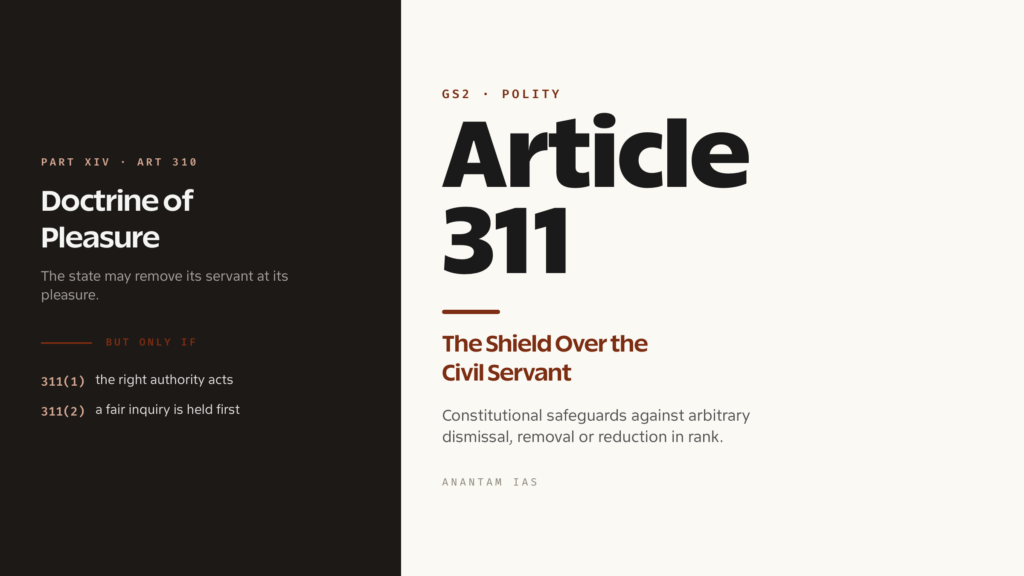
To see why Article 311 matters, you have to start one article earlier, with Article 310 — the doctrine of pleasure. Borrowed from English common law, this doctrine says that a government servant holds office “during the pleasure” of the Crown, meaning the employer can end the relationship at will. India adopted it in a modified form. Under Article 310, every member of the defence services, the civil services of the Union, and the all-India services holds office during the pleasure of the President, and everyone holding a civil post under a State holds office during the pleasure of the Governor. On its face, that is a sweeping power: in theory the state could let an official go without giving any reason at all.
But India did not import the doctrine raw. In England the Crown’s pleasure was almost absolute. Here it was deliberately fenced in, because the framers had seen what an insecure bureaucracy looks like — officers who flatter the politician of the day rather than serve the law, afraid that an unwelcome file noting could cost them their livelihood. A permanent civil service is only worth having if its members can act without fear. So the Constitution kept the doctrine of pleasure but bolted a set of safeguards onto it. As the Supreme Court put it in the landmark Tulsiram Patel case, the Indian pleasure doctrine is “subject to only what is expressly provided in the Constitution” — and the most important of those express limits is Article 311.
The relationship between the two articles is the single cleanest point to carry into an answer. Article 310 is the source of the power; Article 311 is the limit on it. The courts have described Article 311 as being “in the nature of a proviso to Article 310” — it does not abolish the pleasure doctrine, it disciplines it. The President’s or Governor’s pleasure cannot be exercised arbitrarily against a covered employee; it must run through the procedure that Article 311 lays down. Strip away the jargon and the idea is simple: the state may still part with its servants, but only by following fair rules, and only through the proper authority.
The Two Safeguards and Who They Protect
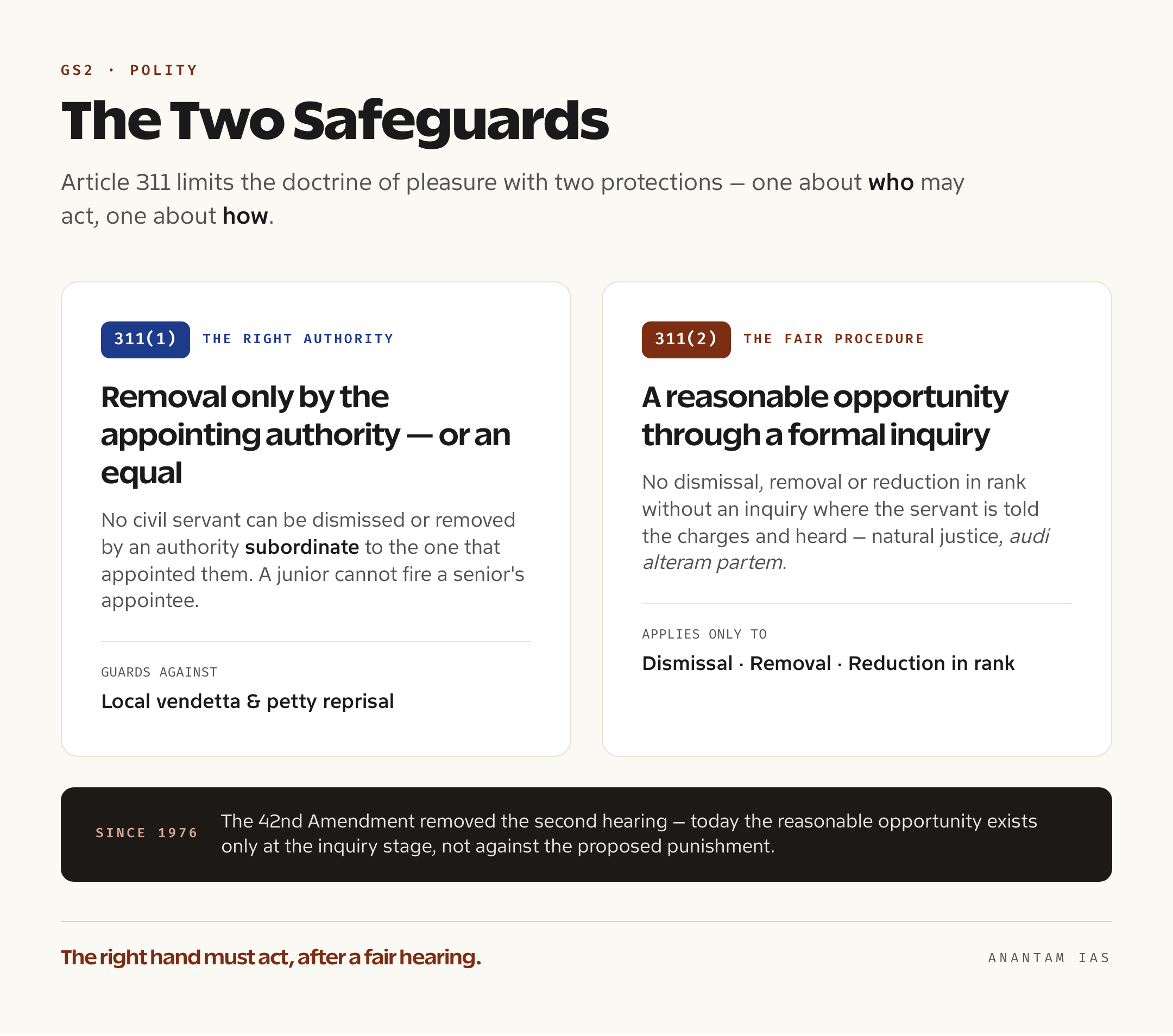
Article 311 builds its protection on two distinct safeguards, and keeping them apart is half the battle in any answer. The first, in Article 311(1), is about who can act. It says no covered person shall be dismissed or removed by an authority subordinate to the one that appointed them. So if an officer was appointed by a particular authority, only that authority — or one of equal or higher rank — can dismiss or remove them. A junior cannot fire a senior’s appointee. This is a guard against pettiness and local vendetta: it makes sure the decision to end a career is taken at the right level, not by some immediate superior nursing a grudge.
The second safeguard, in Article 311(2), is about how the action is taken — and it is the heart of the article. It says no covered person shall be dismissed, removed, or reduced in rank except after an inquiry in which they have been informed of the charges against them and given a “reasonable opportunity of being heard” in respect of those charges. This is the principle of natural justice — the rule that no one should be condemned unheard, what lawyers call audi alteram partem — written into the Constitution for civil servants. In the classic Khem Chand ruling, the Supreme Court spelled out what “reasonable opportunity” really means: the right to know the precise charges, to deny guilt and prove innocence, and to defend oneself by cross-examining the witnesses produced against you. If that procedure is skipped, any dismissal order is void from the very start.
One sharp distinction earns marks here: Article 311(2) bites only on three specific punishments — dismissal, removal, and reduction in rank. These are the major penalties that end or damage a career. Lesser disciplinary actions, such as a warning, a censure, withholding an increment, or compulsory retirement that is not a penalty, do not by themselves trigger the full inquiry requirement. It is also worth knowing that the protection was once stronger. Originally a civil servant got two opportunities to be heard — once during the inquiry, and again to argue against the proposed punishment after the inquiry’s findings. The 42nd Amendment of 1976 removed that second opportunity, so today the reasonable opportunity exists only at the inquiry stage. That is a precise, datable fact that a careful candidate can drop into an answer.
Who Is Covered — and Who Is Left Out
Article 311 does not protect everyone on the government payroll, and the exam loves the boundary. The protection extends to four neatly defined groups: members of a civil service of the Union, members of an all-India service such as the IAS, IPS and Indian Forest Service, members of a civil service of a State, and any person holding a civil post under the Union or a State. The phrase “civil post” is the catch-all — it means an appointment on the civil side of the administration, as opposed to the military side, and it sweeps in a very large body of officials beyond the named services. The common thread is the word civil. If you serve the state in a civilian capacity, Article 311’s shield is almost certainly over you.
Now the exclusions, which is where most slips happen. The clearest is defence personnel — members of the armed forces and those holding posts connected with defence are outside Article 311 altogether. A soldier is governed by the Army Act and its own disciplinary code, and the government can terminate that service without the Article 311 inquiry. That is why the article repeatedly speaks of “civil” services and “civil” posts: the whole point is to distinguish the civilian bureaucracy from the military, which lives under a different, harsher regime by design. Apart from defence, Article 311 also does not extend to certain constitutional functionaries who have their own removal procedures written elsewhere — the Constitution protects judges, the Comptroller and Auditor-General, and members of the Public Service Commissions through separate special provisions rather than through Article 311.
This coverage map matters because it shapes how you frame the safeguard. Article 311 is not a general employment-protection law; it is a targeted constitutional guarantee for the permanent civil bureaucracy that runs the country day to day. By drawing the line at “civil,” the framers gave the people who staff the districts, the secretariats and the all-India services a security that lets them be neutral, while leaving the armed forces under a command discipline that a battlefield requires. Keep that logic in mind and the list of who is in and who is out stops being something to memorise and becomes something you can reason out.
The Three Exceptions: When No Inquiry Is Needed
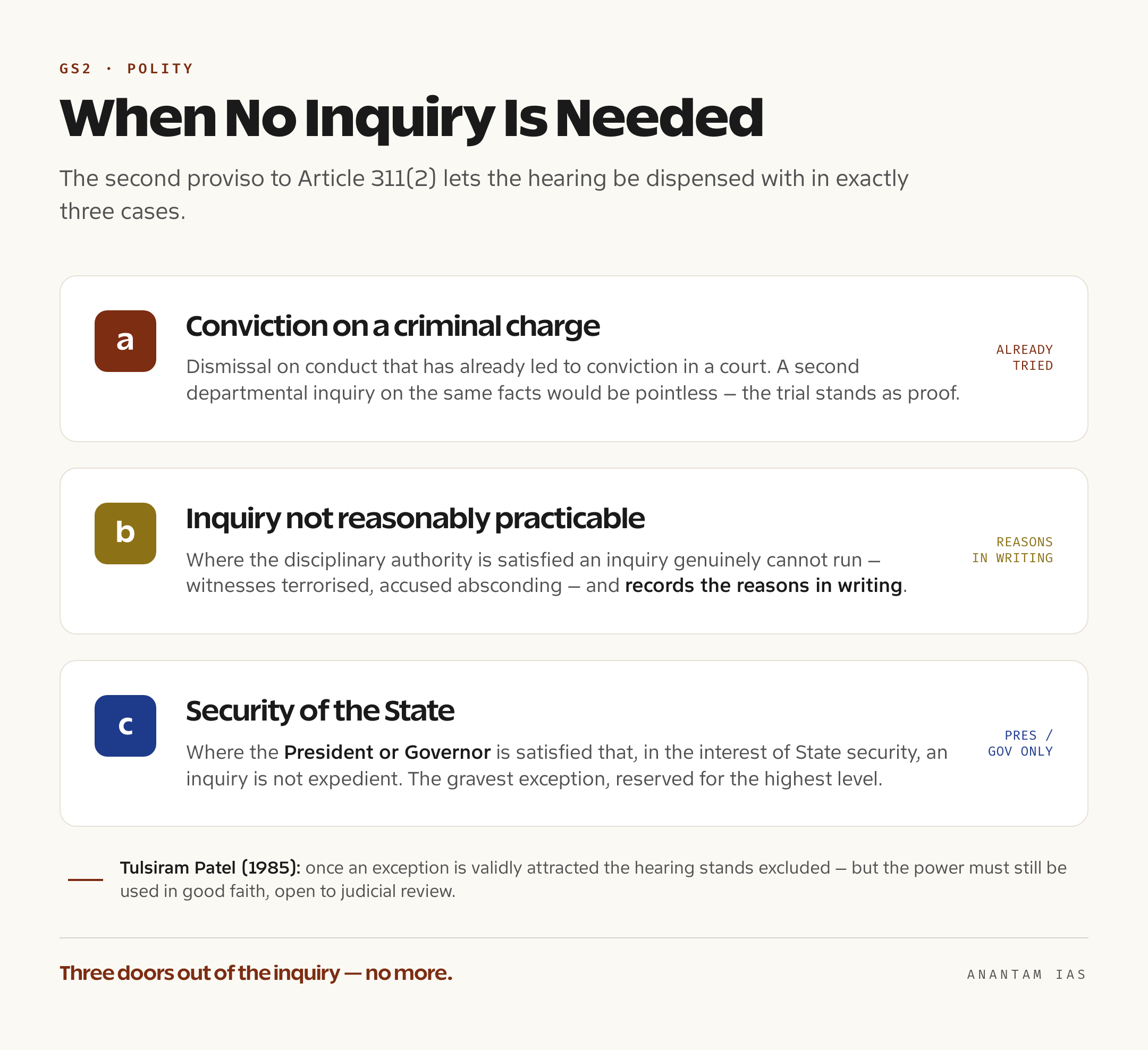
The reasonable-opportunity rule in Article 311(2) is powerful, but it is not absolute. The second proviso to the clause lists three situations in which the inquiry — and with it the hearing — can be dispensed with entirely. These exceptions are the most heavily tested part of the whole article, and they map neatly onto three letters of the proviso. The first, clause (a), applies where a person is dismissed, removed, or reduced in rank on the ground of conduct that has led to their conviction on a criminal charge. The logic is plain: if a court of law has already tried the person and found them guilty after a full trial, holding a second departmental inquiry on the same facts would be pointless. The conviction itself is taken as proof enough.
The second exception, clause (b), is the most discretionary and the most litigated. It applies where the authority empowered to dismiss is satisfied that it is “not reasonably practicable” to hold an inquiry — and it requires that authority to record, in writing, the reasons for that conclusion. This is meant for situations where an inquiry genuinely cannot run: witnesses are being terrorised into silence, the accused is absconding, or the atmosphere makes a fair proceeding impossible. The written-reasons requirement is the safety valve, because it forces the official to commit the justification to paper, where a court can later examine whether the decision was honest or a sham. Under Article 311(3), the authority’s decision on practicability is declared “final,” but the courts have made clear that finality does not put it beyond judicial review for bad faith.
The third exception, clause (c), is the gravest. It applies where the President or the Governor is satisfied that, in the interest of the security of the State, it is not expedient to hold an inquiry. Only the President or the Governor can invoke it — not a routine departmental officer — which keeps it at the highest political level and reserves it for genuine national-security cases, such as espionage or subversion. The great judicial gloss on all three exceptions came in Union of India v. Tulsiram Patel in 1985, where a five-judge Constitution Bench held that once an exception in the second proviso is validly attracted, the right to a hearing under clause (2) stands excluded — and a dismissed employee cannot smuggle that right back in by appealing to the equality guarantee of Article 14. The Court was blunt that public interest, in such cases, must prevail over the individual’s interest. But it equally insisted that even the security exception must be exercised in good faith, leaving the door to judicial review ajar rather than shut.
For Your Mains Answer
This is a high-value topic for GS Paper 2, which covers the Constitution, its structure and functioning, the separation of powers, and the role of the civil services in a democracy. Questions on the doctrine of pleasure, the security of tenure of civil servants, the tension between accountability and protection, and the balance between executive power and natural justice can all be answered with this material. It also feeds GS Paper 4 wherever the integrity and neutrality of public servants is in play. The skill examiners reward is the same one this article uses: state the power, state the limit on it, and judge whether the balance is right — always anchoring the point in the exact clause and the leading case.
How to Build the Answer
Open with the power, not the protection — define the doctrine of pleasure under Article 310, then show that Article 311 is the constitutional fence around it. Move in a logical chain: the source of power (Article 310), the two safeguards (311(1) on the right authority, 311(2) on the reasonable opportunity), who is covered and who is not (civil servants in, defence personnel out), the three exceptions to the inquiry (criminal conviction, impracticability recorded in writing, state-security satisfaction by the President or Governor), and the judicial gloss (Khem Chand on reasonable opportunity, Tulsiram Patel on the exceptions). Close by judging the balance between a secure bureaucracy and an accountable one. That arc — power, limit, scope, exception, evaluation — fits almost any question on the article.
Common Mistakes to Avoid
Don’t treat Article 311 as if it abolishes the doctrine of pleasure — it limits it, sitting as a proviso to Article 310. Don’t say it protects every government employee; defence personnel are squarely outside it. Don’t blur the two safeguards — 311(1) is about the authority that can act, 311(2) is about the procedure it must follow. Don’t forget that 311(2) bites only on three penalties: dismissal, removal, and reduction in rank. And don’t claim the exceptions put a dismissal beyond all review — courts can still strike down a mala fide order, as Tulsiram Patel itself made clear.
A Compact Answer Spine
Article 310 = doctrine of pleasure, the power to end service at will → Article 311 = the constitutional limit on it, a proviso to 310 → safeguard 1 (311(1)): removal only by the appointing authority or an equal → safeguard 2 (311(2)): no dismissal, removal or reduction in rank without an inquiry and a reasonable opportunity (natural justice; Khem Chand) → covers civil services of Union/State, all-India services, and civil-post holders; excludes defence personnel → three exceptions (second proviso): (a) conviction on a criminal charge, (b) inquiry not reasonably practicable, reasons recorded in writing, (c) President/Governor satisfied it is inexpedient for State security → Tulsiram Patel (1985): exceptions validly attracted exclude the hearing, but must be in good faith → verdict: a calibrated balance between a secure and an accountable civil service.
Diagram or Flowchart Idea
Draw Article 310 as a box at the top labelled “Doctrine of Pleasure — power to remove,” with an arrow down into a second box, Article 311, labelled “the limit.” Split that box into two halves — 311(1) “right authority” and 311(2) “fair inquiry” — and hang three small cards off 311(2) for the exceptions. A clean top-down flow like this shows power, limit and escape valves at a single glance and is quick to sketch.
A Balanced-Conclusion Line
A line that lands the marks: “Article 311 does not strip the state of its pleasure to remove a servant — it ensures that pleasure is exercised through the right hand and after a fair hearing, securing a civil service that is neutral without being unaccountable, and protected without being untouchable.”
How to Use Data Without Cramming
You need only a handful of anchors, not a textbook: Articles 310 and 311 of Part XIV, the two safeguards (311(1) authority, 311(2) inquiry), the three penalties (dismissal, removal, reduction in rank), the three exceptions in the second proviso, the 42nd Amendment of 1976 removing the second opportunity, and the two cases — Khem Chand on reasonable opportunity and Tulsiram Patel (1985) on the exceptions. Attribute them plainly — “as the Supreme Court held in Tulsiram Patel” — rather than scattering case names without a point.
FAQ
What is the difference between Article 310 and Article 311? Article 310 is the source of power and Article 311 is the limit on it. Article 310 contains the doctrine of pleasure — every member of the defence and civil services of the Union and the all-India services holds office during the pleasure of the President, and every State civil-post holder during the pleasure of the Governor. Article 311 then restricts that pleasure for civil servants by adding two safeguards: removal only by the appointing authority or an equal (311(1)), and a fair inquiry with a reasonable opportunity before dismissal, removal or reduction in rank (311(2)). The courts describe Article 311 as being “in the nature of a proviso” to Article 310.
Who is protected by Article 311, and who is not? Article 311 protects members of a civil service of the Union, members of an all-India service such as the IAS and IPS, members of a civil service of a State, and any person holding a civil post under the Union or a State. It does not protect defence personnel — members of the armed forces and those in posts connected with defence are outside the article and are governed by their own service laws, such as the Army Act. Certain constitutional functionaries, like judges and the CAG, are protected by separate special provisions rather than by Article 311.
What are the three exceptions to Article 311(2)? The second proviso to Article 311(2) lets the government dispense with an inquiry in three cases: where the person is dismissed on the ground of conduct that led to conviction on a criminal charge; where the disciplinary authority is satisfied it is not reasonably practicable to hold an inquiry and records the reasons in writing; and where the President or Governor is satisfied that, in the interest of the security of the State, holding an inquiry is not expedient. In Union of India v. Tulsiram Patel (1985), the Supreme Court held that once an exception is validly attracted, the right to a hearing stands excluded, though the power must still be used in good faith.
Can a civil servant challenge a dismissal that violates Article 311? Yes. Article 311’s safeguards are enforceable in court. If a dismissal, removal or reduction in rank is passed without following the procedure — without the proper authority, or without a fair inquiry where one was required — the order is treated as void from the start, a nullity with no legal effect, and the courts can quash it and reinstate the officer, as happened in Khem Chand v. Union of India. Even where an exception to the inquiry is invoked, courts can still review the order for mala fides or arbitrariness.
Practice Questions
Prelims MCQs
- With reference to Article 311 of the Constitution, which of the following statements is correct?
(a) It is the source of the doctrine of pleasure
(b) It is in the nature of a proviso to Article 310 and limits the doctrine of pleasure
(c) It protects members of the armed forces from dismissal
(d) It applies to all employees of private companies
Answer: (b) Article 310 contains the doctrine of pleasure; Article 311 limits it and is described by the courts as being in the nature of a proviso to Article 310. - Article 311(2) requires a reasonable opportunity of being heard before which of the following actions against a civil servant?
(a) Warning and censure only
(b) Withholding of increments
(c) Dismissal, removal, or reduction in rank
(d) Transfer to another department
Answer: (c) Article 311(2) applies to the three major penalties — dismissal, removal, and reduction in rank — not to minor disciplinary actions. - Which of the following is NOT one of the three exceptions to the inquiry requirement under Article 311(2)?
(a) Conviction on a criminal charge
(b) The authority being satisfied that it is not reasonably practicable to hold an inquiry
(c) The President or Governor being satisfied that an inquiry is inexpedient for State security
(d) The civil servant having less than ten years of service
Answer: (d) Length of service is not an exception; the three exceptions are criminal conviction, impracticability of inquiry recorded in writing, and the State-security satisfaction of the President or Governor. - Under Article 311(1), a civil servant cannot be dismissed or removed by which authority?
(a) The President of India
(b) An authority subordinate to the one that appointed them
(c) A court of law
(d) The Union Public Service Commission
Answer: (b) Article 311(1) bars dismissal or removal by an authority subordinate to the appointing authority; the action must be taken by the appointing authority or one of equal or higher rank. - The 42nd Amendment Act of 1976 changed Article 311 by:
(a) Extending its protection to defence personnel
(b) Removing the second opportunity to be heard against the proposed punishment
(c) Abolishing the inquiry requirement altogether
(d) Adding a fourth exception to clause (2)
Answer: (b) Before 1976 a civil servant got two opportunities — at the inquiry and against the proposed punishment; the 42nd Amendment removed the second, leaving the reasonable opportunity only at the inquiry stage.
Mains Practice Questions
- “Article 311 does not abolish the doctrine of pleasure; it disciplines it.” Examine the relationship between Article 310 and Article 311 and explain how the Constitution balances executive power with the security of tenure of civil servants. (15 marks, 250 words)
- Discuss the two safeguards provided to civil servants under Article 311 and analyse how they protect the neutrality and independence of the permanent bureaucracy. (15 marks, 250 words)
- Critically examine the three exceptions to the inquiry requirement under the second proviso to Article 311(2). To what extent does judicial review check their misuse? (15 marks, 250 words)
- Article 311 protects civil servants but excludes defence personnel. Discuss the rationale behind this distinction and its implications for administrative accountability. (10 marks, 150 words)
- “Security without accountability breeds complacency; accountability without security breeds servility.” In the light of this statement, evaluate whether the protections under Article 311 strike the right balance for India’s civil services. (15 marks, 250 words)
Tell Google you want more of this.
Add Anantam IAS as a preferred sourceOne tap, and this site shows up more often in your own Top Stories, AI Overviews and AI Mode. Remove it any time.