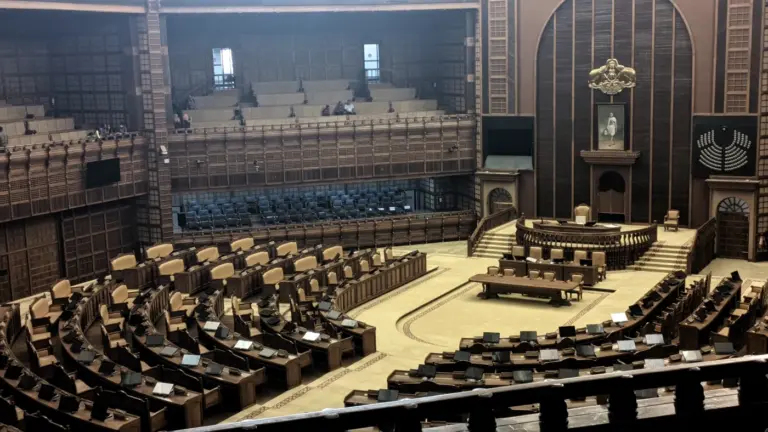
The rule of law means that power is exercised through known, general, prospective rules applied equally — not according to the will of whoever holds office. It is not listed as a fundamental right in the Indian Constitution, and it does not need to be: the Supreme Court has held it to be part of the basic structure, and Articles 14, 21 and 32 give it operative force.
Dicey’s Formulation and Its Limits
| Dicey’s three elements | What it means | Indian position |
|---|---|---|
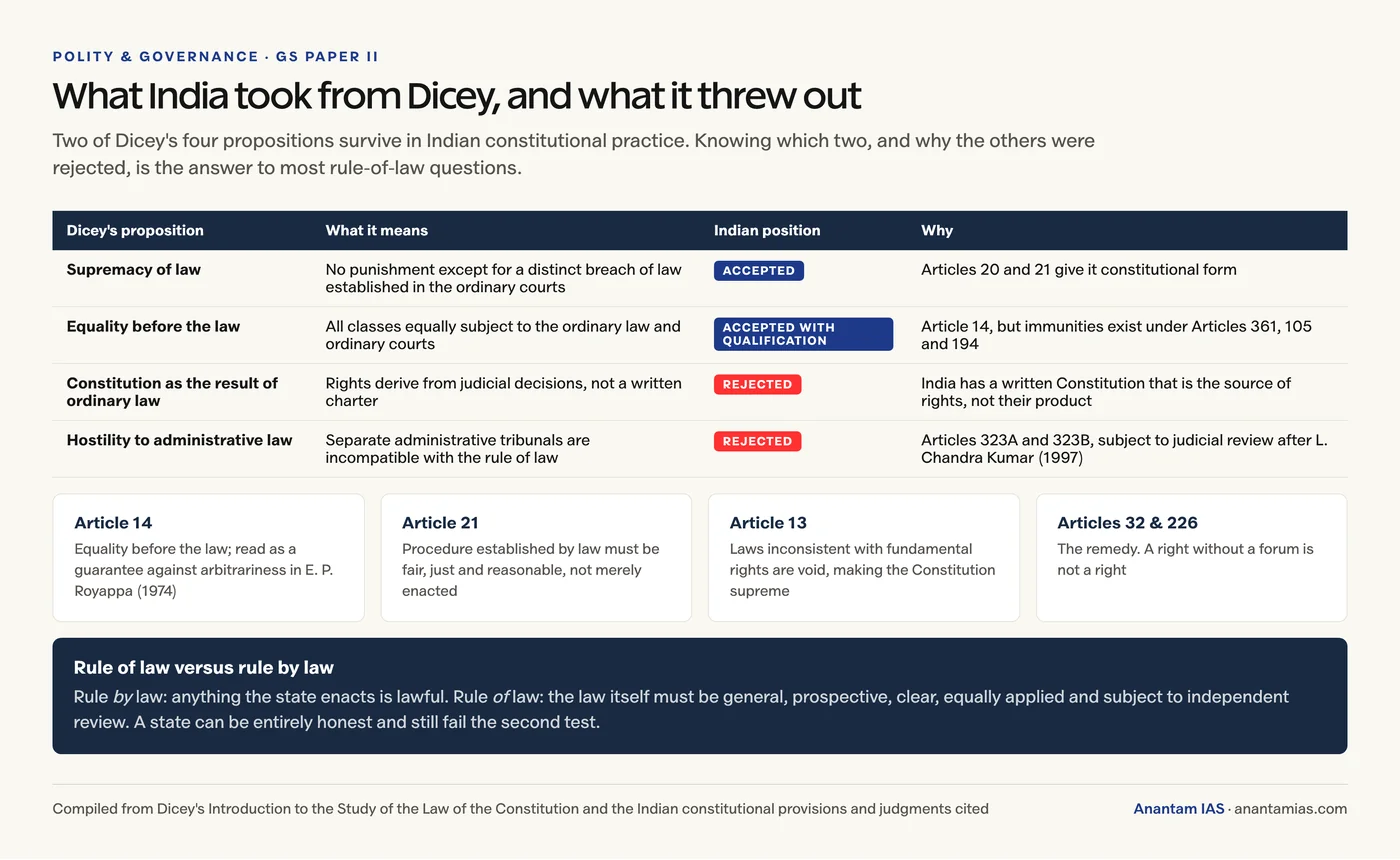
| Supremacy of law | No punishment except for a distinct breach of law established in the ordinary courts | Accepted; Article 20 and Article 21 give it constitutional form |
| Equality before the law | All classes equally subject to the ordinary law and ordinary courts | Accepted in Article 14, but with immunities under Articles 361, 105 and 194 |
| Constitution as the result of ordinary law | Rights derive from judicial decisions, not from a written charter | Rejected. India has a written Constitution that is the source of rights, not their product |
Dicey also rejected administrative law as inherently incompatible with the rule of law. India rejected that too: administrative tribunals under Article 323A and 323B are an accepted part of the system, subject to judicial review.
How the Rule of Law Operates in India
- Article 14 guarantees equality before the law and equal protection of the laws. E. P. Royappa (1974) and Maneka Gandhi (1978) read it as a guarantee against arbitrariness, which is the operative modern content.
- Article 21 requires a procedure established by law that is fair, just and reasonable, not merely enacted.
- Article 13 voids laws inconsistent with fundamental rights, making the Constitution supreme over ordinary legislation.
- Articles 32 and 226 supply the remedy; a right without a forum is not a right.
- Kesavananda Bharati (1973) and Indira Nehru Gandhi (1975) placed the rule of law within the basic structure, so it survives constitutional amendment.
- A. D. M. Jabalpur (1976) is the counter-example — the case in which the Court accepted that Article 21 could be suspended — and it was expressly overruled in Puttaswamy (2017).
The Working Components
- Non-arbitrariness: decisions must rest on reasons, not on will.
- Prospectivity and clarity: Article 20(1) bars retrospective criminal liability; vague laws fail the fairness test.
- Equality of application: selective enforcement of a valid law is itself a rule-of-law failure.
- Access to justice: a formal right that costs more than the citizen can pay is a right in name; the NALSA legal-aid architecture exists to close that gap.
- Independent adjudication: covered in our note on separation of powers.
Where It Is Under Strain
- Judicial pendency, which converts delay into denial regardless of the quality of the law.
- Preventive detention laws, which permit deprivation of liberty without trial and are constitutionally sanctioned under Article 22.
- Wide delegated legislation, where the substantive rule is made by the executive rather than the legislature.
- Selective enforcement and the use of process as punishment — prolonged pre-trial detention in cases that eventually collapse.
- Ordinance-heavy law-making, which bypasses deliberation.
Why It Is More Than Anti-Corruption
A state can be honest and still fail the rule of law, if its decisions are unpredictable, unexplained or unevenly applied. That is why transparency and accountability are better understood as trust-building instruments than as policing tools — the argument developed in our note on the RTI Act and in the wider literature on participatory governance. Rule of law is the condition under which a state can govern by compliance rather than coercion.
Frequently Asked Questions
Is the rule of law mentioned in the Indian Constitution?
Not by name. It operates through Article 14 (equality before the law), Article 21 (fair procedure), Article 13 (laws inconsistent with fundamental rights are void) and Articles 32 and 226 (remedies). The Supreme Court has held it to be part of the basic structure, so it cannot be abrogated by amendment.
What are Dicey’s three elements of the rule of law?
Supremacy of law over arbitrary power, equality before the law with all classes subject to the ordinary courts, and the idea that constitutional rights derive from ordinary judicial decisions rather than a written charter. India accepts the first two with qualifications and rejects the third, because Indian rights flow from a written Constitution.
Which case linked Article 14 to non-arbitrariness?
E. P. Royappa v. State of Tamil Nadu (1974) introduced the proposition that equality and arbitrariness are sworn enemies, and Maneka Gandhi v. Union of India (1978) consolidated it. That reading is the operative modern content of Article 14.
How does A. D. M. Jabalpur relate to the rule of law?
The 1976 judgment accepted that the right to life under Article 21 could be suspended during an Emergency, which is widely regarded as the low point of Indian rule-of-law jurisprudence. It was expressly overruled in K. S. Puttaswamy (2017).
Does administrative law violate the rule of law?
Dicey thought so, but that view is not followed in India. Administrative tribunals under Articles 323A and 323B are an accepted part of the system, provided their decisions remain subject to judicial review, which the Supreme Court secured in L. Chandra Kumar (1997).
What is the difference between rule of law and rule by law?
Rule by law means the state uses legislation as an instrument of its will, and any action is lawful once enacted. Rule of law imposes substantive requirements on the law itself: it must be general, prospective, clear, equally applied and subject to independent review.
Practice Questions
Prelims MCQs
1. The rule of law in India is best located in:
- (a) A specific article naming it
- (b) Articles 14, 21 and 13 read together, and the basic structure
- (c) The Preamble alone
- (d) The Directive Principles
Answer: (b) Articles 14, 21 and 13 read together, and the basic structure
2. Which case established that equality and arbitrariness are ‘sworn enemies’?
- (a) Maneka Gandhi (1978)
- (b) E. P. Royappa (1974)
- (c) Kesavananda Bharati (1973)
- (d) A. K. Gopalan (1950)
Answer: (b) E. P. Royappa (1974)
3. Which of Dicey’s elements is NOT accepted in the Indian context?
- (a) Supremacy of law
- (b) Equality before the law
- (c) The Constitution as the result of ordinary law
- (d) Absence of arbitrary power
Answer: (c) The Constitution as the result of ordinary law
4. A. D. M. Jabalpur v. Shivkant Shukla (1976) was expressly overruled in:
- (a) Maneka Gandhi (1978)
- (b) Minerva Mills (1980)
- (c) K. S. Puttaswamy (2017)
- (d) Kesavananda Bharati (1973)
Answer: (c) K. S. Puttaswamy (2017)
5. Judicial review of administrative tribunal decisions was secured in:
- (a) S. P. Sampath Kumar (1987)
- (b) L. Chandra Kumar (1997)
- (c) Indra Sawhney (1992)
- (d) S. R. Bommai (1994)
Answer: (b) L. Chandra Kumar (1997)
Mains Questions
- “Transparency and accountability in governance are not about controlling corruption but about creating the trust of stakeholders by following the Rule of Law and Participatory Governance.” Comment.
- Distinguish between rule of law and rule by law, with Indian examples.
- Examine the extent to which Dicey’s conception of the rule of law applies to the Indian constitutional system.
- “Delay in adjudication is itself a rule-of-law failure.” Discuss with reference to judicial pendency in India.
- Assess the compatibility of preventive detention with the rule of law under the Indian Constitution.
Tell Google you want more of this.
Add Anantam IAS as a preferred sourceOne tap, and this site shows up more often in your own Top Stories, AI Overviews and AI Mode. Remove it any time.