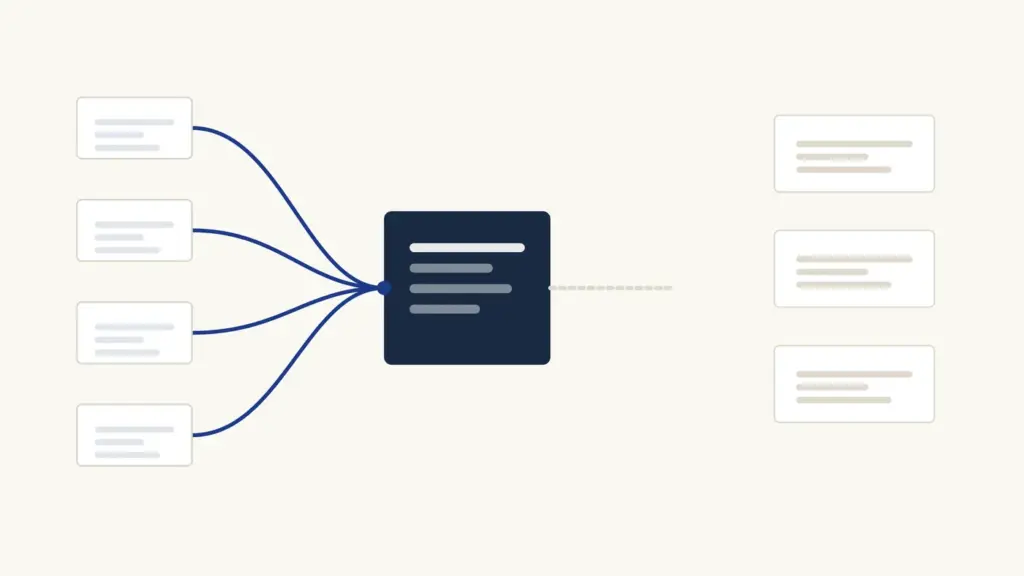
The NCSC and NCST — the National Commission for Scheduled Castes and the National Commission for Scheduled Tribes — are constitutional bodies under Articles 338 and 338A, and their central weakness is that their findings bind nobody. They have the powers of a civil court while inquiring and the standing of a constitutional authority, but no power to compel compliance. That gap between stature and enforcement is the standard exam question.
Constitutional Evolution
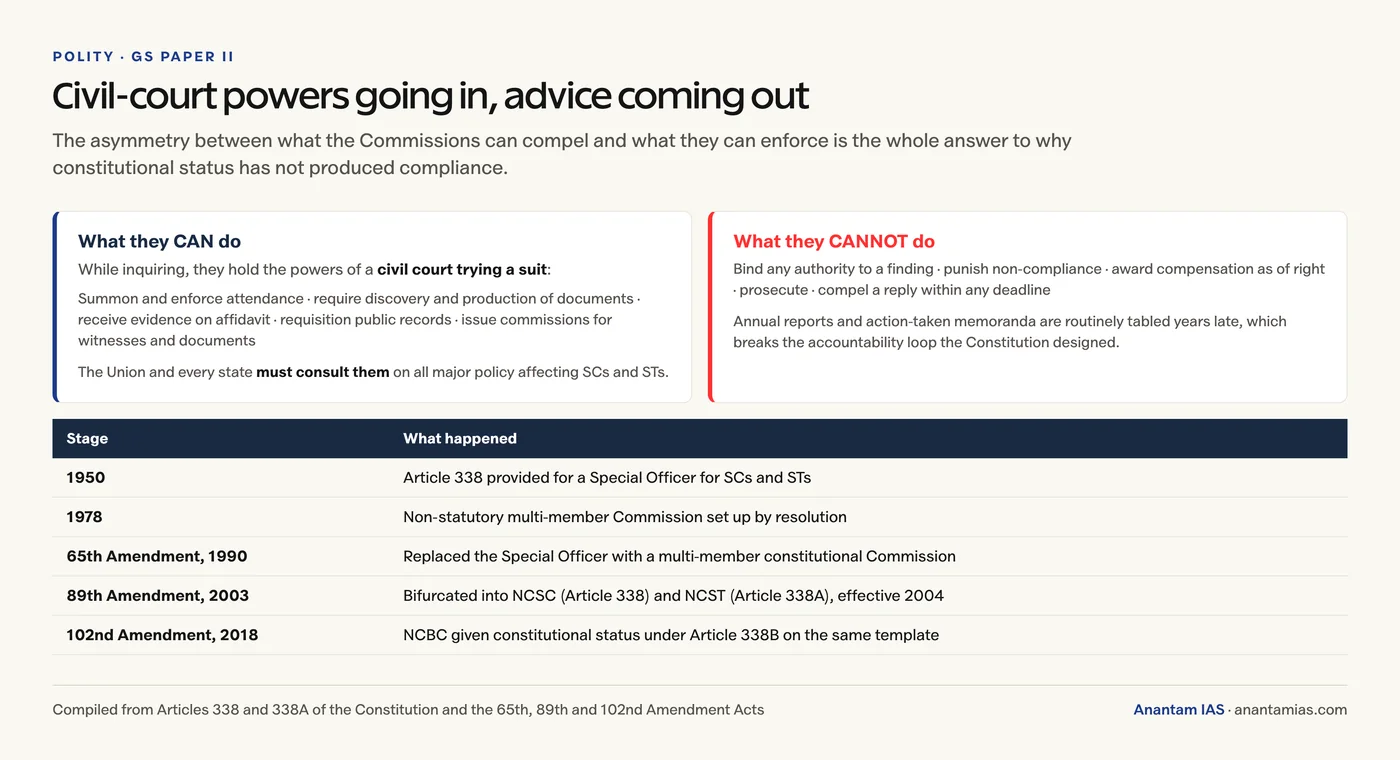
| Stage | What happened |
|---|---|
| 1950 | Article 338 provided for a Special Officer for SCs and STs, later called the Commissioner |
| 1978 | A non-statutory multi-member Commission set up by resolution |
| 65th Amendment, 1990 | Replaced the Special Officer with a multi-member National Commission for SCs and STs |
| 89th Amendment, 2003 | Bifurcated it into the NCSC (Article 338) and the NCST (Article 338A), effective 2004 |
| 102nd Amendment, 2018 | Gave the National Commission for Backward Classes constitutional status under Article 338B, on the same template |
Composition
- A Chairperson, a Vice-Chairperson and three other members (NCSC), appointed by the President by warrant under his hand and seal.
- The NCST has a Chairperson, Vice-Chairperson and three other members, at least one of whom must be a woman.
- Conditions of service and tenure are determined by rules made by the President.
Functions and Powers
- Investigate and monitor all matters relating to the safeguards provided for SCs or STs under the Constitution or any law, and evaluate their working.
- Inquire into specific complaints of deprivation of rights and safeguards.
- Advise on planning for socio-economic development and evaluate progress under the Union and the states.
- Report annually to the President, and at other times as the Commission thinks fit; those reports are laid before Parliament with an action-taken memorandum explaining any non-acceptance.
- Civil court powers while investigating or inquiring: summoning attendance, requiring documents, receiving evidence on affidavit, requisitioning public records and issuing commissions.
- Mandatory consultation: the Union and every state government must consult the Commission on all major policy matters affecting SCs or STs.
- The NCST additionally covers matters relating to mineral and forest rights in Scheduled Areas, and the NCSC’s remit extends to Anglo-Indians and, formerly, to OBCs before Article 338B.
Where the Powers Stop
- Recommendations are not binding. No provision requires any authority to act on a finding.
- No punitive jurisdiction. The Commission cannot punish non-compliance, award compensation as of right, or prosecute.
- Reporting lag. Annual reports have been tabled years late, and action-taken memoranda later still, which breaks the accountability loop the Constitution designed.
- Vacancies and staffing. Chairperson and member posts have gone unfilled for extended periods, and investigative staff are largely on deputation from the departments being examined.
- Overlap without coordination with the machinery under the SC/ST (Prevention of Atrocities) Act, 1989, the NHRC and state commissions.
Measures to Strengthen Them
- A statutory duty on every authority to act on or reasoned-reject a recommendation within a fixed period, with failures reported to Parliament.
- A tabling deadline for annual reports and action-taken memoranda.
- An independent investigative cadre rather than deputation from line departments.
- Transparent, collegium-style appointments with fixed tenure and defined qualifications.
- Suo motu powers linked to the special courts and exclusive public prosecutors under the Atrocities Act.
- A published compliance index by state and department, so non-compliance carries reputational cost.
The design problem is shared across Indian oversight bodies — constitutional stature paired with advisory power — as our note on regulatory and quasi-judicial bodies sets out. Related reading: NCBC and welfare schemes for vulnerable sections.
Frequently Asked Questions
Under which articles are the NCSC and NCST established?
The National Commission for Scheduled Castes is established under Article 338 and the National Commission for Scheduled Tribes under Article 338A. They were separated by the 89th Constitutional Amendment Act, 2003, which took effect in 2004.
Are the recommendations of the NCSC and NCST binding?
No. Their findings and recommendations are advisory. No authority is legally bound to act on them, and the Commissions cannot punish non-compliance, award compensation as of right, or prosecute. This is the principal limit on their effectiveness.
What powers do the NCSC and NCST have while investigating?
While investigating or inquiring into a complaint they have the powers of a civil court trying a suit: summoning and enforcing attendance, requiring the discovery and production of documents, receiving evidence on affidavit, requisitioning public records and issuing commissions for the examination of witnesses and documents.
Must governments consult the NCSC and NCST?
Yes. The Union and every state government are required to consult the relevant Commission on all major policy matters affecting Scheduled Castes or Scheduled Tribes. It is a constitutional obligation, though the quality of consultation varies.
Which amendment separated the SC and ST commissions?
The 89th Constitutional Amendment Act, 2003, which bifurcated the earlier joint National Commission for Scheduled Castes and Scheduled Tribes into two separate bodies with effect from 2004. The joint body itself had been created by the 65th Amendment in 1990.
How can the NCSC and NCST be made more effective?
By imposing a time-bound duty on authorities to act on or reasoned-reject recommendations, setting statutory deadlines for tabling annual and action-taken reports, creating an independent investigative cadre, fixing transparent appointments and tenure, and publishing a state-wise compliance index.
Practice Questions
Prelims MCQs
1. The National Commission for Scheduled Tribes is established under:
- (a) Article 338
- (b) Article 338A
- (c) Article 338B
- (d) Article 339
Answer: (b) Article 338A
2. The NCSC and NCST were separated into two bodies by which amendment?
- (a) 65th Amendment, 1990
- (b) 73rd Amendment, 1992
- (c) 89th Amendment, 2003
- (d) 102nd Amendment, 2018
Answer: (c) 89th Amendment, 2003
3. The National Commission for Backward Classes received constitutional status under:
- (a) Article 338
- (b) Article 338A
- (c) Article 338B
- (d) Article 340
Answer: (c) Article 338B
4. While inquiring into complaints, the NCSC has:
- (a) The powers of a criminal court
- (b) The powers of a civil court trying a suit
- (c) No investigative powers
- (d) Powers of arrest
Answer: (b) The powers of a civil court trying a suit
5. Reports of the NCSC are submitted to:
- (a) The Prime Minister
- (b) The Speaker of the Lok Sabha
- (c) The President
- (d) The Ministry of Social Justice
Answer: (c) The President
Mains Questions
- Do constitutional bodies like the NCSC and NCST possess adequate enforcement powers to secure substantive social equality? Suggest measures to enhance their institutional effectiveness.
- “Constitutional stature without binding power is the recurring design flaw of Indian oversight bodies.” Discuss with reference to the NCSC and NCST.
- Trace the constitutional evolution of the machinery for safeguarding Scheduled Castes and Scheduled Tribes from 1950 to the present.
- Examine the relationship between the NCSC/NCST and the machinery under the SC/ST (Prevention of Atrocities) Act, 1989.
- Assess the significance of the mandatory consultation requirement on major policy matters affecting SCs and STs.
Tell Google you want more of this.
Add Anantam IAS as a preferred sourceOne tap, and this site shows up more often in your own Top Stories, AI Overviews and AI Mode. Remove it any time.