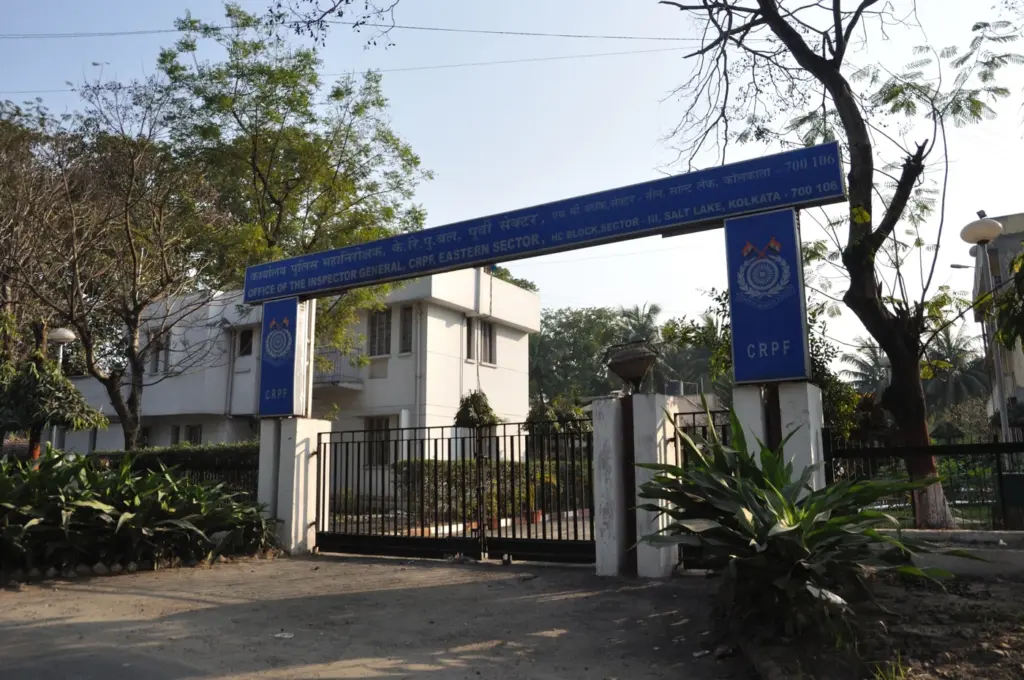
The Central Reserve Police Force (CRPF) is the Union government’s main armed police force for internal security, and by sanctioned strength it’s the largest of India’s Central Armed Police Forces. It was raised on 27 July 1939 as the Crown Representative’s Police and took its present name when the CRPF Act was passed on 28 December 1949. When a state’s own police can’t hold order alone, the CRPF is usually the force the Ministry of Home Affairs sends.
Two wrong pictures of the force are common. One treats it as a smaller army, and the other reads ‘reserve’ as troops sitting in barracks until a war comes. The CRPF is neither. It’s a police force that belongs to the Union and works in aid of the states, and ‘reserve’ means a pool of armed police the Union keeps ready for any state that needs more than its own police can give. Once that is clear, the force’s odd-looking list of duties stops looking odd.
What is the Central Reserve Police Force?
The CRPF is an armed force of the Union under the Ministry of Home Affairs (MHA), governed by the Central Reserve Police Force Act, 1949. Its work is internal security in aid of the states, from riot control to counter-insurgency. It’s one of the Central Armed Police Forces, and the one built for the interior of the country rather than a border.
| Fact | Detail |
|---|---|
| Full form | Central Reserve Police Force (CRPF) |
| Raised | 27 July 1939, as the Crown Representative’s Police, with a single battalion at Neemuch |
| Present name | Since 28 December 1949, under the CRPF Act, 1949 (Act 66 of 1949) |
| Parent ministry | Ministry of Home Affairs |
| Headquarters | New Delhi, as fixed by Section 8(2) of the Act |
| Head | Director General, an IPS officer; the 2026 CAPF Act fills the post by deputation only |
| Sanctioned strength | 3,30,883, with 2,97,604 posted, as on 30 September 2024 |
| Battalions | 248, including 6 Mahila, 16 Rapid Action Force and 10 CoBRA battalions |
| Days it marks | CRPF Day on 19 March (President’s Colour, 1950) and Valour Day on 9 April |
The last row says a lot. CRPF Day remembers the President’s Colour of 1950, and Valour Day remembers 1965, when CRPF companies held a post against a regular army brigade. A police force that has fought soldiers is the thread running through everything below.
How did the Crown Representative’s Police become the CRPF?
The CRPF began as the Crown Representative’s Police on 27 July 1939, a single battalion raised to help the princely states keep order. The Crown Representative was the Viceroy acting for the British Crown in its dealings with those states, so the name tells you whose force it was: the Crown’s, lent to rulers who couldn’t manage unrest on their own. The force’s own history ties its raising to the political agitation that grew in the states after the Congress’s Madras Resolution of 1936.
Independence changed the owner, not the idea. Parliament passed the CRPF Act on 28 December 1949, which renamed the force and made it an armed force of the Union. Sardar Vallabhbhai Patel, then Home Minister, shaped its new charter and gave it its flag. Around independence it also helped the Union establish order in Junagadh, a princely state that resisted joining India.
The dates that define the force after that come in a short run:
- 21 October 1959: Chinese troops ambushed a CRPF patrol at Hot Springs in Ladakh, killing 10. The day is now observed across India as Police Commemoration Day.
- 9 April 1965: two CRPF companies at Sardar Post in Kutch beat back an attack by a Pakistani brigade. The CRPF marks the date every year as Valour Day.
- 1986: the first all-women battalion, 88 (Mahila) Battalion, was raised in Delhi.
- 1987: 13 CRPF companies, including a women’s detachment, were airlifted to Sri Lanka to join the Indian Peace Keeping Force.
- October 1992: the Rapid Action Force was raised for riots and public disturbances.
- 2001: on a Group of Ministers’ recommendation, the CRPF became the country’s primary internal security force. On 13 December that year, CRPF personnel helped foil the attack on Parliament House.
- 2008 to 2011: 10 CoBRA battalions were raised for jungle operations against the Maoist insurgency.
Notice the pattern. Almost every new unit answers a particular problem of its decade, which is why the CRPF can look like several forces sharing one name.
What does the CRPF Act, 1949 say?
The CRPF Act is short, and four provisions carry most of its weight. Its full text is on the Home Ministry’s website.
- Section 3(1) says there ‘shall continue to be’ an armed force maintained by the Central Government and called the Central Reserve Police Force. The word ‘continue’ is the clue: the Act carried the 1939 force forward under a new name rather than creating a new one.
- Section 2(a) defines ‘active duty’ as the duty to restore and preserve order in any local area when there’s a disturbance there. That line is the whole mandate in miniature.
- Section 7 makes it every member’s duty to obey lawful orders and warrants and to bring offenders to justice. Section 7(2) makes members liable to serve outside India too, which is what allows CRPF contingents to join UN peacekeeping missions.
- Section 8 vests superintendence and control in the Central Government and fixes the headquarters at New Delhi. On active duty away from headquarters, the force works under the general control of whichever authority the Central Government prescribes or appoints.
Here’s the part that confuses most readers. Police and public order sit in the State List of the Seventh Schedule, so a state’s police answer to the state, while the CRPF answers to the Union. The two meet because the Home Ministry deploys the CRPF in aid of a state, and on the ground its companies work alongside the state police rather than replacing them.
Think of it as a loan of trained, armed manpower: the state keeps responsibility for order and the Union supplies the extra hands. The analogy breaks at discipline. A CRPF company on loan stays bound by the Act’s own code, under which mutiny or desertion on active duty can bring up to 14 years in prison.
How is the CRPF organized?
The CRPF is commanded by a Director General in New Delhi, with 4 zones under Special Directors General and 21 administrative sectors below them. Its fighting strength lies in battalions, and the force’s current list reads like this:
- 201 general duty (GD) battalions, the standard units
- 16 Rapid Action Force battalions
- 10 CoBRA battalions
- 8 VIP security battalions, along with a VIP security group
- 7 signal battalions
- 6 Mahila battalions
- 1 Special Duty Group
The battalion is the unit to hold in your head. It’s the block the Home Ministry moves from one state to another, and a special battalion is simply a general one given a narrower job and its own training.
Rapid Action Force
The Rapid Action Force (RAF) was raised in October 1992 to deal with riots and other public disturbances, as a unit that can reach a crisis within minimal time. It received the President’s Colour on 7 October 2003. The RAF’s own page lists 15 battalions, 10 of them numbered 99 to 108, while the CRPF’s overall summary counts 16, so cite either figure with its source.
Its smallest unit is a team led by an Inspector, built from three parts:
- a riot-control element
- a tear-smoke element
- a fire element
Each team works as an independent striking unit, and one team in every RAF company is made up of women for situations involving women protesters.
CoBRA battalions
CoBRA stands for Commando Battalion for Resolute Action, the CRPF’s answer to a problem ordinary battalions weren’t built for: guerrilla war in forest. Its personnel are picked from within the CRPF and given commando and jungle-warfare training. The first units date from 2008, and the force’s own record says all 10 were raised between 2008 and 2011, then deployed across 10 states affected by LWE or insurgency, from Chhattisgarh to Meghalaya.
Mahila battalions
The CRPF describes itself as the only paramilitary force in India with 6 Mahila (women’s) battalions. The first, 88 (Mahila) Battalion, was raised in 1986 in Delhi, because policemen handling women’s agitations found that even a small misstep, real or alleged, could become a serious law-and-order problem. It finished training in March 1987 and served during the Meerut riots and then with the IPKF in Sri Lanka. The later Mahila battalions came in stages:
- 135 (Mahila) Battalion, Gandhinagar, in 1995
- 213 Battalion, Nagpur, in 2011
- 232, 233 and 240 (Mahila) Battalions, in 2014-15, 2015-16 and 2016-17
Now the number that surprises people. On 30 September 2024 the CRPF had 10,076 women in a posted strength of 2,97,604, a share of 3.38%. That was the lowest of the six forces in the Home Ministry’s reply to Parliament, below the BSF’s 4.41% and well below the CISF’s 7.02%. Both facts hold at once because 6 battalions are a small slice of 248.
Where is the CRPF deployed?
The CRPF goes wherever a state’s police need armed support. Its official list of duties is worth seeing in full:
- crowd control and riot control
- counter-militancy and counter-insurgency operations
- operations against left-wing extremism
- large security arrangements, especially for elections in disturbed areas
- VIP protection and guarding vital installations
- fighting aggression in wartime
- UN peacekeeping missions
- rescue and relief during natural calamities
Two small figures show how thinly the force is spread beyond the headlines. About 5.68% of its personnel are on VIP security, and about 8.5% guard government facilities in insurgency-affected regions, from secretariats to jails.
Elections
For elections, the Home Ministry makes the CRPF the nodal agency, or coordinator, for moving and deploying the central forces on poll duty. In that role, the CRPF:
- forms state-level coordination groups with each state going to the polls
- runs round-the-clock control rooms through the polling period
- arranges the election special trains that carry companies between states
All of this runs to the schedule set by the Election Commission of India.
Left-wing extremism areas
The LWE theatre is where the CRPF has spent most of its effort this century. The force’s own page counts 91 CRPF units, including all 10 CoBRA battalions, in areas affected by left-wing extremism, and the government’s 2024 profile put more than a third of the force there. In April 2025 the Home Minister said the CRPF had set up more than 400 forward operating bases there in 5 years. A forward operating base is a fortified camp pushed into an area where the state had little presence, and the Home Ministry credits such camps, along with roads and welfare schemes, for the fall in violence.
One experiment deserves a line of its own. The 241 Bastariya Battalion, in existence from 1 April 2017, recruited mostly from four of Bastar’s worst-affected districts, to give the force more local representation and local youth steady jobs. Of its 534 trained recruits, 189 were women, and it passed out at Ambikapur on 21 May 2018.
Jammu and Kashmir
The CRPF runs a separate J&K Zone, and its duties in the Union Territory range from counter-terror operations to guarding pilgrimages such as the Amarnath Yatra and the Mata Vaishno Devi shrine. After the abrogation of Article 370 in 2019, the Home Minister credited the CRPF and other forces with securing the 2024 Assembly elections without a reported booth capture or a single shot fired.
The force has also taken heavy losses there. On 14 February 2019, an explosives-laden car was rammed into a bus in a CRPF convoy at Lethpora in Pulwama district, killing 40 CRPF personnel. The National Investigation Agency filed its chargesheet in the case in August 2020.
What are the main issues facing the CRPF?
Most debates about the CRPF are really debates about being the default answer, and the costs of that role show up in three places.
The first is overstretch, meaning one force pulled across more jobs than its numbers comfortably allow. Nothing stops the same general duty battalion from moving between crowd control and counter-insurgency, though the two jobs call for very different habits. A gap of about 33,000 between sanctioned and posted strength on 30 September 2024 adds to the strain.
The second is leadership. Senior CRPF posts have long been filled partly by IPS officers on deputation, meaning Indian Police Service officers lent to the force for a tenure, and the force’s own cadre officers have gone to court arguing that this blocks their promotions. On 23 May 2025, in Sanjay Prakash v. Union of India, the Supreme Court held that the Group A executive cadre officers of the CAPFs form Organised Group A Services for all purposes. It directed the government to reduce IPS deputation up to the rank of Inspector General progressively over two years. Parliament’s response came in 2026, and that response is now itself before the Court.
The third is representation. The 3.38% share of women sits uneasily with a force that has been raising women’s battalions since 1986.
A newer question is what happens to the 91 LWE units if the decline holds. Whether they move to other duties or stay as insurance against a revival is still open, and the official record doesn’t settle it yet.
What has changed for the CRPF since 2024?
The biggest change is legal: a 2026 Act now decides who leads the CRPF. The rest of the period is a record of the LWE map shrinking and the force adapting its jungle-warfare model for new ground.
- 17 April 2025: at the CRPF Day parade in Neemuch, Madhya Pradesh, Home Minister Amit Shah said about 3 lakh personnel serve in 248 battalions. He set 31 March 2026 as the date to end Naxalism, with the CRPF central to that goal.
- 17 April 2025: Director General Gyanendra Pratap Singh announced an 11th CoBRA battalion for counter-terror work in the forests of Jammu and Kashmir. The force’s February 2026 summary still lists 10, so treat the 11th as announced, not raised.
- 23 May 2025: the Supreme Court’s judgment on cadre status and IPS deputation, described above.
- 21 February 2026: the 87th Raising Day parade was held in Guwahati, the first in the Northeast.
- 30 March 2026: replying to a Lok Sabha debate, the Home Minister said LWE-affected districts had fallen from 126 in 2014 to 2, and that 706 Naxalites were neutralized between 2024 and March 2026.
- 9 April 2026: the President assented to the Central Armed Police Forces (General Administration) Act, 2026, passed by the Rajya Sabha on 1 April. It fills 50% of Inspector General posts and at least 67% of Additional Director General posts by IPS deputation, and all Special Director General and Director General posts by deputation only.
- 4 August 2026: the Supreme Court issued notice on CAPF officers’ petitions challenging Sections 3 and 4 of the Act.
The site’s current-affairs note on the CAPF (General Administration) Act, 2026 sets out the arguments on both sides. The live question is easy to state: the court ruled one way in 2025, Parliament legislated another in 2026, and as of the August 2026 notice the challenge was pending.
How to study the Central Reserve Police Force for exams
The CRPF sits in GS Paper III, where the internal security syllabus asks for ‘various security forces and agencies and their mandate’ and for the ‘linkages between development and spread of extremism’. It also touches Polity whenever a question turns on the Union’s role in public order.
Mains rarely names the CRPF. It asks about a problem and expects the right force in the answer. Mains 2020 GS Paper III asked “Analyze internal security threats and transborder crimes along Myanmar, Bangladesh and Pakistan borders including Line of Control (LoC). Also discuss the role played by various security forces in this regard.” A good answer keeps the border forces on the line and the CRPF in the hinterland. In Prelims, the site’s bank of 1,403 Prelims questions from 2013 to 2026 has no separate internal-security head, so revise the CRPF’s facts alongside Polity, which accounts for 240 of the 1,403 questions.
Six facts to carry into revision:
- Raised on 27 July 1939 as the Crown Representative’s Police; renamed by the CRPF Act on 28 December 1949 (Act 66 of 1949).
- Under the Home Ministry; the largest CAPF, with 3,30,883 sanctioned posts on 30 September 2024.
- Rapid Action Force raised in October 1992 for riots; President’s Colour on 7 October 2003.
- CoBRA: 10 battalions raised between 2008 and 2011 for jungle warfare against LWE.
- First Mahila battalion, the 88th, raised in 1986; 6 in all.
- Hot Springs (21 October 1959) is Police Commemoration Day; Sardar Post (9 April 1965) is Valour Day.
Four confusions cost the most marks:
- Raised versus renamed. 1939 is the raising; 1949 is the Act and the name. A question on when the CRPF was established wants 1939.
- The force versus its units. The RAF and CoBRA are CRPF battalions with narrower jobs, not separate forces.
- The largest CAPF. Some summaries give the title to the BSF, but the Home Ministry’s figures settle it: 3,30,883 sanctioned posts for the CRPF against 2,65,808 for the BSF.
- CRPF versus CISF. Both work inside the country, but the CISF guards installations such as airports and industrial units, while the CRPF handles public order and insurgency.
The five forces now covered by the 2026 Act compare like this:
| Force | Governing Act | Main job | Sanctioned strength (30 Sep 2024) |
|---|---|---|---|
| CRPF | CRPF Act, 1949 | Internal security, riots and counter-insurgency | 3,30,883 |
| BSF | BSF Act, 1968 | Pakistan and Bangladesh borders | 2,65,808 |
| CISF | CISF Act, 1968 | Airports, industrial and other key installations | 1,93,058 |
| SSB | SSB Act, 2007 | Nepal and Bhutan borders | 1,00,444 |
| ITBP | ITBP Act, 1992 | China border | 98,858 |
The BSF note and the overview of internal security forces and agencies carry the sibling forces in more detail.
The CRPF is worth learning properly because it turns up in almost every internal-security answer, from Bastar to Srinagar. Get its mandate right, a Union force in aid of the states, and every other force falls into place around it. Get it wrong, and a border or LWE question starts with the wrong actor.
Frequently Asked Questions
What is the full form of CRPF?
CRPF stands for Central Reserve Police Force. It’s an armed force of the Union under the Ministry of Home Affairs and the main central force for internal security. The word ‘reserve’ refers to a pool of armed police the Union keeps ready to send to states that need help.
When was the CRPF established?
The CRPF was raised on 27 July 1939 as the Crown Representative’s Police, with a single battalion at Neemuch. It took its present name when the CRPF Act was passed on 28 December 1949. So 1939 is the year it was raised, and 1949 is the year of the Act and the new name.
Is the CRPF the largest Central Armed Police Force?
Yes. The Home Ministry told the Lok Sabha that the CRPF’s sanctioned strength was 3,30,883 as on 30 September 2024, against 2,65,808 for the BSF, the next largest. The force’s own website also describes it as India’s largest Central Armed Police Force.
What is the Rapid Action Force?
The Rapid Action Force is a specialized wing of the CRPF, raised in October 1992 to deal with riots and other public disturbances. Its smallest unit is a team led by an Inspector, and one team in each company is made up of women. It received the President’s Colour on 7 October 2003.
What is a CoBRA battalion?
CoBRA stands for Commando Battalion for Resolute Action. These are CRPF battalions trained in commando tactics and jungle warfare for operations against the Maoist insurgency. The force’s record says 10 CoBRA units were raised between 2008 and 2011, and an 11th, for Jammu and Kashmir, was announced in April 2025.
Who controls the CRPF and who heads it?
The CRPF is under the Ministry of Home Affairs, and the CRPF Act, 1949 vests its superintendence and control in the Central Government. It’s headed by a Director General, an IPS officer, and the 2026 CAPF Act fills that post by deputation only.
Why is 21 October linked with the CRPF?
On 21 October 1959, a CRPF patrol was ambushed by Chinese troops at Hot Springs in Ladakh, and 10 personnel were killed. Police forces across India observe the day as Police Commemoration Day in memory of all police personnel who have died on duty.
How is the CRPF different from the CISF?
Both forces work inside the country, but their jobs differ. The CISF guards installations such as airports and industrial units. The CRPF handles public order and insurgency in aid of the states.
Practice Questions
Prelims
1. Consider the following statements about the Central Reserve Police Force: 1. It was raised in 1939 as the Crown Representative’s Police. 2. It received its present name through an Act passed in 1949. Which of the statements given above is/are correct?
- (a) 1 only
- (b) 2 only
- (c) Both 1 and 2
- (d) Neither 1 nor 2
Answer: (c) The force was raised on 27 July 1939 and renamed by the CRPF Act passed on 28 December 1949.
2. Consider the following statements: 1. The Rapid Action Force was raised as a wing of the CRPF in October 1992. 2. CoBRA battalions are manned by Indian Army personnel on deputation. Which of the statements given above is/are correct?
- (a) 1 only
- (b) 2 only
- (c) Both 1 and 2
- (d) Neither 1 nor 2
Answer: (a) CoBRA personnel are selected from within the CRPF; Army deputation is the model of the NSG’s Special Action Group.
3. Consider the following statements about the Mahila battalions of the CRPF: 1. The first, 88 (Mahila) Battalion, was raised in 1986 with its headquarters at Delhi. 2. The CRPF has six Mahila battalions. 3. Women made up more than 10% of the CRPF’s posted strength on 30 September 2024. How many of the statements given above are correct?
- (a) Only one
- (b) Only two
- (c) All three
- (d) None
Answer: (b) Statements 1 and 2 are correct; the share of women was 3.38%.
4. The day observed across India as Police Commemoration Day recalls:
- (a) the defense of Sardar Post in Kutch in 1965
- (b) the ambush of a CRPF patrol at Hot Springs in Ladakh in 1959
- (c) the attack on Parliament House in 2001
- (d) the raising of the Crown Representative’s Police in 1939
Answer: (b) 10 CRPF personnel were killed at Hot Springs on 21 October 1959; Sardar Post is remembered on Valour Day, 9 April.
5. Under the Central Armed Police Forces (General Administration) Act, 2026, the posts of Director General in forces such as the CRPF are to be filled:
- (a) only by promotion from the force’s own cadre
- (b) by deputation only
- (c) half by deputation and half by promotion
- (d) by Army officers on re-employment
Answer: (b) The Act fills Special Director General and Director General posts by deputation only; the 50% rule applies to Inspector General posts.
Mains
- The Government of India recently stated that Left Wing Extremism (LWE) will be eliminated by 2026. What do you understand by LWE and how are the people affected by it? What measures have been taken by the government to eliminate LWE? (10 marks, 150 words) Previous year: Mains 2025, GS Paper III.
- What are the determinants of left-wing extremism in Eastern part of India? What strategy should Government of India, civil administration and security forces adopt to counter the threat in the affected areas? (15 marks, 250 words) Previous year: Mains 2020, GS Paper III.
- The CRPF is a force of the Union, yet police and public order are State subjects. Examine how its deployment reconciles the two and the frictions this creates. (15 marks, 250 words)
- Specialized units such as the Rapid Action Force and CoBRA show how a general-duty force adapts to particular threats. Discuss. (10 marks, 150 words)
- Critically examine the debate over IPS deputation in the Central Armed Police Forces in the light of the Supreme Court’s judgment of May 2025 and the Central Armed Police Forces (General Administration) Act, 2026. (15 marks, 250 words)
Tell Google you want more of this.
Add Anantam IAS as a preferred sourceOne tap, and this site shows up more often in your own Top Stories, AI Overviews and AI Mode. Remove it any time.