
Bisalpur Dam is a major gravity dam on the Banas River in the Tonk district of Rajasthan, India. It serves as the primary source of drinking water for Jaipur, Rajasthan's capital and largest city, along with the towns of Ajmer and Tonk. In a state where water scarcity defines the geography and economy, Bisalpur Dam is one of the most strategically important water infrastructure projects. It also supports irrigation in one of Rajasthan's driest regions.
For UPSC, Bisalpur Dam appears in Geography (GS1) questions on Indian rivers, dams, water resources management, and inter-basin transfers, as well as in GS3 discussions on irrigation and water security.
Location and Basic Details
| Feature | Detail |
|---|---|
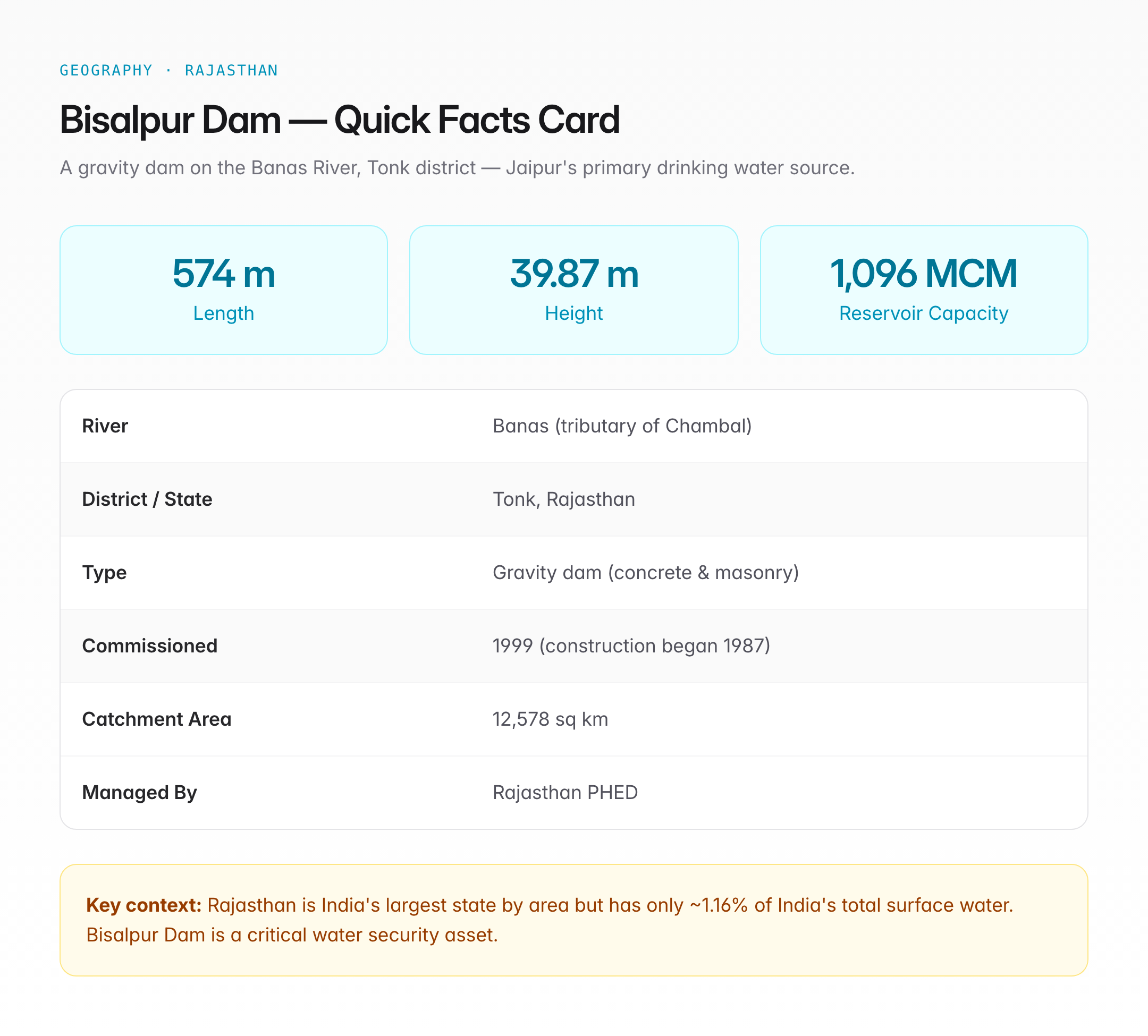
| Name | Bisalpur Dam |
| River | Banas River (tributary of the Chambal) |
| State | Rajasthan |
| District | Tonk |
| Nearest town | Bisalpur (Tonk district) |
| Type | Gravity dam (concrete and masonry) |
| Length | 574 metres |
| Height | 39.87 metres (from deepest foundation) |
| Reservoir capacity | 1,095.84 million cubic metres (MCM) at Full Reservoir Level |
| Full Reservoir Level (FRL) | 315.50 metres |
| Catchment area | 12,578 sq km |
| Commissioned | 1999 (construction began 1987) |
| Managed by | Rajasthan Water Supply Department / PHED |
The Banas River System
The Banas River is the longest river flowing entirely within Rajasthan. Key facts:
- Origin: Khamnor Hills near Kumbhalgarh in the Aravalli Range (Rajsamand district)
- Total length: ~512 km
- Flow direction: South to northeast across Rajasthan
- Joins: Chambal River near Rameshwar (Sawai Madhopur district)
- Major tributaries: Berach, Kothari, Khari, Mashi, Dai, Morel
- Basin area: Covers parts of Rajsamand, Bhilwara, Ajmer, Tonk, Sawai Madhopur
The Banas is a seasonal river that flows primarily during the monsoon. Bisalpur Dam was built to store monsoon flows for year-round use.
Drinking Water Supply — Bisalpur's Primary Role
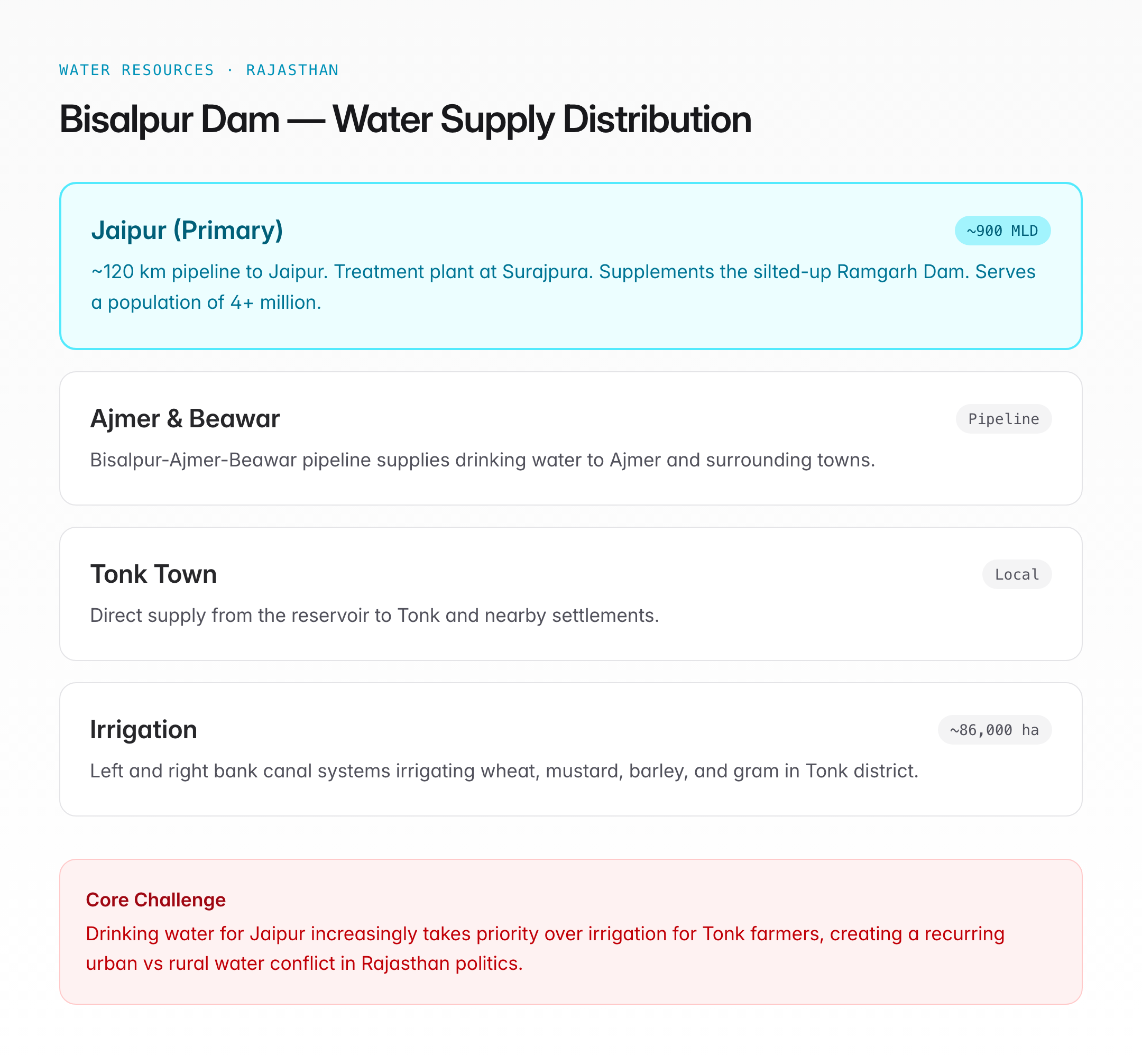
Bisalpur Dam's most critical function is supplying drinking water to three major urban centres:
Bisalpur-Jaipur Water Supply Project
- Pipeline length: ~120 km from dam to Jaipur
- Daily supply: Approximately 900 MLD (Million Litres per Day) to Jaipur
- Treatment plant: Located at Surajpura near Jaipur
- Coverage: Jaipur's drinking water needs, supplementing the Ramgarh Dam (which has largely silted up)
Bisalpur-Ajmer-Beawar Pipeline
- Supplies drinking water to Ajmer and surrounding towns
- Pipeline extends to Beawar and parts of Ajmer district
Tonk Town Supply
- Local supply to Tonk town and nearby settlements directly from the reservoir
Significance: Before the Bisalpur project, Jaipur depended almost entirely on groundwater and the Ramgarh Dam (which stopped receiving adequate inflows due to upstream water diversion). Bisalpur became the city's lifeline, though rapid urbanisation means even this source faces increasing demand pressure.
Irrigation
Bisalpur Dam supports the Bisalpur Irrigation Project, which provides water for agriculture in the arid and semi-arid zones of Tonk and adjacent districts:
| Parameter | Detail |
|---|---|
| Command area | ~86,000 hectares (designed) |
| Canal system | Left bank canal and right bank canal |
| Crops supported | Wheat, mustard, barley, gram, and horticultural crops |
| Irrigation type | Flow irrigation through canal network |
However, the drinking water allocation has increasingly taken priority over irrigation, leading to friction between urban consumers (Jaipur) and rural farmers (Tonk and surrounding districts). This tension is a recurring theme in Rajasthan's water politics.
Wildlife and Ecology Around the Reservoir
The Bisalpur reservoir and its surrounding wetlands have become an important habitat for migratory and resident birds:
- Flamingos: Both Greater and Lesser Flamingos have been spotted at the reservoir, an unusual occurrence for an inland water body
- Demoiselle Cranes: Regular winter visitors
- Bar-headed Geese, Sarus Cranes, Spoonbills: Among the many waterfowl species recorded
- The area has been proposed for Ramsar Site recognition due to its biodiversity value
Challenges Facing Bisalpur Dam
- Fluctuating inflows: The Banas River depends entirely on monsoon rainfall. In drought years (Rajasthan experiences frequent droughts), inflows fall drastically, reducing reservoir storage.
- Rising demand: Jaipur's population has grown from about 2.3 million (2001) to over 4 million. Water demand far outstrips the dam's allocation capacity.
- Siltation: Gradual siltation reduces the effective storage capacity of the reservoir.
- Urban vs rural conflict: Drinking water allocation to Jaipur reduces the water available for irrigation in Tonk, creating political and social tension.
- Groundwater depletion: Despite surface water from Bisalpur, Jaipur continues to extract groundwater at unsustainable rates.
- Water quality: Pollution from upstream agricultural runoff and industrial effluents is a growing concern.
Bisalpur in the Context of Rajasthan's Water Crisis
Rajasthan is India's largest state by area but receives less than 1% of India's total surface water. Key context:
| Parameter | Rajasthan Data |
|---|---|
| Area | 10.4% of India's land area |
| Surface water share | ~1.16% of India's total |
| Average annual rainfall | ~531 mm (varies from <100 mm in Jaisalmer to >1000 mm in southeast) |
| Groundwater status | Most blocks categorised as "over-exploited" or "critical" |
| Major dams | Bisalpur, Rana Pratap Sagar, Gandhi Sagar (on Chambal), Jawai Dam, Mahi Bajaj Sagar |
In this context, Bisalpur is not just a dam — it is a critical water security asset for Rajasthan's most populated urban cluster.
Other Major Dams on the Banas and Its Tributaries
| Dam | River | District | Purpose |
|---|---|---|---|
| Bisalpur | Banas | Tonk | Drinking water + irrigation |
| Nand Samand | Banas (upstream) | Rajsamand | Irrigation |
| Meja Dam | Kothari (tributary) | Bhilwara | Irrigation + drinking water |
| Matri Kundia | Berach (tributary) | Chittorgarh | Irrigation |
UPSC Relevance
GS Paper I: Geography — Indian rivers, dams, water resources, Rajasthan geography.
GS Paper III: Water security, irrigation, inter-sectoral water conflict, drought management.
GS Paper II: Governance — Urban water supply policy, rural-urban water equity.
Key Points for Prelims
- Bisalpur Dam is on the Banas River in Tonk district, Rajasthan
- The Banas is a tributary of the Chambal River and flows entirely within Rajasthan
- Bisalpur is the primary drinking water source for Jaipur
- Also supplies water to Ajmer and Tonk
- Reservoir capacity: approximately 1,095 MCM
- The dam is a gravity dam commissioned in 1999
- Rajasthan has only ~1.16% of India's surface water despite being the largest state by area
- The reservoir area is notable for flamingo sightings and has biodiversity value
- Key challenge: urban (Jaipur) vs rural (Tonk farmers) water allocation conflict
Tell Google you want more of this.
Add Anantam IAS as a preferred sourceOne tap, and this site shows up more often in your own Top Stories, AI Overviews and AI Mode. Remove it any time.